Last night our church held a prayer service in which I invited the congregation to listen for God’s voice to us as I read Scripture. We then responded to this “word of the Lord” through silence, prayer, and song. It was a wonderfully simple service.
One of the extended Bible readings we did was Galatians 5:13–6:10. This is a “how should we then live” passage, the kind found in many New Testament letters sketching out what it looks like for followers of Jesus to live in community with one another in light of the great theological truths just expounded.
As I read this passage, I stumbled over Paul’s use of the word “flesh.” This happens sometimes when I read Paul’s letters publicly. The reason? I fear that people will get the wrong idea.
“The flesh” is a common expression, especially in Paul’s letters, and especially in Romans and Galatians. Just a few examples:
- “Those who live according to the flesh set their minds on the things of the flesh, but those who live according to the Spirit set their minds on the things of the Spirit” (Rom 8:5).
- “Put on the Lord Jesus Christ, and make no provision for the flesh, to gratify its desires” (Rom 13:14).
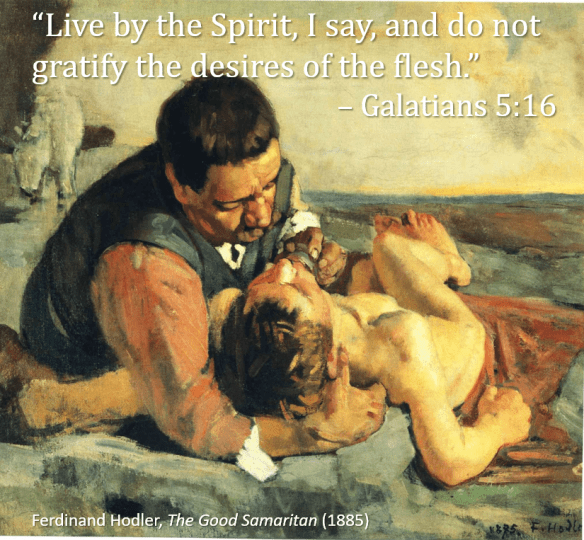
- “Live by the Spirit, I say, and do not gratify the desires of the flesh. For what the flesh desires is opposed to the Spirit, and what the Spirit desires is opposed to the flesh; for these are opposed to each other, to prevent you from doing what you want” (Gal 5:16-17).
- “If you sow to your own flesh, you will reap corruption from the flesh; but if you sow to the Spirit, you will reap eternal life from the Spirit” (Gal 6:8).
Many Christians have taken “the flesh” in these and similar verses to mean quite literally “the physical body”: our eyes and ears, our feet and hands, even (or even especially) our genitalia. All the language about “not living according to the flesh” or “making no provision for the flesh” or “not sowing to the flesh,” is about denying our physical body in some way in favour of some inner spirituality (“bodies are bad, the spiritual is good”). Often this is expressed as downplaying or even rejecting our bodily desires, our desires for food, drink, sex, intimacy, and more.
But this doesn’t quite work. It’s true that the Greek word sarx in common usage meant “flesh” or even “the fleshy parts of a body.” But it could also take on a variety of figurative uses. “All flesh,” for example, means “all living creatures.” “Flesh and blood” can mean “human beings,” or even “one’s own kin.” “One flesh” refers to “shared kinship.”
Paul can use the word “flesh” in these sorts of ways, none of which is inherently negative toward our bodies. Paul can even say, positively, that “the life I now live in the flesh (sarx) I live by the faith of the Son of God, who loved me and gave himself for me” (Gal 2:20).
Paul also uses the word “body” (sōma) quite a bit, and many of these uses are positive. Paul describes the believer’s “body” as “a temple of the Holy Spirit” (1 Cor 6:19). He calls on Christians to offer our “bodies” to God as an act of worship (Rom 12:1). He insists that our future resurrection state—imperishable, immortal, untouched by sin and death—will still involve a sōma, a “body” (1 Cor 15:35-44).
In other words, it’s complicated.
I think we can get at what Paul means in verses like those I quoted above if we dig into the contrast Paul makes between “the flesh” and “the Spirit” (stick with me here, it’s worth it).
Paul likes these kinds of binary contrasts: “flesh” in contrast to “Spirit”; “Law” in contrast to “Christ” or “faith”; “this present age” in contrast to “the coming age.” It’s this last one—“this present age” in contrast to “the coming age”—that helps make sense of the rest of them.
You see, Paul held to a common Jewish notion that human history was divided into two “ages.”
The “present age” is the one we’re in, and it is characterized by “powers” that have influence over us, even control over us. Human kingdoms and rulers and authorities. The internal forces that animate these groups and leaders. The structures and systems they create. These “powers” are not necessarily bad, but they can become “evil powers,” perpetuating injustice and oppression, committing violence and bringing destruction. Behind these “evil powers” is the worst of them all, evident in each and every human life: “sin” and the wide-ranging “death” that accompanies it.
The “coming age,” by contrast, is the promised “kingdom of God,” the “new creation,” in which the powers of sin and death are eradicated and all things are brought under God’s liberating, loving reign. The end result? Life: abundant, eternal, harmonious, flourishing life. Shalom, you could also say.
Here’s the thing: because the Messiah has come, the “coming age” is already here, though it is not yet fully here. The kingdom of God, God’s new creation, has entered this present age in anticipation of its future fulfillment. As followers of Jesus the Christ we are called to live out God’s reign, to live out God’s new creation, resisting the evil powers of this age which are over us, among us, and within us.
This is what the contrast between “the flesh” and “the Spirit” is all about. These are, effectively, contrasting ways of being human in the world.
“Living according to the flesh” means “living according to a self-centered, selfish way of being human,” which is at the root of our sin and all its deathly consequences. Indeed, this “self-centered, selfish way of being human” is what lies behind all the evil powers of this present age: corrupt governments and corporations and presidents and CEOs and more, animated by a spirit of greed or vanity or domination, creating oppressive structures and unjust systems within society.
“Living according to the Spirit,” by contrast, means “living according to a God-centered, other-oriented way of being human” which Jesus taught and lived out among us. The “Spirit,” after all, is “the Spirit of Christ,” shaping us into the image of Jesus. When we “live according to the Spirit,” or we “walk in the Spirit,” we are choosing to walk in the way of Jesus, Jesus’ way of love: a deep devotion to God expressed through humble compassion and care for others.
When Paul talks about “the flesh” in these passages, then, he is not talking about our natural, bodily desires for food, drink, sex, and more. He’s talking about those desires turned inward, distorted through our self-centered selfishness.
The antidote is not to deny our bodily desires. These are part and parcel of what it means to be human. They are God-given, a part of God’s “very good” creation.
Rather, the antidote is to rightly order those natural desires around love for God and others, seeking the common good. It is to strive to fulfill those desires through this God-centred, other-oriented way of love, empowered by the very presence of the resurrected Jesus in us and among us.
It is, in other words, to “live by the Spirit.”


_-_James_Tissot.jpg)


 Michael Pahl