On Being—and Doing—Church

There are many good New Testament passages one can explore to envision what the church should be and do: Romans 12-15, 1 Corinthians 12-14, and Ephesians 4-5 are all good options, among others. Still, when I think about the church there’s one specific verse that always seems to come to mind first:

They devoted themselves to the apostles’ teaching and fellowship, to the breaking of bread and the prayers. (Acts 2:42)

To me this description of the first Jesus followers on the day of Pentecost nicely sums up what it means for us as Christians to “be the church,” to “do church” together.

As the church we are “devoted” to certain things. These are the things that we commit ourselves to, that we are centred on as a church—which is a way of saying that there are lots of other things, maybe even some good things, that aren’t so central, that we’re not as devoted to. There are lots of things we can be and do as a church, but these things are at the heart of them all.

First and foremost, we are devoted to learning and living the way of Jesus as taught by his Apostles: “the apostles’ teaching.” This means we commit ourselves to studying the Christian Scriptures, and in particular the New Testament where we find “the apostles’ teaching,” in order to learn about Jesus and his way of love. As we faithfully follow Jesus in his way of love, God’s justice and peace and flourishing life (“God’s kingdom,” or “salvation”) is manifest in and among and through us.

We are also devoted to the community of fellow Jesus followers, the common life we share together: “the fellowship.” This means we commit ourselves to one another within the church, to each other’s wellbeing, to caring for one another and helping to meet one another’s needs. At bottom this is because, in the midst of our diversity, we hold the absolute essentials in common: everything we are and do centres around Jesus and his way of love.

We are devoted to gathering together in worship and hospitality: “the breaking of bread.” This means we commit ourselves to “breaking bread” together around the Lord’s Table, along with other acts of worship (symbols, stories, songs) that likewise orient us around the central story of Jesus. This also means we commit ourselves to “breaking bread” together in our homes, following Jesus’ example of radical hospitality for all—not only friends and family, but also sinners and strangers, outcasts and enemies.

And we are devoted to regular times of prayer together: “the prayers.” This means we not only pray as individuals as an act of private devotion, but we also gather together regularly to pray: to meditate on who God is and what God has done for us, to praise and thank God for these good gifts, to confess our sins to God and accept God’s forgiveness, and to entreat God to move among us and through us in the world.

Jan Richardson, The Best Supper

For many Christians, this is not the church they envision. Or, perhaps more accurately, they might nod in agreement with this vision of church in theory, but in practice they are either not fully devoted to these things, or they are devoted to other things above these things.

Many Christians envision a church that has lots of programs—especially programs aimed at their particular demographic. These programs are not bad in themselves, of course, and they can in fact be wonderful ways of expressing and nurturing the devotion Acts 2:42 describes.

The problem comes when people want programs that have little if anything to do with that fourfold devotion—they really want a social club with a religious veneer, which they can participate in at their convenience and for their pleasure. Fine, but that’s not a church.

Many Christians envision a church filled with people, often recalling a bygone era of buzzing foyers and bursting sanctuaries. There’s nothing wrong this either—Acts 2 itself describes large numbers of people joining the Jesus movement and participating in new Jesus communities. However, a preoccupation with numbers can be problematic for at least a couple of reasons.

First, many Christians want the large numbers without having to devote themselves to studying the Scriptures and learning the way of Jesus, gathering together regularly for Jesus-centred worship and prayer, and showing radical hospitality in the way of Jesus. It’s ironic—though not terribly surprising—that the Christians who are most critical of “the way things are being done” at church are often the ones who don’t attend Bible studies and prayer meetings and only show up for Sunday worship once or twice a month.

Second, many Christians have bought into a “free market” notion of church. We are competing with other churches for “market share.” We need to produce a good church “product” in order to attract Christians, our “buyers.” If people don’t like our product they’ll go find another “seller,” another church with a better product: high quality music in a style they enjoy, interesting preaching that increases their happiness through moderate self-improvement, vibrant programs catering to their particular demographic, et cetera. So, if we want to increase our market share (i.e. “grow our church”) we need to produce a better product.

Not only is this view of the church thoroughly unbiblical, it’s also unethical—it’s church growth through sheep-stealing, not sheep-finding.

Programs and numbers, then, while being potentially good things, are not central to being and doing church. What is central is this: devotion to the apostles’ teaching and the fellowship, the breaking of bread and the prayers.

Lest anyone think I’m being too idealistic, raising a bar too high for the church in the real world, let me add this: Jesus welcomes all to his table, whatever the level of their devotion. Jesus in his way of love stands at the centre of the church like a bonfire on a cold night, drawing people in by its warmth and light. Some gather close around the fire, freely sharing their songs and stories, bread and wine. Others stay back in the shadows, content to listen and observe. Some drift in and out.

However, while the level of devotion varies among Christians and even changes throughout our lives, the things we are devoted to remain the same: not programs and numbers, not pleasurable music or comfortable teaching or enjoyable socializing, not even correct doctrine or proper behaviour or rituals done right, but learning and living the way of Jesus together, gathering in worship and prayer, in radical hospitality and mutual care, all of this in love.

Anything less—and anything else—is simply not church.

But a church that looks like this? It’s what the world—and we ourselves—desperately need: a living embodiment of God’s kingdom vision of justice, peace, and flourishing life for all.
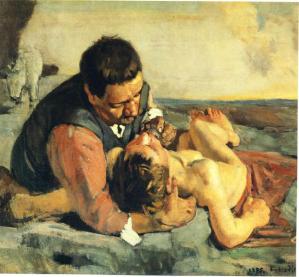
Being Disturbed toward Love and Good Deeds

Ferdinand Hodler, The Good Samaritan

Tucked away in the sermon-letter known as Hebrews, in its summary of its central section, is this evocative statement: “Let us consider how to provoke one another to love and good deeds” (10:24).

The Greek word translated “provoke” in this version is paroxysmos, and it’s actually a noun. It’s almost always negative in connotation. It’s the word used in Acts 15:39, for example, to describe the “sharp disagreement” between Barnabas and Paul—a convulsive eruption of thoughts and emotions and words. A paroxysmos is when something deeply disturbing—something that stirs you up emotionally and psychologically, that aggravates and agitates you in a gut-wrenchingly visceral way—pushes you to act.

Here’s the evocative image, then: We are to be deeply disturbed—provoked, incited, aggravated, agitated—not toward anger or violence, but toward love and good deeds.

This past weekend our church hosted Theatre of the Beat and their latest production, #ChurchToo. The play tackles the issue of sexual violence—discrimination, harassment, abuse, and more—within the church. It’s a timely topic, to be sure. Yet it’s also a difficult one—even a deeply disturbing one.

Those who have seen the play know how deeply disturbing it is. As I watched the final scene I could feel my own gut wrenching—physically clenching—as the actors brilliantly portrayed the bodily impact of sexual violence, an impact that is felt long after the violence has occurred. Afterward, the show’s artistic director talked about how every audience responds the same way: looking away from the stage in shock or shame or agonizing pain, but then looking back; rocking on their chairs as if to leave, but remaining riveted in their seats.

It’s disturbing—and it’s supposed to be disturbing.

But it’s not needlessly disturbing. It portrays the real-life impact of sexual violence for victims, and so invites us to experience this vicariously ourselves, in order to understand better, to be more sympathetic and compassionate, to push us to raise awareness of sexual violence, to prompt us to prevent sexual violence if possible and to respond well to it when it happens.

The play is, in fact, all about “being disturbed toward love and good deeds.”

I’m thankful this is not the only way we can be motivated toward love and good deeds. We can be comforted toward love and good deeds—we might experience compassion, for example, or see compassion modeled, and so be prompted toward greater compassion ourselves. But sometimes we need to be discomforted toward love and good deeds—agitated, aggravated, provoked, incited, deeply disturbed.

As the saying goes, “The gospel comforts the disturbed, but it disturbs the comfortable.” Jesus brings us comfort—Amen! But Jesus does not make us comfortable. Selah.

May God give us a holy discomfort, a willingness to step into the hard realities of this world, to sit with the pain and suffering of others, in order to understand their experiences and show compassion and seek justice. May we be willing to be disturbed by the things that disturb God, so that we can show an ever-increasing love to others in the way God has shown love to us in Jesus.

Jesus Fulfills the Law—in Love

You don’t have to read far into Matthew’s Sermon on the Mount to hear this astounding claim by Jesus:

Do not think that I have come to abolish the Law or the Prophets; I have come not to abolish but to fulfill. For truly I tell you, until heaven and earth pass away, not one letter, not one stroke of a letter, will pass from the Law until all is accomplished. (Matt 5:17-18)

Jesus’ warning that follows is just as astounding:

Therefore, whoever breaks one of the least of these commandments, and teaches others to do the same, will be called least in the kingdom of heaven; but whoever does them and teaches them will be called great in the kingdom of heaven. (Matt 5:19)

It’s no wonder many Christians have insisted that we must obey the Old Testament Law. These are strong words!

But what did Jesus mean when he says, “I did not come to abolish the Law but to fulfill it?”

We get an answer by following the most basic principle of good interpretation: Keep reading.

When we keep reading, for instance, we discover that Jesus can’t mean we’re supposed to literally obey every commandment in the Law. How do we know this? Because immediately after this Jesus reinterprets some Old Testament laws, and even outright overturns some of them.

I’m talking about all the “You’ve heard it said…but I say to you” teachings that follow in Matthew 5. The “you’ve heard it said” each time is a reference to an Old Testament command; the “but I say to you” is Jesus’ new interpretation of that command.

So, for example, the Law of Moses says: “You shall not murder.” But Jesus says: “Do not even harbor anger in your heart against another person.”

Or, the Law of Moses says: “You shall not commit adultery.” But Jesus says: “Do not even nurture lust for another woman in your heart.”

And on it goes, until we get to the last two. The Law of Moses commanded a form of retributive justice, a principle of “proportional retaliation,” for any violent act committed: whatever the offender did to someone, they were to have that very thing done to them. The full commandment in Deuteronomy 19 is this: “Show no pity: life for life, eye for eye, tooth for tooth, hand for hand, foot for foot” (19:21).

And, while the Law of Moses in fact commands kindness for one’s everyday enemies, it does direct the Israelites more than once to annihilate their enemies in battle. The promise of Leviticus 26:7 sums this up: “You shall give chase to your enemies, and they shall fall before you by the sword.”

These commands of the Law, Jesus doesn’t just reinterpret. Jesus outright overturns them. No retribution of any kind is allowed. No violence of any kind is permitted. “Do not retaliate against an evil person,” Jesus says. “Love your enemies.”

If we keep reading some more, all the way through Matthew’s Gospel, we also find that this isn’t the only place that Jesus talks about “the Law and the Prophets.” That’s a clue, by the way. Jesus doesn’t just fulfill the Law, but the Law and the Prophets. All the Jewish Scriptures find their completion in Jesus. All the biblical threads of God’s ways in the world and God’s will for us, all these are woven together in Jesus.

The next reference to “the Law and the Prophets” is also in the Sermon on the Mount. In fact, the Sermon is framed by these two uses of “the Law and the Prophets”: our passage near the beginning, introducing the main part of the Sermon, and the next one near the end, as the Sermon is wrapping up.

And what is this summing-up reference to “the Law and the Prophets”? It’s something we all know, the famous Golden Rule: “In everything do to others as you would have them do to you; for this is the Law and the Prophets” (Matt 7:12).

Doing for others what you would like done for you is the Law and the Prophets—it’s what the Bible is all about. Turning outside of ourselves and looking to others, treating others with the same respect, compassion, kindness, and care that we would like to receive—this fulfills all our obligations under God.

If we keep reading through Matthew’s Gospel, we come to another significant time Jesus talks about “the Law and the Prophets.” It’s in Matthew 22, Jesus’ response to the question, “Teacher, which commandment in the Law is the greatest?”

We all know Jesus’ answer—it’s the Great Commandments:

You shall love the Lord your God with all your heart, and with all your soul, and with all your mind.’ This is the greatest and first commandment. And a second is like it: ‘You shall love your neighbor as yourself.’ On these two commandments hang all the Law and the Prophets. (Matt 22:36-40)

Love—devoted love for God and others—is what the Law and the Prophets are all about. Everything—all God’s ways in the world, all God’s will for us—hangs on these two commandments: love God and love others.

Or, in other words, love is the fulfillment of the Law.

Other early Christians got the message. The Apostle Paul sums this up as neatly as any of them, in Romans 13:8-10:

Owe no one anything, except to love one another; for the one who loves another has fulfilled the Law. The commandments, “You shall not commit adultery; You shall not murder; You shall not steal; You shall not covet”; and any other commandment, are summed up in this word, “Love your neighbor as yourself.” Love does no wrong to a neighbor; therefore, love is the fulfilling of the Law.

Jesus oriented his life around love—not holiness, not purity, not strength or power, not truth or even wisdom, not even justice or peace. He oriented his life around love: devoted love for God and devoted love for others. And in doing so, Jesus demonstrated true holiness and purity, he showed true strength and power, he revealed true wisdom, he carved out the path toward true justice and peace.

In other words, all the things the Law pointed to—holiness, purity, wisdom, truth, mercy, justice, peace—Jesus fulfilled them all in love.

And likewise, when we orient our life around love, we too fulfill the Law. If we orient our life around striving for holiness or spotless purity, we will miss the fullness of God’s will for us. If we orient our life around some pure search for truth, we will miss the fullness of God’s will for us. If we orient our life around a relentless quest for justice, or even peace, we will miss the fullness of God’s will for us.

But when we orient our life around love in the way of Jesus—devoted love for God expressed in devoted love for others—then we discover true holiness and purity, true strength and wisdom, true justice and peace along the way.

I know, I know. Love can seem like a pretty flimsy foundation for a life of holiness, or for the pursuit of truth, or for producing peaceful and just societies. But this is what Jesus teaches, and the rest of the New Testament confirms it for us.

The question is, do we really believe it? Are we willing to put it into practice? Relentlessly, persistently, above all else, seeking to love God and others?

© Michael W. Pahl

Bishop Curry, Luke and Acts, and “Christianity Lite”

There was a lot of buzz this past weekend about the wedding of Meghan Markle and Prince Harry, now the Duchess and Duke of Sussex. And a good bit of that buzz was about the sermon by Bishop Michael Curry, presiding bishop of the Episcopal Church.

Responses to Bishop Curry’s sermon have ranged from astonishment to amusement, from enthusiastic applause to sharp criticism. Some of that criticism has come from Christians, including a former chaplain to Her Majesty the Queen who claimed that Bishop Curry’s sermon represented a watered down version of Christianity, a kind of “Christianity Lite.” The specific critiques are diverse, but in general they seem to boil down to three things: there was too much love, too much social justice, and not enough cross.

However, if this is “Christianity Lite”—showing compassionate love for all including the unrighteous and unrepentant, seeking equitable justice for all and especially the vulnerable and marginalized and oppressed, and all this without a strong penal substitutionary view of Jesus’ death—then Luke the Evangelist, author of a good 27% of our New Testament, is also implicated.

Yep: Luke and Acts are also “Christianity Lite.”

Consider the cross.

Like Bishop Curry in his sermon, Luke does in fact mention Jesus’ death—dozens of times in the Gospel and Acts. What’s more, Jesus’ death is mentioned at significant points in Luke’s accounts of Jesus and the Apostles: in the Gospel’s creed-like “passion predictions” taken up from Mark’s Gospel, anticipating Jesus’ death yet to come; in the Gospel’s “passion narrative,” as rich in meaning as that of any of the Gospels; and in Acts’ several “evangelistic speeches,” where the saving message about Jesus is proclaimed to those who don’t yet believe. In other words, as with Bishop Curry, the cross is pretty important to Luke’s theology.

However, the cross isn’t talked about by Luke in the way at least some of Bishop Curry’s detractors call for. There’s no “You’re a sinner and you’re going to hell, but—good news!—Jesus has died to pay the penalty for your sins” in Luke or Acts—not even in the Apostles’ evangelistic speeches. In fact, “penal substitution” is entirely absent from Luke’s presentation of Jesus’ death—there is nothing in Luke or Acts indicating that Jesus is punished on the cross for our sins, paying a penalty that should be ours to pay.

For Luke, that “Christ died for our sins” means that “Christ died because of our sins,” and “Christ died to show us the way out of our sins.”

The most common interpretation of Jesus’ death by Luke is this stark contrast: human powers have killed Jesus, but God has raised Jesus from the dead. This idea is found in both the Gospel and Acts, explicitly and repeatedly. This refrain fits a Christus victor view of atonement: God has resurrected the crucified Jesus, thus declaring him to be Lord over all powers. The necessary response? Repentance of our collaboration with the evil powers of this world—rulers and idols alike—and walking in the Way in full allegiance to Jesus, Messiah and Lord. And this, of course, is where the gospel preaching of Acts always goes.

The next most common interpretation of Jesus’ death in Luke-Acts is that of Jesus as example to follow: Jesus has taught the way of nonviolent, self-giving love for both neighbours and enemies, and in his own suffering and death he exemplifies this teaching. This is “the way of peace” anticipated by John the Baptist’s father. These are “the things that make for peace” that Jesus laments the people of Jerusalem have missed. Jesus’ followers are to “deny themselves and take up their cross daily and follow him” in these very ways—following Jesus in bringing about peace through nonviolent, self-giving love.

That’s the cross in Luke’s writings—unlikely to pass inspection from at least some of Bishop Curry’s critics. How about love?

Luke’s Gospel, of course, has the same key references to love found in Mark’s Gospel (which Luke almost certainly used) and Matthew’s (which Luke probably used). Love as the Greatest Commandment that sums up the whole Law of Moses: loving God with our whole being, and loving our neighbour as ourselves. Love of enemy as a distinctive hallmark of Jesus-followers.

But Luke also blends in a good-sized helping of other sayings and stories of Jesus about love.

Ferdinand Hodler, The Good Samaritan

It is Luke’s Gospel that fleshes out love of neighbour by telling the story of the Good Samaritan—shockingly making a despised foreigner the epitome of neighbour love. It is Luke’s Gospel that has all three stories of lostness: the lost sheep, the lost coin, and the lost son. In this last story the father’s love for his prodigal son is particularly scandalous: generous from start to finish, watching for the prodigal and running for him without care for propriety, welcoming him home without any amends made or demanded.

Luke’s Gospel has more than the normal quota of stories of Jesus healing people and sharing meals with them, crossing bounds of purity and propriety to do so. He also tells his share of stories about Jesus forgiving sins on God’s behalf—sometimes in response to repentance, sometimes not. And it is Luke’s Gospel (or some manuscripts of it) that has Jesus calling on God to forgive his executioners even as he hangs on the cross, even while they remain ignorant of their heinous sin.

I suspect, then, that Luke’s Gospel has far too much emphasis on love for some—which brings us right to social justice.

One of the strangest criticisms of Bishop Curry’s sermon I’ve seen is that it focused too much on things like racial justice and poverty and the like. The thinking goes like this: the goal of Jesus’ ministry was to bring people into “the kingdom of heaven” (by which is meant simply “heaven,” or “an eternal, spiritual afterlife with God”). His ministry was “spiritual,” not “political”—and, in any case, things like sexism or racism or poverty aren’t really going to change in this world (you know, “the poor you will always have with you”).

But Luke the Evangelist will have none of this.

Leave aside the fact that “kingdom of heaven” is parallel to “kingdom of God,” and that the Jewish expectation of “God’s kingdom” was very much a this-earthly reality. Leave aside the fact that “give to Caesar that which belongs to Caesar and give to God that which belongs to God” would make any devout Jew think, “the earth is the Lord’s and everything in it.” And leave aside the fact that “the poor you will always have with you” is an allusion to Deuteronomy 15:11 where Moses is in fact urging generosity toward the poor.

Quite apart from these things, Luke’s Gospel is explicit in promoting what we today call “social justice,” even specifically along the lines of sex, race, and economics. There’s far too much to mention, so let’s just consider the issue of poverty.

James Tissot, Le magnificat

It is Luke’s Gospel that has Mary sing these words in anticipation of Jesus’ birth: “The Lord has brought down the powerful from their thrones, and lifted up the lowly; he has filled the hungry with good things, and sent the rich away empty.”

It is Luke that makes Isaiah 61 into Jesus’ personal mission statement: “The Spirit of the Lord is upon me, because he has anointed me to bring good news to the poor. He has sent me to proclaim release to the captives and recovery of sight to the blind, to let the oppressed go free, to proclaim the year of the Lord’s favor” (in other words, Jubilee—look it up).

It is Luke that presents Jesus’ beatitudes this way: “Blessed are you who are poor, for yours is the kingdom of God. Blessed are you who are hungry now, for you will be filled.” And he includes some accompanying woes in case we’re tempted to spiritualize this: “But woe to you who are rich, for you have received your consolation. Woe to you who are full now, for you will be hungry.” And just to hammer this home, these are among his following words: “Give to everyone who begs from you.”

It is Luke’s Gospel that says, “When you give a banquet, invite the poor, the crippled, the lame, and the blind.” It is Luke that tells the story of the Rich Man and Lazarus, making sure his hearers know the rich man was being judged for his callous disregard of poor Lazarus at his very gate. It is Luke that tells the story of Zacchaeus, declaring, once Zacchaeus had promised to give half his wealth to the poor and make restitution to any he had defrauded, that “Today salvation has come to this house.”

It is Luke that tells of the early Christians selling their property and giving to the poor among them, even holding all their possessions in common. It is Luke that describes the Apostles’ concern for widows in need, ensuring all received sufficient help regardless of cultural background. It is Luke that mentions the concern of believers in Antioch to provide aid for the poor in Jerusalem affected by famine.

If this is “Christianity Lite”—showing compassionate love for all including the unrighteous and unrepentant, seeking equitable justice for all and especially the vulnerable and marginalized and oppressed, and all this without a strong penal substitutionary view of Jesus’ death—then it’s not just Bishop Curry who is guilty of it. That’s Luke the Evangelist implicated as well, and—at least according to Luke—even Jesus himself.

Not bad company, I’d say.

© Michael W. Pahl

Not the Gospel

Last week our kids took the dogs for a walk (bless them). Along the way they encountered a couple of friendly folks handing out free fire insurance and a ticket to heaven, otherwise known as a “gospel tract.”

Not the gospel.

You know what I mean. Maybe you’ve had someone stop by your house with a “gospel tract,” or you’ve seen one left on a restaurant table or in a public bathroom (yes, people do that). Maybe you’ve even handed them out yourself at some point (full disclosure: I have).

A “gospel tract” is a small pamphlet that tells people how to get to heaven. There are many different versions, but that’s the gist of it. They offer, as I said above, a kind of “fire insurance and a ticket to heaven”—salvation from eternal torture in hell, to eternal bliss with God beyond this earthly life.

The tract my kids brought home is entitled, “Heaven: How Do I Get There?” It assures its reader that they can “KNOW how to get to Heaven” based on “the very Word of God,” by which is meant the Bible. Quoting Bible verses, then, the tract proceeds to outline the gospel in four points: i) “We are all sinners.” ii) “There is a penalty for our sin,” described as “death in Hell.” iii) “Jesus Christ paid that penalty for us.” And, iv) “Trust and take Jesus as your personal Saviour.” The tract then gives a prayer the reader can pray, affirming these four things, and it declares that if you have prayed this prayer “You will go to Heaven, not by what man teaches, but by God’s Word.”

It’s a nice tract: attractive, simple, clear, and confident. There’s only one problem with it: it doesn’t actually present the gospel. This “gospel tract” my kids brought home is, in fact, not the gospel of Jesus Christ.

Now, this is a bit of a touchy topic. Most Christians likely believe some form of the message found in this “gospel tract”: we all sin, and so we all deserve God’s penalty for our sin; but Jesus has died to pay the penalty for our sin and so, if we believe this, we will go to heaven when we die. Even more, most Christians likely believe this “gospel” is clearly taught in the Bible, and that it is at the heart of what it means to be a Christian. So, when someone questions this, accusations of “rejecting the Bible” and “denying the gospel” and “not believing in heaven” and “not believing in Jesus” and “not being a true Christian” fly fast and furious.

That is ironic, and terribly tragic, given that it is actually the “gospel” of these “gospel tracts” that is not the biblical gospel.

I’d encourage anyone who doubts this to do some simple Bible study. Go to all the places in the New Testament where “gospel” or “good news” is mentioned, and read around those verses to see how this “gospel” is described. Then read through the evangelistic speeches in the book of Acts, all those places where the Apostles preach a message of salvation to people. Take some notes on what the gospel is, what the message of salvation is, what is included—and not included—in the true “gospel of Jesus Christ.”

If you do that, here are just two of the surprising things you’ll discover.

First, the gospel is not about us leaving earth and escaping hell and going to heaven. It’s about God’s kingdom coming near, God’s reign of justice and peace and life being established on earth. None of the New Testament descriptions of the gospel even mentions “hell,” and any time “heaven” is mentioned it’s talking about blessings coming from heaven to earth.

Mark’s Gospel says this quite directly: “Jesus came to Galilee, proclaiming the gospel of God, and saying, ‘The time is fulfilled, and the kingdom of God has come near; repent, and believe in the gospel.’” In the Lord’s Prayer Jesus states what this “come near” means: it means God’s kingdom coming “on earth.” This was the Jewish expectation of God’s kingdom: however the reign of God would come about, it would come about on earth, bringing true justice and lasting peace and flourishing life. This was in fact the “gospel” promised by the Prophet Isaiah: that God would come and establish God’s reign on earth, a reign of liberation for the captives and justice for the oppressed.

Also not the gospel.

In various ways the rest of the New Testament affirms this. Every time Jesus is called “Christ” or “Messiah,” for example, it is like a mini-statement of faith: Jesus is the promised king bringing in God’s kingdom on earth. To say that the gospel is a story about “Jesus Christ” means that God’s kingdom is brought about on earth through Jesus’ whole life and ministry. To say that “Christ died for our sins,” or to “preach Christ crucified,” means that God’s kingdom is brought about on earth through Jesus’ death. To say that “Christ was raised on the third day,” that by resurrecting him from the dead “God has made this Jesus both Lord and Messiah,” means that God’s kingdom is brought about on earth through Jesus’ resurrection.

This leads right into the second thing: the gospel doesn’t just focus on Jesus’ death, but as much or more on Jesus’ resurrection. In fact, the gospel encompasses Jesus’ whole life and ministry. There are only a couple of places in the New Testament where Jesus’ death is the sole focus of the gospel being described. Most often there are other things about Jesus also mentioned, and sometimes Jesus’ death isn’t even in the picture.

Jesus’ lineage, being in the family line of David, is gospel—because it gives credence to the claim that he is indeed the promised Messiah come to establish God’s kingdom on earth. Jesus’ teaching is gospel—because it teaches how we can participate in bringing about justice and peace on earth. Jesus’ miracles are gospel—because they are signs that God’s kingdom has come near, bringing flourishing life where there was none before.

Jesus’ suffering and crucifixion are gospel—because by bearing the sins of others and resisting evil powers nonviolently, even out of love, even unto death, Jesus has overcome those powers and delivered us from sin. Jesus’ resurrection and exaltation are gospel—because they are God’s declaration that Jesus is indeed the Messiah bringing about God’s kingdom through self-giving love, that he is even the true Lord over all, including any and all powers of this world.

So, when we make the gospel about leaving earth and escaping hell and going to heaven, we are proclaiming a false gospel. When we focus our attention solely on Jesus’ death in a way that doesn’t mesh with Jesus’ life, teachings, and especially his resurrection, we are proclaiming a false gospel. Sounds harsh, I know, but these popular understandings of the gospel are simply not biblical. They are not the gospel of Jesus Christ.

Yes, the Bible emphasizes that sin is a reality—all those ways we cause harm through our attitudes, words, and actions. And yes, the Bible underscores that when we sin there are consequences—we experience “death,” all that is not-life, including guilt and shame and hostility and pain and even physical death. And so, yes, the Bible points us to the need to be “saved” from our sins, delivered from our harmful ways. But the gospel is not merely a private transaction between me and God, the problem solved by praying a prayer.

And yes, the Bible teaches that Jesus’ death on a cross was “for us,” “for our sins.” But Jesus’ death is not the whole of the gospel, and when that is divorced from the larger story of Jesus the Messiah bringing in God’s kingdom on earth, we can even end up with a distortion of the gospel.

And yes, the Bible assures believers that we will be “with the Lord” after death. But that is not the gospel. In fact, it’s not even the end of the story: the New Testament affirms that at the end of all things we will be resurrected to a transformed bodily existence on a renewed earth. In the end, heaven, in all its fullness, will come to earth.

All this has made me wonder: what might a true “gospel tract” look like, one that is based on the gospel as proclaimed by Jesus and his Apostles in the Bible?

[Update: Here’s a follow-up post on creating a gospel tract, and here’s the tract I’ve created!]

#MLK50

It was 50 years ago today that the “shot rang out in the Memphis sky,” and Martin Luther King, Jr., was assassinated.

Growing up in the ’70s and ’80s, I learned about MLK, of course, but growing up in Canada I didn’t learn a lot. And coming of age in the early ’90s as a white Evangelical, what I did learn was that Martin Luther King was one of those “iffy” Christians, one of those “social justice” Christians who didn’t preach the true gospel and whose salvation status was uncertain.

My perspective has changed a great deal in the last 25 years, of course, and over the last 10 years I have deliberately engaged MLK’s writing and preaching, learning from his life and legacy. He was a flawed man, no question, but he was just as certainly one of the great lights of the twentieth century, even of all human history.

Martin Luther King, Jr., has appeared in my preaching several times over the past few years. Here are the times he also made it into my blogging. Rest in peace, MLK, until the coming of our Lord and the renewal of all things, and the dream is fully realized.

Fifteen Lessons I Learned (or Learned Again) in Teaching on the Cross this Lent

Through Lent this year I taught a Bible study on “The Meaning of the Cross.” We packed a lot into four weeks! We talked about crucifixion in the ancient world and the specific circumstances surrounding Jesus’ execution on a Roman cross. We talked about the theological puzzle this created for the early Christians (“Christ crucified by humans, yet raised from the dead by God—what?!”). We talked about various explanations Christians have given through history of the saving significance of Jesus’ death (“atonement models” or “theories”). This included a particular focus on (and critique of) the dominant model in modern western Protestant circles, Penal Substitution—that on the cross Jesus took our place, taking God’s punishment for our sin and appeasing God’s wrath against us for our sin.

I may create some posts from all this down the road, we’ll see. For now, though, here are fifteen lessons I learned (or learned again) in teaching on the cross through Lent:

Lessons (re)learned in teaching on the cross #1: All atonement metaphors and models reflect the culture in which they were developed. Yes, this includes Penal Substitution. Yes, it also includes recent nonviolent models. It even includes biblical metaphors.

Lessons (re)learned in teaching on the cross #2: How we understand the problem determines how we understand the solution. In the NT the root problem is not “hell” or “guilt” but “sin,” all the ways we harm others/creation. The solution? Rescue from harm, restoration to wholeness.

Lessons (re)learned in teaching on the cross #3: In the OT there are many bases for God’s forgiveness of sins/appeasement of God’s wrath: remorse (Ps 32), persuasion (Num 14), repentance (Jon 3), animal sacrifice (Lev 4-6), and even killing someone with proper zeal (Num 25).

Lessons (re)learned in teaching on the cross #4: There are many different kinds of blood sacrifices in the OT. Several of them had nothing to do with sin—ritual purification, thanksgiving gift, and covenant ratification, for instance.

Lessons (re)learned in teaching on the cross #5: *God did not kill Jesus.* In fact, the NT consistently, emphatically declares that *humans* killed Jesus—*God* raised Jesus from the dead.

Lessons (re)learned in teaching on the cross #6: Rarely if ever does the NT clearly, directly say that Jesus’ death satisfied God’s wrath, or took our punishment, or paid our penalty. One might develop a model that logically requires this, but it’s not stated.

Lessons (re)learned in teaching on the cross #7: The gospel preaching of Acts describes Jesus’ death as something humans did to Jesus, not something Jesus did for us. Forgiveness of sins in Acts is dependent on our repentance, and is based on Jesus’ exaltation not his death.

Lessons (re)learned in teaching on the cross #8: The gospel tradition of 1 Cor 15:3-4, including “Christ died for our sins,” was a kind of “preaching summary” of the apostolic gospel—not a full-blown theology of salvation.

Lessons (re)learned in teaching on the cross #9: In the NT Jesus’ death “for us” or “for our sins” most often simply means “for our benefit” or “in relation to our sins.” Anything more is implied from its context—or read into from our context.

Lessons (re)learned in teaching on the cross #10: The NT uses many different metaphors to describe Jesus’ death. All of them relate Jesus’ death to “our sins” in some way. Most of them, however, don’t do this in a “sacrifice for sins” kind of way.

Lessons (re)learned in teaching on the cross #11: The Gospels don’t give much basis for Penal Substitution: Jesus rejected lethal violence and punitive justice, he agreed with the prophetic critique of blood sacrifice, and he forgave sins freely on God’s behalf—even his own murder!

Lessons (re)learned in teaching on the cross #12: Some Jews in Jesus’ day disputed the legitimacy of the Temple and its sacrifices. All Jews soon after Jesus’ day saw repentance and acts of mercy as “atoning,” no blood sacrifice required. Jesus fits right within this context.

Lessons (re)learned in teaching on the cross #13: The dominant metaphors used by Jesus in the Gospels for interpreting his death were related to liberation from oppressive powers (Passover, Exodus, “ransom/redemption,” “new covenant”).

Lessons (re)learned in teaching on the cross #14: The dominant imagery used by Jesus in the Gospels for applying his death is “identification/participation”: Jesus stands with the sinned-against, and Jesus calls us to follow him in taking up our cross.

Lessons (re)learned in teaching on the cross #15: The dominant interpretation of Jesus’ death in the NT is that it is a revelation of love: it shows God’s (and Jesus’) love for us, and it compels us to respond with love for God and for others—neighbours, strangers, even enemies.

How to put this all together? Check out a couple of other posts of mine on the cross: “The Foolishness of the Cross” and “Atonement and God’s Wrath.”


© Michael W. Pahl

Confessions of a Faithful Doubter

Due to increased interest in a post from last year, “Do Christians Really Need to Believe in Jesus’ Resurrection?,” I’ve decided to post this, an older reflection on various kinds of “doubt” and the value of what I call “faithful doubt.”

There has never been a time in my adult Christian life when I have not doubted.

That’s quite the confession coming from a pastor and former Bible college and Christian university professor. Nevertheless, it is true: doubt and uncertainty have been my constant, uncomfortable companions since God grabbed hold of me as a comfortably hypocritical university student. Alongside a growing desire to read and understand the Scriptures, there developed a growing body of questions about the Bible and the God of the Bible, paralleled by a gnawing suspicion that the answers I had always been taught were too naïve, too simplistic, and possibly not even true.

It is often thought that doubt and faith are mutually exclusive, or even that doubt is the “unsaving” nemesis of “saving” faith. It’s true that Scripture can sometimes describe “doubt” or “unbelief” in negative ways. However, this sort of doubt is often of the “antagonistic skepticism” variety, the atheistic or anti-Christian sort that turns its back on God completely (e.g. Hebrews 3:12). Or, it can be the “wavering hesitation” kind, the agnostic or fickle type of doubt that immobilizes the person in perpetual indecision (e.g. James 1:6-8).

But there is another kind of doubt that, while perhaps not a full-fledged virtue, is nonetheless free from vice. If the “antagonistic skepticism” has its back to God, and the “wavering hesitation” doubt stands sideways, shifting its weight one way then the next, there is a “faithful doubt” that kneels before God, facing God—yet with some nagging uncertainties about that which it perceives.

Let’s be honest: certainty is a myth. Or better, true certainty is the sole prerogative of God, the All-Seeing and All-Knowing One. Mere mortals must content themselves with a conviction coming from faith. While the fruits of human certainty and conviction can sometimes look the same, there is a subtle difference between the two, a subtle difference that makes a world of difference.

Certainty claims an unbroken connection with the divine perspective; it says, “I know because God knows.” Conviction acknowledges the fallibility and finiteness that mark our humanity; it says, “I know only in part, I see only through a dark glass.” Certainty says, “I have faith, which is as good as sight.” Conviction says, “I have faith, despite my lack of sight.” Certainty says, “There is no other way for anyone to explain the evidence.” Conviction says, “There is no other way for me to explain what I’ve experienced.” Certainty says, “I know and therefore everyone should act.” Conviction says, “I believe and therefore I act, and I act alongside others of similar conviction.” At its worst, certainty can lead to a knowledge that merely puffs itself up. At its best, conviction can lead to a love that builds others up.

It is this “conviction,” as I’ve called it, that characterizes authentic Christian faith—whether that of the “doubtless faithful” who seem to live free from difficult questions, or that of the “faithful doubters” haunted by these questions throughout their lives.

While the Church needs the “doubtless faithful,” it also needs its “faithful doubters.” They are the ones who are suspicious of well-worn human rituals and wary of the latest trends and fads; with guidance they can properly scrutinize these for adherence to genuinely Christian convictions. They are the ones who are unconvinced by simplistic answers to complex questions; with encouragement they may seek more nuanced solutions which are paradoxically both less and more satisfying. These “faithful doubters” may find themselves on the fringes of mainstream Christianity, at times even missing out on the full blessings of community life. But the Church needs people on the boundaries, engaging our culture with authentic questions and conversation while also calling the Church to an ever deeper and more authentic faith and life.

For those who tend toward the doubt of “antagonistic skepticism,” hear the word of the Lord through the author of Hebrews: “Take care, brothers and sisters, that none of you has a sinful, unbelieving heart that turns away from the living God.” For those who, like me, are characterized by “faithful doubt,” learn well the prayer of the desperate father: “Lord, I believe! Please help my unbelief!” And for those who have been blessed with an extra measure of faith, follow the command of Jude: “Be merciful to those who doubt.”

I, for one, need all the mercy I can get.

Originally published in Mosaic, the student newspaper at Prairie College, in February 2007. Modified slightly, mostly to reflect current circumstances. For more on doubt and faith, certainty and conviction, check out books like Daniel Taylor’s The Myth of Certainty, Greg Boyd’s Benefit of the Doubt, and Peter Enns’ The Sin of Certainty.

“I Desire Mercy, Not Sacrifice”

Jesus says, “Go and learn what this means: ‘I desire mercy, not sacrifice.’”

Okay, Jesus. I’ll take you up on that. I’ll go to the prophet Hosea to learn this—after all, that’s where this quote comes from.

There’s ancient Israel awash in idolatry and injustice, yet trusting in her religious rituals—prescribed by God in the Law, no less!—to maintain her standing before God. But God would rather have his people living in simple chesed—“steadfast love,” “lovingkindness,” “mercy”: devotion to God and compassion for others—than have them do all the prescribed rituals of the Law put together.

Okay, Jesus, I’m good with that. In fact, I’d love to be free from feeling obligated to do religion in just the right way. I’d love to be free to do religion in a way that’s free, you know? I’d love to be free to do religion in a way that focuses on the stuff that really matters, like “doing justice and loving mercy and walking humbly with God.”

“Go and learn what this means: ‘I desire mercy, not sacrifice.’”

But, I just… Oh, okay. I’ll go deeper. Let me check out the context of your teaching, why you said what you said when you said it.

Isaac Cigoli, The Sacrifice of Isaac

There you are, eating with sinners, and the Really Religious don’t like it. Their concern is about holiness, about maintaining purity—the prescribed “sacrifice” according to the Law. But your concern is about “mercy,” about showing compassion—this is the greater pursuit, God’s greater desire.

Of course, you don’t neglect the reality of sin—you call all sinners to repentance—but you turn “sin” on its head: excluding the marginalized, and especially justifying this by appeals to “holiness” before God, is the greater sin. Purity plus power so easily turns to bigotry and exclusion.

Okay, Jesus, that’s hard, but I think I can do that. I can try to be attentive to those on the fringes, especially those my community labels “sinners.”

“Go and learn what this means: ‘I desire mercy, not sacrifice.’”

But, didn’t I just…? Okay, okay, Jesus. I’ll go still further. After all, there is that other time you said these words.

Your disciples pluck and eat grain on the Sabbath. You heal on the Sabbath. The Really Religious get on your case once again. This time, though, they’re putting the letter of the Law—strict Sabbath observance, that is, “sacrifice”—ahead of its spirit—“mercy.” As the Son of Man, The Human, you are Lord over the Sabbath Law. The Sabbath, you say, was made for humans, not humans for the Sabbath. And so you prioritize the Law’s spirit of mercy over its rigid observance.

Okay, Jesus, I’m pretty sure I can do this. It can be hard to discern the spirit of biblical teaching, harder still to discern the Spirit behind the biblical teaching. But when in doubt, choose mercy—that’s a good guideline right there.

“Go and learn what this means: ‘I desire mercy, not sacrifice.’”

There’s still more to this? I don’t doubt that anymore—you do seem to have a way of saying simple things that aren’t so simple once you start really thinking about them!

“I desire mercy, not sacrifice.” What other “sacrifice” might you mean? More than just the Law-prescribed offerings, or the right religious rituals? More than just living by the letter of the Law?

Oh, yes. There’s you. You gave your own life as a sacrifice. But if you did this, what does it mean to say you—or God, for whom you speak—does not desire sacrifice?

Oh, I see. You mean, no sacrifice of anyone, anytime, in any way.

Your self-giving sacrifice was an end to all sacrifice—not just animal sacrifice, not just religious offerings, but all the ways in which we sacrifice a life to gain the favour of the gods or to create favourable circumstances for ourselves.

No sacrifice, then. No daughters and sons sacrificed in war for The Nation or The Wealthy Few. No condemned prisoners sacrificed eye-for-eye and life-for-life. No brown people sacrificed over there, or right here, to maintain “peace” or satisfy “justice” or fill our White Man’s craving for land and cotton and oil.

No sacrifice. No women suffering abuse while the church keeps silent, all to maintain the church’s (and men’s) reputation and power. No children murdered in school on the altar to the twin gods Gun and Mammon. No LGBTQ folks scapegoated so straight folks don’t have to deal with their own sin. No unborn children pulled from the womb so close to seeing the light of life, and no pregnant women cast out into the wilderness bearing the burden of responsibility for their child.

No sacrifice. No sacrifice, ever.

Only mercy. Only, and forever, mercy.

Blessed Are the Outliers

Our lives in the modern west are greatly affected by statistics. Everything from medical research to political polling relies on statistical analysis. (I’m sure there’s a statistic out there somewhere to prove it.)

One of the realities of statistical analysis is something known as an “outlier.” An outlier is a data point, a recorded observation, that sits outside the mainstream of data. It’s an oddity, an anomaly.

This has nothing to do with coffee.

Say, for example, you’re conducting a poll to see what time of day people in your neighbourhood drink their coffee. Your survey gets 100 responses from coffee drinkers: 52 in the early morning, 28 in the mid-afternoon, 19 in evening after dinner—and 1 in the middle of the night, at 3 a.m. That one data point, that 3 a.m. coffee, is an outlier—it’s outside the mainstream.

What do you do with this outlier?

You might decide that the person probably made a mistake, incorrectly indicating “a.m.” instead of “p.m.” in their response. In that case, you determine the outlier doesn’t reflect reality, and you set it aside (though you might, in your head, include it among the mid-afternoon coffee drinkers).

Or, you might decide that there really is a person who likes a cup of coffee at 3 a.m., but that datum is still statistically irrelevant—it doesn’t reflect the norm. That’s especially helpful if you’re using this poll to start a coffee delivery business—there’s no way you’re getting up at 3 a.m. to bring a coffee to this one person (that is, if they even exist).

But let’s say you expand this research beyond your neighbourhood. The larger your data set, the more varied the responses—and the more outliers you’ll find. While the largest numbers might still clump together around early morning, mid-afternoon, and after dinner, you’d probably discover that there are people drinking coffee at all hours of the day. You might even discover that there is a coterie of 3 a.m. coffee drinkers you’d never considered—night shift workers needing that jolt of caffeine to keep going, perhaps.

This is another reality of statistical analysis: in order for data to be useful, it often needs to be aggregated, lumped together into larger, identifiable groups. It’s not all that useful in politics or marketing, for example, to focus on the individual or the outlier. Whether you’re selling legislation or LEGO, it’s the mainstream, the norm, the aggregate groups, that really matter.

Unfortunately, however, many Christians have bought into this notion, that “it’s the mainstream, the norm, the aggregate groups, that really matter.” I say “unfortunately” because that’s not the way of Jesus.

Jesus taught that God was the kind of shepherd who left the ninety-nine sheep to go searching for the one, wounded, lost sheep. He taught that in God’s economy the last one was just as important as the first. He held up the very least among us—the forgotten poor, the irrelevant outsider—as the one in whom we could see his reflection. Time after time he engaged the individual where they were at—a Samaritan woman, a Roman centurion, a Jewish leper, a man blind from birth, a high-ranking Pharisee, a rich young ruler, a “sinful woman”—their proximity to the aggregate norm irrelevant.

In other words, Jesus saw not just those who fit the norm. He saw the oddities, the anomalies, the statistically irrelevant.

Jesus saw the outliers—and loved them.

This isn’t the way many people think. It’s not the way many Christians think. We often determine the “norm”—both what’s “typical” and what’s “right”—based on aggregate data, and then we either ignore or dismiss all deviations from the norm, all those oddities or anomalies, all those outliers.

Take current debates over sexuality, for example.

We rightly determine that most people are born either biologically male or biologically female—but then we decide this means there are only biologically male or biologically female people. We either remain ignorant (willfully?) of the very existence of intersex persons or we dismiss them as anomalies, the result of sin affecting human genes.

Read this book.

But nothing can change the simple fact that somewhere around 15 out of every 1000 people are born neither fully or exclusively “male” nor fully or exclusively “female,” whether that’s hidden in their DNA or internal sex organs, or that’s obvious from external genitalia. And nothing can change the fact that each one of these persons is created in God’s image, and that they, too, are “fearfully and wonderfully made” by God.

Or, we correctly ascertain that most people are other-sex oriented, that most biologically male humans are sexually attracted to biologically female humans and vice versa—but then we decide this means other sexual orientations are unnatural and willful, even if the person never acts on that attraction. We either pretend gay Christians don’t exist or we dismiss them as anomalies, the result of sin affecting human desires.

But nothing can change the simple fact that through history and across cultures there has always been a small percentage of people, roughly 5-15% of any given human population, who are same- or bi-sex attracted. Nothing can change the fact that none of us, gay or straight, chooses our sexual orientation. And nothing can change the fact that lesbian, gay, and bisexual Christians do indeed exist—experiencing same-sex attraction, some choosing celibacy and others not, but all also experiencing the presence of God’s Spirit in their lives, shaping them toward Christlikeness.

This is just one example of the way Christians buy into the dominant cultural narrative of “natural normativity.” In this narrative there are observable norms in nature or society (what’s “typical”) that reflect God’s norms (what’s “right”). These norms can be determined by simple observation, even by statistical analysis, by aggregating the observed data into identifiable groups, even at times clear binaries. These norms of nature or society are then to be defended or even demanded as God’s clear will. All kinds of social distinctions, based on ethnicity, wealth, gender, class, and more, have been justified through human history by this narrative of “natural normativity.” (Did you know Aristotle believed some people were “slaves by nature”?)

As Christians we should be wary of this. Too often these norms don’t reflect real biblical values, let alone actual Christian values based on the gospel of Jesus Christ. Too often they merely reflect some idealized utopia a generation or two back, when everything was good and everyone was godly—even though that utopia never really existed. Too often these norms only reflect the power structures of a particular society—they’re good for the many, but not for the few, or they’re good for the powerful few, but not for the powerless many.

In so many ways in his own day, Jesus broke through the norms of nature and society, including those that were attributed to God. “Righteous” and “sinners,” men and women, Jew and Gentile, rich and poor—in each of these categories and more Jesus looked past the aggregate groups and engaged with individuals. Provocatively, even scandalously, Jesus went looking for the oddities, the anomalies, the outliers, and brought them into God’s flourishing life of holy love.

How about us as followers of this Jesus? Are we willing to look past the aggregate statistics to the individual person? Are we willing to engage each person regardless of how they fit with the “norm,” and see in them the image of God and the person of Jesus, and share the feast of God’s life and love together with them?

Blessed are the outliers, you might even say, for theirs is the kingdom of God.

© Michael W. Pahl