My Pastoral New Year’s Resolution

I’m not one for New Year’s resolutions. I’ve tried them in the past, but they’ve never worked. “Resolution” can sounds so decisive, so irrevocable. So guilt-inducing.

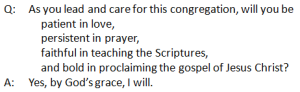
Let’s call this my pastoral New Year’s goal, then. Here’s what I’m aiming for as a pastor for 2017: to be patient in love, persistent in prayer, faithful in teaching the Scriptures, and bold in proclaiming the gospel of Jesus Christ.

commitmentIf that sounds like liturgy, that’s because it is. This was the commitment I made before our congregation when I was installed as pastor. Really, then, my 2017 pastoral New Year’s goal is simply re-committing myself to this calling.

I’ve often been distracted from this. To be fair to myself, though, it’s awfully easy to get distracted from this.

Many pastors feel like they have “a hundred bosses,” or whatever the size of their congregation is, because every person in the church has a different, particular understanding of what it means to be a “pastor,” who a pastor is supposed to be and what they are supposed to do. Some want a congregational visitor, others a community activist, some a spiritual guru, others a private therapist, some a thoughtful theologian, others an extroverted evangelist—and that’s only a small sample of the options. Just imagine the multiple personalities required to do all this, let alone the superhuman skills and physics-bending time and energy.

Into this vortex of competing expectations and impossible demands I hear Jesus’ simple call to me as pastor, a call nicely summarized by that installation liturgy: be patient in love, persistent in prayer, faithful in teaching the Scriptures, and bold in proclaiming the gospel of Jesus Christ.

Be patient in love. This is not so much a specific task to do as it is a general orientation for everything I do. And this is as difficult for me as it is for anyone else—contrary to another common expectation, pastors are not inherently “more spiritual” than others. Yet it is an orientation all Christians are called to nurture in Christ by his Spirit. In whatever tasks I do, in whatever roles I take on, in 2017 I want to strive to be patient with others as I seek to love them in the way of Jesus. (Lord, have mercy!)

Be persistent in prayer. Here my pastoral calling starts to become more specific, and in this I have much room for improvement. This is not incidental to my ministry, but central: to persevere in prayer for those among us and around us, to be deliberate in making and taking time to speak the names and stories, joys and sorrows of our congregation and community before God. May this year be a year of rekindled prayer in my life, in every area of my life.

Be faithful in teaching the Scriptures. You’d think this would already be well in place. After all, this is an area of expertise and experience for me, and teaching the Bible is one of the most fulfilling things I’ve ever done. I have a Ph.D. in biblical studies, for goodness’ sake! But for various reasons this has been pushed to the margins in my ministry. No more: in the coming year I am determined to re-claim this calling, to find and create opportunities to teach the Scriptures in all their difficult challenge and inspired insight.

Tissot - Jesus TeachingBe bold in proclaiming the gospel of Jesus Christ. This is something I have been doing—every sermon I preach is a proclamation of the gospel—but I am resolved (yes, on this I’m “resolved”) to do this even more. Our world—and each one of us—desperately needs to hear God’s good news again and again and again. But beware: this is not the gospel many of us grew up with. It’s the gospel of God’s kingdom come on earth, justice and peace and flourishing life for all, brought about through the crucified and resurrected Jesus. It promises true life, abundant life, but it demands our very lives: walking in the cross-shaped footsteps of the resurrected Jesus. In 2017 I intend to preach this gospel of peace at every opportunity.

Of course, this doesn’t mean that these are the only things I’ll be doing as pastor this year. There are all kinds of specific tasks, necessary or urgent or both, that are part of a lead pastor’s role in this day and age. But these are the things I’ll be focusing my time and energy on, for these are the things to which I have been called.

So watch out, world! Look out, Morden Mennonite Church! Pastor Michael is on the loose! Let 2017 be the year in which I take a leap of faith closer to the goal for which I was commissioned: being patient in love, persistent in prayer, faithful in teaching the Scriptures, and bold in proclaiming the gospel of Jesus Christ!

By God’s grace, may it be so.

Cross-posted from http://www.mordenmennonitechurch.wordpress.com. © Michael W. Pahl.

The Perfect Portrait of God

I’m not a visual artist. I cannot draw, I cannot paint. My stick figures don’t even look like stick figures.

But over the last ten or fifteen years I’ve begun to develop an appreciation for the visual arts. I think it really started when we lived in England and we took advantage of all the free museums and art galleries. And so I’ve been working out what kind of art I like: John Constable’s English Romantic landscapes, Claude Monet’s French Impressionism, among others.

de-grebber-god-inviting-christ-to-right-handI also have an interest in religious art, Christian religious art in particular. Ancient Eastern icons. Rembrandt’s portrayals of the life of Christ. Depictions of God—like the famous one in Michelangelo’s Creation of Adam, or this one by Pieter de Grebber.

It seems that when we attempt to portray God visually, this is where we often end up: God is an old man with a white beard. He might be a kindly grandfather figure, benevolent and benign. Or he might be an untouchable monarch in all his pomp and state. Or he might be a judge, robes swirling, scowling with the full force of the law. But he’s an old man with a white beard, regardless.

And, in our portaits of God, we imagine God as up there, out there, somewhere other. God is heavenly holy, unreachable, untouchable. God is immensity. God is eternity. God is omni-potency.

But did you know that God has actually given us a self-portrait? This portrait of God is an “exact representation of God’s being,” as Hebrews 1 puts it. It is the “very image of God,” as Colossians 1 says. And—although God has nothing against old men with white beards—God’s self-portrait is nothing like our typical picture of God.

This perfect portrait of God is Jesus.

This means that the perfect portrait of God is a baby, born of water. Umbilical cord twisting toward his mother. Amniotic fluid matting his dark hair against his olive skin. Eyes tight shut, mouth open, wailing his newborn cry.

The perfect portrait of God is a child. Toddling, falling, and getting back up. Forming first words—“Abba,” perhaps. Laughing at silly games, scraping knees in play, being comforted in a young mother’s warm embrace. God’s kingdom belongs to such as these.

The perfect portrait of God is a teenager. Learning, questioning, questioning again—even the chief rabbis in Jerusalem. Taking on responsibility, taking on independence, taking on hopes and fears to guide his years ahead. God’s kingdom belongs to these as well.

The perfect portrait of God is a young adult, born of spirit. Living and loving, laughing and lamenting among kith and kin in a small village in Galilee. Acquiring his father’s craft, creating something out of nothing but a bit of formless wood or stone.

The perfect portrait of God is a grown human, fully alive. Devoted to God in faith, committed to others in love, tenacious in hope for good things to come. Doing justice, loving mercy, walking humbly with God. The whole Law is summed up in these things.

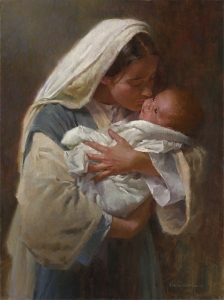
weistling-kissing-the-face-of-godThe perfect portrait of God is Jesus. And this changes everything.

God is not in the earthquake, not in the storm, not in the fire—but in the still silence of a sleeping baby, a mother’s gentle whisper.

God is not in our chariots and horses, our instruments of power and death—but in our acts of tender love and humble compassion.

God is not in our strength, nor in our riches, nor in our wisdom—God is in the poor in spirit, the humble in heart, in those who must rely on God even for their daily bread.

God is not in our might and power—but in the Spirit, God’s persistent yet gentle wind of peace.

God is not in our impressive words written or spoken—but in the Word made flesh, full of grace and truth.

God is in a baby, wrapped in swaddling clothes, and lying in a manger.

Joy to the world! The Lord is come! Our Lord, Emmanuel, “God With Us.”

A meditation given at Morden Mennonite Church on December 25, 2016. Click on images for sources. Cross-posted from http://www.mordenmennonitechurch.wordpress.com. © Michael W. Pahl.

Meditations on a Healing Foot

Three months ago I broke my foot. I’ve been hobbling around on crutches or limping around with a walking cast for thirteen weeks.

Three-plus months, thirteen weeks, and this is the picture that met me when I sat in the doctor’s office the other day.

I know, I thought the same thing.

“Um,” I ventured, “that jagged zig-zaggy bit there…is it supposed to be like that?”

Sure, I was told, it’s “not ideal.” It is, however, “sufficiently aligned.” And “fusing nicely.”

Good enough to ditch the walking cast and start doing some weight-bearing physiotherapy.

I know, I thought the same thing.

“Really?” I said to the doctor. “You’re sure about that?”

“Yes,” he reassured me with a smile, “this is what healing looks like.”

This is what healing looks like.

Almost everyone I know doubts this. I’ve showed the picture to several people. Heard from a few with medical connections. I hear back a collective, “Hmm…”

Yet I have to trust the doctor. He’s an orthopedic surgeon. This is his life, broken bones and such things, especially in the foot. Yes, it’s not ideal, but it’s “within acceptable range.” And it doesn’t actually feel too bad. Some stiffness and soreness, a little tenderness and still some swelling. All normal. My motion is ahead of where one might expect, my physiotherapist says.

This is what healing looks like.

Healing looks like unexpected zig-zags and jagged edges. Slow-forming calluses and even slower fusion. Soreness, stiffness, tenderness, swelling. Not necessarily ideal, but sufficient. “Acceptable.”

This is what healing looks like.

Healing looks like oozing sores and crusty scabs.  Scars forming, and remaining. Twinges every time you step in that particular way, or always at that time of year when the temperature drops.

This is what healing looks like.

Healing looks like chemotherapy and radiation. Losing one’s hair, growing back fuzz. Trips, endless trips, to the doctor, the specialist, the occupational therapist, the physiotherapist. And pills! Endless pills, sorted by shape and size and colour and time taken.

This is what healing looks like.

Healing looks like therapy sessions with the psychologist. A short stint in the mental health facility. Being admitted to the psych ward. Taking medication faithfully, doctor’s orders, even when you’re sure you could now go without it.

This is what healing looks like.

Healing looks messy. It’s painfully slow. And it’s not always the outcome we want, the “ideal.”

Sure, there are times when healing looks like the instant fix. The man leaping up and carrying his mat. The woman knowing immediately her bleeding had stopped. These are remarkable because they are so exceptional.

For there are many times when healing looks reluctant, even shameful. Seven dips in a muddy foreign river. Needing a second crack at healing blindness, or a gooey paste of spit and mud to do the trick.

And there are times, all too many times, when healing just doesn’t happen the way we want. Leaving a dear friend sick, even when you’ve got a reputation as a healer. Crying out to the Lord again and again and yet again to be healed, only to be answered with “My grace is sufficient for you in your weakness.”

There’s that word again: “sufficient.” What we really need, not necessarily what we think we need, or what we really want. Like “daily bread”: just what we most need, just when we most need it.

And what we most need is “grace”: unmerited favour from God, and from others. Grace to be who we are, in sickness and in health. Grace to face each day, one day at a time. Grace to experience flashes of joy and the deep ache of hope. Grace to grieve. Grace to be among those we love, and who love us. All this grace, even in our weakness. Especially in our weakness.

This is what healing looks like.

This is what healing looks like.

This, too, is what healing looks like.


Image: Mironov, “Christ Healing the Blind Man.” © Michael W. Pahl

Christ Our Crucified King

Christ the “King.”

The “kingdom” of God.

I wonder if we’re too used to these words, “king” and “kingdom.” They don’t unnerve us quite the way they should. They should be deeply unsettling.

After all, “kings” are absolute rulers. Each one is a single chain in a dynasty of absolute rulers. They rule over a “kingdom,” a geographical area inhabited by their subjects. The language of “king” and “kingdom” evokes power and privilege: servants at their beck and call, armies under their command, courtiers seeking their favour, their word the law of the land.

And kings have not had a good track record through history, especially not in ancient history. Their kingdoms have, by and large, been oppressive and unjust for all but those at the very top of the social pyramid, those closest to the king. Kingdoms are hierarchies of the strictest order, patriarchies of the strongest kind.

With ancient kings and kingdoms we’re a million miles away from Queen Elizabeth II, a million light-years from a representative democracy like Canada.

And it was into this jarring world of “kings” and “kingdoms” that Jesus came—and turned things on their head. Because Jesus was no ordinary king, and his kingdom no ordinary kingdom.

No king would be born in a barn, attended by the local riff-raff. But Jesus was.

No king would grow up in near-poverty, in a no-name village on the way to nowhere. But Jesus did.

No king would be heralded by a camel-hide-wearing, insect-eating, power-denouncing prophet. But Jesus was.

No king would choose both political insiders and political revolutionaries as his dinner guests, sharing bread and cup with them at his table. But Jesus did.

No king would heal sick peasants for free, or cure the daughter of foreign woman, or the servant of an enemy soldier. But Jesus did.

No king would promise their kingdom to the poor and oppressed and warn off the wealthy and powerful. But Jesus did.

A king would ride into the capital on a warhorse, armor gleaming and armies marching—not on a lowly donkey followed by religious pilgrims, like Jesus did.

A king would demand an audience with the powers-that-be and exact vengeance for his shameful suffering—not stand bloodied before them in dignified silence, exposing their injustice for all to see, like Jesus did.

Velazquez - Christ CrucifiedA king would be enthroned on a grand dais in pomp and ceremony—not lifted up on an executioner’s cross in darkness and storm, like Jesus was.

Jesus was no ordinary king, and his kingdom no ordinary kingdom.

We’ve seen this already in our previous text from Luke’s Gospel—God’s Messiah, the King of the Jews, dying on a Roman cross, making promises of paradise to a condemned criminal. But we also see it in the opening chapter of the Apostle Paul’s letter to the Colossians.

Here Paul talks about God’s kingdom this way:

God’s kingdom is the “kingdom of his beloved Son.” That sounds like ancient patriarchy—men holding all the cards in the game of life. But Paul’s point is to use these words to recall Jesus’ baptism—“You are my beloved Son, with whom I am well-pleased.” Which means Paul’s point is to use these words to bring to mind all those ancient promises about Israel’s Messiah—Jesus is the true “Son of God,” the “Messiah,” the one who will bring about God’s kingdom on earth.

God’s kingdom is a “kingdom of light.” It is here on earth—make no mistake about it. But it’s not about a geographical location. God’s kingdom is “not of this world”: it is from beyond this world of darkness and death. But it is coming “on earth just as it already is in heaven”: God’s kingdom brings heaven to earth.

Wherever the light touches—this is where God reigns. Wherever oppressive evil is banished—this is God’s kingdom. Wherever life blooms in the midst of inevitable death—this is God, reigning from his throne.

Wherever God’s will is done—this is God’s kingdom. Wherever daily bread is provided for all—this is God’s kingdom. Wherever sins are forgiven, both “us” and “them”—this is God’s kingdom. Wherever people are delivered from the time of trial, wherever people are protected from evil—there God is, reigning as king.

All this and more is what Paul means when he says that God “has rescued us from the power of darkness and transferred us into the kingdom of his beloved Son.”

God’s kingdom is also a “kingdom for all creation.” All things, Paul repeats, all things have been created in Jesus and through Jesus and for Jesus. All things are sustained in Jesus, held together in him. All things, all things are reconciled to God through Jesus. All things: visible and invisible, both on earth and in the heavens. All things.

And so God’s kingdom is a “kingdom of reconciliation.” Paul’s words here don’t just mean, “There’s no more fighting.” When Paul speaks here of Christ “reconciling” and “making peace,” he speaks of restoring something broken back to a harmonious whole. All is justice. All is life. All is peace. Shalom.

And so this reconciling work of God overturns the human hierarchies of this world, whether based on gender or race or wealth or status. There’s a reason why the New Testament says that we will “reign with Christ”—the fulfillment of God’s kingdom is a communal reign, all of us gathered together around Jesus, fulfilling the promise of being created in God’s image. And this communal reign has already started: “in Christ,” Paul says, “there is no longer Jew or Greek, there is no longer slave or free, there is no longer male and female.”

Remember, Jesus is no ordinary king, and his kingdom no ordinary kingdom.

Excerpted from my sermon at Morden Mennonite Church on November 20, 2016, for Christ the King Sunday. Image: Velázquez, “Christ Crucified.” Cross-posted from http://www.mordenmennonitechurch.wordpress.com. © Michael W. Pahl.

“Remember Me”

“Jesus, remember me when you come into your kingdom.”

The words of a thief on a cross.

“Thief” isn’t really the right word, though—he was no pickpocket, no petty thief. He was a violent bandit who had, by his own admission, been “condemned justly.” He was a sinner, and he knew it. He was, as Luke puts it, a “criminal.”

He was right where he was supposed to be, hanging on a cross.

But he also knew that Jesus was not where he was supposed to be. Jesus was not a violent bandit, he was not a criminal, he was not a sinner. He had done nothing wrong, nothing to deserve a cross.

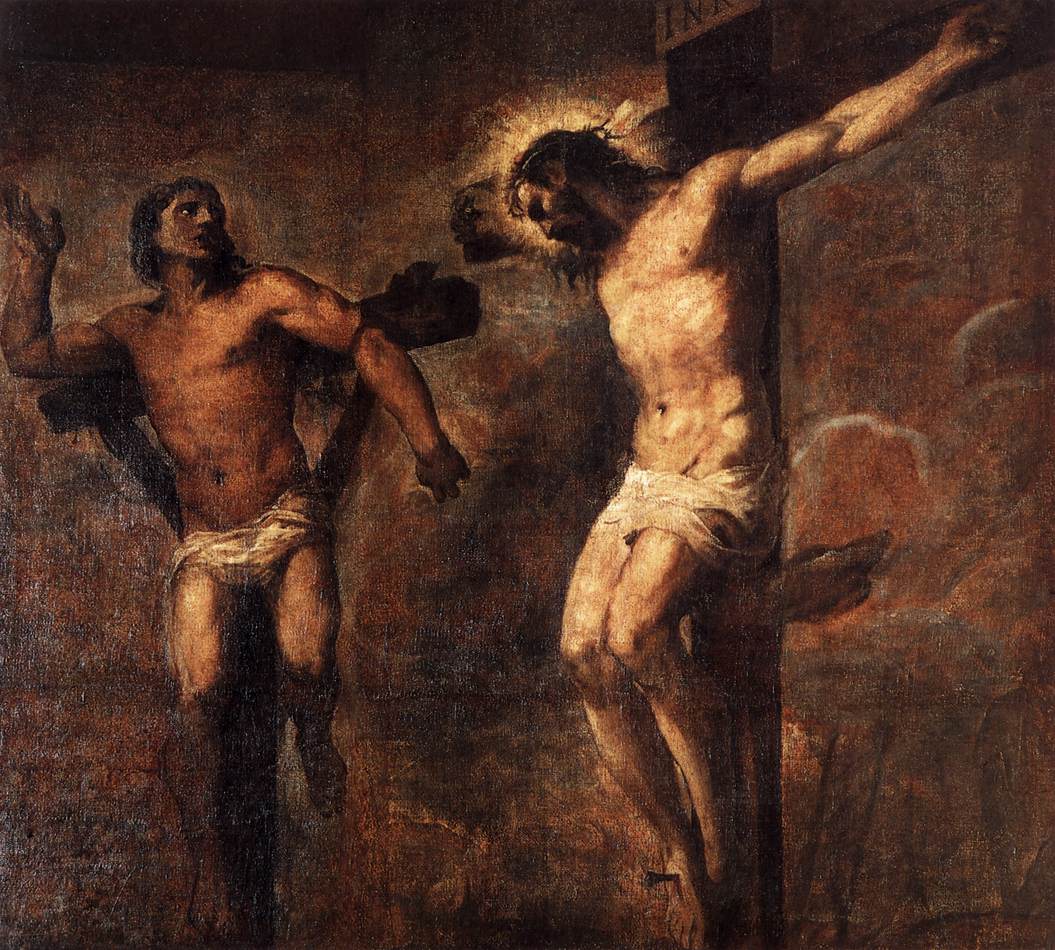
Titian - Christ and the Good TheifAnd so he came to Jesus’ defence when the other criminal on the cross began to mock Jesus, to scorn him. “This man has done nothing wrong,” he rebuked the other bandit. “We deserve what we’re getting, but Jesus doesn’t!”

He knew something was different about Jesus. Could it be true, what they said, that he was the King of the Jews? Could he really be the Messiah, bringing about God’s kingdom? But if so, what was he doing dying on a Roman cross? It made no sense—but still he believed.

And so he called out to Jesus, one crucified man to another: “Jesus! Jesus! When you come into your kingdom, remember me!”

“Jesus, remember me.”

Isn’t this the most basic cry of faith?

“Jesus, I don’t completely understand who you are, I don’t really understand what you are doing, but there is something about you, Jesus, something that points beyond the harsh realities of life and death. Please, remember me!”

Even more, isn’t this the most basic longing of human existence?

When we strip away all our pretence, all the collected debris of our lives, isn’t this what we long for, deep in our souls? To not be forgotten? To be remembered?

Don’t we all, when we breathe our final breaths, want to be assured that someone, somewhere, will remember us? Our names, our stories, our hopes and dreams—that these will not be forgotten, but will live on? Don’t we all, when it comes right down to it, want our lives to matter to someone?

At the deepest level, each one of us is that thief on the cross: we are broken sinners who have broken others, we are desperately in need of mercy, desperately wanting to matter.

And the crucified Jesus looks us right in the eye and says the same words to us that he said to that condemned criminal: “Not only will I remember you—you will be with me.”

We want to be forgiven. Jesus gives us paradise.

We want to be remembered. Jesus gives us his presence.

This post is excerpted from a sermon I preached on November 20, 2016, at Morden Mennonite Church, for Eternity Sunday. Image: Titian, “Christ and the Good Thief.” Cross-posted from http://www.mordenmennonitechurch.wordpress.com. © Michael W. Pahl.

Our Thoughts and Words Matter

us2016Nobody said U.S. politics were dull.

Like most of the world, I watched the recent U.S. presidential race alternating between fascination, amusement, and horror. Sometimes all three at the same time.

It’s the kind of election that will be analyzed from every angle for years to come. I’ve been sorting through my own thinking on “what this all means,” and one of the things that I keep coming back to is this: our thoughts and words matter.

Even more pointedly: As Christians, called to love both neighbour and enemy, it’s not enough that we act in loving ways. We must also think and speak in loving ways.

I’ve often reflected that, if I were set upon by bandits and left for dead by the side of the road, there’s no one I’d rather have find my nearly lifeless body than an Evangelical Christian. Say what you will about Evangelicals, but pretty much every red-blooded Evangelical I know of would stop and help someone in such desperate need, even at great cost to themselves. Evangelicals make great Good Samaritans.

However, I have heard some of those same people speak demeaning, even downright cruel words about others. I have seen some of those good Evangelical Christians manipulate and deceive and aggressively coerce in order to achieve what they believe to be good ends. I have witnessed their haughty looks, their patronizing gazes, their holier-than-thou disdain, their puffed-up egos run amok.

I have been on the receiving end of this. I know whereof I speak.

I know also that this is not merely an “Evangelical Christian” problem. It is a profoundly human problem.

I’ve heard politically correct liberals speak horrendously about conservatives behind closed doors. I’ve seen poverty-advocating progressives walk right by a homeless beggar on the street with not even a flicker of emotion.

The disjunction between outward action and underlying attitude can be found among all of us in one way or another. I’ve seen this problem all too often in myself, across the whole spectrum of ways. We’ve all got a problem, and it’s a deep-seated, far-reaching human problem: a “sin” problem, to use the Christian lingo.

But what has struck me most profoundly over the past few months of observing U.S. politics is this particular disjunction: we don’t seem to get that our outward actions are rooted in our underlying attitudes and fueled by our shared speech.

We men might never walk up to a woman we don’t know and “grab her by the p*ssy”—but we tell blonde jokes behind closed doors, or we mansplain in our work meetings, or we smirk the words “PMS” to our buddy with a roll of the eyes.

We white people might never lay a finger on a non-white person—but we chuckle at the “drunk Indian” or “lazy Mexican” comment, or we  brush off the brouhaha over “Redskins” for a team name, or we think to ourselves that African Americans or Indigenous people just need to “get over it already.”

We straight folks might never assault the LGBTQ folks among us—but we perpetuate lies about some universal “gay lifestyle,” or we speak about bisexuality as if it’s a fake illness, or we’re not really sure we can trust the lesbian math teacher with our children all day.

We Christians might never bomb the nearest Mosque—but we assume the hijab-wearing woman is living in suppressed silence, or we choose the seat at the airport furthest from the Arabic-speaking men, or we forward the latest “Muslims are Taking Over Canada!!!” email to our family.

I’m not talking about those random thoughts that pop into our head from time to time. I’m talking about those attitudes that we allow to settle into our brains and dwell in our souls. We harbor these fearful, demeaning attitudes toward others, we speak fearful, demeaning words about others, and then we are all shocked when people actually act out of fear in cruelty and violence toward others.

But these things are connected. Our thoughts, our words, our actions—they are all of a piece.

Maybe we’re right about ourselves, that we would never physically harm others. But when we nurture harmful attitudes about others in our hearts and minds, when we encourage hurtful speech about others even in private, these thoughts and words will inevitably bear fruit in action—either ours or someone else’s.

This is what’s behind some of Jesus’ most difficult teachings. “Adultery” is not just about sexual intercourse, Jesus declares, and “murder” is not just about the act of killing someone: these outward acts are rooted in our thoughts and anticipated in our words (Matt 5:21-30). In other words, Jesus asserts, “Evil things come from within, from the human heart,” and this is what truly defiles us before God and others (Mark 7:20-23).

To borrow another favourite metaphor of Jesus—and some direct teaching from the Apostle Paul—“we reap what we sow” (Gal 6:7-8). Our thoughts are like seeds that root themselves deep in the soil of our hearts, and they will shoot up in the words that we speak and bear fruit in the actions of our lives.

If we think otherwise, we are deceiving ourselves. We are mocking God; but God will not be mocked.

When we nurture harmful thoughts, even in the deep places of our heart, or speak harmful words, even behind closed doors, we sow seeds of harm that will bear the fruit of harm. This is true for us as individuals, as families and churches, and as a society.

But if we can instead develop settled attitudes toward others that are based on truth and love, and speak words that build up and don’t tear down, then we can sow seeds that will bear the fruit of goodness and truth and beauty in our lives and in the world.

Let’s stop pretending that our inner thoughts and private words don’t matter. They do.

For the love of God—with all our heart, soul, mind, and strength, and our neighbour as ourselves—let’s dig deep within ourselves and scrape out our stony hearts in repentance. After all, God has promised a heart of flesh ready and waiting for us, beating with the love of Christ.

© Michael W. Pahl

God’s Dream for the World

“I have a dream.”

The words are iconic. I’m sure most of us know the speaker, and the context.

Martin Luther King, Jr. The Lincoln Memorial in Washington, D.C. August 28, 1963.

Ground zero of the African-American civil rights movement.

It had been 100 years since Abraham Lincoln himself had issued the Emancipation Proclamation. Almost 98 years since the U.S. Congress had passed the 13th amendment to the U.S. Constitution, abolishing slavery. A full century, in other words, to bring about full equality under the law for African Americans. But it hadn’t happened.

Three, four generations. And it still hadn’t happened. Bits and pieces, here and there, including a decade of rocky attempts at desegregating schools. But the 100-year old promise of freedom was far from fully realized.

And so African Americans were getting restless. Meetings were held, boycotts were enacted. People marched, people protested. Some began to think all this was not enough. A stronger voice was needed, a more powerful statement. Maybe even violence.

Into this world Martin Luther King came. Supporting Rosa Parks in her refusal to give her seat to a white passenger on an Alabama bus. Instrumental in organizing the civil rights movement. Preaching, speaking, rallying, lobbying. Insisting that, in their struggle for justice, African Americans must not resort to the same tactics as their oppressors: no hatred, no cruelty, no violence.

And this was how Martin Luther King, Jr., ended up on the steps of the Lincoln Memorial in Washington, D.C., on August 28, 1963, in front of 200,000 people.

Ground zero of the African-American civil rights movement.

“I have a dream.”

Powerful words, these. Powerful things, dreams.

“I have a dream that one day this nation will rise up and live out the true meaning of its creed: ‘We hold these truths to be self-evident, that all men are created equal.’”

“I have a dream that my four little children will one day live in a nation where they will not be judged by the color of their skin but by the content of their character.”

“I have a dream that one day every valley shall be exalted, and every hill and mountain shall be made low, the rough places will be made plain, and the crooked places will be made straight; ‘and the glory of the Lord shall be revealed and all flesh shall see it together.’”

Sounds biblical, these words. Sounds like God, these dreams.

And that’s because they are.

Nearly two thousand years earlier another prophet had stood on the other side of the world in very similar circumstances. He, too, had a dream.

His name was Jesus. He was from Nazareth, in Galilee. His people, the Jews, were coming up to 100 years under Roman occupation: nearly a century of economic exploitation, heavy taxation, no freedom to choose their own course. Galilee in particular was a simmering cauldron of unrest, always ready to boil over into outright revolt.

It had happened before. Not long after Jesus was born, after the death of King Herod, several people tried to claim the throne to take a run at Rome. Messiahs grew like wildflowers after a spring rain—but they were ruthlessly cut down.

Ten years later—about the time Luke’s Jesus was turning heads as a child in Jerusalem’s Temple—a man named Judah led an outright revolt against Rome, claiming Rome’s heavy taxes amounted to slavery. He and his followers were brutally crushed by the armies of Rome.

And now here Jesus stands, on those very hills of Galilee.

Ground zero of the Jewish resistance movement.

“I have a dream,” Jesus declares.

“I have a dream of God’s kingdom come, God’s will being done, on earth as it is in heaven. On that day every valley shall be exalted, and every hill and mountain shall be made low, the rough places will be made plain, and the crooked places will be made straight; ‘and the glory of the Lord shall be revealed and all flesh shall see it together.’”

Tissot - Jesus Teaching“I have a dream,” Jesus proclaims to his fellow Galileans buckling under the weight of Rome. “I have a dream that one day those who are now grieving will be comforted, those who are now lowly and downtrodden will be in charge, those who are right now starving for justice will have their craving satisfied. I have a dream that one day those who are humble in their spirit and pure in their motives, those who show mercy toward others, those who make peace instead of inflicting violence and waging war, these will live in the fullness of life.”

“I have a dream today!” The crowd rumbles its agreement.

“I have a dream,” Jesus shouts to the restless masses. “I have a dream that one day the last will be first and the first will be last, everyone on equal footing. The Jew will live alongside the Gentile, the rich will sit down with the poor, men and women and elders and children all will share their lives in mutual care and respect.”

“I have a dream today!” You can hear the “Amen!” shouted in the background.

“I have a dream that one day the lost will be found. The struggling, the sick, the stigmatized, the silent, the sinner, all will be brought in to the banquet of God’s great love, the very least feasting until they are satisfied. I have a dream that one day the poor will hear good news for a change, the unwell will know true healing, the outcasts will be embraced, and those left for dead will experience new life.”

“I have a dream that one day oppression will cease and wars will be no more. The powerful and proud will be humbled and the lowly will be lifted up, swords will be turned into plows and seeds of life will be planted for the flourishing of humanity.”

“I have a dream today!” And the applause echoes out over the waters of the Sea of Galilee.

It might seem strange to think about Jesus’ teaching on the kingdom of God as God’s dream for the world. But that’s essentially the idea: the kingdom of God is God’s vision for the world, what the world would be like if people lived out God’s will, God’s way for humanity. The kingdom of God is the best possible world God can imagine.

This still might seem odd, to imagine God dreaming, to think of God imagining a better world. But remember: God is the Creator of all things, and to speak of God as Creator is to speak of God as imagining. Before anything existed, God imagined it. Everything that is, exists because God imagined it first. To use the Apostle Paul’s words, God is the one who “calls into being the things that do not yet exist.”

But God is not done imagining. God is not done dreaming. God has a dream for a better world. And God’s dream for the world is what Jesus called “the kingdom of God.”

And here’s the thing about God’s dreams: when God dreams something, you know it will become reality, even if it takes an eternity.

In fact, God has provided a way for us to see this dream become a reality: through Jesus. Jesus didn’t just stand on the steps of the halls of power and share God’s dream. He taught how this kingdom of God can come down to earth, and then he lived it out. Think back to the story of Jesus.

Title: The parable of the sower [Click for larger image view]God’s kingdom, Jesus says, starts small, like a mustard seed. God’s dream for the world begins in the insignificant spaces in our lives: the everyday, the ordinary, the mundane. God’s dream for the world starts in the hidden places of our lives: in small, unseen acts of empathy and humility and compassion.

The kingdom of God does not come about through flashy programs and glitzy marketing campaigns, but through the nitty-gritty, down-to-earth, day-by-day, moment-by-moment choices we make to be kind, to be patient, to welcome, to forgive, to trust, to rejoice, to persevere.

God’s kingdom, Jesus says, spreads quietly, like yeast in dough. As we do these ordinary acts of love in the hidden spaces of the world, God’s dream begins to spread. It’s contagious. Grace begets grace. Forgiving others leads to others forgiving. Practising empathy and compassion encourages others to do the same. Joyful hospitality and thankful generosity multiply, spawning a community of open-handed and open-hearted people.

The kingdom of God does not come about through guilt manipulation or aggressive coercion, but through the repeated, repeated, repeated practice of Christ-likeness: humbling ourselves, raising up others, seeking the good of all above our own whiny wants.

And this is where God’s dream gets really hard. Because living into God’s kingdom, Jesus says, requires us to lose our lives in order to truly live. If we really want to seek first God’s kingdom and God’s justice, to see God’s dream become reality, Jesus says we must “deny ourselves and take up our cross and follow him.”

The kingdom of God does not come about by an easy road, a life of comfort and ease, insisting on our rights and privileges. It comes about by a narrow path, the path of willingly putting others’ genuine needs before our own personal preferences, seeking the good of all rather than our own selfish whims, knowing that when we all thrive together, we will each thrive even more.

And this is where God’s dream moves beyond our private lives and into the public domain. Because living into God’s kingdom, Jesus says, requires us to stand fast against evil: both that within ourselves and that in the wider world. God’s dream confronts the nightmare of this world’s evil. It demands that we defy those impulses within ourselves that cause harm to the other, and also those larger patterns of hostility and injustice within our societies that cause harm to whole swaths of people.

Racism, sexism, and bigotry of all kinds. Physical, sexual, and other forms of abuse. Economic exploitation and political repression. All the human rulers and underlying ideologies and prevailing attitudes and social structures that support these and other terrible evils.

To seek first God’s dream for the world means we are committing ourselves to stand firm against all these spiritual forces of evil—but to do so through persuasion and not coercion, through compassion and not cruelty, through mercy and not vengeance, through peaceful means and not violence.

Jesus walked this path himself, this narrow path to God’s kingdom. He did the small things, off in a back corner of the Roman Empire. He lived out the infectious way of welcoming love and selfless compassion and grateful joy. He resisted the evil powers of his day, willing to die rather than kill, giving his own life to seek the good of all.

And through all this Jesus sowed the seed of God’s kingdom in the world. In Jesus this dream was plucked from the fertile imagination of God and planted in the earthy soil of our humanity.

This was why, when Jesus was asked when God’s kingdom would come, when God’s dream would become a reality, Jesus could say: “Don’t look for the big, flashy signs! The kingdom of God is already among you. It’s right here—if you’re ready to see it.”

Do you remember the story of Pentecost? After Jesus’ death and resurrection, after Jesus’ exaltation to his rightful place in the universe, the wind of God moved on the face of the deep, just like it did in the beginning. God’s Spirit came upon that ragtag band of Jesus-followers, all huddled together in hope and fear.

And when it came time for the Apostle Peter to explain what was going on to the bewildered crowds, do you remember what Peter said? He quoted the words of the prophet Joel:

I will pour out my Spirit upon all flesh,
and your sons and your daughters shall prophesy,
and your young ones shall see visions,
and your old ones shall dream dreams.

And so it has been ever since.

God’s daughters and sons are still prophesying, they are still dreaming. The young ones, even the old ones—did you hear that?—are still dreaming God’s dreams for the world.

For two thousand years God’s people have been dreaming the dreams of God, imagining God’s kingdom come, God’s will being done, on earth as it is in heaven. Martin Luther King’s dream is just one of those dreams, still awaiting its full realization. Like the dreams of Syrian refugees, and residential school survivors, and many, many others.

The kingdom of God starts small, like a mustard seed. And it can take an age until its branches provide nests for the birds and shade for all who seek it. The arc of the moral universe is long, but it bends surely toward justice.

But to see this become a reality we must dream the dreams of God. We must imagine the world as it can be, flowing with justice and peace and bursting with flourishing life. Only then can we step out in faith and love and hope in the footsteps of Jesus, and grasp the dream that stands before us.

————————————-

Adapted from a sermon preached on October 30, 2016, at Morden Mennonite Church, as part of the “Stirring Our Imagination” worship series. Watch MLK’s full “I have a dream” speech; or listen to the audio recording. Images: 1) U.S. National Archives and Records Administration; 2) “Jesus Teaches By the Sea” by James Tissot; 3) “Parable of the Sower” by Jesus Mafa.

© Michael W. Pahl

(Re-)Imagining Worship

It’s interesting that the New Testament never gives a detailed description of exactly what went on when the first Jesus-followers gathered together to worship. There’s no divinely inspired “order of service.”

The closing worship service at Mennonite Arts Weekend 2016, Cincinnati, Ohio. Photo by Cara Hummel. Sure, we get some glimpses of early Christian worship here and there: some snippets in the book of Acts, some clues in the New Testament letters. But nowhere in the New Testament do we get a really detailed description of what a “worship service” looked like for the first Christians.

Probably it was different in every place.

Jewish Christians in Jerusalem likely modeled their worship meetings after the synagogue service they were familiar with: Scripture readings, a sermon, singing psalms, prayers. Gentile Christians in Corinth may have modeled their gatherings after religious banquets or society meetings: religious rites, speeches, a shared meal.

The “worship services” in churches planted by Paul in Turkey or Greece probably looked very different from the regular meetings in churches planted by Thomas in India or Philip in Africa—different languages, different music, different food and dress, and, of course, different kinds of people.

In fact, the Bible provides quite a diverse list of the sorts of things that God’s people did when they got together to worship, from the ancestors of Israel all the way through to the earliest Christians:

  • telling stories, reciting poetry, chanting psalms;
  • loud cymbals, drums, and horns; soft harps and lyres; no instruments at all;
  • responsive reading, antiphonal singing, dramatic re-enactments, visual art;
  • kneeling, standing, clapping, dancing, eating, drinking;
  • confessing sins, receiving forgiveness, blessing one another;
  • hearing Scripture, teaching the faith, affirming the faith, proclaiming good news, encouraging one another;
  • praying, praising, thanking, silence.

And then there’s the diverse worship history of the church. Beautiful sacred spaces, from large cathedrals to small parish churches. Stained glass, exquisite art, imposing sculpture. Gorgeous cantatas, plainsong chants, simple hymns, well-known carols.

In our own Mennonite tradition, there has been everything from simple unison singing to full-throated four-part harmony, from plain furnishings to elaborate quilting, from the basic hymns-prayers-Scripture-sermon format to intricate services incorporating ancient liturgies from other traditions.

And beyond our Mennonite tradition, beyond the Western history of the church, there’s a whole world of worship out there from across the globe, from every language and culture and tribe and nation.

We can tend to think that there’s only ever been one way the church has worshiped, or that there’s an obvious “best way” to worship God when we gather together, but clearly that’s not the case. It’s never been the case.

And, in fact, it’s not really healthy for us to get stuck in a rut in our worship, always and only doing everything the same way. There’s a reason the Psalms exhort us multiple times to “sing to the Lord a new song.” It’s because a willingness to try new ways of worshiping is like a willingness to explore new ways of thinking about God or to work out new ways of following Jesus—it is evidence of an authentic faith, a faith that is vibrant and growing and very much alive.

All this is what I mean when I say we need to develop a “liturgical imagination.” We need, to use Paul’s words in Colossians, always to remain grounded in the gospel of Jesus Christ, letting the “word of Christ” dwell among us richly in our teaching and preaching, our singing and music, every “word and deed” of our collective worship. But we need to continually re-imagine what this all looks like.

And we have no shortage of resources to work with. We have the examples of worship throughout the biblical writings. We have models of worship throughout the church’s history and from around the world. And we have rich resources among us a congregation, creative gifts in preaching, teaching, storytelling, poetry, music, visual art, tactile art, culinary art, drama, dance, and so much more.

I wonder: how might God’s Spirit prompt us to “sing a new song” in our worship together, to try out new “words and deeds,” fresh ways of worshiping God?

But “developing a liturgical imagination” is more than just the people up in the front leading us in trying out some new things. Each one of us needs to use our imagination in participating in worship.

When we walk into the sanctuary every Sunday morning we all need to be ready to use our God-given imagination, using our imagination to enter into whole new worlds of worship.

Using our imagination to enter the world of the songwriter when we sing their words. Using our imagination to enter into the world of the biblical author when we read their words. Using our imagination to enter into the world of the worship leader or preacher when we hear their words.

Using our imagination to enter into the presence of God here on earth as it is in heaven.

And in this way, as we teach and sing the gospel of Jesus Christ to each other before God, letting the “word of Christ dwell among us richly,” we can come to believe with ever-increasing faith that we are God’s “holy and beloved” children, “chosen by God” to be more and more like Jesus.

Adapted from a sermon preached at Morden Mennonite Church on October 23, 2016, part of a sermon series called “Stirring Our Imagination.” Cross-posted from http://www.mordenmennonitechurch.wordpress.com. © Michael W. Pahl.

“The Word Made Flesh”: On Doing Theology Afresh

A Jew, a Greek, and a Roman walk into a church. No joke.

Imagine it: a Jew, a Greek, and a Roman walk into a church, back in the first century. Let’s say it’s a gathering of believers in Ephesus. And imagine that they happen to do this on the day a brand-new opening to John’s Gospel is debuted. They hear, for the first time ever, these words:

In the beginning was the Word, the Logos, and the Word was with God, and the Word was God. He was in the beginning with God. All things came into being through him, and without him not one thing came into being. What has come into being in him was life, and the life was the light of all people. The light shines in the darkness, and the darkness did not overcome it.

How would each one hear this?

Our first-century Jew might hear this as being about God’s creative command, the “word” God spoke at creation. They might hear this as being about God’s perfect wisdom, by which God created all things. They might hear this as being about God’s prophetic message, the essential “word” God has been communicating since the beginning of time.

Our Greek, however, would hear something different. They might hear this language of “word” or logos, and understand it as referring to the logical principle that under girds the whole universal order, the clear light of reason that holds everything together.

And our Roman? Well, they’d probably hear this along the lines of our Greek. But it’s possible they might hear this language of “word” or logos as the underlying rational law, the binding covenant among people, that keeps society from falling into disorder and chaos. Romans, after all, were big on law on order.

Three different people, hearing the exact same words, but hearing different things.

And all three would be right.

That’s the astonishing beauty of John’s opening prologue: the author has taken something so simple, the basic Greek word for “word,” logos, and used it in a way that makes sense in all those different ways, maybe more.

God’s creative command, God’s perfect wisdom, God’s prophetic message. The logical principle that holds together all reality. The rational law that keeps us from chaos. All these things are the Word, the Logos, that John is talking about.

And this is what makes the sudden turn at verse 14 so dramatic: This Logos, this Word, “became flesh and lived among us” in the person of Jesus of Nazareth.

Mic drop. Stunned silence. Then a flurry of questions.

Really? This man Jesus—the one that was crucified as a lawbreaker—he embodies the law that keeps us from social chaos? This Jew from backwoods Galilee embodies the underlying logic of all reality? Jesus of Nazareth embodies God’s creative command, God’s perfect wisdom, God’s prophetic message? Really?

We’re so used to this passage we don’t even blink when we hear it. But trust me, to anyone hearing this at the end of the first century—Jew, Greek, or Roman—this would have been shocking, even scandalous. It was cutting edge theology, outside the box of any faith tradition passed on by mothers or fathers.

In a moment of creative inspiration, the author of John’s prologue has hit upon this idea of Jesus as the “Word,” the Logos. It’s such a simple thought—a common, everyday word for “word.” But it taps into the complexity of the author’s world—Jews, Greeks, Romans, and more all could hear different nuances of the word logos, and so glimpse something of the full significance of what God has done for us in Jesus.

The author of these words has used his God-given imagination to tap into ideas from the culture of his day and talk in fresh ways about God and creation, Jesus and our world—to do theology, in other words.

And it’s not just John. In fact, the Bible from cover to cover models exactly this kind of “creatively imagining God in fresh ways by tapping into the culture around us.” From Genesis to Revelation, the biblical authors all follow the same pattern.

The two creation stories that start off the Bible draw on language and ideas from other ancient creation stories—like those from Egypt or Mesopotamia—to describe what it means to say that the God of Israel, Yahweh, is the Creator of the world.

The Law of Moses draws on language and ideas from other ancient law codes—like the Babylonian Law of Hammurabi—to shape the distinctive terms of Yahweh’s covenant with Israel.

The Hebrew prophets draw on the patterns of poetry and prophecy from the world around them, in order to call the people of Israel back to Yahweh and point them to God’s future salvation in God’s coming kingdom.

The Gospels took a fairly recent genre of literature in the Roman world—the biography—and used it to create their own kind of story—a Gospel, a presentation of the good news of God’s kingdom drawing near in Jesus of Nazareth.

Jesus himself took a common technique of Jewish Rabbis—the parable story—along with the stuff of everyday life—farmers and seeds, kings and banquets—and used them to describe God and God’s kingdom.

God did not merely plant the exact words of the Bible into the minds of the biblical authors, and then they wrote them down. God worked through their creative imaginations as they drew on all kinds of things from the culture around them to make sense of what it meant for them at that moment to live in faithfulness to God.

Of course, we’re not prophets or apostles. We don’t claim any special inspiration by God. We’re not Jesus. We don’t claim to uniquely embody God.

But we are called to look to these inspired prophets and apostles in order to figure out how to faithfully follow Jesus—including how we think and speak about God and our world, how we do theology. The biblical authors and Jesus himself model for us how to do theology in our own day and age: using our imaginations to draw on all kinds of things from our culture to think and speak about God and creation, Jesus and our world—and then to live in faithfulness to the God whom we believe in our hearts and confess with our mouths.

This, you could say, is how the Word is made flesh in every generation, incarnated in every culture around the globe—including right here among us in Morden, Manitoba.

Adapted from a sermon preached at Morden Mennonite on October 16, 2016, part of a series called “Stirring Our Imagination.” Cross-posted from http://www.mordenmennonitechurch.wordpress.com. © Michael W. Pahl.

Dusting Off the “Golden Rule”

“Treat others the way you want to be treated!”

I don’t know about you, but that’s been a mantra in our house ever since our kids were little.

“Would you like them to treat you that way? No! So treat them the way you want to be treated!”

Of course, this parental advice is always delivered in a calm voice, with an encouraging smile. Because that’s the way we would want to be treated. Ahem.

We all know the “Golden Rule,” it seems. It usually comes out something like that: “Treat others the way you want to be treated.” Here’s the way the NRSV renders Jesus’ words in Matthew 7:12: “In everything do to others as you would have them do to you.”

In everything, do to others as you would have them do to you.

“Treat others the way you want to be treated!”

Here’s the thing. This is not just a good rule of thumb for kids, so they can get along with each other—though it helps with that. Nor is this merely a basic principle for adults, so we can get along with each other—though it helps with that, too.

No, the idea Jesus prompts us toward is much deeper, and much more challenging: Jesus is calling us to nurture empathy and cultivate compassion for others—and then to act on it in love. Jesus, in other words, is calling us to foster an active “moral imagination.”

Through childhood and adolescence and early adulthood most of us develop at least a somewhat healthy self- and other-awareness.

We learn that we are distinct “selves,” unique persons, each with our own interests and desires and hopes and fears. But we also learn that others are also distinct “selves,” unique persons, each with their own interests and desires and hopes and fears. And, along the way, we learn that each one of us, though distinct and even unique, have all kinds of important things in common with everyone else: basic needs for health and warmth, security and freedom, belonging and intimacy and respect and significance.

This process of developing a healthy self- and other-awareness is critical. But the process can be long, and hard, and fraught with all kinds of potential pitfalls.

That’s simply because we have a hard time really seeing the world through anyone else’s eyes other than our own. It’s hard—to use the words of Harper Lee in To Kill a Mockingbird—to “climb inside another person’s skin and walk around in it.” In fact, it’s impossible to fully do that—everything I feel and think and say and do is in this body, perceived through these eyes and ears, processed through this brain, lived out with these hands and feet.

Yet we do have the capacity for compassion. Recent research has confirmed it: empathy can be learned. God has given us this gift.

But how do we develop our in-born capacity for compassion? How do we nurture that God-given gift of empathy?

The answer, I think, is found in another gift from God: our imagination.

If we want to truly love others, if we want to do so with empathy and compassion, we need to exercise our imagination.

What is it like to be that person? What is it like to have had their upbringing, to be in their circumstances, to face their challenges? What is it like to bear their fears and anxieties, to have their passions and interests, to hold their hopes and dreams? What is their story, and what would it be like to live in their story?

If we want to truly love others, we need to imagine ourselves in their shoes. We need to imagine being them in their shoes.

There are all kinds of ways we can develop this kind of “moral imagination.”

One is by simply listening to others. Active listening, that is: giving our entire attention to the other, being fully present with them, drawing on our own experience to feel what they are feeling. And diverse listening: pushing through all our normal discomfort and anxiety, and talking with people who are different from us, letting them tell their story.

Another is through prayer. Praying for others plants their names and faces and stories in our minds and hearts as we bring them before God. Praying not just for those people we like, those who are close to us, but even for those we dislike, those who have harmed us.

A third way to develop our moral imagination is through reading. Not just any reading, mind you, but reading what’s often called “literary fiction”: novels or short stories with complex characters in a vivid setting, facing challenging issues in a realistic way. Harper Lee’s To Kill a Mockingbird is actually a great example, and a great place to start. Several studies have confirmed that reading good fiction pushes us to imagine ourselves in the stories of a wide variety of people who are not at all like us, and this can translate into greater empathy and compassion when we encounter diverse people in real life.

Simple things—and I’m sure there are others. When we do these kinds of things, we develop our God-given moral imaginations, our ability to empathize with others and show them genuine compassion.

And when we do that, we are starting to grasp the deeper idea behind Jesus’ “Golden Rule.”

In everything, do to others as you would have them do to you.

For Jesus, this was not just a “Golden Rule”: a nice phrase to hang above a door or engrave on a bracelet.

For Jesus, this is the key to our humanity. It sums up the Law and the Prophets, the whole Bible. All our obligations to each other under God are encapsulated in this.

Even more, for Jesus, this was a way of life. Being moved by compassion for others, imagining himself in their shoes, imagining being them in their shoes.

And then stepping into their shoes and walking with them through their brokenness and suffering, even bearing their brokenness and suffering when it was most needed—even to the cross.

In everything, do to others as you would have them do to you.

This post is adapted from a sermon I preached at Morden Mennonite Church on September 25, 2016, in the series “Stirring Our Imagination.” Second image from Scarboro Missions via Harry Gensler.

Cross-posted from http://www.mordenmennonitechurch.wordpress.com. © Michael W. Pahl.