“What Would Jesus Do?” is the right question to ask, but…

WWJD BraceletWe all know about the WWJD gear. Those bracelets, of course. The t-shirts. The coffee mugs. The hippy Jesus doll. The hot air balloon.

All that peaked around the turn of the millennium, though it still percolates in our collective Christian consciousness. The idea was sparked by Charles Sheldon’s 1896 book, In His Steps, a story about an inactive church being activated by people asking themselves this one question as they went through their days: “What would Jesus do?”

I’ll admit, I’ve always had mixed feelings about the whole WWJD thing. So often “What Jesus would do” turns out to be “What I would want to do in the first place,” or “What my particular Christian subculture has conditioned me to think Jesus would do.” WWJD has been invoked to vote a certain way or support a certain cause—often in direct opposition to the actual teachings and example of Jesus.

All this has made me rather cynical about WWJD. But when I take a step back from my cynicism, I have to admit that “What would Jesus do?” is a good question to ask. It’s a simple way to guide Christians in making practical, ethical, day-to-day decisions.

Even more, the more I read my New Testament, I have to admit that WWJD is exactly the right question for Christians to ask.

The New Testament in various ways calls on Christians to be as Jesus in the world. We are to be Jesus’ “disciples” or apprentices, “following” Jesus in his way. We are to look to Jesus as our example, we are to think and act the way he does. As a church we are the “body of Christ” in the world: Jesus’ eyes and ears, his mouth, his hands and feet, with Jesus guiding and sustaining us as the body’s head. The whole goal of God’s work in us and among us, Paul says, is to shape us into the image of Jesus, moulded to his character, continuing his calling.

First John sums this all up nicely: “This is how we know we are in him: Whoever claims to live in him must live as Jesus did.”

It’s pretty straightforward. Live like Jesus. Be as Jesus in the world.

And so it’s appropriate, even good and right, for us as Christians to ask ourselves this question in any given situation: “What would Jesus do?”

But if we want to answer that question well, we need to realize that it has several other questions built into it. Before we get to the big question, “What would Jesus do?” we need to first answer at least three other questions.

There’s this one for starters: “What did Jesus do?” Assuming Jesus’ words and actions are consistent (here my ProoftextomaticTM pops up Heb 13:8), it strikes me as pretty important to know what Jesus has said and done if we want to know what Jesus might say and do.

And, of course, Jesus said and did many things.

He told stories of God’s kingdom, God’s vision for a just and peaceful world, an upside down realm where the last are first and the least are feasted and the lost are found. He taught that the most important thing, the all-encompassing command of God, was selfless love: giving oneself in allegiance to God above all other allegiances, giving oneself in compassion for the good of others, both neighbours and enemies.

He freely healed the sick, brought freedom for the oppressed, and life to the dead. He openly ate with sinners and outcasts, rich and poor alike. He boldly rebuked the powers that be, and then walked through suffering and pain to a Roman cross, exposing those oppressive powers for the emptiness and inhumanity of their unjust, even violent, even death-dealing ways.

How well do we know these Gospel stories? How much do we actually read them, study them, reflect on them, imagine ourselves into them?

calm-wwjdHere’s a second question: Why did Jesus do?” If we want to discern what Jesus might do in a twenty-first century situation the first-century Gospels could never have imagined, we have to try to get behind Jesus’ words and deeds to his underlying motivations. What drove Jesus to speak? What compelled him to act? Did he have an overarching sense of purpose? What sorts of specific reasons prompted his particular actions?

This is a trickier question than the first one, since the Gospel authors don’t speak much about Jesus’ inward thoughts and feelings. But one motivation comes up more than any other: love. Jesus did what he did out of love. He did what he did out of a sense of sympathy for the plight of others, a sense of compassion for others, to see them healthy and whole in a just and peaceful world.

Then there’s this third question: How did Jesus do?” This one’s a two-parter, looking at both ways and means.

In what way did Jesus do the things he did? What was his demeanor, his disposition throughout? Again, a tricky question to answer since we don’t get a lot of insight about Jesus’ inner thoughts from the Gospels.

But here’s a suggestion: You know all those virtue lists in the New Testament, like the “fruit of the Spirit” or the “love chapter”? We can think of these as descriptions of Jesus, whose Spirit shapes us into his image, whose example of love lies behind these descriptions of love.

This, then, is the way of Jesus, his demeanor: loving, joyful, peaceable, patient, kind, generous, faithful, gentle, self-controlled. This, then, is the way of Jesus, his fundamental disposition: trusting in God in faith, looking to God in hope, following God in love—and the greatest of these is love.

And with what means did Jesus do the things he did? For Jesus, did the ends justify the means, or were only certain means compatible with the kingdom of God?

Here the Gospels are pretty clear: for Jesus, the ends did not justify the means. He was not willing to do anything to see God’s kingdom come on earth—that’s what the three temptations were all about, what Gethsemane was all about.

Jesus rejected evil as a means to bring about good. He rejected violence as a means to bring about justice. He insisted that only love could conquer hate, that only light could dispel darkness. He was willing to die, but not to kill.

What did Jesus do?”

Why did Jesus do?”

How did Jesus do?”

It’s only after answering these questions that we can finally get to the question, “What would Jesus do?”

We are not called to simply repeat what Jesus said and did. Jesus lived in a very different time and place than we do.

But this is why these other questions are so important. They can help us to “live as Jesus lived” in our own time and place, motivated by the reasons that motivated him, compelled by the purpose that compelled him, showing his character, following his ways, putting into practice his teachings, living as Jesus lived—doing WJWD.

© Michael W. Pahl

“We should re-think our theology? Say what?”

Earlier this summer I preached a sermon on grieving the losses in our lives, whether it’s the loss of someone we love through death or the loss of something we have invested with great significance—a relationship, a career, a home. In the sermon I talked about the need to adjust to the new reality of life without that person or entity we have cherished so much.

I gave some practical suggestions of the kinds of adjustments that might need to be made, adjustments in how we think, in how we live our lives day by day. And one of those suggestions was this: we might need to re-think our theology in light of the loss we have experienced.

I got a bit of push-back on this. “Re-think our theology? No, our theology shouldn’t change according to our experience. Our theology should be a rudder that guides us through the difficult waters. It should be an anchor that holds us firm through the storms of life.”

I understand the impulse behind this push-back. We know we can’t always trust our feelings; how much less when we’re shell-shocked after a traumatic experience. And there is a lot of truth to the idea that whether or not we survive the storms of life depends in large measure on how well we have prepared ourselves—physically, emotionally, psychologically, and also theologically—during the calm before the storm.

It’s also true that the New Testament in various ways speaks of a body of Christian teaching common to all followers of Jesus—and so doesn’t change with the changing times. At its heart is the first-order, foundation-level “gospel” of Christ crucified and risen which Paul claims all the apostles proclaimed (1 Cor 15:1-11). This bare-bones, good-news story about Jesus focused on his death and resurrection, brought together with some early Christian traditions about God (e.g. Matt 28:19; 1 Cor 8:6), became the framework for this common Christian teaching—eventually expressed succinctly in the earliest creeds such as the Apostles’ Creed.

So what do I mean when I say we may need to re-think our theology in light our life experiences?

“Theology” is a human endeavour. It is something we as human beings do, our attempts at making sense of our experiences of God and of everything else in relationship to God.

There are many different theologies out there, even many different Christian theologies. In fact, if we want to get very specific, there are as many different theologies as there are human beings trying to make sense of God and the world around them. That’s a lot of theologies.

Even if we focus just on one particular branch of Christian theology—say, Anabaptist theology—it’s pretty obvious that this theology changes over time. Anabaptists today don’t believe everything in exactly the same way as the original Anabaptists did. We might try to remain faithful to what we believe are the essentials of Anabaptism, but there’s been a lot of theological water under the Anabaptist bridge in five hundred years—and a lot of streams branching off as theological differences have emerged.

This is also true of our own individual theologies. If you’re in your middle years like I am, I sure hope you don’t believe all the same things about God as you did when you were a child, or a teenager, or a young adult. If you do, pretty much any Christian would say your faith has not grown, you have not been maturing spiritually.

For myself, the basic structure of my theology hasn’t changed much since my early university days. But the details of my theology have altered significantly since then, and even how I understand that basic structure is very different. And then there are the peripheral matters—things you won’t find in the New Testament’s gospel summaries, for instance, or in the Apostles’ Creed, say. Many of these have changed 180° for me, or simply fallen by the wayside as unworthy of my strong conviction.

When I say our theology may need to change—or even that, over the course of our life, our theology had better change—this is what I mean by “theology”: our particular ways of understanding and expressing and prioritizing our beliefs about God and everything else in relationship to God.

But if our theology can or even should change over time, what is it that doesn’t change?

The answer, of course, is God.

Our understanding of God changes, but God doesn’t change. Our experience of God changes, but God doesn’t change.

YHWH LoveGod—Being, Person, Love—is the same God, always. Put in biblical terms, the God who created the heavens and the earth, is the God of Abraham, Isaac, and Jacob, is Yahweh the covenant God of Israel, is the Word made flesh in Jesus of Nazareth, is the Spirit indwelling the Church and blowing where it pleases in the wider world.

We don’t put our faith in theology. We put our faith in God.

Our theology supports our faith in God—but it is not God.

Our theology helps us make sense of our experience of God—but it is not God.

Our theology gives us some tools to think about God and speak of God—but it is not God.

It is God who guides us through the difficult waters. God is the anchor that holds us firm through the storms of life. If, when these storms come, we have put our faith in a system of beliefs and not in the true and living God, we may find our “faith” shattered beyond repair.

And sometimes, that’s exactly what we need.

Cross-posted from http://www.mordenmennonitechurch.wordpress.com. © Michael W. Pahl.

#love memes

Here’s a bonus post tacked on to the end of my week-long series, “Love Is All We Need.” It’s all the Scripture pictures from the week, plus a couple of others, available for your downloading and sharing pleasure. See the five series posts for image attributions.

Faith Hope Love

Great Commandment

Love Neighbour

YHWH Love

God is Love

Jesus Love

Clothe in Love

Love Enemies

Love Disciples

Love Covers Sins

“All you ever do is talk about Jesus and love. Why don’t you preach the gospel?”

Okay, so I’ve never heard it put quite that starkly. And I don’t hear this in quite the critical tone of that title, at least not directly. (What’s said about me when I’m not around, well, that may be a different story!)

But I do hear some version of these kinds of questions fairly frequently, especially related to my preaching, mostly in a sort of puzzled tone:

“Why do you talk about Jesus and love all the time?”

sometimes juxtaposed up against

“Why don’t you preach the gospel?”

When that happens, I can’t help but smile to myself.

Many Christians have a particular idea of what it means to “preach the gospel.” For them it means to preach an “evangelistic sermon.” It means giving a Billy Graham-esque explanation of the gospel: that Jesus died on the cross in our place, taking the punishment that we deserved for our sin, and that if we confess our sins to God and believe in this message we can be saved, given the assurance of eternal life with God even beyond the grave. This gospel preaching is often completed with an altar call, an appeal to pray a particular prayer confessing one’s sins and expressing belief in this message.

If I don’t do these things, then, according to many Christians, I’m not “preaching the gospel.”

The problem is, this way of thinking about “preaching the gospel” is not really all that biblical.

Sure, it uses some biblical terms and ideas, words like “gospel” and “sin” and “Jesus” and “cross” and “belief” and “confession” and “salvation” and “eternal life.” But many of those words don’t mean what this popular notion of “preaching the gospel” means by them, and the way those terms and ideas are put together in this popular perspective doesn’t reflect the way the New Testament authors put those terms and ideas together.

Take a look at a few New Testament summaries of the “gospel” or “good news”:

“The beginning of the good news of Jesus Christ, the Son of God…” introducing Mark’s entire story of Jesus. (Mark 1:1)

“Jesus came to Galilee, proclaiming the good news of God, and saying, ‘The time is fulfilled, and the kingdom of God has come near; repent, and believe in the good news.’” (Mark 1:14-15)

Jesus “unrolled the scroll and found the place where it was written: ‘The Spirit of the Lord is upon me, because he has anointed me to bring good news to the poor. He has sent me to proclaim release to the captives and recovery of sight to the blind, to let the oppressed go free, to proclaim the year of the Lord’s favor’…Then he began to say to them, ‘Today this scripture has been fulfilled in your hearing.’” (Luke 4:16-21)

“…the gospel of God, which he promised beforehand through his prophets in the holy scriptures, the gospel concerning his Son, who was descended from David according to the flesh and was declared to be Son of God with power according to the spirit of holiness by resurrection from the dead, Jesus Christ our Lord, through whom we have received grace and apostleship to bring about the obedience of faith among all the Gentiles for the sake of his name.” (Rom 1:1-5)

“Now I would remind you, brothers and sisters, of the good news that I proclaimed to you, which you in turn received, in which also you stand, through which also you are being saved… For I handed on to you as of first importance what I in turn had received: that Christ died for our sins in accordance with the scriptures, and that he was buried, and that he was raised on the third day in accordance with the scriptures, and that he appeared to Cephas, then to the twelve…Whether then it was I or they, so we proclaim and so you have come to believe.” (1 Cor 15:1-11)

“Remember Jesus Christ, raised from the dead, a descendant of David—that is my gospel.” (2 Tim 2:8)

That’s just a sample—the noun “gospel” or “good news” (euangelion) and the verb “preaching the gospel/good news” (euangelizomai) together occur about 125 times in the New Testament, and several of those sketch out what this “gospel” message is that’s being preached.

For sure, some of these passages can be read to fit the popular, Billy Graham-esque idea of the “gospel” I’ve described above. But many, if not most, just don’t make sense in that understanding of the gospel.

The gospel is about all of Jesus’ life, not just his death on the cross?

The gospel is about the kingdom of God?

The gospel is good news for the poor, the blind, the imprisoned, the oppressed?

The gospel is about Jesus being a descendant of David?

The gospel is about Jesus being Lord?

Many of these ideas are prevalent in New Testament descriptions of the gospel, or of the early Christians’ gospel preaching in Acts, yet they are conspicuously absent from the popular Christian notion today of what the gospel is and what it means to “preach the gospel.”

Yet any understanding of the “gospel” we have must try to make sense of the entire witness of the New Testament to the gospel, not just a few ideas read into a few select passages. This means, also, that any understanding of the “gospel” we have must be flexible enough to allow for the varied descriptions of the gospel we find in the New Testament.

The “gospel” is euangelion, it is “good news,” a “good message,” a message of good things, a message that should bring joy to its hearers.

The “gospel” is “according to Scripture,” anticipated by and in continuity with the Jewish Scriptures, the Christian Old Testament.

The “gospel” is about God, the one true and living Creator, the one in whom all things exist, the one in whom we live and move and have our being, the one who works in and through all things to bring about good purposes.

The “gospel” is about the man Jesus of Nazareth, about his life, teachings, good deeds, miracles, death on a Roman cross, and resurrection from the dead.

The “gospel” is about Jesus, that this crucified and resurrected Jesus of Nazareth is the Jewish “Messiah” or “Christ,” the “Son of God,” who is the promised King descended from David who fulfills ancient Israel’s longings for God’s eternal reign of justice and peace and flourishing life for the Jews, for all people, and for all creation.

The “gospel” is about Jesus, that this crucified and resurrected Jesus of Nazareth is therefore “Lord,” the rightful ruler over God’s people, all people, the entire world.

The “gospel” is about “salvation” from “sin,” God rescuing the world through this crucified and resurrected Jesus of Nazareth from all the ways we humans harm each other and the rest of creation through our attitudes, words, and actions, and so work against God’s purposes and desires for us and all creation.

Simply put, the gospel is the good news that God has acted in Jesus to make right all that has gone wrong in the world because of human sin.

This “act of God in Jesus” is an act of grace and mercy, an act of undeserved favour, an act of restorative, self-giving love. And God calls us to respond to this divine love by persistently turning from our harmful, destructive ways (“repentance”), resolutely declaring our allegiance to the world’s true Lord, the crucified and risen Messiah Jesus (“faith”), and daily following in his footsteps of restorative, self-giving love for others and all creation (still “faith”).

Read the Gospels—there’s no “four spiritual laws.” The gospel is not about individual sinners being saved from hell to heaven, but about a sinful world being redeemed so that God’s reign of life and justice and peace might come on earth.

Read Acts—there’s no “sinner’s prayer.” The gospel addresses human sin, right down at its roots, but it does so in a way that impacts not just personal sins but also social sins, systemic sins, all the ways we harm and destroy.

Read Paul’s letters—there’s no “altar call.” The gospel does call for a response, but it’s a summons of allegiance to one who has given himself in humble, selfless love.

And all this is why, when I hear someone say something like, “All you ever do is talk about Jesus and love. Why don’t you preach the gospel?”—I smile to myself.

Yes, all I talk about is Jesus and Jesus’ way of love.

That’s because I’m preaching the gospel.

© Michael W. Pahl

How Should We Then Love?

Love is All We NeedScripture and Jesus on Love | What is Love?
Love, Above All | How Should We Then Love?

I started the week by getting up on my soapbox and boldly declaring: “Love is all we need, folks! All we need is love!”

In our complex, chaotic, confusing world, we Christians don’t need greater certainty about our particular brand of doctrine. We don’t need to find the latest and greatest or oldest and truest form of worship. We don’t need more political engagement, more activism for the Christian cause.

Theology, liturgy, politics, and more are not inherently wrong, of course, and can even be very good, even vitally important—but none of these is the one thing we most desperately need.

We need to love each other.

All we need is love.

Love is all we need.

I’ve spent the last three parts in this series making my case for this claim, and sketching out what this love looks like.

I say, “Love is all we need,” because I believe Scripture points us to this. I believe Jesus points us to this. That was part two.

I say, “Love is all we need,” because I believe all other divine commands and human virtues—including holiness and truth-speaking—are subsumed under love, governed by love, even defined by love. That was part four.

I say, “Love is all we need,” because I believe the love Scripture and Jesus point to is not mere tolerance, or mere affection, but something far more, far more substantial, far more necessary. That was part three.

But what does this love look like in practice? In the nitty-gritty of the real world, where the rubber meets the road of life, what might it look like for us to love each other in the way of Jesus?

The New Testament itself gives some practical suggestions.

Here’s Jesus: “In everything do to others as you would have them do to you” (Matt 7:12; Luke 6:31). This has been analyzed and critiqued from every possible angle, but it seems to me this Golden Rule is simply Jesus’ rough-and-ready guide for putting “Love your neighbour as yourself” into action.

Before you speak or act, pause and think:

How would I feel if someone said this to me? If it would be a good or necessary feeling, say it. If not, zip it.

If I were this person, how would I react if someone did this to me? If my reaction would be positive, do it. If not, don’t.

What would I want someone to do for me if I were in this situation? Do it for them, if you’re at all able.

Then there’s the Good Samaritan story, Jesus’ own commentary on “Love your neighbour as yourself” (Luke 10:25-37). In the story, the Samaritan shows compassion for the Jew—typically hostile neighbours, these—caring for one who was violated, left destitute, left for dead. He treats the man’s injuries, brings him to a place of rest and ensures his continued care, all on his own dime, irrespective of who this man was or whether he was “worthy” of such care.

In a similar vein, James connects this neighbour love with how the poor are treated—not just in terms of caring for their material needs, but also in terms of showing them honour and respect (Jas 2:1-9). And John asks this piercing question: “How does God’s love abide in anyone who has the world’s goods and sees a brother or sister in need and yet refuses help?” (1 John 3:16-18).

“Go,” Jesus says after telling of the Good Samaritan, “and do likewise.”

That woman violated by her abuser—care for her in this way.

That family left destitute after a sudden job loss—love them like this.

That returning veteran dead inside from the trauma of war—show her compassion like this.

That whole mass of people without adequate health care, education, or even food for the table—treat them in this way.

That Muslim immigrant, that gay couple, that redneck conservative or that flaming liberal, whatever your “despised other” is—shower them with this kind of love.

Another angle on putting this Christ-like love into action can be seen in the many “one another” passages, mostly found in Paul’s letters. If “love one another as Jesus has loved us” sums up all the virtues and ideals for Paul, then all the “x one another” passages are expressions of this love.

“Love one another” means “patiently tolerate one another” (Eph 4:2)—yes, those people you dislike, or disagree with.

“Love one another” means “accept one another” (Rom 15:7)—welcome others with open arms, open homes, open tables, even those you might not normally associate with.

“Love one another” means “encourage one another” (1 Thess 5:11)—don’t tear down others with harsh or cruel words, but build them up with kind words (even on the internet).

“Love one another” means “honour one another” (Rom 12:10)—show respect to everyone, even the “nobodies” and “nothings” among you, those on the fringes around you.

“Love one another” means “bear one another’s burdens” (Gal 6:2)—we’ve all got them, those difficult burdens of life, so let’s lend each other a hand with them.

“Love one another” means “do not judge one another” (Rom 14:13)—unless you wear a robe to work and bang a gavel all day, that’s not your job, ever.

“Love one another” means “forgive one another” (Eph 4:32; Col 3:13)—just let it go, release them from the heavy burden of guilt and yourself from the choking tangle of bitterness.

And many more—all specific attitudes and actions that flesh out what it looks like to love one another in the way of Jesus.

The Golden Rule, the Good Samaritan, these “one another” commands—all of these connect to some ideas I’ve suggested already.

In my third post I described this Jesus-love this way: freely giving ourselves for others so that they might experience flourishing life together with us, even if we feel they don’t deserve it, even when it hurts us to do so. This “flourishing life” that is the goal of love, I suggested, is at minimum having our basic, universal human needs met—and this, too, can give us a window on love in action.

Clean air is a basic human need—so love might mean pushing for tougher regulations on polluting industries.

Clean water is a basic human need—so love might mean giving money for clean water initiatives in developing countries.

Nourishing food is a basic human need—so love might mean volunteering at a breakfast program in your local elementary school.

Adequate warmth in clothing and shelter is a basic human need—so love might mean donating blankets and jackets to an inner city soup kitchen before winter hits.

Simple health and safety is a basic human need—so love might mean supporting restorative justice programs in your community. 

Positive relationships with others is a basic human need—so love might mean learning about the complexity of human sexuality so you can better empathize with LGBT persons.

A sense of belonging in a group is a basic human need—so love might mean inviting your new-to-town neighbour to your weekly bowling night.

A sense of meaning or purpose, of experiencing and contributing to beauty, truth, and goodness in the world, is a basic human need—so love might mean starting a community children’s choir or a neighborhood book club.

There is no one-size-fits-all answer to the question, “How should I love others?” Each person is unique, each interaction between people is unique—and each person needs love, every single time we interact with each other.

We can’t do all these things I’ve suggested in this post. We can’t do everything we could ever imagine. We can’t love everyone. We can’t even love all the time.

But we can love this person. We can love in this moment. We can start with one act of love, however small, and let it grow from there.

That’s how kingdoms are born, after all.

Treat others the way you would like to be treated, in your attitudes, your words, your actions toward them.

Give yourself—your time, your energy, your attention, your compassion, your money, your things, your very self—for others.

Do these things, striving for flourishing life together: our basic needs as human persons met, all shared together.

And do these things for all others you encounter: neighbours and enemies, friends and strangers, family and foreigners, good and bad alike.

Sounds simple, and in a way it is. Love cuts through the chaos and confusion of our complex world, it slices through all our insistence on right doctrine or correct morality or proper ritual, right down to what matters most.

But it’s not easy. It is the most difficult thing we can do in life, loving each other.

It’s also the most important.

This kind of love is the foundation for true justice.

This kind of love is the basis for lasting peace.

This kind of love is the source of flourishing life.

This kind of love is the love that God is, the love that God has shown us in Jesus, the love that God calls us as followers of Jesus to live out, energized by the Spirit.

We need to love each other.

All we need is love.

Love is all we need.

Love is All We NeedScripture and Jesus on Love | What is Love?
Love, Above All | How Should We Then Love?

Cross-posted from http://www.mordenmennonitechurch.wordpress.com. © Michael W. Pahl.

Love, Above All

Love is All We NeedScripture and Jesus on Love | What is Love?
Love, Above All | How Should We Then Love?

In my first post I got on my soapbox and boldly declared: “Love is all we need, folks! All we need is love!”

Image: Stephen Hopkins

In our complex, chaotic, confusing world, we Christians don’t need greater certainty about our particular brand of doctrine. We don’t need to find the latest and greatest or oldest and truest form of worship. We don’t need more political engagement, more activism for the Christian cause.

Theology, liturgy, politics, and more are not inherently wrong, of course, and can even be very good, even vitally important—but none of these is the one thing we need more than anything else.

We need to love each other.

All we need is love.

Love is all we need.

Sounds simplistic and naïve, I know. Sounds idealistic, and darn near impossible. Sounds suspiciously like some liberal agenda, or some trendy “spiritual-but-not-religious” kick.

But I say, “Love is all we need,” because I believe Scripture points us to this. I believe Jesus points us to this. That was part two.

I say, “Love is all we need,” because I believe the love Scripture and Jesus point to is not mere tolerance, or mere affection, but something far more, far more substantial, far more necessary. That was part three.

And now I say, “Love is all we need,” because I believe all other divine commands and human virtues—including holiness and truth-speaking—are subsumed under love, governed by love, even defined by love.

Think back to the way the Bible, and particularly the New Testament, speaks about love. Jesus and Paul agree that the whole point of Scripture is love: every command, every promise, every story, every poem in the Bible hangs on the hook of love, loving God and loving others (Matt 22:35-40; Rom 13:8-10). John concurs, affirming that this love is the defining characteristic of the true life of God, truly knowing God, truly being a disciple of Jesus (1 John 3:11-20; 4:7-21; John 13:35).

Paul talks about love as the virtue that “binds together” all other virtues, including the virtues of moral holiness and truthful speech (Col 3:5-14). Love for others, Paul says, is more important than seeking true knowledge, or striving for sinless purity, or having great faith. There are three things that “abide,” he stresses: “faith, hope, and love—but the greatest of these is love” (1 Cor 12:31-13:13).

Underlying these and similar biblical texts is the notion that every ideal humans are to strive for, every virtue Christians are to cultivate, is subsumed under love, governed by love, even defined by love.

How does this work? A few musings—and be prepared, this is the most abstract and “theological” of all these posts on love.

Love incorporates all the other Christian virtues. Again, I’m not talking about a sentimental affection or a clinical self-sacrifice, a benign tolerance or an intense intimacy. I’m talking about the love that God shows us in Jesus, the love that freely gives oneself for the good of the other, to share together in the flourishing life of God. Any human ideal or Christian virtue you can conceive of is subsumed under this love.

You can trust someone without loving them, but you can’t love in this way without trust. You can hope without love, but this Jesus-love includes hope. It’s possible to have justice without love, but not love without justice. Peace, patience, courage, faithfulness, self-control, joy, and more—they’re all the same, woven into the fabric of a Christ-like love.

Clothe in LoveLove defines and governs all the other Christian virtues. If one ever seeks a justice that is not loving toward all involved, then one has not found true justice. If one strives for a faithfulness that is not compassionate or charitable toward others, then one has not found true faithfulness. If we ever feel a tension between holiness and love, or between truth and love, or between any other ideal or virtue and love, we must choose love—because it is in love that we will realize the potential of all other virtues and ideals.

Love precedes and supersedes moral holiness, being “separate from sin.” Before sin was in the world, before moral holiness was even a thing, there was love. After sin and death are dealt their final blow, when moral holiness is no longer a thing, there will still be love.

This is why holiness—in the sense of moral holiness, separation from sin—cannot be the central, most essential attribute of God. God is eternally holy, in the sense of being utterly distinct from all else, wholly other. But moral holiness is not an eternal attribute of God, unless we wish to say sin and evil are eternal.

God’s eternal holiness, God’s distinctness, God’s otherness, is shown first and foremost and always in love. It is, in fact, because God is distinct and other that God can love: love requires a distinction in personhood, an I and a thou, a self and an other, before it can give the self for the other, before it can love the other as it loves itself. Classic Christian theology understands God to have been loving in this way for an eternity as three persons in one God, and God’s love for humanity and all creation is simply an extension of this eternal love within the Trinity.

God is love. This is the essential nature of God’s character, God’s person. And so it is the defining feature of God’s ultimate self-revelation, Jesus Christ. And so it is to be the essential nature and defining feature of those created in God’s image, those being re-created in Christ’s image, God’s new humanity. Just as God’s holiness is manifest first and foremost and always in love, so it is with the holiness God calls Christians to. Our holiness, our distinctiveness, is seen in our love.

Love fulfils truth; it completes it. Love puts flesh on truth. It is truth put into proper practice. By itself, truth—in the sense of “correct knowledge about reality”—has no virtue. It is neither inherently good nor bad. Truth only becomes virtuous, it only becomes good, when it is used in good ways for good ends.

This doesn’t mean that truth has no value. It is valuable and necessary, even in relation to love. Love should be guided by a right perception of reality, as best as we can discern that—recognizing that our knowledge of the truth is always incomplete (1 Cor 13:9-12).

But, while love without knowledge can still be virtuous, knowledge without love never is: it is as a resounding gong or clanging cymbal, it is as nothing at all (1 Cor 13:1-3). Such knowledge risks simply puffing us up in pride, while love—even ignorant love—always builds up others (1 Cor 8:1-3).

These ideas are behind the most significant dimension of a Christian understanding of “truth,” the idea that truth is not just about “correct knowledge of reality,” but that truth is ultimately about a Person, a Person who shows us a certain Way, a Way that leads to Life. Jesus is this Truth, and his Way is love, and this Jesus-love leads to Life (John 14:6).

In all this we’re circling around something very profound, and crucially important: love is at the heart of the gospel, and so at the centre of Christian theology and ethics.

The God who is love has, out of love, come in the person of Jesus, who taught an ethic of love and lived out a life of love, and who suffered in love for us in order to bring us with him into flourishing life, a life energized by the Spirit of Jesus and characterized in its very essence by our love for God and others. We might spend millions of pages and thousands of lifetimes exploring this trinitarian gospel of Jesus-love, but if we ever lose this focus in our theology and ethics, then we no longer have a theology or ethic worthy of being called “Christian.”

It’s love all the way through, no matter how you slice it. It’s love all the way down, from top to bottom. It’s love from beginning to end and everywhere in between.

I’ve sometimes heard people say that calling for love is somehow being wishy-washy. That somehow saying, “We need to love each other,” is being soft on holiness or truth. “Just take a stand, won’t you! Get off the fence on this issue, or that issue, or the next issue. Stand up for truth! Demand holiness!”

Well, here I stand. I can do no other. I give you the strongest moral imperative there is, the most profound truth one could ever declare:

We need to love each other.

All we need is love.

Love is all we need.

If we get this one thing right, everything else will fall into place. If we don’t get this right, nothing else will matter.

Up next, some concluding reflections on putting this love into practice.

Love is All We NeedScripture and Jesus on Love | What is Love?
Love, Above All | How Should We Then Love?

Cross-posted from http://www.mordenmennonitechurch.wordpress.com. © Michael W. Pahl.

What is Love?

Love is All We NeedScripture and Jesus on Love | What is Love?
Love, Above All | How Should We Then Love?

In my first post I got on my soapbox and boldly declared: “Love is all we need, folks! All we need is love!”

diversityIn our complex, chaotic, confusing world, we Christians don’t need greater certainty about our particular brand of doctrine. We don’t need to find the latest and greatest or oldest and truest form of worship. We don’t need more political engagement, more activism for the Christian cause.

Theology, liturgy, politics, and more are not inherently wrong, of course, and can even be very good, even vitally important—but none of these is the one thing we need always and forever.

We need to love each other.

All we need is love.

Love is all we need.

I say this, because, as I outlined in my last post, I believe Scripture points us to this. I believe Jesus points us to this.

But what is this love? What does it look like?

Some people hear “love” and think “affection,” a surge of warmth and fondness toward others. Some people hear “love” and think “tolerance,” acknowledging and accepting others and their actions with a kind of benign smilingness. Some, perhaps conditioned by Christianity, hear “love” and think “self-sacrifice.” Some, of course, hear “love” and think “romance” or even “sex”: physical, emotional, even erotic intimacy.

But the love I’m talking about is not merely affection for others, though feelings of affection are good and beautiful. This love is not merely tolerance of others, though it is important that we acknowledge and accept others’ differences. This love cannot be reduced to simple self-sacrifice, though it is true that we need to break through our selfishness and give of ourselves to others. And although physical and emotional intimacy is a necessary, God-given gift, by itself this is not the love that saves us.

Acceptance. Affection. Self-sacrifice. Intimacy.

Each of these is good and necessary. Each of these gives a glimpse of love, one angle on a multi-faceted love. But none of these by itself is the love we need.

When the biblical authors attempt to describe “love” they consistently point to God’s love for us. In the New Testament, more particularly, they point to God’s love for us in Jesus. To get even more specific, the New Testament often points to Jesus’ suffering and death to portray what true love is all about.

Image: NASA

Image: NASA

So, for example, in the Hebrew Bible we hear of God’s hesed, Yahweh’s loyal love for ancient Israel, standing at the very centre of God’s self-revelation (e.g. Exod 34:6; Ps 145:8-9). We see this loyal love in action from creation on, Yahweh providing and protecting, giving and forgiving, rescuing and restoring, time and time and time again.

In the Gospels we hear Jesus speaking of an Abba Father who cares for the least and last, who seeks the lost, who loves sinners with a ring-and-robe and fatted-calf-feast kind of love (e.g. Luke 15). In the Epistles we hear that “God shows his love for us in that while we still were sinners Christ died for us” (Rom 5:8), that “we know love by this, that Jesus laid down his life for us—and we ought to lay down our lives for one another” (1 John 3:16), and that we are to be “imitators of God” by “living in love, just as Christ loved us and gave himself up for us” (Eph 5:1-2).

“God is love,” we are told, and Jesus comes as “the image of the invisible God,” the “exact imprint of God’s very being,” the ultimate revelation of the God who is love (1 John 4:8, 16; Col 1:15; Heb 1:3; John 1:18).

So in light of God’s love for us, and especially God’s love for us in Jesus, what is this love, this one thing we really need? A few reflections, and then a summary description.

Love starts with a stance of openness. It doesn’t stand aloof, arms crossed in suspicion or scorn, waiting for the other to prove themselves. Love steps forward with arms open wide, even running toward the other. It sees the other as a person, inherently worthy of welcome, of compassion, of affection, of respect. It sees these things, even when the other person cannot see it themselves.

Love is freely given. It is “freely given” in that it is voluntary, not coerced. A forced “love” is no love at all. It is also “freely given” in that it expects nothing in return. That is barter or bribery, or crass capitalism—it is not love.

Love is a giving of oneself. Our time, our attention, our listening ear, our gracious words, our empathy, our loyalty, our experiences, our material resources—all the things that make us who we are as persons, all the things we value as humans, given for the other person. This puts us in a precarious position, because we love without knowing how our love will be perceived, without knowing how it will be received. There is always risk in love.

Love is given whether the recipient deserves it or not. It is loving anyone we cross paths with day by day, our “neighbours.” It is loving “strangers” or “sinners,” those who are different than us in any way, even in ways we vehemently disagree with. It is loving even those who oppose us in anything, even if they do so violently: our “enemies.”

Love is given even when it hurts the giver. This is not an excuse for abuse—remember, love is freely given, never coerced, never forced. This is not the weak being oppressed by the strong, but the strong giving themselves for the weak. Love, at one time or another, in one way or another, will always suffer for the other person. To love is to suffer.

The goal of this love is mutual flourishing, giver and receiver together. The objective is life shared together: not merely surviving but thriving. It is the opposite of what Christians call “sin,” those attitudes and actions that cause harm to others and ourselves.

Think of our most basic needs as human beings. We’ve got those basic physical needs, what we need just to exist: clean air and water, nourishing food, adequate warmth in clothing and shelter, simple health and safety. Then there are those basic psychological, emotional, and social needs we all have, without which we are diminished as persons: positive relationships with others, a sense of belonging in a group, a sense of meaning or purpose, of experiencing and contributing to beauty, truth, and goodness in the world.

These are universal human needs. They can give us a minimal, rough sketch of what “flourishing life” can look like. Which means they can give us a working description of what love should strive for: ensuring others have these basic human needs met, meeting these basic needs for others, for one another together.

This, then, is love: freely giving ourselves for others so that they might experience flourishing life together with us, even if we feel they don’t deserve it, even when it hurts us to do so.

Let that sink in a little.

Go back and read that again.

As you do, pause to think about different people in your life, people you encounter day by day—those you’re close to, those you’re not, those you like, those you don’t.

What would it look like to love them like this?

What would our world be like if we loved one another like this?

Stay tuned for part four.

Love is All We NeedScripture and Jesus on Love | What is Love?
Love, Above All | How Should We Then Love?

Cross-posted from http://www.mordenmennonitechurch.wordpress.com. © Michael W. Pahl.

Scripture and Jesus on Love

Love is All We Need | Scripture and Jesus on Love | What is Love?
Love, Above All | How Should We Then Love?

In my first post I got on my soapbox and boldly declared: “Love is all we need, folks! All we need is love!”

reg_div_typeIn our complex, chaotic, confusing world, we Christians don’t need greater certainty about our particular brand of doctrine. We don’t need to find the latest and greatest or oldest and truest form of worship. We don’t need more political engagement, more activism for the Christian cause.

Theology, liturgy, politics, and more are not inherently wrong, of course, and can even be very good, even vitally important—but none of these is the one thing we need over and above anything else.

We need to love each other.

All we need is love.

Love is all we need.

Let’s start with a quick survey of some biblical texts. It’s not just that “love” is mentioned a lot in the Bible—that’s true, but it’s more than that. It’s the way love is talked about in the Bible that’s so significant.

Take the Great (or Greatest) Commandment. Here’s Matthew’s version of the story:

A lawyer asked Jesus a question to test him. “Teacher, which commandment in the law is the greatest?” He said to him, “‘You shall love the Lord your God with all your heart, and with all your soul, and with all your mind.’ This is the greatest and first commandment. And a second is like it: ‘You shall love your neighbor as yourself.’ On these two commandments hang all the law and the prophets.” (Matt 22:35-40; cf. Mark 12:28-34; Luke 10:25-28; Deut 6:4-5; Lev 19:18)

Jesus’ response is right in line with similar teachings from other great Rabbis (e.g. Hillel), and the first part is straight out of the Shema, the daily recitation of devout Jews. But Jesus does something distinctive if not novel: he binds a second command to the “greatest and first,” he connects loving people with loving God. These two loves go hand in hand—you can’t have one without the other.

The final statement is crucial. All the Law and the Prophets, the Jewish Scriptures, the entire Old Testament—every command, every promise, every story, every poem—hangs on the hook of these two commandments. This two-dimensional love—vertical love for God, horizontal love for others—is the point of everything in Scripture, it is Scripture’s end goal. If we read anything in Scripture in a way that does not lead us to greater love for God and love for others, we have not read Scripture correctly.

The earliest Christians got this. Take Paul in Romans 13:

Owe no one anything, except to love one another; for the one who loves another has fulfilled the law. The commandments, “You shall not commit adultery; You shall not murder; You shall not steal; You shall not covet”; and any other commandment, are summed up in this word, “Love your neighbor as yourself.” Love does no wrong to a neighbor; therefore, love is the fulfilling of the law. (Rom 13:8-10; cf. Gal 5:14)

What’s the one thing we owe each other? The one, single thing? Love.

And what sums up every commandment God has ever given? I mean, every single one—including commands like “Be holy” or “Speak the truth”? Love.

And what is it that expresses the underlying intention and overarching goal of the Law of Moses, that brings the whole Torah to fruition? Love.

Sounds a whole lot like Jesus to me.

Interesting, too, to note why these things are true: because “love does no wrong to a neighbor.” Love does not cause harm to others. Put the other way, love brings good to others. Love is life-giving. That’s why love is the fulfillment of the Torah, whose purpose was to bring God’s people life (Deut 30:11-20).

Then take 1 John. This is hard to quote and summarize because these themes of love are woven throughout the letter, but some key texts are 1 John 3:11-20 and 4:7-21. A few highlights:

We know that we have passed from death to life because we love one another. Whoever does not love abides in death.

Beloved, let us love one another, because love is from God; everyone who loves is born of God and knows God. Whoever does not love does not know God, for God is love.

No one has ever seen God; if we love one another, God lives in us, and his love is perfected in us.

Those who say, “I love God,” and hate their brothers or sisters, are liars; for those who do not love a brother or sister whom they have seen, cannot love God whom they have not seen. The commandment we have from him is this: those who love God must love their brothers and sisters also.

Strong words, all of them. Yet they are right in line with Jesus’ Great Commandment teaching: love is at the essence of life, at the heart of God’s will for us, and our love for God is inseparable from our love for others. No wonder another text of John’s depicts Jesus saying that love is the hallmark of true disciples of Jesus (John 13:35).

There’s more. Much more.

There’s Jesus teaching on love throughout the Gospels, in all the Gospels. Loving neighbours the same way a Samaritan does (Luke 10:25-37). Loving enemies the same way the Creator does (Matt 5:43-48; cf. Luke 6:27-31). Loving prodigal sinners and self-righteous brothers the same way a Father does (Luke 15:11-32). Loving fellow disciples the same way Jesus does (John 13:34-35).

There’s Paul speaking of love in his letters. That love is the “most excellent way,” a far greater way than seeking knowledge of right doctrine, or pursuing mountaintop spiritual experiences, or striving for an ascetic, avoid-it-all, moral purity (1 Cor 12:31-13:13; cf. 8:1-3). That the “only thing that counts,” the thing that really matters most, is “faith working—or being expressed—through love” (Gal 5:6). That love is the virtue that is “over all” other virtues, that “binds together” all other virtues (Col 3:14), including the virtues of moral holiness and truthful speech (3:5-14).

There’s John’s three-layered love theology that circles through his writings over and over again: the Father loves the Son, the Father loves us through the Son, and so we are to love one another in the way of the Son (e.g. John 15:9-12). There’s James’ Jesus-like description of “fulfilling the royal law found in Scripture, ‘You shall love your neighbor as yourself’” (Jas 2:8). There’s Peter’s Paul-like summary: “Above all, maintain constant love for one another, for love covers a multitude of sins” (1 Pet 4:8).

It’s everywhere. This bottom-line, heart-of-the-matter, sums-it-all-up kind of perspective on love is everywhere in the New Testament, weaving together threads of love that run through the Old Testament.

Love really is all we need.

But what is this love? What does it look like? That’s the next post.

Love is All We Need | Scripture and Jesus on Love | What is Love?
Love, Above All | How Should We Then Love?

Cross-posted from http://www.mordenmennonitechurch.wordpress.com. © Michael W. Pahl.

Love is All We Need

Love is All We Need | Scripture and Jesus on Love | What is Love?
Love, Above All | How Should We Then Love?

We live in turbulent times.

Everything is changing. Nothing seems certain any more.

Humans NYOur knowledge of the universe is growing exponentially, racing beyond our wisdom, outpacing our ability to tame this knowledge for good purposes.

Our globe has shrunk to a village, but it’s a village made up of thousands of distinct cultures, dozens of religions with hundreds of offshoots, and seven billion one-of-a-kind individuals.

Our world is increasingly complex, and we don’t know how to handle this. We scramble for some kind of order in all the chaos and confusion.

We’re afraid, though we don’t like to admit it. We’re afraid of change, afraid of losing what we value most, afraid of the unknown other, the unknown future, afraid of a meaningless existence.

We mask all these fears with stuff—big houses and new cars, gizmos and gadgets and mindless entertainment, all just bread and circuses. Or we medicate our fears away—whether it’s prescription drugs or spiritual highs or something else—anaesthetizing our angst until it retreats to the depths of our subconscious.

Naturally, everyone’s got an opinion on what should be done—that’s part of the mad scramble for order, and part of the chaos and confusion. We take sides on issue x or issue y, digging into our polarized positions in binary code. We shout at each other IN ALL CAPS across the internet. We react to opposition with flaming words, with shaming and scapegoating, or with bullets and bombs—betraying all those underlying fears, and giving us even more reason to fear.

We Christians have our own brands of chaos and confusion, growing from those same complex realities. Faith nomads shift from one Christian tradition to another, church attendance overall is on the decline, and Christianity’s public influence is waning even faster. And we eagerly contribute to the cacophony of opinions on what should be done about all this.

Some of us call for allegiance to doctrinal systems that lay everything out with clarity and certainty—in this we will find our stability, we are told. Others turn to the latest fandangled worship bling or revive tried-and-true forms of ancient ritual. Still others shrug their shoulders at theology or liturgy and instead focus on social justice efforts or political engagement.

Some point to charismatic speakers or compelling authors and hang on their every word—surely they will point the way forward. Others appeal for a simple return to the Bible, apparently unaware that the Christian Scriptures have in fact spawned dozens of different worldviews themselves, contributing to the complexity and chaos and confusion of our post-Christendom world.

In the midst of this chaos and confusion, standing in the complexity of our world, I join my voice to those who say this:

We need to love each other.

All we need is love.

Love is all we need.

Yikes! Did you hear that? That was the sound of Christians shouting their objections at me. (Yes, we Christians do that, in case you haven’t noticed.)

“Love? Seriously? The world’s problems are going to be solved by holding hands and singing ‘Kumbaya’? Get real!”

“Love, sure. But we are also called by God to be holy, we are called to seek and speak truth. Love without holiness and truth is no love at all!”

“You’re just another liberal following the crowd, reducing the gospel to mere ‘tolerance,’ willing to accept anything and everything in the name of love!”

Well, before you grab your pitchforks and storm mi casa, hear me out.

I say, “Love is all we need,” because I believe Scripture points us to this. I believe Jesus points us to this.

I say, “Love is all we need,” because I believe all other divine commands and human virtues—including holiness and truth-speaking—are subsumed under love, governed by love, even defined by love.

I say, “Love is all we need,” because I believe the love Scripture and Jesus point to is not mere tolerance, or mere affection, but something far more, far more substantial, far more necessary.

Love is all we need.

Faith Hope LoveIf we get this one thing right, everything else will fall into place. If we don’t get this right, nothing else will matter.

Sound a little over-the-top? Well, come back tomorrow and I’ll begin fleshing this out in a series of blog posts this week.

In the meantime, here’s a little reading to get you started.

Love is All We Need | Scripture and Jesus on Love | What is Love?
Love, Above All | How Should We Then Love?

Cross-posted from http://www.mordenmennonitechurch.wordpress.com. © Michael W. Pahl.

Mary on the Margins

Yesterday I preached on John 20:1-18, focusing on Jesus’ encounter with Mary Magdalene. We don’t know much about the historical Mary Magdalene, but the little we get from the Gospels indicates she was a significant person in Jesus’ life and ministry.

You’d be hard pressed to find an early Christian with as impressive a résumé as she had. Consider this:

  • Mary was with Jesus throughout his ministry after being healed of demon possession, traveling with Jesus and the Twelve disciples, one of a group of women who supported them out of their own pockets (Luke 8:1-3).
  • Mary witnessed the three central gospel events: Jesus’ death, his burial, and his resurrection (Matt 27:55-56, 61; 28:1-10).
  • Mary was the first person commissioned by the risen Jesus to bear witness to his resurrection (John 20:17-18; Mark 16:9-11).
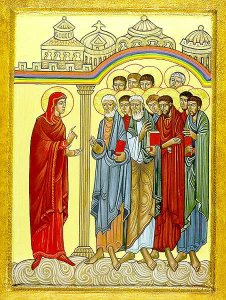
Mary Magdalene Announces

Mary Preaching to the Apostles

As I noted in my sermon, Mary thus fit the criteria for being an apostle: she had been with Jesus through his ministry, and she was the star witness to his resurrection (see Acts 1:21-22). It is not surprising, then, that she has been called “Apostle to the Apostles” in the Western Church, and “Equal to the Apostles” in the East.

However, through much of Church history Mary has been pushed to the margins.

From early on she was ignored. In the New Testament she disappears after the Gospels, and she’s left off the “official apostolic list” of resurrection witnesses in 1 Corinthians 15.

And then she was maligned. As the centuries passed she was identified with the unnamed woman who anointed Jesus’ feet, who, in Luke’s Gospel, is identified only as a “sinner.” In the medieval imagination this morphed into Mary being a prostitute, and a particularly lascivious one at that. Paintings of a later era often show her in a provocative pose even in penitence, taunting the viewer with her brazen sexuality.

None of this, however, is even hinted at in the Gospels. Mary Magdalene is never identified as the woman who anointed Jesus’ feet. She is never described as a “sinner,” let alone as a prostitute or adulteress. She was as I described her above: healed of demon possession, and then a faithful disciple of Jesus, an important person in Jesus’ life and ministry, and a crucial witness to Jesus’ death, burial, and resurrection.

Mary Magdalene, faithful disciple and first witness of the crucified and resurrected Jesus, was first ignored, and then maligned. Mary was shoved to the margins—all because she was a woman.

Yet this was not Jesus’ perspective on women. Of course, Jesus was no modern feminist. He chose twelve men to be his first apostles, after all, a nod to the patriarchy of his ancient Jewish world: the Twelve represent the twelve tribes of Israel, the sons of Jacob, as Jesus is re-making the people of God.

Yet along the way Jesus undermined that patriarchal mindset. He is remembered across the Gospels as sticking a burr under the saddle of patriarchy, a barb here, a bristle there, until the male-dominated world gets mighty uncomfortable. Consider this:

  • Jesus talks to women as equals, not as inferiors—like the Samaritan woman at the well (John 4:1-42).
  • Jesus even accepts a rebuke by a woman, and commends her for it—the Gentile woman from the region of Tyre and Sidon (Matt 15:21-28).
  • Jesus frequently praises women for their faith and piety—the poor widow with her meagre offering (Luke 21:1-4), the bleeding woman who touched his garment in the crowd (Mark 5:25-34), the ten virgins waiting faithfully for the bridegroom to come (Matt 25:1-13), and more.
  • Jesus heals women in ways that show concern for their unique difficulties in society, or that elevate them to places of honour—raising the widow of Nain’s only son so that she would be cared for (Luke 7:11-17), or healing the woman bent double and calling her a “daughter of Abraham” (Luke 13:10-17, the only place that phrase is used in the New Testament).
  • Jesus speaks of women as his “disciples,” his true “mothers” and “sisters” who do God’s will—unusual if not unprecedented for a Rabbi of the day (Matt 12:46-50).
  • Jesus even highlights another Mary, Martha and Lazarus’ sister, as the ideal disciple learning from her Rabbi (Luke 10:38-42).

And when the resurrected Jesus appears, he appears first to the faithful one on the margins, the one whose testimony would be suspect simply because she was a woman: Mary Magdalene. Jesus doesn’t marginalize Mary—he brings her right into the centre of God’s work in the world, first witness to the dawn of a new creation.

How well are we following Jesus in this way? Are we men following Jesus in drawing women into the centre of God’s work in the world, deliberately creating space for women among us to use their gifts and share their voice, allowing them to create this space for themselves, sharing this co-created space as full equals?

And what about others on the margins? What about those who have God-given gifts to share, God-given voices to use, but whom we hold at arm’s length, keeping them on the sidelines, in the shadows?

Jesus looks to the last in the world, the least in society, those who have lost their way. He sees them. He sees their gifts, he hears their voice. He seeks them, he finds them. He draws them in, and lifts them up, and empowers them to use their God-given gifts, to speak with their God-given voice.

May we who claim to follow Jesus do the same.


In a moment of inspiration last week I wrote a poem (it is still National Poetry Month, after all). It’s a poem about Mary Magdalene, Mary on the margins, Mary brought into the centre of God’s work in the world. It is simply called, “With.”

With

I stand among them,
yet not with them.
Their number is fixed:
signs of the heavens,
tribes of the father
—no girls allowed.

I learn among them,
yet not with them.
Hearing good news,
kingdom come
and will be done
—first for the Jew.

I walk among them,
yet not with them.
Preaching good news,
feeding poor mouths,
healing disease
—cast out with the demons.

Where have they gone?
Why have they fled?
The cross before me,
the tomb behind me,
the garden around me:
he is with me
—and I am with him.

© Michael W. Pahl