“Give Up All Your Possessions”: Wrestling with Jesus’ Teaching

Jesus says a lot of hard things. Some are things that are hard to understand. Some are things that are hard to do.

A teaching of Jesus that definitely falls into the latter category is Luke 14:33: “None of you can become my disciple if you do not give up all your possessions.”

Heinrich Hofmann, Christ and the Rich Young Ruler

Most people are familiar with a version of this saying in the context of the Rich Ruler. In that story, narrated in varying ways in Matthew 19:16-22, Mark 10:17-22, and Luke 18:18-23, a rich man comes to Jesus and asks, “What must I do to inherit eternal life?” Jesus tells him to follow the Ten Commandments (and some Christians today are like, “Wrong answer, Jesus”).

The rich ruler responds by saying he’s kept these since his youth, and Jesus doesn’t insist he must be mistaken for no one can fully keep the Law (“Doesn’t Jesus know how to do this?”). Instead, Jesus says the rich man only lacks one thing: “Sell what you own, and give the money to the poor. (“What?!”) Then come, follow me.”

With this version of the saying—“Sell everything you own and give the money to the poor”—we could be forgiven for saying, “Ah, that’s just for the Rich Ruler. Clearly he had a greed problem.” But Luke 14:33 doesn’t let us off the hook like that. This is for all Jesus’ would-be disciples: “None of you can become my disciple if you do not give up all your possessions.”

What do we do with this?

Well, the first thing we should do is to sit with this hard teaching of Jesus, and really wrestle with the possibility that it is calling us to do the very thing it seems it is calling us to do. Even if, in the end, we conclude that Jesus is using hyperbole, or exaggeration for effect (which is very much a Jesus thing to do), we need to sit with the full challenge of this hard teaching.

Yet, having done that, I think there are good reasons for thinking Jesus is using hyperbole here, that not every disciple of Jesus literally has to give up every last one of their possessions.

The first reason is that, just a few chapters later, we see this put into practice. Zacchaeus, that diminutive but wealthy tax collector, determines he wants to be a disciple of Jesus. Yet he doesn’t literally give up every last denarius in his vast collection of denarii. No, but he does give up half of his wealth for the poor, and commit to paying back anyone he’s defrauded four times what he took from them. That’s good enough for Jesus, who resolutely declares, “Today salvation has come to this house” (Luke 19:1-10).

Second, we know of other people in Luke’s double narrative who have wealth and, while being very generous, do not literally give away all of their possessions as Jesus’ disciples. There are the women who support Jesus and the Twelve out of their resources, for instance—this is a continuous reality, which means they didn’t give everything away in one shot (Luke 8:1-3). In Acts also, for example, there’s Lydia, the wealthy businesswoman who sells purple cloth to the upper crust—there’s no indication she gave away all her wealth (Acts 16:13-15). And even in those halcyon days of the early Christian movement, when people shared their possessions with such joy and zeal, Peter makes clear that there was no requirement that the wealthy sell all their property—it was theirs to do with as they wished (Acts 5:4).

This last story can help us come to a solution in our wrestling with Rabbi Jesus’ teaching. In those early chapters of Acts, we’re told that “no one claimed private ownership of any possessions, but everything they owned was held in common” (4:32)—yet clearly, as we’ve just seen, that doesn’t mean everyone was literally required to give up their property. Rather, statements like this—and, I’d suggest, Jesus’ teaching in Luke 14:33—call us to a different perspective on our possessions and property than we’re told in the dominant economic narratives of our day.

Capitalism suggests private property is the cornerstone of economic wellbeing.

Communism insists there should be no private property at all, only collective ownership.

The Jesus way, embodied by Jesus’ early disciples, is different than either of these: we may own possessions and property, but ultimately they aren’t ours alone. Ultimately, they belong to God, and thus they can and should be used for the good of God’s people, and for the good of all.

This way of understanding Luke 14:33, I think, gets to the spirit of Jesus’ teaching. And it remains a hard teaching for us, challenging us always to examine our relationship to our possessions and property, holding them loosely, always open to opening up our hands to give generously to those in need—even if it means selling our possessions and property to do so.

How do we know when Jesus is speaking figuratively?

How do we know when Jesus is speaking figuratively and not literally? Apparently, when he uses violent imagery.

That’s certainly the case on at least two occasions.

First one? “Fire from heaven.”

In Luke 12:49, Jesus says, “I have come to cast fire upon the earth, and how I wish it were already ablaze!” He then goes on to use further violent imagery, that he hasn’t come to bring peace on earth but rather division, splitting households and families.

It’s interesting language—especially because a few chapters earlier James and John were eager to take these words quite literally. Jesus and his disciples entered a Samaritan village, but the people did not welcome them. So they left, shaking the dust off their feet (see Luke 10:10-11). Yet that dust-shaking wasn’t good enough for James and John. “Lord,” they said to Jesus, “do you want us to command fire to come down from heaven and consume them?” But Jesus, in this respect at least, is not like Elijah from of old (2 Kgs 1), and he rebuked them for this (Luke 9:53-55).

In other words: no, the “fire from heaven” language Jesus uses is not to be taken literally.

Second example? “Buy a sword.”

In Luke 22:36, he tells his disciples that “the one who has no sword must sell his cloak and buy one.” This, he says, is so that the Scripture is fulfilled that says he will be counted among the lawless. The disciples take him literally, and they assure him that they have two swords among them already (I’m betting on Simon Peter and Simon the Zealot). Jesus replies—with no commentary on his tone of voice—“It is enough.”

Gérard Douffet,Taking of Christ with the Malchus Episode

But just a few verses later it becomes clear that Jesus was speaking figuratively about swords and their use. Judas leads a crowd to arrest Jesus, and his disciples ask, “Lord, should we strike with the sword?” Without waiting for an answer, one of them—John’s Gospel says it was Peter—strikes a servant of the high priest and slices off his ear. Jesus’ response? “No more of this”—and he heals the man (Luke 22:47-51). Matthew’s Gospel adds the famous saying of Jesus: “For all who take up the sword will die by the sword” (Matt 26:52).

In other words: no, the “buy a sword” language Jesus uses is not to be taken literally.

Twice, then, Jesus has used imagery of violence. And twice his disciples have taken him literally when they should have taken him figuratively.

Of course, figurative language is still describing something real. It’s used for a reason. Jesus’ message does divide families, still today. His words of love which do indeed bring peace can create division among households when those words are rejected. And his call for his disciples to buy a sword both demonstrates the seriousness of the situation before them and foretells the manner of his death—that he would be crucified as a common criminal, alongside convicted brigands.

Jesus’ violent imagery was to be taken seriously. But it was not to be taken literally.

I wonder, does that apply elsewhere?

His words about “plucking out your eye” and “cutting off your hand” if they cause you to sin (Matt 5:29-30)? Yes, our sins of harm against others are serious, so take them seriously. But no, don’t literally gouge out your eye or hack off your hand.

His words about the fires of hell for those who commit the most serious of these sins of harm, especially the rich against the poor and the powerful against the powerless (Matt 5:22; 18:9; 23:33; Luke 16:19-31)? Yes, the consequences of our sins are serious. But no, people are not literally going to burn for their sins.

What about beyond the Gospels? What about, say, the book of Revelation? There’s plenty of violent imagery there, including violence against the enemies of God by the returning Jesus coming from the heavens (Rev 19-20). I believe the same holds true here: while God’s judgment is serious, it’s not going to be a blood bath culminating in a lake of burning sulfur.

Regardless of how far we take this principle, it’s worth pondering: when Jesus uses the imagery of violence, he’s not meaning his disciples to take him literally.

Take Jesus seriously when he talks about fire and swords, oh yes. But don’t take him literally.

What is Paul’s salvation story?

What is Paul’s salvation story?

No, I don’t mean his personal story of meeting Jesus and being called by him—though for Paul that story is part of the larger story I’m referring to. I mean Paul’s cosmic salvation story, his big-picture narrative of salvation, what it is he believes salvation is all about.

This is important to discern, because for many Christians (especially evangelicals) the Apostle Paul is the go-to for understanding salvation, the GOAT for explaining the gospel. This is not an easy story to discern, however, because Paul never simply lays out a salvation narrative—he’s written a bunch of letters, each of which is dealing with specific situations faced by his first readers and himself. Scholars continue to debate whether we can even discern a larger salvation narrative from Paul’s writings, let alone what that story might be.

However, scholars are pretty well united on what that grand story of salvation for Paul is not—and this isn’t good news for the conservative evangelicals who typically narrate salvation in this way.

Paul’s story of salvation is not that the goal of human existence is to get to heaven when we die, avoiding an eternity of conscious torment in punishment for our sins. It’s not that Jesus came to earth solely to save us from this fate and bring us to heaven after death. It’s not that Jesus took our place on the cross, taking the punishment that was due us, as God poured out God’s wrath on Jesus on the cross. It’s not that this “penal substitutionary atonement” is what allows us to go to heaven after death, if we believe that Jesus did this for us.

That’s not Paul’s salvation story.

I mentioned earlier that Paul’s salvation story was a “cosmic” story. I said that Paul’s salvation story isn’t merely about his own salvation, but that his individual story was part of a larger, cosmic story. This is important to note. Paul wouldn’t recognize the common evangelical Christian salvation story I’ve just told, because it’s far too individualistic—about Jesus dying for my sins on the cross, taking my place, so I can be with Jesus in heaven when I die—and not nearly big enough, not cosmic enough.

Here’s how I see Paul’s cosmic salvation story.

Humanity is under the sway of cosmic powers at work in the world, the greatest of which are sin and its inevitable partner-in-destruction, death. What we need is to be liberated from these powers and brought into a new age, an era where sin and death no longer hold sway, where instead we experience righteousness and life, along with the fruits of these: justice and peace and joy and more. For Paul, this is salvation; this is the kingdom of God.

As God’s Messiah, the Christ, Jesus has come from that new age into our world, to bring about God’s reign, God’s salvation. Though sinless—and thus not under the power of sin and death—he entered into our world of sin and death, and in faithfulness to God willingly suffered under sin and death on the cross. However, God raised Jesus from the dead, overturning death and opening the way for humanity to enter into his kingdom, the new age of righteousness and life, justice, peace, and joy. We become part of this new age as we align our faith with Jesus’ faithfulness, walking in his way of the cross through death into new life.

Our individual stories of salvation are thus part of this cosmic story of salvation. Paul’s come-to-Jesus moment was Paul being swept up into this cosmic story. My come-to-Jesus moment was me being swept up into this cosmic story. And that’s true for everyone who has ever aligned their faith with Jesus’ faithfulness, to walk in his way of the cross, his way of love.

And yes, this story does mean that when I die I can expect to be with Jesus, one day being raised from the dead like Jesus was. But it’s not about being saved from hell, but being liberated from sin and death. And the story of salvation is so much bigger than me being with Jesus someday. It’s cosmic in scope—with, one day, all creation even brought into harmony with Jesus’ way of cruciform love.

Something like this story better explains both the totality of Paul’s theology in his letters and the specific statements Paul makes along the way. It better explains the way Paul talks about the cross and Jesus’ death, as well as his statements on sin and death and Jesus’ resurrection. It also explains justification: we share in Jesus’ vindication (his “justification”) by God through his resurrection from the dead.

So don’t be ashamed of Paul’s gospel! It’s God’s saving power for all who believe, after all, liberation from the powers of sin and death coming for all who walk in Jesus’ faithful way of love. And, understood in this way, it complements well the other salvation stories told in the New Testament.


© Michael W. Pahl

Mary, Did You Know?

Domenico Ghirlandaio, Visitazione

Advent always brings us to Mary, the mother of Jesus. As we await Jesus’ birth, we naturally walk with Mary as she awaits Jesus’ birth, as told primarily in Luke’s Gospel. We listen in on the Annunciation, the angel Gabriel’s announcement to Mary of what was to come. We eavesdrop on the Magnificat, as Mary sings to Elizabeth about what God has done through these miraculous events. We journey with Mary and Joseph to Bethlehem, where the long-awaited Christ child will be born.

Advent also brings us to a perennial (and at least mildly annoying) debate over a song about Mary, called “Mary, Did You Know?” Written by Mark Lowry and Buddy Greene in 1991, the song has become a favourite Christmas song for many. I like the song myself, and have sung it for more than one Christmas Eve service. As an expression of wonderment at the birth of the Christ child, it’s a heartstring-puller.

The song repeats the question, “Mary, did you know…?” filling in the ellipsis with a series of claims about Jesus. “That your baby boy will one day walk on water?” “That your baby boy will give sight to a blind man?” “That your baby boy has walked where angels trod? And when you kiss your little baby you’ve kissed the face of God?”

And here’s where the debate comes in. What exactly did Mary know? In a rare show of unity, conservative evangelicals and feminist exvangelicals agree that Mary did know all these things, thank you very much. After all, it’s all right there in Luke’s Gospel—the Annunciation, the Magnificat, the story of Jesus’ birth. And don’t question Mary—she’s had enough mansplaining over the centuries.

As a historically trained biblical scholar and long-time church minister, for me this debate represents an opportunity. It’s a chance for us to peel back the layers of Luke’s Gospel—both the Gospel itself, and its interpretations over the years—and talk about how we get at what it means for us.

And so, I waded into the 2024 “Mary Did You Know Wars” with this post on social media:

[whispers] even if luke’s gospel relied on mary’s recollections, the magnificat is a lukan creation

[looks around] and luke’s theology isn’t the high christology of john

[awkward pause] so mary probably didn’t know

[cough] bright side, luke especially highlights women, including mary

[backs away slowly]

Let me unpack this a little.

Here’s what I imagine is going on with Luke’s infancy narrative. Luke follows prompts from Jesus’ first biography, Mark, in telling the story of Jesus in parallel to and in contrast with stories of Roman emperors and the like. It’s a messianic Christology by comparison and contrast, if you will. This includes Luke’s infancy narrative, which has exactly these kinds of parallels and contrasts of miraculous conceptions, divine signs at birth, and so on, in birth stories of Roman emperors. For Luke, these highlight the significance of Jesus: he is the world’s true Saviour and Lord, though he is these things in a very different way than the world’s emperors and kings.

Now, I happen to think it’s likely Luke had some reminisces of Mary at hand when he crafted his narrative. I don’t know exactly what those might have been, but I think the historical Mary may well have believed something special, something out of the ordinary, had happened with Jesus’ conception and birth. Regardless, Luke has taken that kernel and, following the practices of ancient historians, wrapped it in some solid mythos (a royal or imperial mythos, couched in language and style familiar to readers of the Jewish Scriptures awaiting a Davidic messiah). And all of this is to achieve his purpose as a biographer of Jesus of Nazareth: to highlight the significance of Jesus for the reader, again, that Jesus is the world’s true Saviour and Lord—a Saviour and Lord for the whole world, not just the Jewish people.

There’s a distinction, then, it seems to me, between “what Mary thought about who Jesus was” and “who Jesus was”—the same distinction we can (in fact, must) make between “what Jesus himself thought about who he was” and “who he was.” These do not need to be the same thing (I believe it was Roman Catholic scholar Raymond Brown who helpfully noted this). We don’t need the historical Jesus, let alone the historical Mary, to have viewed Jesus as God the Son, “truly God and truly man,” “true God from true God, begotten, not made; of the same essence as the Father,” for those things to be true about him.

So, no, the Lukan Mary didn’t know, and the historical Mary probably didn’t know, the high Christology of the much-loved and oft-despised song, “Mary, Did You Know?”

Luke’s Mary knew that Jesus would be the promised Messiah, that is, “the Son of God,” bringing in God’s reign of justice and peace on earth, but she (that is, her narrator, Luke) would not have understood this to mean “God through whom all things were created, come in the flesh as a human being.”

And since our earliest interpretations of Jesus (Paul, Mark, Matthew, Luke) adopt this “high royal messianic Christology” but not a “high incarnational Christology” (like that of John, expanded in the later creeds) it seems unlikely the historical Mary knew anything more than the messianic Christology of Luke at most, and possibly no more than that her son, Jesus, was in some way special, and specially called by God.

Yet none of this prevents us from agreeing with Luke, and later John, and still later the Nicene and Chalcedonian creeds, as to exactly how it is that Jesus is “in some way special, and specially called by God.” He is indeed the Messiah, the Son of God, the world’s true Saviour and Lord, as well as God the Son come in the flesh as a human being, and so true God and true man, embodying both God in perfect reflection of the divine and humanity in perfect fulfillment of our promise as those created in God’s image.

Leonardo Da Vinci, Annunciazione


© Michael W. Pahl

Seven Miles to Emmaus

Caravaggio, Supper at Emmaus

It was a great question. “What do you think of Emmaus in the story?”

This was Jarrod McKenna, asking the question of me on the InVerse podcast he hosts with Drew Hart. We were doing some creative reflection on Luke’s road to Emmaus story in Luke 24.

“I haven’t thought much about the significance of Emmaus itself,” I said, “but I’d be tempted to draw some significance from Emmaus being seven miles from Jerusalem. You know, seven being the number of divine completion or perfection. The two disciples are on a journey toward complete understanding of Jesus, accompanied by the risen Jesus himself.”

Or something like that, is what I said. A wonderful creative reflection, maybe even a brilliant insight.

And completely, utterly wrong.

You don’t need a PhD in New Testament (as I have) to know that the NRSV’s “about seven miles” is a translation of a phrase that is literally “sixty stadia,” an ancient distance which the NRSV has converted to “about seven miles.” All you have to do is look at the NRSV’s note in the margin, and it will tell you.

So lesson one from this story of me on a podcast: “Don’t make a brilliant creative insight about some fine point in the text based on an English version of the Bible.” (And, I suppose, part two of lesson one: especially don’t do this on a podcast that is potentially listened to by thousands of people.)

But there’s another lesson in this story of me on a podcast, and you get a hint of it in that same marginal note in the NRSV. The NRSV Updated Edition has this note on its phrase, “about seven miles,” in Luke 24:13: “Gk sixty stadia; other ancient authorities read a hundred sixty stadia.”

This note is worth exploring, because it points to several challenges with any kind of a simple reading of this verse.

One challenge is that no one can say for sure how long “sixty stadia” was. A stadion was a Greek unit of measurement 600 feet long. But that’s ancient Greek feet, not our modern unit of measurement called the foot, and the length of that ancient foot varied throughout the Hellenized world of the day. Best guess? A single stadion was between 150 and 200 metres. Sixty stadia, then? Somewhere between 9 and 12 kilometres—or “about seven miles.”

But you’ll notice in the marginal note that “other ancient authorities read a hundred sixty stadia.” What’s going on there?

Well, this highlights the simple fact that we don’t have the original copies of our biblical writings. We don’t have The One document first written by the author or authorized by them for publication, for any of the biblical writings. What we have are copies of copies of copies of these original manuscripts. And as those copies were made, changes were introduced into the text. There are thousands of these variants, as they’re known, and most of them are like this one—relatively insignificant, at least in terms of conveying the gist of the passage.

But still profoundly interesting, nonetheless. This particular variant could have been a simple accident: the scribe thought he heard “a hundred sixty” and so wrote that in. But it could also have been because there is a location for Emmaus that makes better sense, and this one happens to be a hundred sixty stadia from Jerusalem.

Because this is another challenge with this verse: we don’t know for sure where this Emmaus was. There are some options which are 60 stadia or “about seven miles” from Jerusalem, but, interestingly, the most common option historically is more like 160 stadia from Jerusalem, called Emmaus Nicopolis. So, it’s at least possible that a later scribe “corrected” the manuscript he was working on, changing it from “sixty stadia” to “a hundred sixty stadia” because he “knew” that Emmaus was in fact 160 stadia from Jerusalem.

But this gets even more interesting, because there is in fact a variant in another ancient manuscript that writes this as “seven stadia.” Here we are, back to my ingenious speculation about the significance of the number seven. What’s going on now?

Well, 60 stadia is not only roughly seven modern miles. It’s also roughly seven ancient Roman miles. It’s possible, then, perhaps even likely, that you had a scribe who tried to convert the “sixty stadia” to Roman miles, but forgot to change the unit of measurement in the conversion and so came up with “seven stadia.”

What’s the second lesson in all this? If the first lesson is, “Don’t make a brilliant creative insight about some fine point in the text based on an English version of the Bible,” the second is like it: “Don’t make a brilliant creative insight about some fine point in the text without first checking for textual variants.”

After all, you might find an ancient scribal error that supports your original brilliant insight—and still be wrong.


© Michael W. Pahl

“God is on the throne.” What does this even mean?

“God is on the throne.”

The saying gets pulled out any time something happens that isn’t to our liking. A roadblock in a relationship. A cancer diagnosis. An unwanted election result.

“Don’t worry. God is still on the throne.”

It’s well-meaning, intended to bring comfort when hard things happen. It’s equivalent to “God is sovereign.” Or more directly: “God is in control.”

“God is in control.” That’s getting to the heart of what most people seem to mean when they say, “God is on the throne” or “God is sovereign.” All these are intended to suggest that God controls the circumstances in our lives, that things only happen because God decrees that they happen, or at least that God allows them to happen.

There are certainly texts in the Bible that suggest this way of thinking about God. Psalms that lyrically portray fire and hail, snow and ice arriving at God’s very command (Psa 148:8). Proverbs that sagely profess that every decision derived from casting lots (like throwing a dice) is from God (Prov 16:33). Prophets that poetically proclaim words of God like this:

I am the Lord, and there is no other.
I form light and create darkness,
I make weal and create woe;
I the Lord do all these things. (Isa 45:6-7)

But it doesn’t take much reflection to problematize this view of God. What kind of loving God is it who allows or even decrees evil things to happen, especially to good people? Or, another angle on this problem: how can we reconcile this evil-decreeing or evil-allowing God with other passages of Scripture, like the statement that it is “the thief” who comes “to steal and kill and destroy,” not God, whose Son brings “life, and life abundantly” (John 10:10)?

Or, perhaps most to the point: if “God is love” (1 John 4:8, 16), how can this God be party to any harm against others, which is the antithesis of love (Rom 13:10)?

It seems some choices need to be made as to which biblical texts we start and end with, which ones will control our interpretation of other texts. And as I do this, I can’t help but conclude that God is not in control of all things.

For this, I look primarily to none other than Jesus, and the prayer he taught his disciples. If we are to pray, “Your will be done on earth as it is in heaven” (Matt 6:10), this presumes that at present God’s will is not being done on earth, at least not fully. No, God is not in control of all things, and no, God is not the author of evil, or even its passive partner. God is, indeed, love.

So let’s go back to “God is on the throne.” This is a metaphor—“God is sovereign” is another version of the metaphor. And the metaphor is this: God is comparable to a king or queen, ruling over their realm from their throne.

Makes sense. The basic metaphor is not hard to grasp.

But here’s the thing—there is no king or queen who, in their sovereign rule, controls all the things that happen in their realm. That’s not the point of declaring their sovereignty. It’s not the point of saying, “The king (or queen) is on the throne.”

Rather, the point is this: because the monarch is on the throne, because they are sovereign in their realm, all within their realm owe their allegiance to them. Those under their sovereignty are not controlled by them. Rather, they owe their fealty to them, and are called upon to obey their will.

“God is on the throne,” then, is not equivalent to “God is in control.” Instead, it’s more like “God is in charge.”

Yes, “God is on the throne.” Yes, “God is sovereign.” But this doesn’t mean God controls everything that happens, or even that God allows all things to happen, and especially not all this world’s death and destruction, degradation and devastation.

Rather, to claim that “God is on the throne” or “God is sovereign” means that God calls us to allegiance to God and God’s ways, which is allegiance to Jesus as God’s Messiah and Jesus’ way of love (Matt 28:18-20). Which means that God calls us to resist the reign of sin and death and evil and injustice as it is in the world, to instead “seek first God’s reign and God’s justice” (Matt 6:33), praying, longing, working for “God’s reign to come, God’s will to be done, on earth as it is in heaven” (Matt 6:10).

Is God present with us in all things, even poverty and sickness and death, even injustice and evil? Absolutely (Heb 13:5-6).

Does God work through all things, even suffering and sin, to bring about God’s good purposes? Most definitely (Rom 8:28-30).

These are tremendous promises of God, growing out of the goodness of the God who is love. But God does not control all things, for God neither decrees nor allows evil to happen. Rather, God calls us to allegiance to God as revealed in Jesus and his way of love, resisting the forces of sin and death, evil and injustice.

And it is when we walk in this way of faith and hope and love that we can have the full assurance of God’s faithful presence always with us and God’s good purposes ultimately worked out for us.


© Michael W. Pahl

The One Where Michael Shows Some Empathy for Donald Trump

It’s no secret that I’m not a fan of Donald Trump.

In numerous social media posts, I’ve tried to tell it like it is with Trump. I’ve called out his misogyny and racism and pathological lying from the beginning. I’ve red-flagged the wave of Christian nationalism he’s riding on. I’ve spoken of his lies fueling “xenophobic and racist bigots” in their threat of violence. I’ve used humour to mock Trump’s sad triumphalist tendencies and the irreverence of his Christian supporters. I’ve questioned the legitimacy of the claim that Trump is a “person of faith.” As recently as two weeks ago, I laid this criticism on him: “Trump is overtly racist and misogynist and ableist. His policies benefit the wealthy at the expense of the middle class and the poor.”
No, it’s no secret that I’m not a fan of Donald Trump.

Or maybe it is a secret, because when I posted the following call to my Christian siblings on one social media platform recently, people mistook me for a MAGA Trump supporter:

Christians, please tell me we’re not mocking an 80-year old man for nearly stumbling getting into a truck. There’s much to critique, even to critique using humour, but this isn’t it.

Now, in case you missed it, in that post I’m referring to Trump’s stumble at the door of a garbage truck at a staged event in response to Joe Biden’s (apparent) reference to Trump’s supporters as “garbage.” Trump looked every bit of his 78 years as he tottered uneasily by the truck.

As dozens of comments piled up, with people apparently missing the “much to critique” sentence of my post, I added this to the mix:

The comments on this are wild! Assumptions about my political leanings, generalizations about Christians, none of which apply to me. And more mocking of Trump for his age and his appearance. Trump is a fascist, a rapist, a racist, and a pathological liar. Let’s focus on the content of his character and the things he says he’ll do as president.

But it seems this still wasn’t clear enough. People continued their confirmation bias, assuming me to be an evangelical Christian MAGA Trump supporter simply because I showed a sliver of empathy for a nearly 80-year old man. The comments on the post are now into the hundreds, with a high percentage of them along these lines.

That’s not what I’ve found most concerning in the comments, however.

It’s no secret also that I lean left in economic and social policy. For me this grows out of my deeply held Christian convictions, a Jesus-centred Anabaptism that grounds itself primarily in Jesus’ teaching and way of life as presented in the Gospels. Now, I know that most people who lean left politically are not Christian, so I don’t assume they share my Christian values. But I did kind of assume that people who advocate for economic and social justice would have some empathy to tap into, even related to Donald Trump.

Well, you know what they say about “Don’t assume.”

Yep, you guessed it. The now-hundreds of comments on my social media post, mostly by anti-Trump folks who seem to lean left, are mostly a blend of “eye for an eye” and “hate your enemy” and “show no mercy.” Some of them even literally quote “eye for an eye” as if it is a Christian saying (it’s not). In other words, most of these left-leaning folks can muster no empathy for Donald Trump; indeed, they’ve intentionally blocked off any empathy, some dehumanizing him to the point of calling him things like “evil incarnate.”

Now, I get it. Donald Trump is not any random 80-year old man (yes, commenters, I know he’s 78—I’m doing a thing called “rounding up”). He currently wields immense power. And this is exactly why his misogyny, racism, ableism, and economically and socially violent policies need to be resisted, even through mockery if need be.

And I get that Trump’s health is of national concern if he’s going to be president of the United States. If he can’t do the job, that’s a big deal for those who care about such things.

But none of this justifies mocking him for his age, for his appearance, for his physical ability. If we stoop to that, we’re on the road to becoming Trumpist ourselves.

But we’re still not to the thing I’ve found most concerning about the comments on my social media post.

No, what I’ve found most concerning is that some of the people mocking Trump in this way, even using dehumanizing language of Trump, describe themselves as Christians.

My siblings in Christ, this should not be. And trust me, I’ve been way more horrified at the ways Trump and some of his supporters have mocked people for their age, their appearance, or their physical ability.

It doesn’t matter who it is—this should not be. It doesn’t matter what they’ve done—this should not be.

As Christians we are called to love our neighbours as if their needs were our own needs. And Jesus expands “neighbours” to mean strangers who are not like us, even enemies who oppose us and the very things we value. We are to love our enemies, blessing them, praying for them. Resisting them in their evil and injustice, yes, but doing so in a way that overcomes evil with good. After all, our struggle is against evil spiritual forces like misogyny and racism and homophobia and militarism and economic disparity, not against flesh and blood humans.

And yes, this even means humans like Donald J. Trump.


© Michael W. Pahl

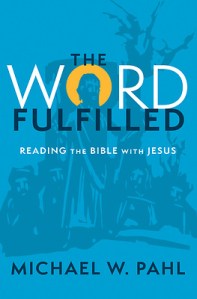
The Word Fulfilled: Reading the Bible with Jesus

How did Jesus read his Bible, and what does that mean for how we should read ours?

That’s the basic question behind The Word Fulfilled: Reading the Bible with Jesus, my latest book and my first in thirteen years. It builds on a simple idea: as Christians we are followers of Jesus, learning from his teachings and his way of life—and this should include his way of reading Scripture.

Now, anyone who knows even a little about early Judaism (Jesus’ Jewish context) will know that Jesus didn’t have a “Bible,” at least not like we do. For one thing, Jesus’ Scriptures were not the Christian Old and New Testaments, but rather the Jewish Tanakh: the Law of Moses, the Prophets, and the Writings (including the Psalms). For another, there was no book that collected all these writings of Scripture together. That kind of “Bible” was many centuries away.

I explore all this in The Word Fulfilled, along with some implications of this for how we think about our Bible as Christians. Then, I look at seven particular passages from the Jewish Scriptures which Jesus highlights in the Gospel accounts, exploring how Jesus read them. As part of this I also describe broader trends in how Jesus in the Gospels (and the New Testament as a whole) uses Scripture: his favourite biblical books, his posture in reading Scripture generally, and so on. All this has significant implications for how we should read the Bible today.

The book is written in a conversational style. I’ve deliberately avoided excessive notes. To make up for this (since it is important to “show your work”), I’ve included a “Digging Deeper” section at the end of the book which explores the historical and cultural context of Jesus and the Gospels. There’s also a study guide for those who might want to use the book for small group discussions.

This conversational style also includes what is perhaps the most distinctive feature of the book. Each of the core chapters (focusing on the seven scriptural passages) includes a vignette, a fictional story of Jesus growing up in his context, engaging with his Scriptures. These were fun to write, and they’ve been well-received when I’ve used them in preaching and teaching settings. I hope every reader enjoys these pieces of “Gospels fan faction” as much as I enjoyed writing them!

A Jesus-Centred Christianity

We’re hearing more about “Jesus-centred Christianity.” At least, I am. And I’m realizing that there are some very different understandings out there of what this means. How do I understand this? And what difference does this make?

James Tissot, The Sermon of the Beatitudes

It needs to be said up front that all Christianity is in some way “Jesus-centred.” It’s in the name, after all: “Christianity,” those who believe in Jesus, whom we hold to be the “Christ” or Messiah anticipated in the Psalms and the Prophets. Every stream of Christianity in one way or another grounds its faith and life in Jesus.

So, what I’m describing as Jesus-centred Christianity shouldn’t be taken to mean that other forms of Christianity are not in some way centred on or grounded in Jesus. They are. Rather, what I’m describing is a particular way in which Christian faith and life is centred on Jesus.

First, Jesus-centred Christianity is centred on the person and ministry of Jesus of Nazareth, primarily (but not exclusively) as presented to us in the four Gospels. Some versions of Christianity focus on Jesus’ death in a way that can feel like Jesus’ life and teaching is irrelevant. Others focus on Jesus’ teachings in a way that can feel like they are divorced from his life and death. What I’m talking about is a holistic view of Jesus: his birth, baptism, teachings, actions, suffering, death, resurrection, and promise of his return.

Second, this kind of centring on Jesus leads to some characteristic beliefs and practices. Discipleship, or intentionally learning from Jesus as presented to us in the Gospels. Being prompted and empowered by the Spirit. Shared meals, including the Lord’s Supper. Free healing. Nonviolent peacemaking. Generous simplicity. Gentle compassion. Persistent prayer. Merciful forgiveness. Humble faith. Suffering in solidarity with the powerless. Bringing resurrection life to the world. And above all, love—loving God pre-eminently by loving others as if their needs were our own.

Third, the kind of Jesus-centred Christianity I’m talking about means being radically centred on Jesus. It means not letting anything else draw attention away from this focus on Jesus. There are diverse beliefs and practices that can support this Jesus focus—a robust Trinitarian theology, for instance, or a particular way of baptizing or doing the Lord’s Supper or organizing as a church—but this approach doesn’t allow any other beliefs or practices or people or ideas to move into the centre with Jesus. It’s about a radical allegiance to Jesus and his way of being, his way of life, his way of love.

So what difference does this make? Why choose this kind of Jesus-centred Christianity over other versions of Christianity?

One key reason is the unifying power of a Jesus-centred Christianity. Often accompanying the language of “Jesus-centred Christianity” is an understanding of what’s called “centred-set” Christianity versus “bounded-set.” This language comes from mathematics via missionary anthropologist Paul Hiebert, and it’s been articulated well for Christianity and the church by scholars such as Mark Baker.

The idea is this: rather than focusing on defining and guarding the boundaries of Christianity, who’s in and who’s out—a “bounded-set” Christianity—we should focus on what draws us together toward the centre, with boundaries being irrelevant—a “centred-set” Christianity. Jesus-centred Christianity holds that Jesus, as described above, is what is at the centre, drawing us in. The result is a way of being Christian that allows for tremendous diversity in belief and practice while still recognizing a unifying, gravitational force at the centre.

Yet this Jesus-centred Christianity is not free of disagreement and dispute. There are many important and difficult questions still open for discernment. The advantage of a Jesus-centred approach, however, is that it helps us to focus the questions and narrow the possible answers. It keeps us from being distracted by the variety of ways Scripture or our culture addresses these questions—we are always forced to ask, “But what about Jesus?” and “What does a Jesus-way of approaching this look like?” And we are more likely to be able to discern together in a way that is characterized and defined by love. This is not merely theoretical—I’ve seen this difference in action.

But the primary reason for myself and many others for holding to a Jesus-centred Christianity as I’ve described it is simply that it makes the best sense to us of what authentic Christian faith and life should be. It’s what we see in the beliefs and practices of the earliest Christians as found in the New Testament—and for the first few centuries of the church, and throughout church history along the margins of Christendom. Any time there has been a revival or reformation in Christian history, it has included something more or less approximating the kind of Jesus-centred Christianity I’ve described above. That should be instructive for us.

I don’t particularly care which denomination a Christian is identified with, though I do think some denominations are more compatible with a Jesus-centred Christianity than others (cough Mennonites cough). But I do pray that we as Christians, regardless of our denomination, can re-claim a Jesus-centred Christianity that confesses with the early church: Jesus—the Christ from Nazareth who taught love, lived love, suffered and died and rose again in love—is Lord.


© Michael W. Pahl

On Abortion and Human Personhood

Human embryo at 7 weeks

Growing up evangelical, I was taught that human fetuses (even embryos) are full human persons, and therefore abortion is the same as killing any other human: in rare cases justified, but most often murder.

When this is your frame of reference, nothing else really matters.

What is the plight of single parents raising children in poverty (or any other similarly tragic circumstance) compared to the murder of thousands upon thousands of human persons through abortion? It is most urgent that we stop this mass murder.

And who cares if we elect a godless and immoral president who enriches the rich and impoverishes the poor as long as he puts conservative judges on the supreme court to overturn Roe v. Wade? We’re talking about mass murder!

Within that frame of reference, this logic is pretty unassailable.

The basic premise of this view is that an unborn baby is a human life, or, as I’ve put it, “human fetuses are full human persons.” There are two ironies to this:

Irony #1: Evangelicals before the 1970s didn’t all agree on this.

Irony #2: This premise is, at best, biblically questionable.

Yes, the Bible a few times speaks of God “knowing” or “forming” someone in the womb. Psalm 139 is a beautiful, life-affirming passage. Jeremiah 1 and Galatians 1 are powerful, call-affirming passages. But in each instance this is a particular person who has grown up to be known by God, not a generic statement about God’s intimate relationship with every fetus. It says nothing about the fetus’ “human personhood.”

According to the Torah a fetus is not legally a full human person. Exodus 21:22-25 speaks of harm to an unborn child as harm to the pregnant woman, not harm to the child as person. It is thus worthy of a fine but not worthy of “life for life” retribution. The Jewish view—arising from this and other passages—is that a fetus is not a “soul” until birth.

The New Testament says nothing directly on the question of the personhood of a fetus. Jesus, in particular, says nothing on this.

All this to say, there are good reasons why Christians historically haven’t agreed on this most basic question of when full human personhood (the “soul”) develops. If there is a predominant Christian view historically, it is that the soul emerges  at the “quickening,” the first discernible fetal movements (that is, around 16-20 weeks).

Which means evangelicals have built a decades-long culture war and political agenda on a dubious foundation, the idea that all human fetuses (even embryos) are full human persons. The collateral damage of this dubiously founded war has been immeasurable.

Now, there are still very good Christian reasons for wanting to reduce abortions. It is a form of violence, as my denomination’s Confession of Faith puts it in its only reference to abortion.

Surgical abortion can be terribly traumatic for women. (Which puts the lie to the notion that most women who get such abortions are doing so casually.) Also, I suspect most people would join me in thinking of late-term fetuses as “unborn children,” and thus abortions at that stage as violence against human persons. (And yes, I recognize that late-term abortions are extremely rare, and really only happen when the life of the mother is at risk, and so no, I don’t have any desire to legislate what is a difficult medical and moral decision best decided between the pregnant person and their doctor.)

So, yes, I’m all for reducing abortions. But let’s reduce abortions by the one way which has actually been proven to work: reducing poverty, increasing educational opportunities and social supports, and providing good and comprehensive health care—including access to safe abortions.

P.S. None of this should be taken to imply that people who grieve the loss of an unborn child shouldn’t do so. When a person is carrying a child that is wanted and loved, it is a child they are carrying, not merely a fetus. May God’s peace be with you.

[Note: This has been lightly edited since originally being posted, to reflect a correction given by a family member who is a medical doctor.]


© Michael W. Pahl