Faith Alone, by Grace Alone, by God’s Spirit Alone

Modified from a sermon preached on May 18, 2025, based on Acts 15:1-21.


The Dispute

There are few events in the life of the early church more momentous than the Jerusalem Council of Acts 15. If this council in Jerusalem hadn’t occurred, or if it had ended differently, it’s possible none of us non-Jewish Christians would be Christian.

To appreciate the importance of this Jerusalem Council, we need to understand the dispute that prompted it.

We’re often told that what prompted the Council were Jews saying we’re saved by our good works—and Paul’s response, then, is that we are saved by faith, not by works. But this wasn’t the issue the Jerusalem Council was wrestling with.

You see, Jews in that day didn’t believe they were saved by their good works.

They were taught from childhood that God had chosen the people of Israel entirely on the basis of his mercy, not because they were especially holy or mighty. They were taught that God had delivered the people of Israel from bondage in Egypt entirely by God’s grace, bringing them to Mount Sinai and blessing them with the covenant and the Law.

Jews didn’t believe they were saved by their good works. Their entire story told otherwise. They were, rather, saved by God to do good works—pretty much what Paul himself as a Jew teaches.

So what was going on in Acts, then? What was it that got some of the Jewish Christians so hot and bothered?

Simply this: some Jewish Christians believed that the Gentiles who were coming to faith in Jesus needed to become Jews. They believed Gentiles, non-Jews, needed to convert to Judaism in order to participate in the saved people of God. And the sign of that conversion? Male circumcision.

This had nothing to do with Jews proclaiming some kind of works-righteousness. It had everything to do with some Jewish Christians trying to be faithful to their Scriptures.

Because that is what the Jewish Scriptures—our Old Testament—sure seemed to teach: that Israel was God’s chosen, saved people, and that Gentiles were welcome to be chosen and saved as well—they just needed to become Jewish.

In fact, there was an expectation that one day this would happen. The Prophet Isaiah, for example, anticipated this:

In days to come
the mountain of the Lord’s house
shall be established as the highest of the mountains
and shall be raised above the hills;
all the Gentiles shall stream to it.
Many peoples shall come and say,
“Come, let us go up to the mountain of the Lord,
to the house of the God of Jacob,
that he may teach us his ways
and that we may walk in his paths.”
For out of Zion shall go forth instruction
and the word of the Lord from Jerusalem. (Isa 2:2-3)

Gentiles were expected to come to God in the days of the Messiah—but it was expected that they would become Jews, taking on the yoke of the Torah, entering into God’s covenant with Israel.

Gerbrand van den Eeckhout, Vision of Cornelius the Centurion

This was the dispute, then, in the early Church; not so much, “How are we saved?” as, “Who are the true people of God?” Is God the God of the Jews only, and are the Jews the only people of God? Or is God the God of Gentiles as well, and can Gentiles be part of God’s people as Gentiles, without having to become Jews?

So now you can see why I say that, without the Jerusalem Council of Acts 15, or if the Jerusalem Council had gone differently, non-Jewish Christians wouldn’t be here. There would be no Gentiles in the Jesus movement—and thus no Mennonites.

The Council

But before we get to the Council’s final resolution, let’s highlight two things from the Council itself.

First, note the way the church handled this dispute.

They didn’t ignore the dispute, pretending it didn’t exist, letting it simmer on the back burner until it boiled over and burned everyone. They didn’t passive aggressively interact with each other, pretending nice but still getting their jabs in (nonviolently, of course). They didn’t simply go with the majority (keep in mind, all of them at the Council were Jewish—the Gentiles were the vulnerable minority).

No, they faced up to the dispute. They arranged a way for all points of view to be represented. They came together, face to face, to talk it through. They owned their own opinions, not hiding behind anonymity. And they were honest with each other—the text says there was “much debate” (15:7). And through it all, as far as we know, they were gracious to each other.

Much for us to learn here.

Second, note what it was that persuaded the Council.

It wasn’t the Bible. Their Bible, if anything, was against the inclusion of the Gentiles as Gentiles. As I’ve already noted, the Old Testament Scriptures did expect that non-Jews would come to God, but that they would come to God by becoming Jews.

There was a category of “righteous Gentile”—non-Jews who worshiped God and rejected idolatry, who prayed regularly, who gave generously to the poor, who were good to the Jewish people. But if these righteous Gentiles wanted to be part of the saved people of God, they needed to become Jews.

No, the Bible wasn’t what persuaded the Council. It wasn’t until after the decision was discerned that James turned back to the Scriptures and read them differently, seeing in them God’s desire for Gentile salvation.

No, what persuaded the Council were stories—people’s stories of their experiences with Gentiles, stories of the undeniable work of the Spirit in the lives of Gentiles—without them having become Jews first.

Hear again the words of Peter at the Council:

After there had been much debate, Peter stood up and said to them, “My brothers, you know that in the early days God made a choice among you, that I should be the one through whom the gentiles would hear the message of the good news and become believers.

“And God, who knows the human heart, testified to them by giving them the Holy Spirit, just as he did to us, and in cleansing their hearts by faith he has made no distinction between them and us.

“Now, therefore, why are you putting God to the test by placing on the neck of the disciples a yoke that neither our ancestors nor we have been able to bear? On the contrary, we believe that we will be saved through the grace of the Lord Jesus, just as they will.” (Acts 15:7-11)

Peter’s point? These stories of Gentiles coming to faith show that we’re saved by faith alone, by God’s grace alone, entirely by the work of the Spirit—adding anything else to the mix is adding something beyond what God desires or requires.

The Resolution

And so the Council came to this resolution.

Participation in the saved people of God is not on the basis of particular ancestry or religious expression.

Rather, participation in the saved people of God is entirely through faith alone, by God’s grace alone—a work of the Spirit of God.

This resolution needs some pondering. We need to pause and reflect on it for us today.

Participation in the saved people of God is not on the basis of particular ancestry or religious expression. Let’s be honest: we Mennonites have not been very good at following this.

We play the “Mennonite game,” looking for family connections or school connections between us, unconsciously emphasizing that “Mennonite” means a certain pedigree, and anything else is “not really Mennonite” or “second-class Mennonite.”

We think that our way of worshiping—of singing, of baptizing, of praying, of communion—is the way to worship, and anything else is less than ideal.

I can probably think of a dozen ways like this in which we as Mennonites have subtly emphasized that participation in the saved people of God is on the basis of particular ancestry or religious expression.

But Acts 15—and really the whole New Testament—is clear. Participation in the saved people of God is not on the basis of particular ancestry or religious expression. Rather, participation in the saved people of God is entirely through faith, by God’s grace, a work of the Spirit of God. We still have some work to do in this.

But there’s more. The Apostle Paul, in his letters, expands this beyond simply ancestry and religious expression. There’s Galatians 3:28, for example, where Paul says: “There is no longer Jew or Greek; there is no longer slave or free; there is no longer male and female, for all of you are one in Christ Jesus.”

Here Paul emphasizes the Jew-Gentile question: particular ancestry and religious expression has nothing to do with one’s participation in the saved people of God.

But Paul also emphasizes two other social distinctions: slave-free, and male-female. So we can expand our statement:

Participation in the saved people of God is not on the basis of particular ancestry, religious expression, social status, or gender.

Rather, participation in the saved people of God is entirely through faith alone, by God’s grace alone—a work of the Spirit of God.

People of every social status are welcome to be part of God’s people, just as they are. People of every gender are welcome to be part of God’s people, just as they are. They can be full participants in the church, in all of its dimensions.

But Paul’s expansion of this raises question for us. How else should this be expanded? What other social distinctions do we make that are ultimately irrelevant in Christ? How else have we cut off people from participation in God’s people simply on the basis of factors they have no control over? Race, age, sexual orientation?

Participation in the saved people of God is entirely a work of the Spirit of God. It’s entirely about a person’s faith in Christ, by the grace of God, prompted by the presence of the Spirit. Entirely. Adding anything else to the mix, any other requirement to participate fully among God’s people, is making a different gospel which is no gospel at all, to use Paul’s words in Galatians 1.

So, my friends, there is much for us to ponder from Acts 15.

There’s much for us to ponder in how we process difficult questions and have hard conversations. Creating safe spaces for all voices. Taking time to hear all voices. Owning our opinions, not hiding behind anonymity. Paying special attention to the vulnerable minority among us. Dealing with all this graciously.

There’s much for us to ponder in how we discern God’s will. It’s not a matter of simply quoting Bible verses at each other. The Bible is crucial to our discernment, yes, but this story teaches us that our experience can disrupt what we think the Bible means, making us read the Bible differently. We need to pay attention to our experience of God, people’s stories of God’s work in their lives.

And there’s much for us to ponder in how we determine who can fully participate in the church. If we are adding anything to the simple call for personal faith in Christ, by the grace of God, prompted by the presence of God’s Spirit in the person’s life, then we are building roadblocks that God calls us to tear down.

May God’s Spirit teach us in these things, and may we have humble hearts to learn God’s ever-expanding ways of love and grace. Amen.


© Michael W. Pahl

Paul’s “Marxism”

In this coming Sunday’s Epistle reading (2 Cor 5:7-15), we see Paul at his most “communist”:

“Now finish doing [the collection of money for the needy in Jerusalem], so that your eagerness may be matched by completing it according to your means. For if the eagerness is there, the gift is acceptable according to what one has—not according to what one does not have. I do not mean that there should be relief for others and pressure on you, but it is a question of a fair balance between your present abundance and their need, so that their abundance may be for your need, in order that there may be a fair balance. As it is written,

‘The one who had much did not have too much,
and the one who had little did not have too little.’”

Not exactly Marx: this is from “each according to their means” to each according to their needs. Yet the goals are similar: that no one should “have too much” and that no one should “have too little.”

These principles were not unique to Paul. They were seen in the earliest church as reflected in the early stories of Acts. “They would sell their possessions and goods and distribute the proceeds to all, as any had need” (Acts 2:45). “There was not a needy person among them, for as many as owned lands or houses sold them and brought the proceeds of what was sold. They laid it at the apostles’ feet, and it was distributed to each as any had need” (Acts 4:34-35).

James Tissot, The Miracle of the Loaves and Fishes

And the earliest Christians were simply following the example of Jesus, the Messiah who led a band of followers funded by women of means, who taught his followers to give generously in answer to prayer for “our (collective) daily bread,” and who distributed food freely and equitably to the needy (Luke 8:1-3; 6:30-38; 11:1-4; 9:10-17).

All this is a far cry from our day. In January 2019 Oxfam reported that the world’s 26 richest people had as much wealth as the poorest 50% (3.8 billion people). All reports during the pandemic indicate that the rich have only gotten richer while the poor have stayed the same or gotten poorer.

Is the church any better? When adjusted for scale (there are few billionaires in the church of any denomination) it’s hard to say we are. The wealthier among us often hold disproportionate power and influence. We who have comforts really, really like them, while those without might get a Facebook post from us or a few cans for the food bank or maybe a march to the Legislature.

This is not to burden any of us individually with the pressure of dealing with systemic poverty—systemic issues require systemic change. But are there things we can do individually, as families, even more as congregations, as MCM and MC Canada, to help us as a society take constructive steps toward real and lasting economic justice?

This is not Marxism—it is walking in the way of Jesus, who walked in the way of Moses and the Prophets.

The Not-So-Nice, Not-So-Safe Spirit of God

We have walked with the resurrected Jesus to his ascension and exaltation, and now this coming Sunday we are at Pentecost. Naturally, then, our lectionary texts for this Sunday are filled with references to the Spirit.

Mennonites haven’t been entirely sure what to do with Pentecost, I’d say. To be honest, we haven’t always been sure what to do with the Spirit. Yes, we have developed our nice, safe ways of interpreting the Pentecost coming of the Spirit, mostly around things like “God’s presence is with us” and a lot of stuff about “communal discernment” as the work of the Spirit.

But I’m struck by this reality regarding the Spirit in our upcoming lectionary texts: the Spirit isn’t “nice and safe.”

When the Spirit comes in Acts 2, there are tongues of fire and the sound of a rushing wind (in southern Manitoba these days, this doesn’t sound all that safe). There is a cacophony of voices and languages, exuberantly declaring God’s praises (in most of our Mennonite churches, this would be frowned upon).

There is a declaration of the Spirit’s prophetic presence, falling on old and young, women and men equally (it’s dangerous having one prophet, let alone a whole church full of them, crossing gender and class lines). There is a cut-to-the-heart repentance for complicity with state violence, and a radical turn to a generous and simple common life, a life held together by breaking bread and prayers and the teaching about Jesus (in our nationalistic and capitalistic society, these things are far from safe).

And that’s just Acts 2.

Elsewhere in our Scripture texts, the coming of the Spirit brings sudden life out of dusty, dry-bones death (Psalm 104, politicized in Ezekiel 37 as the return of conquered and enslaved Israel from exile). The Spirit groans with us in our deepest griefs and longings—indeed with all creation, groaning under the weight of human greed and hubris—anticipating with hope the fullness of redemption (Romans 8). The Spirit convicts the world of its harmful ways and guides Jesus’ followers into the fullness of truth regarding Jesus and his justice-bringing ways of love (John 16).

It turns out that while the Spirit is unquestionably good, the Spirit is not necessarily safe. While the Spirit does make us secure in God’s love, the Spirit does not guarantee our physical or social security. While the Spirit does bring us comfort, the coming of the Spirit is not comfortable. The wind of the Spirit blows the doors off our categories, it shatters our illusions and self-delusions, it turns power on its head and our world’s values upside-down.

As we enter Pentecost, let’s attune ourselves to the true Pentecost Spirit in our churches and in the world around us: the not-so-nice, not-so-safe Spirit of God. And let’s ask ourselves: how, then, can we support one another as we follow this dangerous Pentecost Spirit into the world?

Life Finds a Way

In this second week of Easter, this verse from the upcoming Sunday’s lectionary readings has lodged itself in my brain: “You killed the Author of life, whom God raised from the dead” (Acts 3:15). It’s in Peter’s address to those “men of Israel” (not all Jews!) who colluded with their rulers and Rome to execute Jesus.

There are three astounding claims in this verse.

First astounding claim: Jesus is “the Author of life.” Jesus is the origin of life, the ruler of life (archēgos). Everything Jesus did, he did to bring about life. Everything Jesus continues to do by the Spirit, he does to bring about life. This, then is who God is: the Author of life, the one who writes our stories toward a full and thriving life. That which brings about death is not-God; this is the Satan, the anti-God, the thief who comes “to steal and kill and destroy.” Jesus has come to bring life, a life that is abundant (John 10:10).

Second astounding claim: Jesus, the Author of life, was killed. Humans killed the origin of life. Powerful humans, coalescing in the powers-that-be—human structures and systems of injustice and oppression—killed the ruler of life. The Author of life was written out of his own story. While God always moves creation toward life, we can do things that bring about death—even the death of God.

Third astounding claim: God raised the Author of life from the dead. God overturned the verdict of the human powers-that-be; God undid the death and destruction of the Satan, the anti-God, the thief. To quote that well-known theologian, Dr. Ian Malcolm, in Jurassic Park: “Life, uh, finds a way.” The God who always and only moves creation toward life, finds a way to bring life even out of death.

May we be chastened by the reality that we as humans can do things that bring death, even writing the Author of life out of their own story. But may we be encouraged that the Author of life still lives, and God is writing our story toward a full and thriving life, an abundant life for all persons and all creation.

Faithful Disciples

From December 2017 through February 2018, I wrote a series of short articles for MennoMedia’s Adult Bible Study Online. Over the past three weeks I have reproduced those here in my blog. Here is the article for February 18, 2018, based on Acts 9:36-43.

“There was a disciple” who “was always doing good and helping the poor.”

If you only heard that description, you could be forgiven for assuming the biblical author was talking about a man. It is true, after all, that nearly all the New Testament descriptions of a “disciple” are referring to a man—nearly all, but not quite all. This is, in fact, the only clear reference to an individual woman as a “disciple,” the disciple Tabitha, or Dorcas.

This reflects Luke’s special emphasis on the universal impact of the gospel and the democratizing work of the Spirit. The gospel is for all people, the Spirit comes on all believers, regardless of their social status, their ethnic or religious background, their age, or their gender. For many of us today this might seem commonplace. In the first century world, this was radical.

Luke narrates the birth story of Jesus from Mary’s perspective, not Joseph’s (Luke 1-2). He tells not just of Simeon but also the prophetess Anna at Jesus’ purification in the temple (2:36-38). Luke, alone of all the Gospel authors, mentions by name the women who supported Jesus’ ministry (8:1-3). He alone tells of Mary of Bethany’s instruction at the feet of Jesus—the word “disciple” is not used of Mary, but Luke depicts her in the classic posture of a devoted disciple (10:38-42). Luke describes the women at the cross, at the empty tomb, and in the upper room. In Acts he mentions the four prophetess daughters of Philip (21:8-9), and he makes sure to highlight Priscilla’s role in instructing Apollos alongside her husband Aquila (18:24-26).

All this is right in line with Luke’s conviction that the Spirit of God has indeed been “poured out on all flesh,” both “sons and daughters,” both “men and women” (Acts 2:17-18).

I said above that for many of us today this egalitarianism might seem commonplace. But recent events in North American society have exposed how far we really are from seeing the full equality of women promised by Pentecost. Women are paid much less than men for the same work, even with the same expertise and experience. Women experience sexual harassment and violence at rates far higher than men. While there are encouraging steps forward in addressing these and other inequities, there are also discouraging steps back.

As Christians, proclaimers of the universal gospel, empowered by the democratizing Spirit, we should be leading the way in advocating for the full equality of women in every respect. And we can start by recognizing, listening to, and learning from Jesus’ women disciples—both past and present.

The Difference between Gods and God

From December 2017 through February 2018, I wrote a series of short articles for MennoMedia’s Adult Bible Study Online. Over the next three weeks I will reproduce those here in my blog. Here is the article for December 17, 2017, based on Acts 14.

The Bible has a complicated relationship with the “gods” of this world. Some biblical texts suggest that there are in fact other deities beyond the God of Israel. Other texts suggest these other “gods” aren’t true deity at all—there is only one true and living God. Some biblical passages describe other gods as “demons” and call on God’s people to avoid these demonic beings at all costs. Other biblical passages seem to view at least some other gods as reflections, albeit imperfect or incomplete reflections, of the one true and living God.

Ancient peoples tended to name as “gods” those realities which they believed had power over them and so required their passive submission, their pious veneration, or even their total allegiance. We in the modern west might not use the language of “gods” to describe these powerful realities, but they are still with us. Political ideologies, economic systems, nationalism and materialism and racism and more—all with their founding mythologies and sacred rituals and mediating priesthoods—hold sway over us in various ways, calling for our submission, our veneration, and even our allegiance.

Within this matrix of many “gods” and “lords,” whether ancient or modern, stands this word from the Apostle Paul, perhaps reflecting a common early Christian confession: “There is no God but one. Indeed, even though there may be so-called gods in heaven or on earth—as in fact there are many gods and many lords—yet for us there is one God, the Father, from whom are all things and for whom we exist, and one Lord, Jesus Christ, through whom are all things and through whom we exist” (1 Cor 8:4-6).

What might it mean for us today to turn from the “gods” of our day to the one true God, to live as if God alone really is the one “from whom are all things and for whom we exist”? What might it mean for us today to confess that “Jesus is Lord” and no one or nothing else is “lord,” to live as if Jesus alone truly is the one “through whom are all things and through whom we exist”?

And are we willing, like Paul in Lystra, to call the world to allegiance to the one true God and Lord even if it means suffering in the way of Jesus?

Who or What Is in Control?

From December 2017 through February 2018, I wrote a series of short articles for MennoMedia’s Adult Bible Study Online. Over the next three weeks I will reproduce those here in my blog. Here is the article for December 10, 2017, based on Acts 13:1-12.

Acts 13:6-12 is a story of identity and power.

Names are important in the story. There’s Bar-Jesus (“son of Jesus”) also called Elymas (“the sorcerer”), and “Saul also called Paul,” as well as Sergius Paulus (that is, also “Paul”). It can be confusing, but all this narrative naming boils down to this question: which of these is a true “son of Jesus,” and which is actually a “son of the devil”? This is a story of identity.

It’s also a story of power. On the one hand you’ve got Elymas cozying up to the powerful, seeking to use the powers that be (both human and supernatural) for his own ends. On the other hand there’s Paul speaking truth to power, the truth of the gospel, the good news of One who died at the hands of the powers that be to free us from all evil powers (both natural and spiritual).

Even Paul participates in a display of supernatural power, speaking a temporary blindness upon Elymas. Yet notice what wins over the proconsul Paulus in the end: “When the proconsul saw what had happened, he believed, for he was amazed at the teaching about the Lord” (13:12). It was the persuasive gospel, not coercive sorcery, that brought about change. It was the strange story of a crucified king, not the sheer force of a supernatural power, that saved the day.

We have many temptations today to seek or maintain worldly power. This is especially so when our lofty plans for bringing about good in the world seem to be thwarted. We can then become frustrated and impatient, and start to look for alternate ways to accomplish those good ends. If only we had some real power on our side, imagine all the good we could do! If only we had political control, judicial authority, economic clout, cultural influence, spiritual dominance, or even just sheer physical force, imagine what we could accomplish for the kingdom!

But this is not the way of Jesus, who deliberately rejected worldly power at both the beginning and end of his career (Matt 4:1-11; 26:36-56). It’s not the way of the gospel, the beautiful good news of a crucified and resurrected king bringing about an upside-down kingdom through patient, persistent, selfless love.

In the end, it is those who trust in and live out this “weak power” of God (1 Cor 1:21-25) who prove themselves to be the true “Bar-Jesus.”

Healing, Proclamation, and Repentance

From December 2017 through February 2018, I wrote a series of short articles for MennoMedia’s Adult Bible Study Online. Over the next three weeks I will reproduce those here in my blog. Here is the article for December 3, 2017, based on Acts 3.

Healing, proclamation, and repentance. These three words are an apt summary of the story found in Acts 3: a miraculous healing leads to the proclamation of the gospel and a call for repentance.

Today I am struck not so much by the healing, nor even by the proclamation, but by the repentance. Specifically, who it was that was called to repent: the people of Jerusalem, those whom Luke in his Gospel often calls “the crowd.” These were the ordinary descendants of ancient Israel, common folk yet devoutly religious—and now, complicit in the murder of Jesus of Nazareth, God’s “Holy and Righteous One” (3:12-15).

This makes me wonder: who are the parallel “crowds” today—devoutly religious with a strong heritage of faith, yet collectively complicit in grave injustice?

On November 20, over 100 American theologians and church leaders released “The Boston Declaration,” a statement in response to systemic racism, sexism, and other forms of injustice within the United States (thebostondeclaration.com). Hundreds more have signed the declaration since. It is a powerful statement: biblically sound, theologically robust, and unflinchingly prophetic.

Among many striking features of the statement is its clear note of repentance. “We acknowledge the manifold and complicated ways we participate in these [racist and patriarchal] systems,” the authors state, “even as we are often complicit in them. We confess that the Church, in a variety of forms, has too often failed to follow the way of Jesus and perform the good news.”

The world needs to see the healing, restorative, transformative power of the gospel among us. As this happens we must be prepared to proclaim that good news of Jesus for the world and to call the “crowds” to repent of their complicity with the death-dealing powers of this age. This is part of our apostolic, prophetic task as God’s people in the world.

However, for us to do this, we must ourselves repent, following the example of the signatories to “The Boston Declaration.” We, the devoutly religious with a strong heritage of faith, have been complicit, knowingly or otherwise, with systemic racism, sexism, nationalism, militarism, and more. May God give us—healed, gospel-proclaimers—the grace also to be among the repentant.

On Being—and Doing—Church

There are many good New Testament passages one can explore to envision what the church should be and do: Romans 12-15, 1 Corinthians 12-14, and Ephesians 4-5 are all good options, among others. Still, when I think about the church there’s one specific verse that always seems to come to mind first:

They devoted themselves to the apostles’ teaching and fellowship, to the breaking of bread and the prayers. (Acts 2:42)

To me this description of the first Jesus followers on the day of Pentecost nicely sums up what it means for us as Christians to “be the church,” to “do church” together.

As the church we are “devoted” to certain things. These are the things that we commit ourselves to, that we are centred on as a church—which is a way of saying that there are lots of other things, maybe even some good things, that aren’t so central, that we’re not as devoted to. There are lots of things we can be and do as a church, but these things are at the heart of them all.

First and foremost, we are devoted to learning and living the way of Jesus as taught by his Apostles: “the apostles’ teaching.” This means we commit ourselves to studying the Christian Scriptures, and in particular the New Testament where we find “the apostles’ teaching,” in order to learn about Jesus and his way of love. As we faithfully follow Jesus in his way of love, God’s justice and peace and flourishing life (“God’s kingdom,” or “salvation”) is manifest in and among and through us.

We are also devoted to the community of fellow Jesus followers, the common life we share together: “the fellowship.” This means we commit ourselves to one another within the church, to each other’s wellbeing, to caring for one another and helping to meet one another’s needs. At bottom this is because, in the midst of our diversity, we hold the absolute essentials in common: everything we are and do centres around Jesus and his way of love.

We are devoted to gathering together in worship and hospitality: “the breaking of bread.” This means we commit ourselves to “breaking bread” together around the Lord’s Table, along with other acts of worship (symbols, stories, songs) that likewise orient us around the central story of Jesus. This also means we commit ourselves to “breaking bread” together in our homes, following Jesus’ example of radical hospitality for all—not only friends and family, but also sinners and strangers, outcasts and enemies.

And we are devoted to regular times of prayer together: “the prayers.” This means we not only pray as individuals as an act of private devotion, but we also gather together regularly to pray: to meditate on who God is and what God has done for us, to praise and thank God for these good gifts, to confess our sins to God and accept God’s forgiveness, and to entreat God to move among us and through us in the world.

Jan Richardson, The Best Supper

For many Christians, this is not the church they envision. Or, perhaps more accurately, they might nod in agreement with this vision of church in theory, but in practice they are either not fully devoted to these things, or they are devoted to other things above these things.

Many Christians envision a church that has lots of programs—especially programs aimed at their particular demographic. These programs are not bad in themselves, of course, and they can in fact be wonderful ways of expressing and nurturing the devotion Acts 2:42 describes.

The problem comes when people want programs that have little if anything to do with that fourfold devotion—they really want a social club with a religious veneer, which they can participate in at their convenience and for their pleasure. Fine, but that’s not a church.

Many Christians envision a church filled with people, often recalling a bygone era of buzzing foyers and bursting sanctuaries. There’s nothing wrong this either—Acts 2 itself describes large numbers of people joining the Jesus movement and participating in new Jesus communities. However, a preoccupation with numbers can be problematic for at least a couple of reasons.

First, many Christians want the large numbers without having to devote themselves to studying the Scriptures and learning the way of Jesus, gathering together regularly for Jesus-centred worship and prayer, and showing radical hospitality in the way of Jesus. It’s ironic—though not terribly surprising—that the Christians who are most critical of “the way things are being done” at church are often the ones who don’t attend Bible studies and prayer meetings and only show up for Sunday worship once or twice a month.

Second, many Christians have bought into a “free market” notion of church. We are competing with other churches for “market share.” We need to produce a good church “product” in order to attract Christians, our “buyers.” If people don’t like our product they’ll go find another “seller,” another church with a better product: high quality music in a style they enjoy, interesting preaching that increases their happiness through moderate self-improvement, vibrant programs catering to their particular demographic, et cetera. So, if we want to increase our market share (i.e. “grow our church”) we need to produce a better product.

Not only is this view of the church thoroughly unbiblical, it’s also unethical—it’s church growth through sheep-stealing, not sheep-finding.

Programs and numbers, then, while being potentially good things, are not central to being and doing church. What is central is this: devotion to the apostles’ teaching and the fellowship, the breaking of bread and the prayers.

Lest anyone think I’m being too idealistic, raising a bar too high for the church in the real world, let me add this: Jesus welcomes all to his table, whatever the level of their devotion. Jesus in his way of love stands at the centre of the church like a bonfire on a cold night, drawing people in by its warmth and light. Some gather close around the fire, freely sharing their songs and stories, bread and wine. Others stay back in the shadows, content to listen and observe. Some drift in and out.

However, while the level of devotion varies among Christians and even changes throughout our lives, the things we are devoted to remain the same: not programs and numbers, not pleasurable music or comfortable teaching or enjoyable socializing, not even correct doctrine or proper behaviour or rituals done right, but learning and living the way of Jesus together, gathering in worship and prayer, in radical hospitality and mutual care, all of this in love.

Anything less—and anything else—is simply not church.

But a church that looks like this? It’s what the world—and we ourselves—desperately need: a living embodiment of God’s kingdom vision of justice, peace, and flourishing life for all.

Bishop Curry, Luke and Acts, and “Christianity Lite”

There was a lot of buzz this past weekend about the wedding of Meghan Markle and Prince Harry, now the Duchess and Duke of Sussex. And a good bit of that buzz was about the sermon by Bishop Michael Curry, presiding bishop of the Episcopal Church.

Responses to Bishop Curry’s sermon have ranged from astonishment to amusement, from enthusiastic applause to sharp criticism. Some of that criticism has come from Christians, including a former chaplain to Her Majesty the Queen who claimed that Bishop Curry’s sermon represented a watered down version of Christianity, a kind of “Christianity Lite.” The specific critiques are diverse, but in general they seem to boil down to three things: there was too much love, too much social justice, and not enough cross.

However, if this is “Christianity Lite”—showing compassionate love for all including the unrighteous and unrepentant, seeking equitable justice for all and especially the vulnerable and marginalized and oppressed, and all this without a strong penal substitutionary view of Jesus’ death—then Luke the Evangelist, author of a good 27% of our New Testament, is also implicated.

Yep: Luke and Acts are also “Christianity Lite.”

Consider the cross.

Like Bishop Curry in his sermon, Luke does in fact mention Jesus’ death—dozens of times in the Gospel and Acts. What’s more, Jesus’ death is mentioned at significant points in Luke’s accounts of Jesus and the Apostles: in the Gospel’s creed-like “passion predictions” taken up from Mark’s Gospel, anticipating Jesus’ death yet to come; in the Gospel’s “passion narrative,” as rich in meaning as that of any of the Gospels; and in Acts’ several “evangelistic speeches,” where the saving message about Jesus is proclaimed to those who don’t yet believe. In other words, as with Bishop Curry, the cross is pretty important to Luke’s theology.

However, the cross isn’t talked about by Luke in the way at least some of Bishop Curry’s detractors call for. There’s no “You’re a sinner and you’re going to hell, but—good news!—Jesus has died to pay the penalty for your sins” in Luke or Acts—not even in the Apostles’ evangelistic speeches. In fact, “penal substitution” is entirely absent from Luke’s presentation of Jesus’ death—there is nothing in Luke or Acts indicating that Jesus is punished on the cross for our sins, paying a penalty that should be ours to pay.

For Luke, that “Christ died for our sins” means that “Christ died because of our sins,” and “Christ died to show us the way out of our sins.”

The most common interpretation of Jesus’ death by Luke is this stark contrast: human powers have killed Jesus, but God has raised Jesus from the dead. This idea is found in both the Gospel and Acts, explicitly and repeatedly. This refrain fits a Christus victor view of atonement: God has resurrected the crucified Jesus, thus declaring him to be Lord over all powers. The necessary response? Repentance of our collaboration with the evil powers of this world—rulers and idols alike—and walking in the Way in full allegiance to Jesus, Messiah and Lord. And this, of course, is where the gospel preaching of Acts always goes.

The next most common interpretation of Jesus’ death in Luke-Acts is that of Jesus as example to follow: Jesus has taught the way of nonviolent, self-giving love for both neighbours and enemies, and in his own suffering and death he exemplifies this teaching. This is “the way of peace” anticipated by John the Baptist’s father. These are “the things that make for peace” that Jesus laments the people of Jerusalem have missed. Jesus’ followers are to “deny themselves and take up their cross daily and follow him” in these very ways—following Jesus in bringing about peace through nonviolent, self-giving love.

That’s the cross in Luke’s writings—unlikely to pass inspection from at least some of Bishop Curry’s critics. How about love?

Luke’s Gospel, of course, has the same key references to love found in Mark’s Gospel (which Luke almost certainly used) and Matthew’s (which Luke probably used). Love as the Greatest Commandment that sums up the whole Law of Moses: loving God with our whole being, and loving our neighbour as ourselves. Love of enemy as a distinctive hallmark of Jesus-followers.

But Luke also blends in a good-sized helping of other sayings and stories of Jesus about love.

Ferdinand Hodler, The Good Samaritan

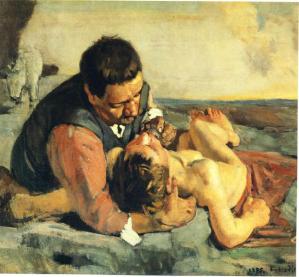
It is Luke’s Gospel that fleshes out love of neighbour by telling the story of the Good Samaritan—shockingly making a despised foreigner the epitome of neighbour love. It is Luke’s Gospel that has all three stories of lostness: the lost sheep, the lost coin, and the lost son. In this last story the father’s love for his prodigal son is particularly scandalous: generous from start to finish, watching for the prodigal and running for him without care for propriety, welcoming him home without any amends made or demanded.

Luke’s Gospel has more than the normal quota of stories of Jesus healing people and sharing meals with them, crossing bounds of purity and propriety to do so. He also tells his share of stories about Jesus forgiving sins on God’s behalf—sometimes in response to repentance, sometimes not. And it is Luke’s Gospel (or some manuscripts of it) that has Jesus calling on God to forgive his executioners even as he hangs on the cross, even while they remain ignorant of their heinous sin.

I suspect, then, that Luke’s Gospel has far too much emphasis on love for some—which brings us right to social justice.

One of the strangest criticisms of Bishop Curry’s sermon I’ve seen is that it focused too much on things like racial justice and poverty and the like. The thinking goes like this: the goal of Jesus’ ministry was to bring people into “the kingdom of heaven” (by which is meant simply “heaven,” or “an eternal, spiritual afterlife with God”). His ministry was “spiritual,” not “political”—and, in any case, things like sexism or racism or poverty aren’t really going to change in this world (you know, “the poor you will always have with you”).

But Luke the Evangelist will have none of this.

Leave aside the fact that “kingdom of heaven” is parallel to “kingdom of God,” and that the Jewish expectation of “God’s kingdom” was very much a this-earthly reality. Leave aside the fact that “give to Caesar that which belongs to Caesar and give to God that which belongs to God” would make any devout Jew think, “the earth is the Lord’s and everything in it.” And leave aside the fact that “the poor you will always have with you” is an allusion to Deuteronomy 15:11 where Moses is in fact urging generosity toward the poor.

Quite apart from these things, Luke’s Gospel is explicit in promoting what we today call “social justice,” even specifically along the lines of sex, race, and economics. There’s far too much to mention, so let’s just consider the issue of poverty.

James Tissot, Le magnificat

It is Luke’s Gospel that has Mary sing these words in anticipation of Jesus’ birth: “The Lord has brought down the powerful from their thrones, and lifted up the lowly; he has filled the hungry with good things, and sent the rich away empty.”

It is Luke that makes Isaiah 61 into Jesus’ personal mission statement: “The Spirit of the Lord is upon me, because he has anointed me to bring good news to the poor. He has sent me to proclaim release to the captives and recovery of sight to the blind, to let the oppressed go free, to proclaim the year of the Lord’s favor” (in other words, Jubilee—look it up).

It is Luke that presents Jesus’ beatitudes this way: “Blessed are you who are poor, for yours is the kingdom of God. Blessed are you who are hungry now, for you will be filled.” And he includes some accompanying woes in case we’re tempted to spiritualize this: “But woe to you who are rich, for you have received your consolation. Woe to you who are full now, for you will be hungry.” And just to hammer this home, these are among his following words: “Give to everyone who begs from you.”

It is Luke’s Gospel that says, “When you give a banquet, invite the poor, the crippled, the lame, and the blind.” It is Luke that tells the story of the Rich Man and Lazarus, making sure his hearers know the rich man was being judged for his callous disregard of poor Lazarus at his very gate. It is Luke that tells the story of Zacchaeus, declaring, once Zacchaeus had promised to give half his wealth to the poor and make restitution to any he had defrauded, that “Today salvation has come to this house.”

It is Luke that tells of the early Christians selling their property and giving to the poor among them, even holding all their possessions in common. It is Luke that describes the Apostles’ concern for widows in need, ensuring all received sufficient help regardless of cultural background. It is Luke that mentions the concern of believers in Antioch to provide aid for the poor in Jerusalem affected by famine.

If this is “Christianity Lite”—showing compassionate love for all including the unrighteous and unrepentant, seeking equitable justice for all and especially the vulnerable and marginalized and oppressed, and all this without a strong penal substitutionary view of Jesus’ death—then it’s not just Bishop Curry who is guilty of it. That’s Luke the Evangelist implicated as well, and—at least according to Luke—even Jesus himself.

Not bad company, I’d say.

© Michael W. Pahl