What is Christianity 101?

I recently posted this online:

A social media post with this text: "Christians believe that every person is created in God's image—no exceptions. Christians believe that we are to love every neighbour as ourselves—no exceptions. This is Christianity 101. It sure feels like a lot of Christians need to go back and re-learn the basics."

It got me thinking: what is Christianity 101? In other words, what are the basics that every Christian should know and live out?

It’s not a new reflection for me. Along the way I’ve taught plenty of “Intro to Christianity” type courses in academic contexts, along with my share of catechism or baptismal preparation-type classes in churches. I’ve even written a short intro to Christian theology from a biblical theological angle—most of which I still agree with. 😜

But at this time in my life—after 30+ years of Christian academic and church ministry—and at this moment in time—in the shadow of fascism’s resurgence, in an era of increasing distrust and polarization, in a climate-changing world, a democracy-precarious world, and so on and so on—what should every Christian know and live out?

A quadrilateral of thoughts—which would make for a great four-session series…

First, Jesus.

Christianity 101 starts with Jesus—he is, after all, the very image of God, God’s message made flesh, as well as the only foundation for our faith and for the church. Put another way, there’s a reason why Jesus’ name, or a title for Jesus, is on every page of the New Testament.

A basic Christian understanding of Jesus should include a familiarity with the stories and teachings of Jesus in the Gospels. It should include an appreciation of the larger significance of the key episodes in Jesus’ life, and his core teachings. It should include a grasp of the scope of basic Christian confessions like “Jesus is the Christ” and “Jesus is Lord.” It should include a commitment to follow Jesus as Christ and Lord, following in his way of love leading to justice and peace and life.

Second, God.

If Jesus is on every page of the New Testament, God is there at least as often. In fact, the story of Jesus is presented in the New Testament as a story about God, about what God is up to in the world. And Jesus himself had much to say about these things.

A basic Christian understanding of God should include a recognition of God as Creator, both distinct from creation and intimately involved in it—with the strong implication that creation is good, and loved by God. It should include a recognition of God as Saviour or Redeemer—the One who, ultimately, delivers us from our ways of harm and restores us to goodness and life and justice and peace. It should include reflection on the triune nature of God, at the very least that God acts in the world through Jesus by the Spirit and that we come to God and experience God through Jesus by the Spirit.

Third, faith.

The call to faith in God is persistent through the Christian Scriptures, carrying through the New Testament. This is not merely a call to believe certain things about God, though there are such things (see above for some of them). Rather, biblical faith is much more about a personal trust in God, an entrusting of ourselves into God’s care, come what may. It’s also a call to commitment or even allegiance—as Christians we are to follow God’s ways above any other ways, and these ways are the ways of Jesus, the ways of the Spirit.

This faith in God, this devotion to God, this love of God, is expressed and nurtured in certain ways. Christianity 101 would begin to nurture some of these ways of faith, including prayer, worship, solitude, community, study, service, simplicity, generosity, and more. And the greatest of these is…

Fourth, love.

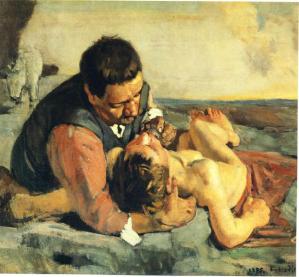
Ferdinand Hodler, The Good Samaritan

The call to love is also persistent through the Christians Scriptures, and especially in the New Testament. This is also the primary “way of God, way of Jesus, way of the Spirit” in which we are to live. It is the primary expression of a genuine Christian faith. It is the primary characteristic of those who claim to follow Jesus.

This basic Christian love is not merely affection, tolerance, respect, or simple kindness—though it includes those attitudes and actions which are commonly called “love.” Basic Christian love is, as one should expect, love in the way of Jesus.

Jesus called his followers to love both neighbours and enemies, and he told stories about and lived out this neighbour-enemy love. It’s an open-hearted, open-armed, open-handed love, giving generously of one’s self. It sees each person as one created in God’s image and loved by God. It’s a practical care for the needs of others, as if their needs were our own—and especially those most in need, most vulnerable to harm. It’s a readiness to forgive when harmed, even when it’s hard. It’s a willingness to stand in solidarity with the harmed, even at great personal sacrifice. It is this way of love that leads to true justice, lasting peace, and flourishing life for all, and all God’s creation.

Jesus. God. Faith. Love.

It’s a quadrilateral of basic Christianity, within which there is plenty of room for lifelong, expansive growth.


© Michael W. Pahl

A Jesus-Centred Christianity

We’re hearing more about “Jesus-centred Christianity.” At least, I am. And I’m realizing that there are some very different understandings out there of what this means. How do I understand this? And what difference does this make?

James Tissot, The Sermon of the Beatitudes

It needs to be said up front that all Christianity is in some way “Jesus-centred.” It’s in the name, after all: “Christianity,” those who believe in Jesus, whom we hold to be the “Christ” or Messiah anticipated in the Psalms and the Prophets. Every stream of Christianity in one way or another grounds its faith and life in Jesus.

So, what I’m describing as Jesus-centred Christianity shouldn’t be taken to mean that other forms of Christianity are not in some way centred on or grounded in Jesus. They are. Rather, what I’m describing is a particular way in which Christian faith and life is centred on Jesus.

First, Jesus-centred Christianity is centred on the person and ministry of Jesus of Nazareth, primarily (but not exclusively) as presented to us in the four Gospels. Some versions of Christianity focus on Jesus’ death in a way that can feel like Jesus’ life and teaching is irrelevant. Others focus on Jesus’ teachings in a way that can feel like they are divorced from his life and death. What I’m talking about is a holistic view of Jesus: his birth, baptism, teachings, actions, suffering, death, resurrection, and promise of his return.

Second, this kind of centring on Jesus leads to some characteristic beliefs and practices. Discipleship, or intentionally learning from Jesus as presented to us in the Gospels. Being prompted and empowered by the Spirit. Shared meals, including the Lord’s Supper. Free healing. Nonviolent peacemaking. Generous simplicity. Gentle compassion. Persistent prayer. Merciful forgiveness. Humble faith. Suffering in solidarity with the powerless. Bringing resurrection life to the world. And above all, love—loving God pre-eminently by loving others as if their needs were our own.

Third, the kind of Jesus-centred Christianity I’m talking about means being radically centred on Jesus. It means not letting anything else draw attention away from this focus on Jesus. There are diverse beliefs and practices that can support this Jesus focus—a robust Trinitarian theology, for instance, or a particular way of baptizing or doing the Lord’s Supper or organizing as a church—but this approach doesn’t allow any other beliefs or practices or people or ideas to move into the centre with Jesus. It’s about a radical allegiance to Jesus and his way of being, his way of life, his way of love.

So what difference does this make? Why choose this kind of Jesus-centred Christianity over other versions of Christianity?

One key reason is the unifying power of a Jesus-centred Christianity. Often accompanying the language of “Jesus-centred Christianity” is an understanding of what’s called “centred-set” Christianity versus “bounded-set.” This language comes from mathematics via missionary anthropologist Paul Hiebert, and it’s been articulated well for Christianity and the church by scholars such as Mark Baker.

The idea is this: rather than focusing on defining and guarding the boundaries of Christianity, who’s in and who’s out—a “bounded-set” Christianity—we should focus on what draws us together toward the centre, with boundaries being irrelevant—a “centred-set” Christianity. Jesus-centred Christianity holds that Jesus, as described above, is what is at the centre, drawing us in. The result is a way of being Christian that allows for tremendous diversity in belief and practice while still recognizing a unifying, gravitational force at the centre.

Yet this Jesus-centred Christianity is not free of disagreement and dispute. There are many important and difficult questions still open for discernment. The advantage of a Jesus-centred approach, however, is that it helps us to focus the questions and narrow the possible answers. It keeps us from being distracted by the variety of ways Scripture or our culture addresses these questions—we are always forced to ask, “But what about Jesus?” and “What does a Jesus-way of approaching this look like?” And we are more likely to be able to discern together in a way that is characterized and defined by love. This is not merely theoretical—I’ve seen this difference in action.

But the primary reason for myself and many others for holding to a Jesus-centred Christianity as I’ve described it is simply that it makes the best sense to us of what authentic Christian faith and life should be. It’s what we see in the beliefs and practices of the earliest Christians as found in the New Testament—and for the first few centuries of the church, and throughout church history along the margins of Christendom. Any time there has been a revival or reformation in Christian history, it has included something more or less approximating the kind of Jesus-centred Christianity I’ve described above. That should be instructive for us.

I don’t particularly care which denomination a Christian is identified with, though I do think some denominations are more compatible with a Jesus-centred Christianity than others (cough Mennonites cough). But I do pray that we as Christians, regardless of our denomination, can re-claim a Jesus-centred Christianity that confesses with the early church: Jesus—the Christ from Nazareth who taught love, lived love, suffered and died and rose again in love—is Lord.


© Michael W. Pahl

What is Christian nationalism? And why is it a problem?

There’s a lot of discussion about Christian nationalism these days, and a lot of people are unsure what to make of it, or even what Christian nationalism (CN) is. Some thoughts on what it is and why it’s a problem…

Let’s start with “nationalism.” Encyclopaedia Britannica gets it nicely: “Nationalism is an ideology that emphasizes loyalty, devotion, or allegiance to a nation or nation-state and holds that such obligations outweigh other individual or group interests.” Nationalism is not just patriotism; it’s an elevation of the nation-state to a place of high allegiance, often with a sense of the nation’s superiority over others.

“Christian” nationalism adds the expectation that the nation reflect specific values deemed to be Christian, in its constitution, laws, policies, and so on. Typically it means that these things should be based on biblical laws or teachings, especially the Ten Commandments.

Christian nationalism thus holds the expectation that Christianity be privileged in some way by the state, perhaps even adopted as the state religion. In more extreme forms, CN includes ideas like requiring high-ranking government officials to be Christian or expecting immigrants to adopt Christianity.

If this is hard to imagine, just replace “Christian” with “Islamic” or “Jewish,” and imagine Islamic or Jewish nationalism as the guiding ideology for a nation-state.

So much for what it is. What’s wrong with it? Well, there are several problems with nationalism generally and Christian nationalism in particular. Here are a few…

First, nationalism’s elevation of the nation-state and the sense of the nation’s superiority can lead to interventionist, even expansionist, policies, resulting in increased violence world-wide and (ironically) less security at home.

Now, nationalism is an inherently isolationist ideology. It sees “globalism”—nation-states working together in a way that is perceived to erase national identities—as a threat. However, nationalism can become expansionist. The nation can seek to impose its values on other nations through cultural, economic, military, or other means. This is when nationalism becomes imperialism. Think 400 years of colonization by western European nation-states. Or Russian expansionism now in Ukraine. Or most US foreign policy since WWII.

Second, when this nationalism conflates the nation-state with a particular person, you get cult-like authoritarian regimes, even under the guise of “democracy.” Think Nazi Germany, or Putin’s Russia, or MAGA America. Combine with the previous, and you get war. Even world wars.

Third, an obvious problem with Christian nationalism is this: which Christianity? Inevitably it is a conservative version, mirroring nationalism’s expectation of allegiance and its sense of superiority. Literalist in its reading of Scripture and fundamentalist in its outlook.

And white. And patriarchal. This also needs to be said: Christian nationalism is a white, patriarchalist movement. It’s an attempt to re-create a lost society, a golden era of 1950s white, “family values” suburbia. Think “Leave it to Beaver,” but with more overt Christianity.

But this is only one slice of Christianity, and a relatively recent one at that. Christianity originated on the margins; anything like Christian nationalism was unthinkable for its first 300 years. The “kingdom” Jesus envisioned is “not of this world”: it’s not a political entity, a nation-state.

And the Christianity that grew from Jesus wasn’t white, and it wasn’t patriarchal. Following Jesus’ way, early Christianity was intercultural and egalitarian, sometimes even radically so.

Finally, Christian nationalism seeks to impose religious values on others who do not share those values, even requiring them to live contrary to their own religious (or non-religious) values. Which, of course, is a problem if the nation is striving to be a democracy.

Note: the problem is not having different values, or seeking to persuade others to share one’s values, or even seeking to establish laws for the common good on the basis of one’s values. All this is fundamental to democracy.

The problem is not even that sometimes we have to agree to things deemed to be for the common good which go against our personal values. Again, democracy. Or just, “living together.”

No, the problem is the imposition of one’s values on others, requiring them through a use of power to abide by or even adopt those values themselves, and especially without striving through dialogue, debate, and compromise to determine a “common good.” This is not democracy.

This is also not many Christians’ understanding of Christianity. Jesus didn’t impose. He didn’t coerce. He didn’t use power to make people follow his way. The opposite, in fact.

Jesus gave up his power, he gave up his privilege, in order to serve others, to meet their deepest needs, to love them. This is Philippians 2. This is the Gospels. This is the gospel.

And this is authentic, historic Christianity.


© Michael W. Pahl

Following Jesus Is Not Enough

Okay, let me start by saying I really do believe following Jesus is “enough,” in the sense that “following Jesus” nicely sums up what it means to be a Christian. Following Jesus in his teachings and way of life, united with him in his death and resurrection, and so being conformed by the Spirit to the image of God’s Son—this is what being a Christian means.

But here’s the problem: “following Jesus” can so easily be used to mean whatever we want it to mean.

We pick and choose which teachings of Jesus we think are really important. We make morality solely about inward intentions or private sexuality. We make the cross about an individual transaction with God. We view the resurrection as something still to come, no bearing on the here and now.

And then we can go on amassing our possessions, condemning “sinners,” ignoring the poor at our gates, and otherwise living in stark contrast to the way of Jesus.

It’s a well-worn path, a broad road even, this individualizing and privatizing and genericizing and spiritualizing of “following Jesus,” so we can justify our comfort and privilege, maintain our sense of piety and morality, and otherwise feel good about the life we lead.

It’s a path I find myself on often.

And so we need something to help us focus what it means to “follow Jesus,” to be “united with Christ,” to be “conformed to the image of God’s Son.”

Here’s where I’ve been helped by Black theologians like James Cone, by feminist theologians like Elisabeth Schüssler Fiorenza, by liberation theologians like Gustavo Gutiérrez. Here’s where the practical theology of people like Martin Luther King, Jr. has been important to me.

It’s from these followers of Jesus and others like them that I have learned of God’s “preferential option for the poor.” This is not that God loves the poor more than the rich, but that, because God is love, God pays particular attention to the poor.

Ferdinand Hodler, The Good Samaritan

“The poor” in biblical context does not simply refer to the financially destitute. The phrase is aligned with “widows” and “orphans,” “aliens” and “strangers.” Jesus used words like “last” and “least” to refer to these children of God who were left at the bottom rung of society. “The poor” is often used, then, as a kind of cipher for all who are impoverished in power—economic power, yes, but also political power, social power, the power to change one’s circumstances for their wellbeing.

“Remembering the poor”—in the sense of “paying attention to those who are impoverished in power”—was at the heart of Jesus’ ministry. It was a crucial emphasis of his teaching. It was the way he lived. It gives greater meaning to the cross as God’s solidarity with the powerless, the evil-oppressed. It brings Jesus’ resurrection, God’s life-giving liberation, into the here and now.

This divine attention to the impoverished in power is the lens that can help us focus what it means to “follow Jesus.” When we “remember the poor” as we follow Jesus, we begin to see the world through Jesus’ eyes. We pay attention to those marginalized or even oppressed by powerful forces beyond their control, both spiritual and material. We see the ways we might be complicit with these powerful forces, whether by circumstance or by choice. We are Spirit-prompted to repent of this complicity and to walk in solidarity with the power-impoverished, even if it means a cross.

All this recalibrates our love of God and neighbour. It realigns our sense of morality and our ethics. It reforms our theology and heightens our worship. It draws us more closely to the way of Jesus. It unites us in practical ways with Christ in his death and resurrection, revealing us to be conformed to the image of Christ.

“Remembering the poor” helps us to follow Jesus. And this is indeed enough.

Living and Loving in the Way of Jesus

“We know love by this, that he laid down his life for us—and we ought to lay down our lives for one another. How does God’s love abide in anyone who has the world’s goods and sees a brother or sister in need and yet refuses help?”  (1 John 3:16-17).

The whole passage from this coming Sunday’s lectionary readings is worth reading: 1 John 3:16-24. It’s a good summary of what the Christian faith is all about.

It’s all there: a focus on Jesus, on his life and teachings of love, on his death as the ultimate example of love, on his resurrection presence in which we abide, alongside a call to follow in Jesus’ footsteps, praying boldly and relying on the Spirit to love not with mere words but “in truth and action.”

The passage reminds me of words from earlier in the Elder’s sermon-letter: “By this we may be sure that we are in [Jesus]: whoever says, ‘I abide in him,’ ought to walk just as he walked” (1 John 2:5-6).

And this in turn reminds me of the famous words of early Anabaptist Hans Denck: “No one may truly know Christ except one who follows him in life.”

May we keep it simple in our Christian lives: day by day focusing on living and loving in the way of Jesus. In this moment, and now in this moment, and now in this: how can I live out the love of Christ for those around me, for the person right in front of me?

Navigating the Waters around Supersessionism

There has been a good deal of online chatter recently about “supersessionism.”

Supersessionism is the idea that Judaism has been superseded by Christianity (as “the true religion”), or that Israel has been superseded by the Church (as “the people of God”). In this way of thinking, Christianity is superior to Judaism and the Church has replaced Israel.

It’s no surprise that supersessionism has been part of the mix in a lot of Christian anti-Semitism through history. Christians and Jews both, then, are right to condemn supersessionism.

However, it turns out it’s not all that easy to spot this anti-Semitic supersessionism in the wild. A Rabbi might condemn something they think reflects an aberrant, “supersessionist” version of Christianity only to find out it’s an essential part of historically orthodox Christianity. A Christian pastor might criticize other Christians for the latent “supersessionism” of their Christ-centred interpretation of the Old Testament, only to find themselves labeled “supersessionist” because of their Trinitarian reading of the Old Testament.

Contrary to some online exhortations (“C’mon Christians, it’s not so hard! Just don’t be supersessionist!”) this really is a rather knotty problem for Christians. And it won’t go away any time soon, because the tensions inherent to the problem of supersessionism grow out of the very nature of Christianity itself.

Here are a few historical realities that need to be considered by anyone—Christian or Jew—who wants to talk about Christianity and supersessionism. While there is debate about many of the details of these things among historians of Christian origins and early Judaism (a.k.a. late Second Temple Judaism), the basic points are not all that controversial.

1) Jesus of Nazareth was a devout Jew. As far as we can tell historically, he remained so to the end (Jesus was executed under Roman jurisdiction in or around 30 CE). Keep in mind, though, Jews (or perhaps better, “Judeans”) in the first century disputed vigorously among themselves as to what God-approved, Torah-faithful religious devotion should look like.

2) Paul of Tarsus was a devout Jew. His revelatory Jesus-experience near Damascus (within a few years of Jesus’ death) was not a “conversion” from one religion to another; he describes it rather as a prophetic “call” by the God of his ancestors to proclaim Jesus as Messiah and Lord among the Gentiles (non-Jews, “the nations”; e.g. Gal 1). As far as we know, Paul considered himself to be a devout Jew to the end of his life. This claim was sharply disputed by other Jews of his day.

3) The earliest followers of Jesus were all Jews, and most of the authors of the writings that make up the New Testament were Jews. The scriptures of early Judaism were their scriptures, because they were Jews. They claimed Jesus as the promised Messiah of Israel, their Messiah. They viewed what had happened to Jesus and what was happening among them as the beginning of the fulfillment of Jewish expectations for God’s “last days” salvation.

So far this sounds like Christianity should be simply a sect of Judaism. In fact, that’s essentially what it was, to start with: a branch of early Judaism on the “apocalyptic” side of the family tree. So what happened? A few more historical realities to keep in mind:

4) Early in the development of this Jesus movement these Jesus-followers began to understand Jesus in rather exalted, even exclusive, terms. Jesus was viewed not only as Davidic Messiah bringing about God’s promised reign on earth, but as Lord over all powers of this age, even as the fullest revelation of God to humanity—even as God-in-human-flesh. Exactly how early this “high Christology” developed and how widespread it was are matters of debate among historians, but these ideas are evident in one form or another throughout the New Testament writings, even in the earliest of them (Paul’s letters, written 15-30 years after Jesus, ca. 45-60 CE).

5) Within a decade or so after Jesus, Gentiles had begun to join this Jewish Jesus movement. This created a contentious problem for the movement: do we accept Gentiles as Gentiles, or do we expect Gentiles to become Jews? Within another decade, a formal decision was made accepting Gentiles as “righteous Gentiles,” no conversion necessary (Acts 15; ca. 49 CE); however, the controversy continued for many years after. That decision, though, along with the active evangelization of Gentiles by people like Paul, meant that it wasn’t long before Gentiles outnumbered Jews within the Jesus movement (e.g. this seems to have been the case in the Roman churches Paul wrote to in the late 50s CE).

6) By the end of the first century, “the parting of the ways” between Christianity and Judaism was well on its way; by the middle of the second century this parting was effectively complete. The “Gentilization” of the Jesus movement, along with the desire of these Christians to distinguish themselves from Jews in the aftermath of two failed Jewish revolts against Rome (66-73 and 132-136 CE), paved the way for this parting (which was not often as amicable as the word “parting” implies). Christianity emerged as a predominantly Gentile religion, and Judaism evolved into its current form (Pharisaic-Rabbinic).

These historical realities are part of the DNA of Christianity. They can’t simply be brushed aside. Nor does it work to blame supersessionism on a later Hellenization/Romanization of an early Jewish Jesus-movement (no “Thanks, Constantine!” allowed here). An exalted, even exclusive view of Jesus in relation to all other powers of this age and all other claims of divine revelation was already present in the earliest, “most Jewish” versions of Christianity.

In other words, again, the tensions inherent to the problem of supersessionism grow out of the very nature of Christianity itself. We might try to resolve these tensions by denying Christianity’s organic connection to early Judaism, as if Christianity and Judaism are completely distinct religions. Or, we might try to resolve these tensions by denying Christianity’s strong claims about Jesus even related to the Torah and key aspects of Jewish belief and practice, as if there is nothing distinctive about Christianity related to Judaism. Either way, we end up with something that is not Christianity.

So, what should we do?

Well, we need to be honest about the origins of Christianity and the nature of Christianity’s claims about Jesus. This should be part of any religious instruction about Christianity and Judaism, and part of any Jewish-Christian dialogue. It doesn’t help to gloss over these realities in order to resolve any problems that might arise from them.

We also need to be honest about the history of Christian anti-Semitism, and the ways in which Christian teachings about “Christianity as the true religion” and “the Church as God’s true people” have helped to fuel that anti-Semitism (not to mention European colonization and similar evils). This, too, should be part of religious instruction for Christians about Christianity and Judaism, and confessed by Christians in Jewish-Christian dialogue.

We Christians must also do the hard work of thinking carefully about Christianity’s origins and claims related to Judaism.

What does it mean for Christianity and our relationship to Judaism that Jesus was and remained a devout Jew? What does it mean for Christianity and our relationship to Judaism—and any other religion, for that matter—that Jesus did not found Christianity as a religion, let alone a religion distinct from Judaism?

What does it mean for Gentile Christians and our religious practices that Jesus was and remained a devout Jew? What does this mean for our relationship to the scriptures, symbols, and practices of Judaism, including reading Torah, keeping Sabbath, performing ritual washings, and eating sacred meals?

What is the significance of the fact that the Jewish scriptures (the Tanakh) say nothing directly about Jesus, yet they make up most of the Christian scriptures (as the Old Testament)? What does it mean to claim that the Jewish scriptures bear witness to Jesus? What does it mean to claim that Jesus (not any scripture) provides us with the fullest revelation of God and God’s will?

What does it mean for “Israel” to be the people of God, yet for “the Church” also to be the people of God? What exactly is the relationship between the two? What, in fact, does it mean for any specific group of people to claim they are “the people of God,” or “the children/family of God”? How does this relate to biblical ideas that all people are created “in God’s image” and are “God’s children”?

How do we understand the repeated New Testament claim that the new Messianic community forming around Jesus (“the Church”) is in some way an extension of the ancient people of “Israel” in fulfillment of Israel’s scriptures? That in Jesus the Messiah (“in Christ”) Gentiles have been “grafted in” to Israel, included in Israel’s promised inheritance?

What does it mean to claim that Jesus of Nazareth, crucified by Rome and resurrected by God, is Israel’s Messiah? That this Messiah Jesus is Lord over all powers of this world, including religious powers? That this Messiah Jesus is the ultimate revelation of God, even God incarnate? How do these claims relate to modern Judaism? to other religions? to other claims of divine revelation and authority?

These and similar questions are more complicated and difficult than they might appear on the surface. Yet we must grapple with these questions in order to navigate the waters around supersessionism. Let’s strive to do so with historical and theological integrity as Christians, with a deep sensitivity and love for our Jewish neighbours, and with grace for one another—because we will make mistakes along the way.


Preserving Faith for Future Generations

From December 2017 through February 2018, I wrote a series of short articles for MennoMedia’s Adult Bible Study Online. Over the past three weeks I have reproduced those here in my blog. Here is the article for February 25, 2018, based on 1 Timothy 6:11-21.

First Timothy concludes with this exhortation: “Guard what has been entrusted to your care.” This is very similar to another exhortation in the Pastoral Epistles, 2 Timothy 1:13-14: “What you heard from me, keep as the pattern of sound teaching, with faith and love in Christ Jesus. Guard the good deposit that was entrusted to you—guard it with the help of the Holy Spirit who lives in us.” These echo Paul’s plea to “hold fast to the teachings” or “traditions” he had passed on (2 Thess 2:15; cf. Rom 6:17; 1 Cor 11:2), and they are right in line with perhaps the best known of these New Testament appeals, Jude 3: “contend for the faith that was once for all entrusted to the saints.”

Yet what precisely is this “deposit,” this “faith,” these “traditions”? And how exactly do we “hold fast to” these traditions, or “guard” this deposit, or “contend for” this faith?

For many Christians today, the “deposit” of “faith” is a fairly comprehensive set of beliefs and practices. It might include everything from specific convictions about the nature of the Bible and how to read it, to particular ideas about the timing of creation, what counts as “sin,” the meaning of Jesus’ death, the mode of baptism, worship style, and much, much more. It’s “the way we’ve always done things,” it’s the “faith of our fathers,” it’s that “old time religion”—even when, in reality, the generations before us went through significant adaptations to their way of faith and life.

However, Kathleen Kern is almost certainly correct in her suggestion that the entrusted gift in view here is the gospel (Adult Bible Study student guide, 78). The “deposit” we are to “guard,” the “faith” for which we are to “contend,” the “traditions” to which we are to “hold fast”—these are all describing some aspect of the good news story of Jesus, Israel’s Messiah and the world’s true Lord, who brings about God’s saving kingdom on earth through his life, death, and resurrection.

How can we preserve this gospel for future generations? Our passage points to an answer: “pursue righteousness, godliness, faith, love, endurance, and gentleness,” it says, and so “fight the good fight of the faith” (6:11-12). In other words, we preserve the gospel for future generations by living out the gospel in our own—in authentic faith and love, in genuine godliness and gracious gentleness, with patient perseverance, always seeking first God’s kingdom and justice.

What non-essential beliefs or practices have we added to the simple gospel of Jesus? Which of these might we be wrongly expecting that the next generation keep? Are we striving to live out the good news of Jesus with authenticity and integrity? Are we willing to allow the next generation to live out the gospel in their own way, for their own time?

Holding on to Identity as a Minority Faith

From December 2017 through February 2018, I wrote a series of short articles for MennoMedia’s Adult Bible Study Online. Over three weeks I am reproducing those here in my blog. Here is the article for January 7, 2018, based on Daniel 1.

Christianity is the largest religion in the world, with an estimated 2.3 billion adherents. As of 2015, three-quarters of Americans and two-thirds of Canadians identify as Christians. We are hardly a minority faith.

Still, it is true that Christianity’s public influence has declined. Christianity is no longer the touchstone of North American culture that it once was. Christianity no longer defines social values or public policy in quite the way it once did. The institutions of Christianity are not as prominent or as powerful as they once were, and the institutions of our western society are no longer exclusively or even predominantly Christian—if they ever were. Christendom is no more.

This means that although Christianity is not a minority faith in North America it can often feel like it is. For some, this presents a challenge, even a catastrophe. I think it presents an opportunity.

This changed situation is an opportunity for us to reflect on and sharpen our identity as Christians: What does it really mean to be “Christian”? What marks us off as “Christian”? What distinctive beliefs or rituals or symbols or sacred stories are at the heart of this thing called “Christianity”?

The story of Daniel and his three companions in Daniel 1 is a story about early Jewish identity. Ostensibly about Israelites exiled in ancient Babylonia, yet really about Maccabean Jews under pressure to Hellenize, the story remains for Jews a powerful symbol of maintaining their religious and cultural identity in the face of enormous pressure to assimilate. For us as Christians, it can stand as a biblical call to reflect on our identity as Christians, asking those same questions forced upon us by our own post-Christendom context.

So, what does mark us off as “Christian”? Contra Daniel 1, the New Testament insists it’s not our diet—“all foods are clean,” Mark concludes based on Jesus’ teaching (Mark 7:14-19), and Paul declares that “the kingdom of God is not food and drink” (Rom 14:14-17). Likewise, it’s not the observance of holy days like the Sabbath (Rom 14:5-6; Col 2:16-17) or covenant rituals like circumcision (Gal 5:6; 6:15).

For Christians, beliefs, rituals, symbols, and sacred stories have tremendous value in nurturing the things that matter most, but they are not themselves those essentials of Christianity. Rather, as markers of Christian identity Jesus and the Apostles consistently point us to a cluster of lived-out virtues: a trusting, obedient faith, a persevering, persistent hope, and, above all, a self-giving, other-delighting love, all in the way of Jesus, all nurtured by the Spirit.

My Confession of Faith

There is only one reason why I am, and remain, a Christian: Jesus.

In Jesus I see God embodied, a God who is a friend of sinners, who finds the lost and feasts the least and firsts the last. In Jesus I see a God who runs to wayward children, welcoming them in lavish banquets of love.

In Jesus I see a God who stands in solidarity with the poor, the outcast, the stranger. In Jesus I see a God who stands firm against oppression and exclusion by the powerful and privileged.

In Jesus I see a God who loves stories and riddles, flowers and children, and eating good food with good friends and the very best of wine.

In Jesus I see a God who dreams of a better world, a kingdom of justice and peace and flourishing life, and who dares to plant that dream in the world with such a small and insignificant seed: love.

In Jesus I see a God who is willing to die rather than kill, following his own words of nonviolence on his own way of the cross.

In Jesus I see a God who turns death into new life, shame into honour, guilt into forgiveness, futility into purpose, brokenness into wholeness, suffering into joy, despair into hope—and this gives me hope.

In Jesus I also see, then, humanity as we are meant to be: walking in all these ways of Jesus, centered on devotion to our Creator expressed through compassion and care for other humans and all creation, paying special attention to the most vulnerable of God’s creatures.

I am not a Christian because of other Christians, though I know many good Christians. I am not a Christian because of the Bible, though the Bible points me to Jesus and tells me his story.

There is only one reason why I am, and remain, a Christian: Jesus.

© Michael W. Pahl

Bishop Curry, Luke and Acts, and “Christianity Lite”

There was a lot of buzz this past weekend about the wedding of Meghan Markle and Prince Harry, now the Duchess and Duke of Sussex. And a good bit of that buzz was about the sermon by Bishop Michael Curry, presiding bishop of the Episcopal Church.

Responses to Bishop Curry’s sermon have ranged from astonishment to amusement, from enthusiastic applause to sharp criticism. Some of that criticism has come from Christians, including a former chaplain to Her Majesty the Queen who claimed that Bishop Curry’s sermon represented a watered down version of Christianity, a kind of “Christianity Lite.” The specific critiques are diverse, but in general they seem to boil down to three things: there was too much love, too much social justice, and not enough cross.

However, if this is “Christianity Lite”—showing compassionate love for all including the unrighteous and unrepentant, seeking equitable justice for all and especially the vulnerable and marginalized and oppressed, and all this without a strong penal substitutionary view of Jesus’ death—then Luke the Evangelist, author of a good 27% of our New Testament, is also implicated.

Yep: Luke and Acts are also “Christianity Lite.”

Consider the cross.

Like Bishop Curry in his sermon, Luke does in fact mention Jesus’ death—dozens of times in the Gospel and Acts. What’s more, Jesus’ death is mentioned at significant points in Luke’s accounts of Jesus and the Apostles: in the Gospel’s creed-like “passion predictions” taken up from Mark’s Gospel, anticipating Jesus’ death yet to come; in the Gospel’s “passion narrative,” as rich in meaning as that of any of the Gospels; and in Acts’ several “evangelistic speeches,” where the saving message about Jesus is proclaimed to those who don’t yet believe. In other words, as with Bishop Curry, the cross is pretty important to Luke’s theology.

However, the cross isn’t talked about by Luke in the way at least some of Bishop Curry’s detractors call for. There’s no “You’re a sinner and you’re going to hell, but—good news!—Jesus has died to pay the penalty for your sins” in Luke or Acts—not even in the Apostles’ evangelistic speeches. In fact, “penal substitution” is entirely absent from Luke’s presentation of Jesus’ death—there is nothing in Luke or Acts indicating that Jesus is punished on the cross for our sins, paying a penalty that should be ours to pay.

For Luke, that “Christ died for our sins” means that “Christ died because of our sins,” and “Christ died to show us the way out of our sins.”

The most common interpretation of Jesus’ death by Luke is this stark contrast: human powers have killed Jesus, but God has raised Jesus from the dead. This idea is found in both the Gospel and Acts, explicitly and repeatedly. This refrain fits a Christus victor view of atonement: God has resurrected the crucified Jesus, thus declaring him to be Lord over all powers. The necessary response? Repentance of our collaboration with the evil powers of this world—rulers and idols alike—and walking in the Way in full allegiance to Jesus, Messiah and Lord. And this, of course, is where the gospel preaching of Acts always goes.

The next most common interpretation of Jesus’ death in Luke-Acts is that of Jesus as example to follow: Jesus has taught the way of nonviolent, self-giving love for both neighbours and enemies, and in his own suffering and death he exemplifies this teaching. This is “the way of peace” anticipated by John the Baptist’s father. These are “the things that make for peace” that Jesus laments the people of Jerusalem have missed. Jesus’ followers are to “deny themselves and take up their cross daily and follow him” in these very ways—following Jesus in bringing about peace through nonviolent, self-giving love.

That’s the cross in Luke’s writings—unlikely to pass inspection from at least some of Bishop Curry’s critics. How about love?

Luke’s Gospel, of course, has the same key references to love found in Mark’s Gospel (which Luke almost certainly used) and Matthew’s (which Luke probably used). Love as the Greatest Commandment that sums up the whole Law of Moses: loving God with our whole being, and loving our neighbour as ourselves. Love of enemy as a distinctive hallmark of Jesus-followers.

But Luke also blends in a good-sized helping of other sayings and stories of Jesus about love.

Ferdinand Hodler, The Good Samaritan

It is Luke’s Gospel that fleshes out love of neighbour by telling the story of the Good Samaritan—shockingly making a despised foreigner the epitome of neighbour love. It is Luke’s Gospel that has all three stories of lostness: the lost sheep, the lost coin, and the lost son. In this last story the father’s love for his prodigal son is particularly scandalous: generous from start to finish, watching for the prodigal and running for him without care for propriety, welcoming him home without any amends made or demanded.

Luke’s Gospel has more than the normal quota of stories of Jesus healing people and sharing meals with them, crossing bounds of purity and propriety to do so. He also tells his share of stories about Jesus forgiving sins on God’s behalf—sometimes in response to repentance, sometimes not. And it is Luke’s Gospel (or some manuscripts of it) that has Jesus calling on God to forgive his executioners even as he hangs on the cross, even while they remain ignorant of their heinous sin.

I suspect, then, that Luke’s Gospel has far too much emphasis on love for some—which brings us right to social justice.

One of the strangest criticisms of Bishop Curry’s sermon I’ve seen is that it focused too much on things like racial justice and poverty and the like. The thinking goes like this: the goal of Jesus’ ministry was to bring people into “the kingdom of heaven” (by which is meant simply “heaven,” or “an eternal, spiritual afterlife with God”). His ministry was “spiritual,” not “political”—and, in any case, things like sexism or racism or poverty aren’t really going to change in this world (you know, “the poor you will always have with you”).

But Luke the Evangelist will have none of this.

Leave aside the fact that “kingdom of heaven” is parallel to “kingdom of God,” and that the Jewish expectation of “God’s kingdom” was very much a this-earthly reality. Leave aside the fact that “give to Caesar that which belongs to Caesar and give to God that which belongs to God” would make any devout Jew think, “the earth is the Lord’s and everything in it.” And leave aside the fact that “the poor you will always have with you” is an allusion to Deuteronomy 15:11 where Moses is in fact urging generosity toward the poor.

Quite apart from these things, Luke’s Gospel is explicit in promoting what we today call “social justice,” even specifically along the lines of sex, race, and economics. There’s far too much to mention, so let’s just consider the issue of poverty.

James Tissot, Le magnificat

It is Luke’s Gospel that has Mary sing these words in anticipation of Jesus’ birth: “The Lord has brought down the powerful from their thrones, and lifted up the lowly; he has filled the hungry with good things, and sent the rich away empty.”

It is Luke that makes Isaiah 61 into Jesus’ personal mission statement: “The Spirit of the Lord is upon me, because he has anointed me to bring good news to the poor. He has sent me to proclaim release to the captives and recovery of sight to the blind, to let the oppressed go free, to proclaim the year of the Lord’s favor” (in other words, Jubilee—look it up).

It is Luke that presents Jesus’ beatitudes this way: “Blessed are you who are poor, for yours is the kingdom of God. Blessed are you who are hungry now, for you will be filled.” And he includes some accompanying woes in case we’re tempted to spiritualize this: “But woe to you who are rich, for you have received your consolation. Woe to you who are full now, for you will be hungry.” And just to hammer this home, these are among his following words: “Give to everyone who begs from you.”

It is Luke’s Gospel that says, “When you give a banquet, invite the poor, the crippled, the lame, and the blind.” It is Luke that tells the story of the Rich Man and Lazarus, making sure his hearers know the rich man was being judged for his callous disregard of poor Lazarus at his very gate. It is Luke that tells the story of Zacchaeus, declaring, once Zacchaeus had promised to give half his wealth to the poor and make restitution to any he had defrauded, that “Today salvation has come to this house.”

It is Luke that tells of the early Christians selling their property and giving to the poor among them, even holding all their possessions in common. It is Luke that describes the Apostles’ concern for widows in need, ensuring all received sufficient help regardless of cultural background. It is Luke that mentions the concern of believers in Antioch to provide aid for the poor in Jerusalem affected by famine.

If this is “Christianity Lite”—showing compassionate love for all including the unrighteous and unrepentant, seeking equitable justice for all and especially the vulnerable and marginalized and oppressed, and all this without a strong penal substitutionary view of Jesus’ death—then it’s not just Bishop Curry who is guilty of it. That’s Luke the Evangelist implicated as well, and—at least according to Luke—even Jesus himself.

Not bad company, I’d say.

© Michael W. Pahl