The One Where Michael Shows Some Empathy for Donald Trump

It’s no secret that I’m not a fan of Donald Trump.

In numerous social media posts, I’ve tried to tell it like it is with Trump. I’ve called out his misogyny and racism and pathological lying from the beginning. I’ve red-flagged the wave of Christian nationalism he’s riding on. I’ve spoken of his lies fueling “xenophobic and racist bigots” in their threat of violence. I’ve used humour to mock Trump’s sad triumphalist tendencies and the irreverence of his Christian supporters. I’ve questioned the legitimacy of the claim that Trump is a “person of faith.” As recently as two weeks ago, I laid this criticism on him: “Trump is overtly racist and misogynist and ableist. His policies benefit the wealthy at the expense of the middle class and the poor.”

No, it’s no secret that I’m not a fan of Donald Trump.

Or maybe it is a secret, because when I posted the following call to my Christian siblings on one social media platform recently, people mistook me for a MAGA Trump supporter:

Christians, please tell me we’re not mocking an 80-year old man for nearly stumbling getting into a truck. There’s much to critique, even to critique using humour, but this isn’t it.

Now, in case you missed it, in that post I’m referring to Trump’s stumble at the door of a garbage truck at a staged event in response to Joe Biden’s (apparent) reference to Trump’s supporters as “garbage.” Trump looked every bit of his 78 years as he tottered uneasily by the truck.

As dozens of comments piled up, with people apparently missing the “much to critique” sentence of my post, I added this to the mix:

The comments on this are wild! Assumptions about my political leanings, generalizations about Christians, none of which apply to me. And more mocking of Trump for his age and his appearance. Trump is a fascist, a rapist, a racist, and a pathological liar. Let’s focus on the content of his character and the things he says he’ll do as president.

But it seems this still wasn’t clear enough. People continued their confirmation bias, assuming me to be an evangelical Christian MAGA Trump supporter simply because I showed a sliver of empathy for a nearly 80-year old man. The comments on the post are now into the hundreds, with a high percentage of them along these lines.

That’s not what I’ve found most concerning in the comments, however.

It’s no secret also that I lean left in economic and social policy. For me this grows out of my deeply held Christian convictions, a Jesus-centred Anabaptism that grounds itself primarily in Jesus’ teaching and way of life as presented in the Gospels. Now, I know that most people who lean left politically are not Christian, so I don’t assume they share my Christian values. But I did kind of assume that people who advocate for economic and social justice would have some empathy to tap into, even related to Donald Trump.

Well, you know what they say about “Don’t assume.”

Yep, you guessed it. The now-hundreds of comments on my social media post, mostly by anti-Trump folks who seem to lean left, are mostly a blend of “eye for an eye” and “hate your enemy” and “show no mercy.” Some of them even literally quote “eye for an eye” as if it is a Christian saying (it’s not). In other words, most of these left-leaning folks can muster no empathy for Donald Trump; indeed, they’ve intentionally blocked off any empathy, some dehumanizing him to the point of calling him things like “evil incarnate.”

Now, I get it. Donald Trump is not any random 80-year old man (yes, commenters, I know he’s 78—I’m doing a thing called “rounding up”). He currently wields immense power. And this is exactly why his misogyny, racism, ableism, and economically and socially violent policies need to be resisted, even through mockery if need be.

And I get that Trump’s health is of national concern if he’s going to be president of the United States. If he can’t do the job, that’s a big deal for those who care about such things.

But none of this justifies mocking him for his age, for his appearance, for his physical ability. If we stoop to that, we’re on the road to becoming Trumpist ourselves.

But we’re still not to the thing I’ve found most concerning about the comments on my social media post.

No, what I’ve found most concerning is that some of the people mocking Trump in this way, even using dehumanizing language of Trump, describe themselves as Christians.

My siblings in Christ, this should not be. And trust me, I’ve been way more horrified at the ways Trump and some of his supporters have mocked people for their age, their appearance, or their physical ability.

It doesn’t matter who it is—this should not be. It doesn’t matter what they’ve done—this should not be.

As Christians we are called to love our neighbours as if their needs were our own needs. And Jesus expands “neighbours” to mean strangers who are not like us, even enemies who oppose us and the very things we value. We are to love our enemies, blessing them, praying for them. Resisting them in their evil and injustice, yes, but doing so in a way that overcomes evil with good. After all, our struggle is against evil spiritual forces like misogyny and racism and homophobia and militarism and economic disparity, not against flesh and blood humans.

And yes, this even means humans like Donald J. Trump.


© Michael W. Pahl
Meditations on a Broken Foot

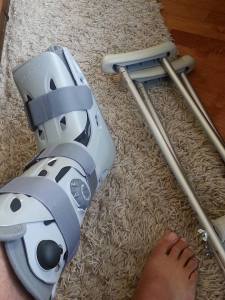
I broke my foot just over three weeks ago. I’m strapped into my accursed amazing AircastTM for another four weeks or so, probably at least three of those still on crutches. I’ve named my crutches, we’re on such good terms: Starsky and Hutch. (Starsky’s the one with the scratch about halfway down.)

Aircast, Starsky, and Hutch

Aircast, Starsky, and Hutch

As far as difficult life experiences go, this one doesn’t rank near the top. I’ve seen too much death, experienced too much loss, for a mere broken meta-something-or-other to even crack the top ten. (Okay, bad choice of words, “crack.”)

But a broken foot is still no small thing. It hurt like Hades when it happened, and also for the first four days whenever I walked on it before I saw a doctor (don’t ask). Even now I’m up to the daily maximum on extra-strength Advil, just to keep up with the constant, cramp-like ache and the occasional bout of throbbing.

Actually, my body aches in places that shouldn’t ache. My shoulders and the heels of my hands ache from all that hopping around with Starsky and Hutch (I’d forgotten that hands even had heels). My AircastTM-ed leg aches from stiffening in place. My other leg aches from bearing all my weight on every other step, turning on the spot, lifting me up and down.

Every trip is an adventure. (Actually, let’s not use the word “trip.”) A stray sock on the floor is now a perilous threat. A heavy door is an impenetrable barrier. A row of steep steps is a sheer cliff (one “bonus”: I’ve not watched as much TV, the TV being in the basement). Even small, routine actions—picking up that book, carrying it to the chair, sitting in the chair—involve numerous, awkward steps to accomplish. I literally think ahead through all the distinct actions needed just to get ready for bed.

And then there’s the restlessness, the feeling of antsy-ness I get from sitting around, from not being able to go and do. Good thing I’m not generally a “go-er” or a “do-er,” a Type A kind of personality, or this would be much worse. But still there’s a nagging feeling of uselessness, a desire to be useful beyond just emailing and phoning and reading and thinking and planning and sermonating and—oh, yes—praying.

I’ve made it to a few meetings. I’ve even served at a funeral and preached at two Sunday services and stayed upright for some other church events and community activities. But still, the feeling of antsy uselessness remains. I was all excited the other day when I could actually run a couple family errands (the bank in Winkler has a drive-thru, as does Tim Hortons).

But enough about my woes. What you really want to know is, what have I learned from all this? Isn’t that, after all, why these things happen to us, to teach us?

Well, in spite of my misgivings about the theology that is often behind that idea (more on that later), I think I am learning a thing or two as I ponder my broken foot.

I’m learning patience, for one thing.

Patience with the process of healing. Healing of any kind—outward or inward, of the body or of the heart or mind—takes time, and is impossible to rush. In fact, trying to hurry up the healing can often make it worse.

Patience with myself. Yes, there are 143 separate steps involved in getting ready for bed (give or take), but they all have to be done, and in order, and safely. Time is secondary.

The beach where I broke my foot while saving my family from the bear.

The beach where I broke my foot while saving my family from the bear.

Patience with others. I need to rely on others more than I’m used to (another thing I’m learning). That means that others are doing things for me that I normally do for myself. And, let’s just say, I can have very particular ways that I like to do those things (alright, I can be pretty anal about some things). So I’m learning to be patient with others, with the way they do things, and to accept their gracious gifts with humility (okay, another thing I’m learning).

Here’s something else I’m learning: empathy.

You know all that maneuvering around with Starsky and Hutch? All those impenetrable barriers (doors) and sheer cliffs (steps) and perilous threats everywhere (socks on the floor)? All that things-taking-extra-time and that needing-to-rely-on-others?

Imagine what it’s like for those who face these realities all the time.

Imagine what it’s like to never be able to get into that building, or up to that floor, or into that room, because you have a disability and the place is inaccessible.

Imagine what it’s like to be always dependent on the goodwill of other people, especially if you are living alone and the people you have to depend on are mostly strangers.

Imagine what it’s like to be in constant pain or exhaustion, or to be utterly spent after doing just a few basic, household tasks.

Many people around us face these sorts of realities every day. My broken foot pales in comparison, but it does give me a small window onto the experience of those with these greater, ongoing challenges.

There’s one more thing I’m learning—or really, that I’ve had confirmed: God did not do this, nor did God allow it to happen.

I know there are many Christians who find deep comfort in the belief that “God allowed this to happen” whenever they face an illness or a death, a job loss or even a broken foot. I can understand this. It can help people cope with a difficult circumstance if they believe there is some larger purpose behind it, that God is in control of our lives and allows even the bad things to happen in our lives in order to accomplish that larger purpose.

But I don’t believe that to be true—at least, not in the way most people mean.

I don’t believe God does anything that causes harm. I don’t believe God even allows anything that causes harm, if by “allow” you mean “knows about it in advance, could do something about it, but either passively does nothing about it or even actively permits it to happen.”

I know, I know. I know all the Bible verses and theological rebuttals. More importantly, I’ve seen the comfort this belief brings to some people. I do not want to take that comfort away from you, if this belief brings you comfort.

But I can’t believe it for myself. I can’t believe in a God who would allow a child to be raped for some greater good. I can’t believe in a God who would permit millions of people to be slaughtered in genocide for some larger purpose. It’s obscene to put my broken foot in the same category, but the principle applies all the way down the line: God does not cause harm, or even allow harm, ever.

The biblical portrayal of God in all this is rather mixed—let’s be honest. But the biblical vision of God and God’s creation, at both the beginning and the end of the story, is that God brings flourishing life, not death. That which brings harm, which brings death, is decidedly not-God. Even more importantly, this is the biblical portrayal of God as shown in Jesus. God brings abundant life; it is the enemy who steals and kills and destroys.

But note—and this is really, really important—this is not the same thing as saying that God cannot work through our experiences of harm. God does not cause harm. God does not even sit by and give permission for harm to happen. But God can and does enter into our experiences of hardship and pain and craft those experiences toward good ends. This is in fact the story of Jesus, the story of the gospel: God enters into our human experience in Jesus, God enters into our human-induced experience of suffering and sorrow and even death, and God weaves that experience into something life-giving and good.

The Jesus I’m following. Even he stumbled and fell and needed help. (DeGrazia, Way of the Cross)

This I’m convinced of, sitting here with my AircastTM-ed foot, swallowing another extra-strength Advil: God didn’t do this, I did. But God is with me through the pain and healing, and God can use this experience to shape me more closely to the image of Jesus.

As long as I can avoid the stray socks.


See my follow-up post here: Meditations on a Healing Foot.

© Michael W. Pahl