A Brief Commentary on Colossians

Rembrandt van Rijn, Saint Paul

Over the past few weeks I’ve been teaching an online course on Paul’s letter to the Colossians. As we’ve gone through the letter, I’ve also been noting on social media some insights gained from studying Colossians. It occurred to me at some point that these form a kind of short-hand commentary on the letter. Here are those social media posts, making for A Brief Commentary on Colossians.


Scholars debate whether Paul actually wrote Colossians (Col 1:1), mostly on theological grounds. Pseudonymous writings were known in the ancient world, a devoted disciple writing in their mentor’s name.

I have doubts about other Pauline letters, but I believe Paul directly authorized Colossians.


Colossians—like most of Paul’s letters—begins with an extended prayer (Col 1:3ff.). Typically these prayers merge into a theologically rich section, which forms the basis for practical exhortations.

A helpful pattern: prayerful theologizing lived out practically. Faith lived out in love.


“God-Lord-Spirit” (e.g. Col 1:3-8) is Paul’s incipient trinitarianism—not the full-blown version of later orthodoxy, but a helpful triad for describing God and God’s work in the world.

God the Father works through our Lord Jesus Christ by the Holy Spirit. We come to God through Jesus by the Spirit.


“Faith-Hope-Love” (e.g. Col 1:3-5) is Paul’s triad of core Christian virtues.

“Faith” = trust in God + allegiance to God’s ways

“Hope” = future-focused faith, grounded in Jesus’ resurrection from the dead

“Love” = love in the way of Jesus: self-giving, other-lifting, compassion-in-action


Paul’s prayers (e.g. Col 1:3ff.) are saturated with gratitude. Joyful thanksgiving is a hallmark of Christian prayer.

Yes, we also lament—and so did Paul. But more often than not, our prayers should be marked by humble, joy-filled gratitude for the people in our lives and all that God has given us.


“The word of truth” in Col 1:5 is not the Bible. It’s “the gospel,” the text says, the orally proclaimed message about Jesus. This is true of nearly all “word of x” language in the NT, including “word of God.”

The story of Jesus is God’s good-news word to the world. The Bible bears witness to this.


The fruit of the gospel, the fruit of the Spirit’s work in response to the good news about Jesus, is faith, hope, and love in the way of Jesus (Col 1:3-8).

The seed of the word is planted in the soil of our hearts, and if the soil is good it bears much fruit (Mark 4:20).


Four common themes in Paul’s prayers (e.g. Col 1:3ff.):
1) Gratitude for the other, for their faith, hope, and/or love.
2) For the knowledge of God’s will to be fruitful in doing God’s will.
3) For strength to endure hardships with joyful thanksgiving.
4) For growth in love for one another.

What’s in our prayers?


“From the day you heard the gospel and truly comprehended the grace of God” (Col 1:6).

What a wonderful description of a come-to-Jesus moment! Hearing the good-news story of Jesus and fully grasping the amazing grace of God—and being utterly transformed in the encounter.


Paul makes much of his “co-workers” like Epaphras (Col 1:7), faithful men and women who shared with Paul in bringing the good news of Jesus to the world. Contrary to our imagined lone-ranger image of Paul (like Rembrandt’s famous painting, above), he depended on others, working in community.


Knowledge of God and God’s will is never given by God so we can appear clever or wise in the eyes of others. These are given by God to make us fruitful in good works, the works of faith and hope and love—works which are often unseen by others (Col 1:9-10).


God has “rescued us from the power of shadows and transferred us into the kingdom of God’s beloved Son” (Col 1:14).

In other words, we’ve experienced a profound change in lordship: formerly slaves to evil powers, now committed followers of Jesus and his way of love leading to justice and peace.


Col 1:15-20 is highly poetic, and may be from an early Christian hymn (see also 1 Cor 8:6 and Phil 2:6-11). I love the idea of early Jesus-followers gathering in Ephesus or Colossae, their croaky dawn voices singing off-key, “Praise be Jesus the Christ, the image of the invisible God…”


Jesus is “the image of the invisible God” (Col 1:15). No one has ever seen God in God’s fullness, but when we look to Jesus we see God as God is—faithful, compassionate, merciful, working through weakness, walking in love.


We are created in the image of God (Gen 1:27)—Jesus *is* the image of God (Col 1:15).

This means we who follow Jesus are being re-created in the image of Jesus (Col 3:10-11)—becoming more and more like him in his way of being, his way of living in the world.


Jesus— “all things have been created through him and for him” (Col 1:16). Jesus is the embodiment of divine wisdom, through which God created and sustains all things (Prov 8:22-31). If we want to know what divine wisdom looks like, look to Jesus: pure, peaceable, gentle, merciful… (Jas 3:17).


For the Apostle Paul, the powers of this world are both “visible and invisible” (Col 1:16)—material and spiritual, human and non-human, personal and impersonal. They are humans with power. They are powerful systems and structures. They are the spirit that animates and compels these powers.


The powers of this world—human, systemic, spiritual—were created by God (Col 1:16). When good, we are called to participate with them, using power to serve. When evil, we are called to resist them, nonviolently. Either way, we trust in God’s ultimate reconciliation of these powers (Col 1:20).


Jesus is “the head of the body, the church” (Col 1:18). He is the source of the church’s life, the guiding authority over the church. The church is called to live out the life of Jesus, to continue his reconciling mission in the world (Luke 4:18-19; 19:10; Acts 10:36).


Jesus is both the “firstborn of all creation” and the “firstborn from the dead” (Col 1:15, 18). “Firstborn” is not emphasizing his origins, but his status—in both God’s original creation and God’s new creation, Jesus is Lord, having “first place in everything.”


In Jesus “all the fullness (of God) dwells” (Col 1:19). Everything that is God is found in Jesus. All God’s transcendence-in-immanence, all God’s power-in-weakness, all God’s majesty-in-humility, all God’s sovereignty-in-service, all God’s holiness-in-mercy, all God’s faithfulness-in-love.


Through Jesus “God was pleased to reconcile to God’s self all things” (Col 1:20). This was Jesus’ mission, and he continues this mission through the church and by God’s Spirit in the world. All things—every person, everything in creation—will be renewed, brought to wholeness and harmony!


In Jesus God has reconciled all things, “making peace through the blood of his cross” (Col 1:20). This isn’t penal substitutionary atonement—it’s Christus victor, Jesus through his bloody crucifixion at the hands of the world’s powers disarming these powers and triumphing over them (Col 2:14-15).


Paul uses strong language to describe the way Gentiles live: “hostile in mind, doing evil deeds” (Col 1:21). There’s surely hyperbole here, common early Jewish rhetoric, but it highlights a reality for all of us: we all have habits of harm which can enslave us, from which we need to be liberated.


We who are in Christ are “holy and blameless and irreproachable”—as long as we “continue securely established and steadfast in the faith” (Col 1:22-23). Throughout the NT Christian faith is portrayed as an ongoing journey, growing in our trust in God and our commitment to Jesus’ way of love.


In what sense has the gospel already “been proclaimed to every creature under heaven” (Col 1:23)? Through Jesus’ resurrection from the dead and his exaltation to God’s right hand: these are God’s public declaration of the defeat of sin and death, and of Jesus as Lord over all evil powers.


If “the gospel has been proclaimed to every creature under heaven” (Col 1:23) then all God’s creatures can proclaim the good news back to us—if we have eyes to see and ears to hear.


“God was pleased to reconcile to God’s self all things”; the gospel “has been proclaimed to every creature under heaven” (Col 1:20, 23). The good-news story of Jesus has profound implications for everything God has created, and we as Christians are called to live into the restoration of creation.


Paul on his sufferings: “In my flesh I am completing what is lacking in Christ’s afflictions” (Col 1:24). This is not that Jesus didn’t suffer enough on the cross; it’s that our co-suffering love with and for others is an extension of Jesus’ co-suffering love with and for the world.


Paul is realistic about physical suffering: he calls it a “groaning” with creation and the Spirit, even a “messenger of Satan” (Rom 8; 2 Cor 12). Yet Paul chooses to rejoice in suffering (e.g. Col 1:24) because, even though it’s not from God, God can work through it to bring about God’s good purpose (Rom 8:28-30).


For Paul “the word of God” is not the Bible—it’s the gospel, the good-news story of Jesus. In Col 1:25 it’s specifically the good news that this gospel brings to Gentiles: the “mystery” of how, through Jesus, God has brought us into the people of God, widening the circle of God’s saving mercy.


“Christ in you, the hope of glory” (Col 1:27)—a Pauline gospel summary. We who are “in Christ” have Christ “in us,” Christ’s very Spirit. This gives us “the hope of glory”—the assurance that one day we will fully reflect Christ’s glory, the fullness of Jesus’ character, as children of God (Rom 8).


“So that we may present everyone mature in Christ” (Col 1:28)—this is Paul’s ministry goal for individual people. Being increasingly shaped into the image of Christ, the character of Jesus—his way of faith, his way of love.


“I want their hearts to be encouraged and united in love” (Col 2:2)—this is Paul’s ministry goal for communities of faith. “Encouraging” them—building them up—so that they are “united in love”—not united in particular beliefs, but in following Jesus’ way of love.


In Jesus Christ “are hidden all the treasures of wisdom and knowledge” (Col 2:3). This doesn’t mean there is no knowledge outside of Christ. Rather, it means that in Christ we find the wisdom and knowledge that most matters in life—how to live a life of faith, hope, and love.


“Though I am absent in body, yet I am with you in spirit” (Col 2:5). We’ve all experienced this, the sense of being with someone in spirit even when we can’t be there in person. Paul’s words, though, hold an ambiguity that deepens this for fellow Christians—”I am with you in spirit/the Spirit.”


“Christ Jesus the Lord” (Col 2:6)—two early Christian confessions rolled into one.

Jesus is the Christ, the Messiah, the one who brings about God’s reign of justice and peace and life on earth.

Jesus is Lord, the one who holds our ultimate allegiance, above all other powers of this age.


As Christians we “receive” Jesus as Christ and Lord (Col 2:6)—we gladly welcome him as Christ and Lord, and we learn the traditional Christian teaching about him as Christ and Lord.

This is the same way in which we continue to “walk” in Jesus—as our Messiah and our Lord.


The Christian life is “walking in Jesus” as Christ and Lord—walking with Jesus, walking in his way of life (Col 2:6). We never get beyond this—spiritual maturity is about walking more closely with Jesus, more closely reflecting his character, his motives, his desires.


No, Paul is not against “philosophy” in general (Col 2:8)—he shows evidence of being familiar with, and using, some of the philosophy of his day. Here he’s probably speaking against a kind of “sophistry,” using clever but false arguments, or beautifully sounding but ultimately meaningless rhetoric.


“In Jesus the whole fullness of deity dwells bodily” (Col 2:9). Everything that God is, is found in Jesus. All God’s transcendence-in-immanence, all God’s power-in-weakness, all God’s majesty-in-humility, all God’s sovereignty-in-service, all God’s holiness-in-mercy, all God’s faithfulness-in-love.


For the Apostle Paul, Christians are those who have been crucified with Jesus (dying to our self-focused desires), buried with him (symbolized in baptism), and raised from the dead with him (sharing in his life of faith, hope, and love) (Col 2:12).


In Christ God has “forgiven us all our trespasses” (Col 2:13). This might seem irresponsible of God, not keeping us accountable. But God has also given us God’s Spirit, who works in us a life of repentance from our habits of harm, and a life of faith and love in the way of Jesus.


In crucifying Jesus the powers-that-be thought they were disarming Jesus, publicly humiliating him, triumphing over him. In a surprising twist, however, through the cross—stamped with the approval of his resurrection by God—Jesus has actually done these things to the powers of this age (Col 2:15).


Paul never denounces Jews for keeping kosher or observing Sabbath—he himself was an observant Jew. Rather, his point in Col 2 etc. is that Gentiles do not need to become Jews in order to be part of the messianic people of God—for both Jewish and Gentile Christians, the “fullness” is found in Jesus.


For Paul, the “world” and the “flesh” (e.g. Col 2:20-23) are the collective and individual manifestations respectively of living a self-focused life not centered on Jesus’ way of faith, hope, and love. In their extremes, they can reflect either rigid rule-keeping or wild self-indulgence.


Christians often equate “worldly” with selfish indulgence or rampant immorality. But in Col 2:20-23 Paul describes rigid rule-keeping as equally “of the world.” Legalism is just as worldly as licentiousness. The way of Jesus is neither of these extremes.


It’s something fundamentalisms don’t get: a way of life based on prohibitions cannot actually bring about holiness. This has “an appearance of wisdom” but it fails to deal with the root of the problem: our deeply ingrained habits of harm (Col 2:20-23). We need the Spirit. We need Jesus’ way of love.


For Paul, heaven is not a place we go after we die; it is the realm of God now, where God is most fully present (“the things above,” Col 3:1). In Christian eschatology, heaven comes down to earth; we long for God’s reign to come on earth as it is in heaven—and one day it will (Matt 6:10; Rev 21-22).

Don’t get me wrong. Paul does speak about “life after death,” but it’s not about being “in heaven.” It’s about being “with Christ” (Phil 1:23), “with the Lord” (2 Cor 5:8)—with Jesus. The ultimate goal is the resurrection of the body, living within a renewed creation (Rom 8:18-30).


If heaven/ “the things above” is where God is most fully present, “earthly” things are those which do not reflect God’s presence (Col 3:2, 5). These are not our basic human desires, which are good; they are those harmful or excessive desires we nurture, and the actions that come from them.


For Paul, “sexual immorality” (Col 3:5) refers to harmful or excessive sexual desires, attitudes, and actions: lust, promiscuity, infidelity, idolatry, exploitation, violence. Note: this has nothing to do with sexual orientation, and nothing to do with loving and committed same-sex marriages.


Paul says that greed is a form of idolatry (Col 3:5). A desire to accumulate wealth or power is akin to worshiping another god, one who commands our allegiance—and demands that we sacrifice others along the way. We cannot serve both God and Mammon (Matt 6:24).


Anger is not in itself sin— “Be angry but do not sin,” Eph 4:26 says. But not all anger is righteous, and even righteous anger can fester into rage or malice (Col 3:8). This—harmful or excessive anger—we must guard against, for it does not bring about the righteousness or justice of God (Jas 1:20).


For Christians, “Christ is all and in all” (Col 3:11). “Christ is all”—Jesus is our Messiah and Lord, in whom we find all we need for a life of faith and hope and love. And “Christ is in all”—by the Spirit the risen Jesus is in and among all followers of Jesus, with us to the end of the age.


In our baptism—and day by day throughout the Christian life—we are remade into the image of God, that is, the image of Jesus (Col 3:9-11; see 1:15). In this renewal of God’s image, there is no distinction along lines of ethnicity, culture, language, religious expression, gender, social status…


In our baptism—and day by day throughout the Christian life—we commit to putting off habits of harm and putting on holy habits of love: compassion, kindness, humility, meekness, patience, forbearance, and forgiveness (Col 3:12-14). This is like putting on Jesus, clothing ourselves in his character.


Love in the way of Jesus is the virtue that “binds together” all other Christian virtues (Col 3:14). It is “the more excellent way” (1 Cor 12:31). It is the greatest of the abiding virtues of faith, hope, and love (13:13). “Faith working through love” is “the only thing that matters” (Gal 5:6).

Love in the way of Jesus is the purpose of freedom for the Christian (Gal 5:13). This—loving our neighbour as if their needs were our own—sums up the entire Torah (Rom 13:8-10; Gal 5:14). It is the first of the fruit of God’s Spirit in our lives (Gal 5:22).

“Therefore be imitators of God, as beloved children, and walk in love, as Christ loved us and gave himself up for us” (Eph 5:1-2).


“The peace of Christ” can be inward peace, peace with one another, peace with God, peace within creation. It’s a full shalom.

In Col 3:15, the focus is on peace with one another: “the peace of Christ” is to “rule” or “judge” among us, being the determining factor among us as church communities.


“The word of Christ”: the gospel, the good-news story of Jesus. “Dwell”: make a home in. “You”: a collective plural. “Richly”: abundantly, in fullness.

“Let the word of Christ dwell in you richly”: Let the good-news story of Jesus make itself fully at home among you as a community (Col 3:16).


How does the good-news story of Jesus make itself at home among us? Through our teaching and our worship (Col 3:16). As with believers individually, so with the church collectively—we never move beyond the gospel, we never move beyond Jesus, but maturity is a deepening of life in Jesus (Col 2:6-7).


“Do everything in the name of the Lord Jesus”: do everything as if you were an envoy of Jesus, specially commissioned by him (Col 3:17). That’s a daunting task! But it is our calling as followers of Jesus: to be as Jesus to the world, especially in the way we love.


“Giving thanks to the Father” (Col 1:12). “Abounding in thanksgiving” (2:7). “Be thankful” (3:15). “Giving thanks to God the Father through Jesus” (3:17). “Devote yourselves to prayer, in thanksgiving” (4:2).

Gratitude—and the basic contentment that comes with it—is essential to the Christian life.


Col 3:18-4:1 is a “household code,” similar to the better known one in Eph 5:22-6:9. How should we read these for today?

Household codes, following Aristotle’s example, reinforced patriarchal norms to maintain order and stability in society. In following household codes, the early Christians were reassuring the powers-that-be that Christianity was not a threat to the social order.

Why was this needed? Because Christianity *was* a threat to the social order. After all, Jesus is Lord, not Caesar. And all that “brother/sister” language for fellow believers, and not promoting marriage, de-centered the biological family. The first Christians were not about “family values.”

(By the way, for more on that idea—that the earliest Christians were not “family values”—see my blog post here.)

Yet even the Pauline household codes pushed against the patriarchy: according to Col and Eph, the patriarch of the household had significant obligations to household members, outlined using Christian language of love and equity, reflecting Jesus’ Lordship.

Ephesians’ household code begins by calling on all Christians—including patriarchs—to “submit to one another out of reverence for Christ” (Eph 5:21). Both refer to one of Paul’s axioms: “There is no partiality with God”—God views all people on equal footing (Eph 6:9; Col 3:25).

So how should we read these for today? Christians should always be pushing toward greater equity and egalitarianism. Always. These household codes show us how the early Christians strove to do that, pushing against patriarchal norms even while, at times, having to live within them.


Christians must work against human enslavement, in all its forms. Yet Paul’s words to Christian slaves in his day are good words for all of us as Christians in our work: “Whatever task you do, work as for the Lord and not for humans. You serve the Lord Christ” (Col 3:23-24).


“There is no partiality” with God (Col 3:25); this is one of Paul’s axioms (Rom 2:11; Gal 2:6; Eph 6:9). God regards each person equally, through the eyes of love, regardless of their ethnicity, culture, religion, gender, age, socio-economic status—or any other social distinction we might make.


“Devote yourselves to prayer, with thanksgiving” (Col 4:2).

“Persevere in prayer” (Rom 12:12).

“Pray without ceasing, give thanks in all circumstances” (1 Thess 5:17-18).

Regular, persistent prayer—with thanksgiving—is a fundamental reality of the Christian life. It’s the air we breathe.


I’ll say it again: for Paul “the word” is not the Bible—it’s the gospel, the good-news story of Jesus, “the mystery of Christ” (Col 4:3). As Christians may we all—through our words and through our deeds—”reveal” this mystery clearly (4:4).


Christians: “Conduct yourselves wisely toward outsiders… Let your speech always be gracious” (Col 4:5-6).

I’ll say it again for those in the back of the social media room: Christians are called to let our speech always be gracious toward those who are not Christians.

Gracious. Always.


The ends of Paul’s letters are often skipped over, but in some ways they’re the most interesting parts (e.g. Col 4:7-18). It’s there that we learn about Paul’s coworkers and we get a window onto his closest relationships. We can even glimpse God at work behind the scenes of the NT.


“Onesimus, the faithful and beloved brother, who is one of you” (Col 4:9). This is the same Onesimus who is the runaway slave from Philemon, for whom Paul in that letter advocates. He is to be received “no longer as a slave but more than a slave, a beloved brother” (Philmn 16).


The Colossians have received instructions about “Mark the cousin of Barnabas”; they are to welcome him if he comes (Col 4:10). This is the same Mark that Paul didn’t want to bring along on his second missionary journey (Acts 15:36-39). A reconciliation behind the scenes of the New Testament.


“My coworkers for the kingdom of God” (Col 4:11). As Christians, this is what we are called to be and to do: working together in Jesus’ way of love to see God’s reign come on earth as it is in heaven, God’s reign of true justice and lasting peace and flourishing life for all people.


“Luke, the beloved physician” (Col 4:14). This is the traditional author of the third Gospel and the Acts of the Apostles. We have no solid way of confirming this, but there’s also no good reason to doubt this tradition.


“Nympha and the church in her house” (Col 4:15). Women served as patrons, deacons, teachers, and even apostles in the early church (see Rom 16:1-7). However we understand prohibitions against women having authority (e.g. 1 Tim 2:12), in practice women had much authority—and should still have.


Paul wrote a letter to the Laodiceans, yet we don’t have such a letter (Col 4:16). Was this lost? Or was it, perhaps, the letter to Philemon, or to the Ephesians? Regardless, we know of at least two other letters Paul wrote which have been lost to us, to the Corinthians (see 1 Cor 5:9; 2 Cor 2:3-4).


“I, Paul, write this greeting with my own hand” (Col 4:18). Common practice: hire a scribe to prepare the papyrus and ink, take notes, and write out the letter. The author, then—if able—would write a short greeting in their hand. In Gal 6:11 Paul contrasts his large writing with that of the scribe.


“Grace be with you” (Col 4:18). Paul normally ends his letters with a benediction such as this, often longer. “Grace” is Paul’s shorthand for the unearned gifts of God, given to us in Jesus, given through the presence of the Spirit.

Grace be with you, my friends.


© Michael W. Pahl

Faith Alone, by Grace Alone, by God’s Spirit Alone

Modified from a sermon preached on May 18, 2025, based on Acts 15:1-21.


The Dispute

There are few events in the life of the early church more momentous than the Jerusalem Council of Acts 15. If this council in Jerusalem hadn’t occurred, or if it had ended differently, it’s possible none of us non-Jewish Christians would be Christian.

To appreciate the importance of this Jerusalem Council, we need to understand the dispute that prompted it.

We’re often told that what prompted the Council were Jews saying we’re saved by our good works—and Paul’s response, then, is that we are saved by faith, not by works. But this wasn’t the issue the Jerusalem Council was wrestling with.

You see, Jews in that day didn’t believe they were saved by their good works.

They were taught from childhood that God had chosen the people of Israel entirely on the basis of his mercy, not because they were especially holy or mighty. They were taught that God had delivered the people of Israel from bondage in Egypt entirely by God’s grace, bringing them to Mount Sinai and blessing them with the covenant and the Law.

Jews didn’t believe they were saved by their good works. Their entire story told otherwise. They were, rather, saved by God to do good works—pretty much what Paul himself as a Jew teaches.

So what was going on in Acts, then? What was it that got some of the Jewish Christians so hot and bothered?

Simply this: some Jewish Christians believed that the Gentiles who were coming to faith in Jesus needed to become Jews. They believed Gentiles, non-Jews, needed to convert to Judaism in order to participate in the saved people of God. And the sign of that conversion? Male circumcision.

This had nothing to do with Jews proclaiming some kind of works-righteousness. It had everything to do with some Jewish Christians trying to be faithful to their Scriptures.

Because that is what the Jewish Scriptures—our Old Testament—sure seemed to teach: that Israel was God’s chosen, saved people, and that Gentiles were welcome to be chosen and saved as well—they just needed to become Jewish.

In fact, there was an expectation that one day this would happen. The Prophet Isaiah, for example, anticipated this:

In days to come
the mountain of the Lord’s house
shall be established as the highest of the mountains
and shall be raised above the hills;
all the Gentiles shall stream to it.
Many peoples shall come and say,
“Come, let us go up to the mountain of the Lord,
to the house of the God of Jacob,
that he may teach us his ways
and that we may walk in his paths.”
For out of Zion shall go forth instruction
and the word of the Lord from Jerusalem. (Isa 2:2-3)

Gentiles were expected to come to God in the days of the Messiah—but it was expected that they would become Jews, taking on the yoke of the Torah, entering into God’s covenant with Israel.

Gerbrand van den Eeckhout, Vision of Cornelius the Centurion

This was the dispute, then, in the early Church; not so much, “How are we saved?” as, “Who are the true people of God?” Is God the God of the Jews only, and are the Jews the only people of God? Or is God the God of Gentiles as well, and can Gentiles be part of God’s people as Gentiles, without having to become Jews?

So now you can see why I say that, without the Jerusalem Council of Acts 15, or if the Jerusalem Council had gone differently, non-Jewish Christians wouldn’t be here. There would be no Gentiles in the Jesus movement—and thus no Mennonites.

The Council

But before we get to the Council’s final resolution, let’s highlight two things from the Council itself.

First, note the way the church handled this dispute.

They didn’t ignore the dispute, pretending it didn’t exist, letting it simmer on the back burner until it boiled over and burned everyone. They didn’t passive aggressively interact with each other, pretending nice but still getting their jabs in (nonviolently, of course). They didn’t simply go with the majority (keep in mind, all of them at the Council were Jewish—the Gentiles were the vulnerable minority).

No, they faced up to the dispute. They arranged a way for all points of view to be represented. They came together, face to face, to talk it through. They owned their own opinions, not hiding behind anonymity. And they were honest with each other—the text says there was “much debate” (15:7). And through it all, as far as we know, they were gracious to each other.

Much for us to learn here.

Second, note what it was that persuaded the Council.

It wasn’t the Bible. Their Bible, if anything, was against the inclusion of the Gentiles as Gentiles. As I’ve already noted, the Old Testament Scriptures did expect that non-Jews would come to God, but that they would come to God by becoming Jews.

There was a category of “righteous Gentile”—non-Jews who worshiped God and rejected idolatry, who prayed regularly, who gave generously to the poor, who were good to the Jewish people. But if these righteous Gentiles wanted to be part of the saved people of God, they needed to become Jews.

No, the Bible wasn’t what persuaded the Council. It wasn’t until after the decision was discerned that James turned back to the Scriptures and read them differently, seeing in them God’s desire for Gentile salvation.

No, what persuaded the Council were stories—people’s stories of their experiences with Gentiles, stories of the undeniable work of the Spirit in the lives of Gentiles—without them having become Jews first.

Hear again the words of Peter at the Council:

After there had been much debate, Peter stood up and said to them, “My brothers, you know that in the early days God made a choice among you, that I should be the one through whom the gentiles would hear the message of the good news and become believers.

“And God, who knows the human heart, testified to them by giving them the Holy Spirit, just as he did to us, and in cleansing their hearts by faith he has made no distinction between them and us.

“Now, therefore, why are you putting God to the test by placing on the neck of the disciples a yoke that neither our ancestors nor we have been able to bear? On the contrary, we believe that we will be saved through the grace of the Lord Jesus, just as they will.” (Acts 15:7-11)

Peter’s point? These stories of Gentiles coming to faith show that we’re saved by faith alone, by God’s grace alone, entirely by the work of the Spirit—adding anything else to the mix is adding something beyond what God desires or requires.

The Resolution

And so the Council came to this resolution.

Participation in the saved people of God is not on the basis of particular ancestry or religious expression.

Rather, participation in the saved people of God is entirely through faith alone, by God’s grace alone—a work of the Spirit of God.

This resolution needs some pondering. We need to pause and reflect on it for us today.

Participation in the saved people of God is not on the basis of particular ancestry or religious expression. Let’s be honest: we Mennonites have not been very good at following this.

We play the “Mennonite game,” looking for family connections or school connections between us, unconsciously emphasizing that “Mennonite” means a certain pedigree, and anything else is “not really Mennonite” or “second-class Mennonite.”

We think that our way of worshiping—of singing, of baptizing, of praying, of communion—is the way to worship, and anything else is less than ideal.

I can probably think of a dozen ways like this in which we as Mennonites have subtly emphasized that participation in the saved people of God is on the basis of particular ancestry or religious expression.

But Acts 15—and really the whole New Testament—is clear. Participation in the saved people of God is not on the basis of particular ancestry or religious expression. Rather, participation in the saved people of God is entirely through faith, by God’s grace, a work of the Spirit of God. We still have some work to do in this.

But there’s more. The Apostle Paul, in his letters, expands this beyond simply ancestry and religious expression. There’s Galatians 3:28, for example, where Paul says: “There is no longer Jew or Greek; there is no longer slave or free; there is no longer male and female, for all of you are one in Christ Jesus.”

Here Paul emphasizes the Jew-Gentile question: particular ancestry and religious expression has nothing to do with one’s participation in the saved people of God.

But Paul also emphasizes two other social distinctions: slave-free, and male-female. So we can expand our statement:

Participation in the saved people of God is not on the basis of particular ancestry, religious expression, social status, or gender.

Rather, participation in the saved people of God is entirely through faith alone, by God’s grace alone—a work of the Spirit of God.

People of every social status are welcome to be part of God’s people, just as they are. People of every gender are welcome to be part of God’s people, just as they are. They can be full participants in the church, in all of its dimensions.

But Paul’s expansion of this raises question for us. How else should this be expanded? What other social distinctions do we make that are ultimately irrelevant in Christ? How else have we cut off people from participation in God’s people simply on the basis of factors they have no control over? Race, age, sexual orientation?

Participation in the saved people of God is entirely a work of the Spirit of God. It’s entirely about a person’s faith in Christ, by the grace of God, prompted by the presence of the Spirit. Entirely. Adding anything else to the mix, any other requirement to participate fully among God’s people, is making a different gospel which is no gospel at all, to use Paul’s words in Galatians 1.

So, my friends, there is much for us to ponder from Acts 15.

There’s much for us to ponder in how we process difficult questions and have hard conversations. Creating safe spaces for all voices. Taking time to hear all voices. Owning our opinions, not hiding behind anonymity. Paying special attention to the vulnerable minority among us. Dealing with all this graciously.

There’s much for us to ponder in how we discern God’s will. It’s not a matter of simply quoting Bible verses at each other. The Bible is crucial to our discernment, yes, but this story teaches us that our experience can disrupt what we think the Bible means, making us read the Bible differently. We need to pay attention to our experience of God, people’s stories of God’s work in their lives.

And there’s much for us to ponder in how we determine who can fully participate in the church. If we are adding anything to the simple call for personal faith in Christ, by the grace of God, prompted by the presence of God’s Spirit in the person’s life, then we are building roadblocks that God calls us to tear down.

May God’s Spirit teach us in these things, and may we have humble hearts to learn God’s ever-expanding ways of love and grace. Amen.


© Michael W. Pahl

What is Christianity 101?

I recently posted this online:

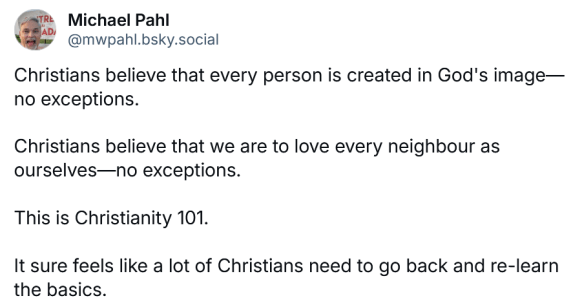
A social media post with this text: "Christians believe that every person is created in God's image—no exceptions. Christians believe that we are to love every neighbour as ourselves—no exceptions. This is Christianity 101. It sure feels like a lot of Christians need to go back and re-learn the basics."

It got me thinking: what is Christianity 101? In other words, what are the basics that every Christian should know and live out?

It’s not a new reflection for me. Along the way I’ve taught plenty of “Intro to Christianity” type courses in academic contexts, along with my share of catechism or baptismal preparation-type classes in churches. I’ve even written a short intro to Christian theology from a biblical theological angle—most of which I still agree with. 😜

But at this time in my life—after 30+ years of Christian academic and church ministry—and at this moment in time—in the shadow of fascism’s resurgence, in an era of increasing distrust and polarization, in a climate-changing world, a democracy-precarious world, and so on and so on—what should every Christian know and live out?

A quadrilateral of thoughts—which would make for a great four-session series…

First, Jesus.

Christianity 101 starts with Jesus—he is, after all, the very image of God, God’s message made flesh, as well as the only foundation for our faith and for the church. Put another way, there’s a reason why Jesus’ name, or a title for Jesus, is on every page of the New Testament.

A basic Christian understanding of Jesus should include a familiarity with the stories and teachings of Jesus in the Gospels. It should include an appreciation of the larger significance of the key episodes in Jesus’ life, and his core teachings. It should include a grasp of the scope of basic Christian confessions like “Jesus is the Christ” and “Jesus is Lord.” It should include a commitment to follow Jesus as Christ and Lord, following in his way of love leading to justice and peace and life.

Second, God.

If Jesus is on every page of the New Testament, God is there at least as often. In fact, the story of Jesus is presented in the New Testament as a story about God, about what God is up to in the world. And Jesus himself had much to say about these things.

A basic Christian understanding of God should include a recognition of God as Creator, both distinct from creation and intimately involved in it—with the strong implication that creation is good, and loved by God. It should include a recognition of God as Saviour or Redeemer—the One who, ultimately, delivers us from our ways of harm and restores us to goodness and life and justice and peace. It should include reflection on the triune nature of God, at the very least that God acts in the world through Jesus by the Spirit and that we come to God and experience God through Jesus by the Spirit.

Third, faith.

The call to faith in God is persistent through the Christian Scriptures, carrying through the New Testament. This is not merely a call to believe certain things about God, though there are such things (see above for some of them). Rather, biblical faith is much more about a personal trust in God, an entrusting of ourselves into God’s care, come what may. It’s also a call to commitment or even allegiance—as Christians we are to follow God’s ways above any other ways, and these ways are the ways of Jesus, the ways of the Spirit.

This faith in God, this devotion to God, this love of God, is expressed and nurtured in certain ways. Christianity 101 would begin to nurture some of these ways of faith, including prayer, worship, solitude, community, study, service, simplicity, generosity, and more. And the greatest of these is…

Fourth, love.

Ferdinand Hodler, The Good Samaritan

The call to love is also persistent through the Christians Scriptures, and especially in the New Testament. This is also the primary “way of God, way of Jesus, way of the Spirit” in which we are to live. It is the primary expression of a genuine Christian faith. It is the primary characteristic of those who claim to follow Jesus.

This basic Christian love is not merely affection, tolerance, respect, or simple kindness—though it includes those attitudes and actions which are commonly called “love.” Basic Christian love is, as one should expect, love in the way of Jesus.

Jesus called his followers to love both neighbours and enemies, and he told stories about and lived out this neighbour-enemy love. It’s an open-hearted, open-armed, open-handed love, giving generously of one’s self. It sees each person as one created in God’s image and loved by God. It’s a practical care for the needs of others, as if their needs were our own—and especially those most in need, most vulnerable to harm. It’s a readiness to forgive when harmed, even when it’s hard. It’s a willingness to stand in solidarity with the harmed, even at great personal sacrifice. It is this way of love that leads to true justice, lasting peace, and flourishing life for all, and all God’s creation.

Jesus. God. Faith. Love.

It’s a quadrilateral of basic Christianity, within which there is plenty of room for lifelong, expansive growth.


© Michael W. Pahl

Following Christ into Catastrophe

We seem to be constantly on the verge of impending catastrophe. COVID. Climate change. The collapse of Twitter.

That last example is a bit tongue-in-cheek, but there’s some truth in it. The collapse of Twitter (if it happens) would have significant negative impact on some people’s livelihoods, health supports, advocacy networks, and more. But it’s also true in a different way: the way people are responding to Twitter’s demise reveals some of the social dynamics at play in the larger catastrophes we face.

It seems to me there are two unhelpful responses to these catastrophes.

One is to get swept up in the tidal wave of fear and despair—the hysteria—that accompanies any perceived catastrophe. There is even a kind of “culture of catastrophe” at work in some segments of society, where our way of being in the world, even our identity in society, is determined in relation to whatever the current catastrophe is. We are required always to be in a heightened state of anxiety and urgent action—a sure-fire recipe for mental ill health and societal conflict.

The other unhelpful response, though, is to downplay or even ignore the seriousness of the problem. Catastrophes do happen. Catastrophes have happened in history, and they are happening around the world. COVID and climate change are real problems. Injustice and inequity, bigotry and violence, disease and disaster, in all their forms, are real problems. To suggest otherwise is to be naïve, or even to betray our historical or geographical privilege—those living in the middle of catastrophe don’t have the option of ignoring it.

So what should we do? In particular, how should we as Christians follow Christ into catastrophe?

Well, we have some good guidance from Jesus himself in the Gospels. After all, Jesus predicted a catastrophe, and gave instructions for his followers on how to walk in that catastrophe. Let’s give a glance at Jesus’ “Apocalyptic Discourse” (yes, that’s what scholars call it) in Matthew’s Gospel.

David Roberts, The Siege and Destruction of Jerusalem, Wikimedia Commons

In Matthew 24-25, Jesus describes the destruction of the Jerusalem Temple, a catastrophe which happened roughly 40 years after Jesus. (For a few historical-critical thoughts on this, see below.*) Jesus sets this catastrophe in the context of even wider catastrophes: wars, natural disasters, famines, plagues, and the like. And then Jesus gives some guidance for his followers on how they should walk into those catastrophes.

One word of guidance from Jesus is especially highlighted through chapter 24, summed up in this phrase: watch and pray.

“Stay awake,” Jesus says, be watchful. Be aware of what is going on, pay attention to the things that are happening and what they mean. Be ready for God’s deliverance when it comes. And pray. Pray as Jesus taught us (Matt 6:9-13). Trust in our loving God for our daily bread. Pray for salvation from the time of trial and deliverance from evil. Hope in God’s good future on the far side of the apocalypse.

Take seriously what’s going on. But don’t get caught up in the hysteria; don’t get swept up in the fear and despair. Don’t let the unfolding catastrophe determine your way of being in the world, your identity in the world. Watch and pray.

Another word of guidance is especially bought home in chapter 25, summed up this way: care for “the least” among us as the worst unfolds around us.

Jesus calls his followers to use what God has given us to invest into God’s kingdom, God’s reign of justice and peace and life. Feed the hungry, Jesus says, welcome the stranger, clothe the naked, heal the sick, care for the imprisoned. In other words, continue to “seek first God’s reign and God’s justice” (Matt 6:33).

Don’t give up on this world; and especially, don’t give up on those among us most vulnerable to harm by evil forces in times of trial. Care for “the least” among us as the worst unfolds around us.

Some of us as Christians are good at not getting caught up in the hysteria of COVID or climate change or any other impending catastrophe. But then we’re often not as good at being aware of the reality of the problems, or at focusing on the most vulnerable through those problems, and those vulnerable people get harmed.

Others of us are good at being aware of the problems and, sometimes at least, centering the most vulnerable in the midst of those problems. But then we’re often not as good at prayerfully trusting in God for our present, or prayerfully hoping in God for the future, and we walk in unhealthy anxiety and inflame conflict with others who are not our enemies.

May we take Jesus’ words to heart, and follow Christ into the catastrophes of our time, walking always in faith, hope, and love, especially for those most often deemed least in our world.

———————————

*Here’s my take on the Synoptic apocalyptic discourses. There’s such a strong memory of Jesus’ predicting a future calamitous end, and even specifically the destruction of the Jerusalem Temple, that I think it likely Jesus did indeed predict this. That memory is preserved not just in all four Gospels (Matt 24; Mark 13; Luke 21; John 2) but also in other NT passages (e.g. 1 Thess 4-5). And there were certainly enough signs in Jesus’ day that things were not going to end well for the Jewish people in their struggle against Roman imperial power. A Temple destruction in some not-too-distant future was also on the minds of others (see accounts in Josephus).

I also think it likely that Jesus believed the end of the age and the dawn of the coming age, the fullness of the reign of God, would come at the time of the Temple’s destruction. In this Jesus was wrong. However, the Gospel authors, all writing after the Temple’s destruction in 70 CE (Mark as a possible exception to this), still saw value in Jesus’ words. Yes, they embellished Jesus’ predictions to make them fit more directly with recent historical events (especially Luke in Luke 21:20-24), but they didn’t substantially change the tradition they had received (so they believed) from Jesus. Why is that?

One reason, I think, is simply that it confirmed Jesus as a prophet. He had predicted the Temple’s destruction, and look, it happened. But I think there’s another reason: they saw in Jesus’ words continuing guidance for them in the midst of the wider “catastrophes” he highlighted. Wars, natural disasters, famines, and plagues continued, along with false prophets and false messiahs and opposition and even persecution of Jesus’ followers. While Jesus’ return and the fulfillment of God’s reign was transferred to some unknown future, we still live in this “time between the times” where all these calamitous events take place. We need Jesus’ guidance on how to live in these ongoing days of evil.


© Michael W. Pahl

My Faith Story

On September 4, 2022, I shared my faith story with my congregation as part of the process of transferring my membership from my previous congregation. Here is what I shared.

If I were to sum up my faith journey in a phrase, it might be this: “Pursuing Jesus who first found me.”

I grew up in a conservative evangelical environment, nominally Anabaptist. I knew my Bible. I knew about Jesus. But I didn’t know Jesus.

In my university days I went on a spiritual quest. I checked out other religions—Hinduism and Buddhism fascinated me for a while. I actively participated in a different church every year of university: Pentecostal, United Church, Lutheran, Baptist. I was baptized in that Baptist church.

Along the way I had a profound spiritual experience that pushed me back to the Bible. I read it like I’d never read it before, in huge chunks: all of Isaiah in one sitting, all of Luke and Acts in another, all of Genesis in a morning, all of John in an afternoon, Romans before bed. I gorged on Scripture.

And that’s how I first met Jesus. I read the Bible and I found Jesus. Or rather, Jesus found me, and I’ve pursued him ever since.

Later, when I was teaching through the New Testament at a small Christian college and working on my Ph.D., I had an epiphany: this Jesus-centred reading of Scripture had made me into an Anabaptist. By reading the Bible to follow Jesus I had become committed to Jesus’ way of nonviolence, his way of just peace, his way of community, his way of love.

And so, when I left this nondenominational college to move into pastoral ministry, it made sense to serve in a Mennonite congregation, one that was thoroughly Anabaptist.

That was 13 years ago, and our journey since then has brought us from Alberta to Ohio to Manitoba, and now into my current role as Executive Minister of Mennonite Church Manitoba, and member of Home Street Mennonite Church. I’m grateful for this congregation, for its commitment to pursue Jesus who first found us.

Last week Ingrid shared about developing a centred-set approach to church instead of a bounded-set approach. I’ve also taught that concept since first coming across missionary anthropologist Paul Hiebert’s use of this idea. And this, to me, is at the centre of this thing we call “Christianity,” and this thing we call “church”: Jesus, and Jesus’ way of love.

Jesus of Nazareth, crucified Messiah and resurrected Lord, and Jesus’ way of devotion for God expressed through compassion for others, especially those the world deems “last,” “least,” or “lost.”

We gather around Jesus and his way of love like people gathering around a bonfire on a cold, dark night. We draw close to Jesus and his love for light and warmth, and as we do so we find ourselves drawing closer to each other.

Around this fire we tell our stories, we sing our songs, we pray our prayers, we share our bread and wine. And we commit ourselves to following Jesus and his way of love as we go out into the world, carrying our candles lit with the fire of Jesus’ love.

As we go we proclaim the greatest revelation Jesus has given us: God is love. We should know this from Scripture, we should know this from observing creation around us, but in Jesus this is confirmed and clarified: God is love.

God always loves. God cannot not love. Everything God does is motivated by love and enacted in love. This means that anything we experience that is not of love is not of God. God is not the author of evil or suffering or harm.

Love is the essence of God in a way that God’s other attributes are not. God’s holiness is a holy love. God’s justice is a just love. God’s wisdom is a wise love. God’s power is a powerful love.

All is being moved by love towards God’s good purposes. Love is stronger than injustice or violence. Love is stronger than every other power. Love is stronger than death. In the end, love will win, and all will be well.

Jesus, and Jesus’ way of love, pointing us to the God who is love.

This is indeed good news.

“Fully convinced”?

“Being fully convinced that God was able to do what God had promised.”

These are the words that jump off the page for me as I look ahead to the lectionary texts for this coming Sunday. These come from Romans 4, Paul’s midrash on the Abrahamic covenant stories of Genesis 15 and 17. For Paul, this is a core element of the faith God desires of us.

“Being fully convinced that God is able to do what God has promised.”

I don’t think I have that kind of faith, or, at least, not often. “Fully convinced?” Hopeful, sure, that God will do what God has promised. Trusting in God through all things, regardless of what happens, yes. But “fully convinced”? That seems like a faith too great for mere mortals like me.

And then I remember the rest of Abraham’s story. Sure, at these moments of encounter with God, when God comes before him in awe and wonder, then Abraham could well have been “fully convinced that God was able to do what God had promised.” But the rest of the story shows us that Abraham was not always “fully convinced.” In fact, he sometimes wasn’t trusting in God at all.

It turns out Abraham was human after all. Just as human as the God-man Jesus, who wrestled with doubts in the Garden of Gethsemane. Just as human as you and me.

God is able to do what God has promised. That reality doesn’t depend on our faith or lack of faith. The invitation to faith is an invitation to rest in this reality. Let’s cherish our experiences of full conviction, for sure. But may we always be encouraged that even great examples of faith like Abraham, even our Lord Jesus, wrestled with doubt in times of uncertainty and distress. This, too, is faith.

Five Simple Hacks to Revolutionize Your Bible Reading

You don’t have to be a Bible scholar to get more out of your Bible reading. Ideally, sure, we’d all be reading the Bible in ancient Hebrew and Aramaic and Greek with a full understanding of the relevant ancient cultures—but we all know that’s not going to happen. So, here are a few tricks of the trade—a few “Bible reading hacks”—to help you maximize your English Bible reading. Beware, though, you might find this actually revolutionizes your Bible reading—and radicalizes your faith in Jesus and his way of love.

Read “Jesus” as “Jesus of Nazareth.”

We as Christians tend to think about Jesus in generic sorts of ways, or we domesticate Jesus so he fits better with who we already are. Reading “Jesus” in the New Testament as “Jesus of Nazareth” reminds us that it’s not just some generic Jesus whom we trust and obey, but a very specific Jesus: a first-century Jew from rural Galilee who lived in certain ways and taught certain things and, as a result, was rejected by many of his religious leaders as a blasphemer and executed by the Roman Empire as an enemy of the state. See here for some direct biblical reminders of Jesus as a man from Nazareth.

Read “Christ” as “Messiah.”

Most Christians probably know that “Christ” is not Jesus’ second name, but a title: it is the equivalent of “Messiah.” There were a few different messianic expectations among Jews in the first century, but the most common—and the one behind the New Testament word “Christ”—was the expectation of a king in the family line of ancient Israel’s King David, who would arise and bring about God’s reign of justice and peace on earth. See here for a few of these kingdom expectations. Confessing Jesus as “Christ” means claiming these expectations are being fulfilled in Jesus of Nazareth.

Read “kingdom of God” as “God’s reign of justice and peace and life”—and read “salvation” the same way.

We might tend to think of the “kingdom of God” as equivalent to “heaven,” by which we mean “an eternal, spiritual future of perfection and bliss.” This can be especially so when we read Matthew’s preferred phrase, “kingdom of heaven.” However, this is not what language of “God as king” or “God’s kingdom” meant for Jews in Jesus’ day.

The “kingdom of God” is about God’s reign as rightful ruler over all creation, bringing justice and peace for all people and flourishing life for all things. It is closely tied to biblical language of “salvation”: God’s reign brings deliverance from evil powers that oppress us (economic, political, spiritual, and more), and a restoration to freedom and full, flourishing life. “Eternal life”? That’s “the life of the coming age”: life under God’s reign, experiencing God’s “salvation” even now, in this age. Notice the way this language is all connected in this passage, for example.

God’s kingdom is “of heaven”—originating in God’s holy presence and reflecting God’s righteous character—and so it is “not of this world”—the very opposite of the power-hungry, violent empires we have known in human history. But in Messiah Jesus of Nazareth this reign of God “has come near,” and one day it will fully come about “on earth as it is in heaven.” This is the fullness of “salvation” for which we all yearn, deep in our bones.

Read “faith” as “devotion” or even “allegiance.”

The biblical language of “faith” is much more than just “believing the right things about the right things.” In fact, James describes that kind of “faith” on its own as “dead,” “barren,” “unable to save.” Yet this is often what Christians mean by “faith.”

In the Bible the language of “faith” and “believing” is much more personal than propositional. It’s primarily about trusting in God through all things, being devoted to God in all ways. It is really about allegiance: “faith” is a commitment to God and God’s ways as revealed in Jesus. Reading “faith” language as “devotion” or even “allegiance” reminds us of the radical nature of Christian faith.

Read “love” as “Jesus’ way of love.”

“Love” is another of those words that can mean a lot of different things for us. But in the New Testament the “love” we are to aspire to has a very specific association with Jesus. It is “love in the way of Jesus,” which includes things like breaking bread with “sinners” and other outcasts, welcoming “strangers,” blessing “enemies,” forgiving those who sin against us, caring for “the least” in society, bringing good news to the poor, freely healing the sick, warning powerful oppressors, and liberating people from evil forces that coerce and constrain them. In other words, “love” is how we live into God’s reign of justice and peace and life.

Next time you’re reading the New Testament, give these “Bible reading hacks” a try. Just remember my warning: if you take this Bible reading seriously, you might find yourself on the same path as Jesus, loving outcasts and walking with the oppressed and being crucified by the powers-that-be. The good news? There’s a resurrection on the other side. This is the narrow path leads to true life, for you and for all.

© Michael W. Pahl

Preserving Faith for Future Generations

From December 2017 through February 2018, I wrote a series of short articles for MennoMedia’s Adult Bible Study Online. Over the past three weeks I have reproduced those here in my blog. Here is the article for February 25, 2018, based on 1 Timothy 6:11-21.

First Timothy concludes with this exhortation: “Guard what has been entrusted to your care.” This is very similar to another exhortation in the Pastoral Epistles, 2 Timothy 1:13-14: “What you heard from me, keep as the pattern of sound teaching, with faith and love in Christ Jesus. Guard the good deposit that was entrusted to you—guard it with the help of the Holy Spirit who lives in us.” These echo Paul’s plea to “hold fast to the teachings” or “traditions” he had passed on (2 Thess 2:15; cf. Rom 6:17; 1 Cor 11:2), and they are right in line with perhaps the best known of these New Testament appeals, Jude 3: “contend for the faith that was once for all entrusted to the saints.”

Yet what precisely is this “deposit,” this “faith,” these “traditions”? And how exactly do we “hold fast to” these traditions, or “guard” this deposit, or “contend for” this faith?

For many Christians today, the “deposit” of “faith” is a fairly comprehensive set of beliefs and practices. It might include everything from specific convictions about the nature of the Bible and how to read it, to particular ideas about the timing of creation, what counts as “sin,” the meaning of Jesus’ death, the mode of baptism, worship style, and much, much more. It’s “the way we’ve always done things,” it’s the “faith of our fathers,” it’s that “old time religion”—even when, in reality, the generations before us went through significant adaptations to their way of faith and life.

However, Kathleen Kern is almost certainly correct in her suggestion that the entrusted gift in view here is the gospel (Adult Bible Study student guide, 78). The “deposit” we are to “guard,” the “faith” for which we are to “contend,” the “traditions” to which we are to “hold fast”—these are all describing some aspect of the good news story of Jesus, Israel’s Messiah and the world’s true Lord, who brings about God’s saving kingdom on earth through his life, death, and resurrection.

How can we preserve this gospel for future generations? Our passage points to an answer: “pursue righteousness, godliness, faith, love, endurance, and gentleness,” it says, and so “fight the good fight of the faith” (6:11-12). In other words, we preserve the gospel for future generations by living out the gospel in our own—in authentic faith and love, in genuine godliness and gracious gentleness, with patient perseverance, always seeking first God’s kingdom and justice.

What non-essential beliefs or practices have we added to the simple gospel of Jesus? Which of these might we be wrongly expecting that the next generation keep? Are we striving to live out the good news of Jesus with authenticity and integrity? Are we willing to allow the next generation to live out the gospel in their own way, for their own time?

Faith and Works

From December 2017 through February 2018, I wrote a series of short articles for MennoMedia’s Adult Bible Study Online. Over three weeks I am reproducing those here in my blog. Here is the article for February 4, 2018, based on James 2:14-26.

As the Adult Bible Study student guide notes, it’s possible that James was responding to a misunderstanding of Paul’s teaching about being justified by faith and not by works of the Law. In fact, given the similarities in wording between specific statements in Paul’s letters (Rom 3:28; Gal 2:16) and here (Jas 2:24), this is likely the case. Some had understood Paul to mean that our actions don’t matter with regard to salvation—all that matters is believing certain things to be true. Sadly, many Christians today also understand Paul’s teaching this way—and they either accept this teaching as gospel or reject Paul as having distorted Jesus’ teaching.

It’s a common misunderstanding of Paul’s teaching, that “faith” is simply “belief,” mentally assenting to certain truths—that Jesus died for our sins and rose again, for example. However, the word for “faith (pistis) can have a wide range of meanings. It can include “belief,” but it can also mean “trust,” “faithfulness,” or “allegiance.” Paul in fact draws on this whole semantic range of the word pistis: yes, believing certain things to be true is important, but so is trusting in God in a personal way, as well as showing faithfulness and demonstrating allegiance to God. This is underscored by the many ways Paul speaks about genuine faith as that which works itself out in loving actions (e.g. Gal 5:6).

James gives two examples of these “loving actions” that result from genuine faith: caring for the poor (2:1-9, 14-17), and protecting the foreigner (2:25-26). This is significant for at least two reasons.

First, these are prominent themes throughout the Scriptures. Concern for the poor, including the widow and orphan, and concern for the foreigner or stranger, is deeply embedded in the Law of Moses and repeatedly voiced by the Prophets (e.g. Lev 19:10, 34; Deut 15:7-11; Isa 1:17; Jer 22:3). This concern for the poor and the stranger, representing the most vulnerable in society, continues through the teaching of Jesus and the rest of the New Testament (e.g. Matt 25:34-40; Rom 12:13; Gal 2:10; 1 John 3:17).

Second, this is significant because these continue to be prominent needs—and controversial flashpoints—today. Somehow, in certain conservative Christian circles, caring for the poor and welcoming the stranger, or calling on governments to attend to these needs, has become a sign of theological liberalism. But can we claim to have genuine, living, saving faith, yet refuse to stand with the poor and the foreigner, with all who are vulnerable and marginalized in society? Both James and Paul—following in the footsteps of Jesus, following the Law and the Prophets—are clear: the answer is a resounding “no.”

Holding on to Identity as a Minority Faith

From December 2017 through February 2018, I wrote a series of short articles for MennoMedia’s Adult Bible Study Online. Over three weeks I am reproducing those here in my blog. Here is the article for January 7, 2018, based on Daniel 1.

Christianity is the largest religion in the world, with an estimated 2.3 billion adherents. As of 2015, three-quarters of Americans and two-thirds of Canadians identify as Christians. We are hardly a minority faith.

Still, it is true that Christianity’s public influence has declined. Christianity is no longer the touchstone of North American culture that it once was. Christianity no longer defines social values or public policy in quite the way it once did. The institutions of Christianity are not as prominent or as powerful as they once were, and the institutions of our western society are no longer exclusively or even predominantly Christian—if they ever were. Christendom is no more.

This means that although Christianity is not a minority faith in North America it can often feel like it is. For some, this presents a challenge, even a catastrophe. I think it presents an opportunity.

This changed situation is an opportunity for us to reflect on and sharpen our identity as Christians: What does it really mean to be “Christian”? What marks us off as “Christian”? What distinctive beliefs or rituals or symbols or sacred stories are at the heart of this thing called “Christianity”?

The story of Daniel and his three companions in Daniel 1 is a story about early Jewish identity. Ostensibly about Israelites exiled in ancient Babylonia, yet really about Maccabean Jews under pressure to Hellenize, the story remains for Jews a powerful symbol of maintaining their religious and cultural identity in the face of enormous pressure to assimilate. For us as Christians, it can stand as a biblical call to reflect on our identity as Christians, asking those same questions forced upon us by our own post-Christendom context.

So, what does mark us off as “Christian”? Contra Daniel 1, the New Testament insists it’s not our diet—“all foods are clean,” Mark concludes based on Jesus’ teaching (Mark 7:14-19), and Paul declares that “the kingdom of God is not food and drink” (Rom 14:14-17). Likewise, it’s not the observance of holy days like the Sabbath (Rom 14:5-6; Col 2:16-17) or covenant rituals like circumcision (Gal 5:6; 6:15).

For Christians, beliefs, rituals, symbols, and sacred stories have tremendous value in nurturing the things that matter most, but they are not themselves those essentials of Christianity. Rather, as markers of Christian identity Jesus and the Apostles consistently point us to a cluster of lived-out virtues: a trusting, obedient faith, a persevering, persistent hope, and, above all, a self-giving, other-delighting love, all in the way of Jesus, all nurtured by the Spirit.