
I recently posted this online:
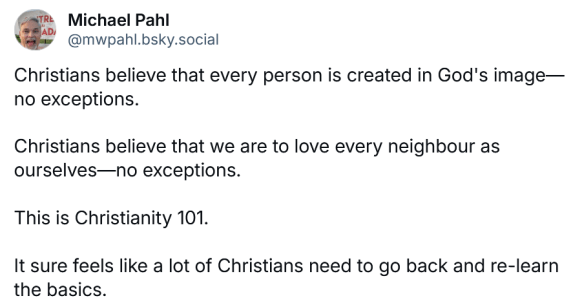
It got me thinking: what is Christianity 101? In other words, what are the basics that every Christian should know and live out?
It’s not a new reflection for me. Along the way I’ve taught plenty of “Intro to Christianity” type courses in academic contexts, along with my share of catechism or baptismal preparation-type classes in churches. I’ve even written a short intro to Christian theology from a biblical theological angle—most of which I still agree with. 😜
But at this time in my life—after 30+ years of Christian academic and church ministry—and at this moment in time—in the shadow of fascism’s resurgence, in an era of increasing distrust and polarization, in a climate-changing world, a democracy-precarious world, and so on and so on—what should every Christian know and live out?
A quadrilateral of thoughts—which would make for a great four-session series…
First, Jesus.
Christianity 101 starts with Jesus—he is, after all, the very image of God, God’s message made flesh, as well as the only foundation for our faith and for the church. Put another way, there’s a reason why Jesus’ name, or a title for Jesus, is on every page of the New Testament.
A basic Christian understanding of Jesus should include a familiarity with the stories and teachings of Jesus in the Gospels. It should include an appreciation of the larger significance of the key episodes in Jesus’ life, and his core teachings. It should include a grasp of the scope of basic Christian confessions like “Jesus is the Christ” and “Jesus is Lord.” It should include a commitment to follow Jesus as Christ and Lord, following in his way of love leading to justice and peace and life.
Second, God.
If Jesus is on every page of the New Testament, God is there at least as often. In fact, the story of Jesus is presented in the New Testament as a story about God, about what God is up to in the world. And Jesus himself had much to say about these things.
A basic Christian understanding of God should include a recognition of God as Creator, both distinct from creation and intimately involved in it—with the strong implication that creation is good, and loved by God. It should include a recognition of God as Saviour or Redeemer—the One who, ultimately, delivers us from our ways of harm and restores us to goodness and life and justice and peace. It should include reflection on the triune nature of God, at the very least that God acts in the world through Jesus by the Spirit and that we come to God and experience God through Jesus by the Spirit.
Third, faith.
The call to faith in God is persistent through the Christian Scriptures, carrying through the New Testament. This is not merely a call to believe certain things about God, though there are such things (see above for some of them). Rather, biblical faith is much more about a personal trust in God, an entrusting of ourselves into God’s care, come what may. It’s also a call to commitment or even allegiance—as Christians we are to follow God’s ways above any other ways, and these ways are the ways of Jesus, the ways of the Spirit.
This faith in God, this devotion to God, this love of God, is expressed and nurtured in certain ways. Christianity 101 would begin to nurture some of these ways of faith, including prayer, worship, solitude, community, study, service, simplicity, generosity, and more. And the greatest of these is…
Fourth, love.

Ferdinand Hodler, The Good Samaritan
The call to love is also persistent through the Christians Scriptures, and especially in the New Testament. This is also the primary “way of God, way of Jesus, way of the Spirit” in which we are to live. It is the primary expression of a genuine Christian faith. It is the primary characteristic of those who claim to follow Jesus.
This basic Christian love is not merely affection, tolerance, respect, or simple kindness—though it includes those attitudes and actions which are commonly called “love.” Basic Christian love is, as one should expect, love in the way of Jesus.
Jesus called his followers to love both neighbours and enemies, and he told stories about and lived out this neighbour-enemy love. It’s an open-hearted, open-armed, open-handed love, giving generously of one’s self. It sees each person as one created in God’s image and loved by God. It’s a practical care for the needs of others, as if their needs were our own—and especially those most in need, most vulnerable to harm. It’s a readiness to forgive when harmed, even when it’s hard. It’s a willingness to stand in solidarity with the harmed, even at great personal sacrifice. It is this way of love that leads to true justice, lasting peace, and flourishing life for all, and all God’s creation.
Jesus. God. Faith. Love.
It’s a quadrilateral of basic Christianity, within which there is plenty of room for lifelong, expansive growth.
© Michael W. Pahl
 © Michael W. Pahl

#/media/File:Annibale_Carracci_-_Holy_Women_at_Christ'_s_Tomb_-_WGA4454.jpg)

 Michael Pahl