A Vision of the Last Days

From December 2017 through February 2018, I wrote a series of short articles for MennoMedia’s Adult Bible Study Online. Over three weeks I am reproducing those here in my blog. Here is the article for January 28, 2018, based on Daniel 10-12.

“The last days.”

In popular Christian parlance, the phrase suggests the final strands of earthly, human history. The thread of history stretches back before us to the dawn of time, and ahead of us, at some future point, this thread ends with “the last days.” For many Christians this phrase also conjures up images of portents in the heavens and cataclysms on earth. “The last days” is the end of it all, before God wipes the slate clean and creates a new heaven and earth.

If this is our understanding, it might be disconcerting to learn that this kind of language is used in Scripture to describe happenings within human history, including what is, for us, past history.

This is the case here in Daniel 10-12. Daniel’s vision describes “the last days,” even “days yet to come”—that’s more literally the wording of Daniel 10:14. This sort of language continues throughout the vision with the phrase “appointed time” or “time of completion” (11:35; 12:4, 9). Yet scholars are agreed that the visions describe historical persons and events in the second century B.C.E., now more than 2,000 years ago.

This is also the case throughout the New Testament. Peter’s Pentecost sermon applied Joel’s vision of “the last days,” with all its heavenly portents and earthly cataclysms, to Peter’s present day (Acts 2:16-21). Paul declared that Jesus’ birth occurred “at the fullness of time” (Gal 4:4), and he described himself and his readers as those “on whom the ends of the ages have come” (1 Cor 10:11). The author of Hebrews declared that “in these last days” God has spoken to us through his Son, Jesus (Heb 1:2). And John the Seer stated that his apocalyptic visions described realities which were present in his own time, or were very soon to come about (Rev 1:1, 19).

It’s enough to make you think that perhaps we’ve gotten the whole “last days” thing quite badly wrong. But then, what is the point of all this “end times” language in Scripture?

Its main purpose is reassurance. This language is intended to reassure God’s people that, regardless of how bad things might seem in the present, God is in fact working within human history to bring about God’s good purposes. And its main focus is on Jesus. Jesus’ birth, life, death, and resurrection have inaugurated the time of fulfillment. We are in “the last days” right now: God’s good purposes have already been accomplished through Jesus, and now God is working out those good purposes throughout the earth.

In a world filled with the bad news of nuclear threat, civil wars, economic injustice, racism, divisive politics, sexual abuse, and more, this reassurance is the good news we all need.

Holding on to Identity as a Minority Faith

From December 2017 through February 2018, I wrote a series of short articles for MennoMedia’s Adult Bible Study Online. Over three weeks I am reproducing those here in my blog. Here is the article for January 7, 2018, based on Daniel 1.

Christianity is the largest religion in the world, with an estimated 2.3 billion adherents. As of 2015, three-quarters of Americans and two-thirds of Canadians identify as Christians. We are hardly a minority faith.

Still, it is true that Christianity’s public influence has declined. Christianity is no longer the touchstone of North American culture that it once was. Christianity no longer defines social values or public policy in quite the way it once did. The institutions of Christianity are not as prominent or as powerful as they once were, and the institutions of our western society are no longer exclusively or even predominantly Christian—if they ever were. Christendom is no more.

This means that although Christianity is not a minority faith in North America it can often feel like it is. For some, this presents a challenge, even a catastrophe. I think it presents an opportunity.

This changed situation is an opportunity for us to reflect on and sharpen our identity as Christians: What does it really mean to be “Christian”? What marks us off as “Christian”? What distinctive beliefs or rituals or symbols or sacred stories are at the heart of this thing called “Christianity”?

The story of Daniel and his three companions in Daniel 1 is a story about early Jewish identity. Ostensibly about Israelites exiled in ancient Babylonia, yet really about Maccabean Jews under pressure to Hellenize, the story remains for Jews a powerful symbol of maintaining their religious and cultural identity in the face of enormous pressure to assimilate. For us as Christians, it can stand as a biblical call to reflect on our identity as Christians, asking those same questions forced upon us by our own post-Christendom context.

So, what does mark us off as “Christian”? Contra Daniel 1, the New Testament insists it’s not our diet—“all foods are clean,” Mark concludes based on Jesus’ teaching (Mark 7:14-19), and Paul declares that “the kingdom of God is not food and drink” (Rom 14:14-17). Likewise, it’s not the observance of holy days like the Sabbath (Rom 14:5-6; Col 2:16-17) or covenant rituals like circumcision (Gal 5:6; 6:15).

For Christians, beliefs, rituals, symbols, and sacred stories have tremendous value in nurturing the things that matter most, but they are not themselves those essentials of Christianity. Rather, as markers of Christian identity Jesus and the Apostles consistently point us to a cluster of lived-out virtues: a trusting, obedient faith, a persevering, persistent hope, and, above all, a self-giving, other-delighting love, all in the way of Jesus, all nurtured by the Spirit.

Walking Together in Unity

From December 2017 through February 2018, I wrote a series of short articles for MennoMedia’s Adult Bible Study Online. Over the next three weeks I will reproduce those here in my blog. Here is the article for December 31, 2017, based on Ephesians 4.

We live in a divided world, and it seems increasingly to be so. Where once there might have been allowance for nuanced positions that do not fit neatly into an either/or—a “third way,” even—there now seems to be a “you’re either with us or against us” kind of mindset in western society.

“Unity,” in this us-versus-them world, means “absolute solidarity,” “total agreement,” or even “complete uniformity” of belief and practice, whether we are talking about religion or politics or social issues. This “unity” is achieved through acts of power: decisive leadership giving firm direction, backroom deals and deceitful manipulation if necessary, enforced agreement with established dogma, harsh public shaming if someone steps out of line.

 You’re either with us in all things—blessed “unity”—or you’re against us—accursed “other,” beyond the pale.

Ephesians 4:1-16 gives us a very different picture of unity. It is a unity grounded in the simple one-ness of God, yet with a diversity reflected in the complex three-ness of God’s redemptive work. There is one-and-only-one Spirit at work among us all, one-and-only-one Lord to whom we owe our allegiance, one-and-only-one God who is “above all and in all and through all”—therefore we must walk in this one-ness. Yet God the Father’s work is through the Lord Jesus and by the Holy Spirit, who gives manifold gifts to all—therefore we must walk in this many-ness.

This one-yet-many unity is a gift given to us: it already is, we just need to walk in it, to live it out, to “keep” or maintain it. And we maintain this unity of the Spirit “through the bond of peace”: not through power politics or strong-arm tactics, but through Christ-like humility, gentleness, patience, and forbearance in love.

Leaders among us are not to lord it over those whom they lead; they are not “the deciders” or “the doers,” or even visionaries with great personal charisma. They are God’s gifts to us, whose sole task is to equip us to do works of service so that we might fully realize our calling to be Christ’s body in the world, continuing Jesus’ mission in the world: the unity of all things (1:9-10), including the reconciliation of all “others” (2:13-18).

What might happen in our world if we fully embraced this radical vision of unity in our churches, instead of the superficial “unity” our world promotes?

Seeking the True King: The True Story

From December 2017 through February 2018, I wrote a series of short articles for MennoMedia’s Adult Bible Study Online. Over the next three weeks I will reproduce those here in my blog. Here is the article for December 24, 2017, based on Matthew 2:1-12.

This is a tale of two kings, with two very different kingdoms.

The first is “King Herod,” known to history as “Herod the Great.” A ruthless tyrant, he murdered a wife and some children out of jealousy and suspicion. He is known to history as “the Great” because of his grand building programs—built intentionally to increase his fame, a vain attempt at immortality. Herod had been pronounced “King of Judea” by the Roman Senate. He seized on this title, and despite his impure lineage and dubious religious devotion he called himself “King of the Judeans”—that is, “King of the Jews.”

The second is a baby, called “king of the Jews” by others—he would never, at any time in his life, claim the title himself. This king was born in questionable circumstances himself, though his lineage from the great Israelite kings of old was secure (Matt 1:1-25). He would become known as a prophet like Elijah, speaking truth to power while lifting up the lowly through merciful miracles. He would become known as a teacher like Moses, giving divine instruction from the mountain and further explanation along the way. He was the Messiah, the promised Jewish king who establishes God’s kingdom on earth.

Herod’s kingdom represents the way of the world: concerned with power and privilege and prestige for the few, to hell with the weak and the lowly. Jesus’ kingdom represents the way of God: concerned with compassion and equity and true life for all, to hell with the rich and mighty—should they continue their hellish, destructive ways.

It is precisely at the conjunction of these two kingdoms in history that the Magi arrive on the scene. They are seekers of secret wisdom, and they have seen the signs: a new kingdom is dawning, and the old kingdoms of this world are fading into obscurity. And so, they do what any wise person would do: they pledge allegiance to the greater king and his divine kingdom, child though he be. They offer their kingly gifts to the only worthy king they have met on their journey.

The conflict between these two kingdoms occurs in every generation. The kingdoms of our world—the world’s ways of establishing human relationships, of organizing and governing societies, based around power and privilege and prestige—these kingdoms continue with ever-fading allure. We hear stories of sexual abuse, political deceit, oppressive legislation, and deadly foreign policy—these are the hallmarks of Herod’s kingdom, stumbling into self-destruction.

Yet God’s kingdom—with relationships characterized by humble compassion and geared toward mutual flourishing—this kingdom is evident among us with ever-increasing glory. Will we follow the Magi in bringing our gifts to Jesus, pledging our allegiance to this greater king and his divine kingdom of justice and peace and flourishing life for all?

The Difference between Gods and God

From December 2017 through February 2018, I wrote a series of short articles for MennoMedia’s Adult Bible Study Online. Over the next three weeks I will reproduce those here in my blog. Here is the article for December 17, 2017, based on Acts 14.

The Bible has a complicated relationship with the “gods” of this world. Some biblical texts suggest that there are in fact other deities beyond the God of Israel. Other texts suggest these other “gods” aren’t true deity at all—there is only one true and living God. Some biblical passages describe other gods as “demons” and call on God’s people to avoid these demonic beings at all costs. Other biblical passages seem to view at least some other gods as reflections, albeit imperfect or incomplete reflections, of the one true and living God.

Ancient peoples tended to name as “gods” those realities which they believed had power over them and so required their passive submission, their pious veneration, or even their total allegiance. We in the modern west might not use the language of “gods” to describe these powerful realities, but they are still with us. Political ideologies, economic systems, nationalism and materialism and racism and more—all with their founding mythologies and sacred rituals and mediating priesthoods—hold sway over us in various ways, calling for our submission, our veneration, and even our allegiance.

Within this matrix of many “gods” and “lords,” whether ancient or modern, stands this word from the Apostle Paul, perhaps reflecting a common early Christian confession: “There is no God but one. Indeed, even though there may be so-called gods in heaven or on earth—as in fact there are many gods and many lords—yet for us there is one God, the Father, from whom are all things and for whom we exist, and one Lord, Jesus Christ, through whom are all things and through whom we exist” (1 Cor 8:4-6).

What might it mean for us today to turn from the “gods” of our day to the one true God, to live as if God alone really is the one “from whom are all things and for whom we exist”? What might it mean for us today to confess that “Jesus is Lord” and no one or nothing else is “lord,” to live as if Jesus alone truly is the one “through whom are all things and through whom we exist”?

And are we willing, like Paul in Lystra, to call the world to allegiance to the one true God and Lord even if it means suffering in the way of Jesus?

Who or What Is in Control?

From December 2017 through February 2018, I wrote a series of short articles for MennoMedia’s Adult Bible Study Online. Over the next three weeks I will reproduce those here in my blog. Here is the article for December 10, 2017, based on Acts 13:1-12.

Acts 13:6-12 is a story of identity and power.

Names are important in the story. There’s Bar-Jesus (“son of Jesus”) also called Elymas (“the sorcerer”), and “Saul also called Paul,” as well as Sergius Paulus (that is, also “Paul”). It can be confusing, but all this narrative naming boils down to this question: which of these is a true “son of Jesus,” and which is actually a “son of the devil”? This is a story of identity.

It’s also a story of power. On the one hand you’ve got Elymas cozying up to the powerful, seeking to use the powers that be (both human and supernatural) for his own ends. On the other hand there’s Paul speaking truth to power, the truth of the gospel, the good news of One who died at the hands of the powers that be to free us from all evil powers (both natural and spiritual).

Even Paul participates in a display of supernatural power, speaking a temporary blindness upon Elymas. Yet notice what wins over the proconsul Paulus in the end: “When the proconsul saw what had happened, he believed, for he was amazed at the teaching about the Lord” (13:12). It was the persuasive gospel, not coercive sorcery, that brought about change. It was the strange story of a crucified king, not the sheer force of a supernatural power, that saved the day.

We have many temptations today to seek or maintain worldly power. This is especially so when our lofty plans for bringing about good in the world seem to be thwarted. We can then become frustrated and impatient, and start to look for alternate ways to accomplish those good ends. If only we had some real power on our side, imagine all the good we could do! If only we had political control, judicial authority, economic clout, cultural influence, spiritual dominance, or even just sheer physical force, imagine what we could accomplish for the kingdom!

But this is not the way of Jesus, who deliberately rejected worldly power at both the beginning and end of his career (Matt 4:1-11; 26:36-56). It’s not the way of the gospel, the beautiful good news of a crucified and resurrected king bringing about an upside-down kingdom through patient, persistent, selfless love.

In the end, it is those who trust in and live out this “weak power” of God (1 Cor 1:21-25) who prove themselves to be the true “Bar-Jesus.”

The Paradox of Tolerance: A Parable

God’s reign is like a lavish dinner party put on by a most generous host. The host invited not only the wealthy but the poor, not only the healthy but the sick, not only the powerful but the powerless, not only the acceptable and privileged but the outcast and unworthy as well.

As they sat down for dinner some began to complain, saying, “That person should not be here. They can sit in the other room, maybe, and get the leftovers, but they have no place at this table.” The host admonished them, saying, “All whom I invite are welcome at my table, and they may eat whatever I place before them.”

But still the grumbling continued: “That person should not be here. They have no place at this table, eating this sumptuous feast!” Once again the host affirmed: “All whom I invite are welcome at my table, and they may eat whatever I place before them.”

The objectors rose up from the table, gnashing their teeth, and declared: “I will not eat with that person. Either they go or I do.”

To which the host proclaimed: “It shall be as you have said. And yet I say again: All whom I invite are welcome at my table, and they may eat whatever I place before them.”

Eugène Burnand, The Great Banquet

My Confession of Faith

There is only one reason why I am, and remain, a Christian: Jesus.

In Jesus I see God embodied, a God who is a friend of sinners, who finds the lost and feasts the least and firsts the last. In Jesus I see a God who runs to wayward children, welcoming them in lavish banquets of love.

In Jesus I see a God who stands in solidarity with the poor, the outcast, the stranger. In Jesus I see a God who stands firm against oppression and exclusion by the powerful and privileged.

In Jesus I see a God who loves stories and riddles, flowers and children, and eating good food with good friends and the very best of wine.

In Jesus I see a God who dreams of a better world, a kingdom of justice and peace and flourishing life, and who dares to plant that dream in the world with such a small and insignificant seed: love.

In Jesus I see a God who is willing to die rather than kill, following his own words of nonviolence on his own way of the cross.

In Jesus I see a God who turns death into new life, shame into honour, guilt into forgiveness, futility into purpose, brokenness into wholeness, suffering into joy, despair into hope—and this gives me hope.

In Jesus I also see, then, humanity as we are meant to be: walking in all these ways of Jesus, centered on devotion to our Creator expressed through compassion and care for other humans and all creation, paying special attention to the most vulnerable of God’s creatures.

I am not a Christian because of other Christians, though I know many good Christians. I am not a Christian because of the Bible, though the Bible points me to Jesus and tells me his story.

There is only one reason why I am, and remain, a Christian: Jesus.

© Michael W. Pahl

What’s up with Paul’s language of “the flesh”?

Last night our church held a prayer service in which I invited the congregation to listen for God’s voice to us as I read Scripture. We then responded to this “word of the Lord” through silence, prayer, and song. It was a wonderfully simple service.

One of the extended Bible readings we did was Galatians 5:13–6:10. This is a “how should we then live” passage, the kind found in many New Testament letters sketching out what it looks like for followers of Jesus to live in community with one another in light of the great theological truths just expounded.

As I read this passage, I stumbled over Paul’s use of the word “flesh.” This happens sometimes when I read Paul’s letters publicly. The reason? I fear that people will get the wrong idea.

“The flesh” is a common expression, especially in Paul’s letters, and especially in Romans and Galatians. Just a few examples:

  • “Those who live according to the flesh set their minds on the things of the flesh, but those who live according to the Spirit set their minds on the things of the Spirit” (Rom 8:5).
  • “Put on the Lord Jesus Christ, and make no provision for the flesh, to gratify its desires” (Rom 13:14).
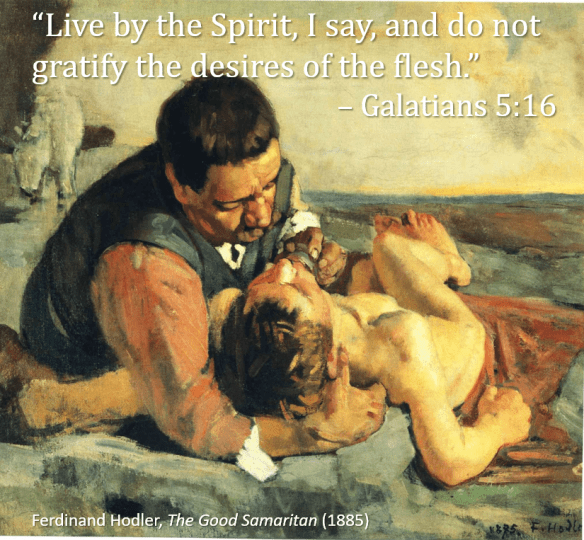
  • “Live by the Spirit, I say, and do not gratify the desires of the flesh. For what the flesh desires is opposed to the Spirit, and what the Spirit desires is opposed to the flesh; for these are opposed to each other, to prevent you from doing what you want” (Gal 5:16-17).
  • “If you sow to your own flesh, you will reap corruption from the flesh; but if you sow to the Spirit, you will reap eternal life from the Spirit” (Gal 6:8).

Many Christians have taken “the flesh” in these and similar verses to mean quite literally “the physical body”: our eyes and ears, our feet and hands, even (or even especially) our genitalia. All the language about “not living according to the flesh” or “making no provision for the flesh” or “not sowing to the flesh,” is about denying our physical body in some way in favour of some inner spirituality (“bodies are bad, the spiritual is good”). Often this is expressed as downplaying or even rejecting our bodily desires, our desires for food, drink, sex, intimacy, and more.

But this doesn’t quite work. It’s true that the Greek word sarx in common usage meant “flesh” or even “the fleshy parts of a body.” But it could also take on a variety of figurative uses. “All flesh,” for example, means “all living creatures.” “Flesh and blood” can mean “human beings,” or even “one’s own kin.” “One flesh” refers to “shared kinship.”

Paul can use the word “flesh” in these sorts of ways, none of which is inherently negative toward our bodies. Paul can even say, positively, that “the life I now live in the flesh (sarx) I live by the faith of the Son of God, who loved me and gave himself for me” (Gal 2:20).

Paul also uses the word “body” (sōma) quite a bit, and many of these uses are positive. Paul describes the believer’s “body” as “a temple of the Holy Spirit” (1 Cor 6:19). He calls on Christians to offer our “bodies” to God as an act of worship (Rom 12:1). He insists that our future resurrection state—imperishable, immortal, untouched by sin and death—will still involve a sōma, a “body” (1 Cor 15:35-44).

In other words, it’s complicated.

I think we can get at what Paul means in verses like those I quoted above if we dig into the contrast Paul makes between “the flesh” and “the Spirit” (stick with me here, it’s worth it).

Paul likes these kinds of binary contrasts: “flesh” in contrast to “Spirit”; “Law” in contrast to “Christ” or “faith”; “this present age” in contrast to “the coming age.” It’s this last one—“this present age” in contrast to “the coming age”—that helps make sense of the rest of them.

You see, Paul held to a common Jewish notion that human history was divided into two “ages.”

The “present age” is the one we’re in, and it is characterized by “powers” that have influence over us, even control over us. Human kingdoms and rulers and authorities. The internal forces that animate these groups and leaders. The structures and systems they create. These “powers” are not necessarily bad, but they can become “evil powers,” perpetuating injustice and oppression, committing violence and bringing destruction. Behind these “evil powers” is the worst of them all, evident in each and every human life: “sin” and the wide-ranging “death” that accompanies it.

The “coming age,” by contrast, is the promised “kingdom of God,” the “new creation,” in which the powers of sin and death are eradicated and all things are brought under God’s liberating, loving reign. The end result? Life: abundant, eternal, harmonious, flourishing life. Shalom, you could also say.

Here’s the thing: because the Messiah has come, the “coming age” is already here, though it is not yet fully here. The kingdom of God, God’s new creation, has entered this present age in anticipation of its future fulfillment. As followers of Jesus the Christ we are called to live out God’s reign, to live out God’s new creation, resisting the evil powers of this age which are over us, among us, and within us.

This is what the contrast between “the flesh” and “the Spirit” is all about. These are, effectively, contrasting ways of being human in the world.

“Living according to the flesh” means “living according to a self-centered, selfish way of being human,” which is at the root of our sin and all its deathly consequences. Indeed, this “self-centered, selfish way of being human” is what lies behind all the evil powers of this present age: corrupt governments and corporations and presidents and CEOs and more, animated by a spirit of greed or vanity or domination, creating oppressive structures and unjust systems within society.

“Living according to the Spirit,” by contrast, means “living according to a God-centered, other-oriented way of being human” which Jesus taught and lived out among us. The “Spirit,” after all, is “the Spirit of Christ,” shaping us into the image of Jesus. When we “live according to the Spirit,” or we “walk in the Spirit,” we are choosing to walk in the way of Jesus, Jesus’ way of love: a deep devotion to God expressed through humble compassion and care for others.

When Paul talks about “the flesh” in these passages, then, he is not talking about our natural, bodily desires for food, drink, sex, and more. He’s talking about those desires turned inward, distorted through our self-centered selfishness.

The antidote is not to deny our bodily desires. These are part and parcel of what it means to be human. They are God-given, a part of God’s “very good” creation.

Rather, the antidote is to rightly order those natural desires around love for God and others, seeking the common good. It is to strive to fulfill those desires through this God-centred, other-oriented way of love, empowered by the very presence of the resurrected Jesus in us and among us.

It is, in other words, to “live by the Spirit.”
The Bible and Same-Sex Relationships

This was the subtitle of a study conference our denomination had 3.5 years ago, hosted at our church: “The Bible and Same-Sex Relationships.” I was one of the plenary speakers at the conference. Although I would word a few things differently now—I’ve learned much since then, and my own perspective has settled—I feel two of my presentations have some enduring value and so I thought I’d share the videos here.

The first is about how we approach the Bible generally: how we read it as Christians, as Anabaptist Christians in particular, and especially when talking about complicated and controversial topics. While there’s much more that could be said about biblical interpretation than I say here, it’s still a good summary of my thinking on this.

The second is a set of concluding reflections on points of agreement between what we called the “traditional” and the “affirming” views. If there is a practically workable “middle way” or even “third way” for churches on this—even simply a basis for fellowship among individuals or churches who disagree—it will be built around the kinds of things I highlight here. (Note: I’m well aware of the delicious irony of me speaking about Jesus being “clear” on the call to love, in light of my reflections on “the Bible is clear on X” in the previous video!)