“Concrete Koinonia”

As I look ahead to this coming Sunday’s lectionary readings, the reality of koinōnia stands out to me. Koinōnia comes from the Greek word for “common” or “shared” (koinos), and so koinōnia has the idea of “that which is held in common,” “that which is shared among us.”

Contrary to the way we often use the word “fellowship,” in the New Testament Christians don’t “fellowship,” as a verb. Rather, we have “fellowship,” as a noun. This koinōnia is a gift from God, a gift of God’s Spirit to us as God’s people.

1 John 1:3 describes it this way: “We declare to you what we have seen and heard so that you also may have koinōnia with us; and truly our koinōnia is with the Father and with his Son Jesus Christ.” There are things we hold in common, realities we share together—in 1 John these would be things like “life” and “light” and “love”—and as we share these common realities together we discover they are in fact realities God has shared with us, realities we hold in common with Jesus.

This “fellowship,” this koinōnia, is not just some abstract truth but a concrete, lived out experience. The love, light, and life we share together in Jesus works itself out in a shared life together, a common way of life in which we come together in acts of love and deeds of light that bring life among us and beyond us.

This “concrete koinōnia” comes out in another lectionary text for this Sunday, Acts 4:32-35: “Now the whole group of those who believed were of one heart and soul, and no one claimed private ownership of any possessions, but everything they owned was held in common (koinos)… There was not a needy person among them, for as many as owned lands or houses sold them and brought the proceeds of what was sold. They laid it at the apostles’ feet, and it was distributed to each as any had need.”

This is the new reality the resurrected Jesus creates among us by the Spirit: a shared reality in which we hold in common a new life of love and light, in which we live out this new reality in ways which re-order our common life so that no one is needy, no one is marginalized, no one is oppressed by forces beyond their control.

The Good News of “Holy Terror”

As we begin our Holy Week journey toward the cross, we know already that the story ends with the good news of resurrection. But Mark gives us a different take on Jesus’ resurrection than we typically think of.

Here are the (most likely*) final words of Mark’s Gospel: “So [Mary, Mary, and Salome] went out and fled from the tomb, for terror and amazement had seized them; and they said nothing to anyone, for they were afraid.”

Fear, even terror? How is this good news?

There’s a long history in the Bible of “holy fear,” even “holy terror,” in the presence of God. This isn’t (normally) because God is angry or abusive, but because God is so…absolutely other. “Holy,” to use the biblical language. When we humans find ourselves in the absolute presence of the transcendent God, we realize that God is not like we had imagined: God is so much greater than we had ever imagined.

This biblical thread finds its way into Mark’s Gospel story of Jesus. When Jesus teaches, people are “astounded.” When Jesus casts out demons, they are “in awe.” When Jesus heals, they are “stunned.” When Jesus walks on the water, his disciples are “terrified.” When Jesus calms the storm, they literally “fear with a great fear.” “Who is this,” they ask, “that even the wind and the sea obey him?”

So we really shouldn’t be surprised when Mark ends his Gospel with these same words, following this long biblical tradition. In Jesus’ resurrection, God has revealed God’s self in all God’s fullness: in life rising out of death, in peace growing out of violence, in liberation bursting out of oppression, in love blooming in the midst of hate. In Jesus’ resurrection, God has blown the doors off all our expectations of who God is and what God does.

This Easter may we, like the two Marys and Salome, come face to face with God in the resurrected Jesus, so that the walls we build around God might be shattered in the revelation of God’s life and peace and liberation and love. This is a good “holy terror.” This is good news.

* Mark’s Gospel has several different endings in ancient manuscripts of Mark. Most textual critics think Mark’s Gospel originally ended here, at Mark 16:8. Later scribes weren’t satisfied with this ending so they added their own or borrowed from the other Gospels.

The New Covenant Gospel

“This is the covenant that I will make with the house of Israel after those days, says the Lord: I will put my law within them, and I will write it on their hearts; and I will be their God, and they shall be my people. No longer shall they teach one another, or say to each other, ‘Know the Lord,’ for they shall all know me, from the least of them to the greatest, says the Lord; for I will forgive their iniquity, and remember their sin no more.” (Jeremiah 31:33-34)

These have to be some of the most beautiful words in Scripture.

Israel has broken the covenant. They’ve messed up big time. All that idolatry and injustice, all that pursuit of “gods” of wealth and power, all that oppression of the poor and the vulnerable—it’s caught up with them. Their society has collapsed, their homes have been destroyed, their temple has been desecrated, and they are enslaved in shame in a foreign land.

Yet God has not forgotten them—especially the poor and the lowly, the widow and the orphan, the enslaved and imprisoned. God promises a new covenant with them: the heart of the Torah written on their hearts, full forgiveness of their immense sins, intimate knowledge of God by all from least to greatest. In sum: “I will be their God, and they shall be my people.”

To a people shattered and broken, humbled and humiliated, this is God’s commitment. And Jesus brings this commitment to fruition. Jesus establishes this new covenant for all peoples, Jew and Gentile, slave and free, male and female and more.

May this gospel of inclusion, this good news of God’s compassion and forgiveness, God’s intimate, guiding presence, spur you on this week in your work and your worship.

The Gathered Redeemed

I’ve always loved Psalm 107 for the ways it describes the diversity of our encounters with God. No two people come to God in the same way. No two people experience God in the same way.

There’s the intro in verses 1-3: “Give thanks to God, for God is good! God’s steadfast love endures forever! Let the redeemed say so, all those God redeemed and gathered in from all different directions.” Then the Psalmist gives four different examples of how “the redeemed” have come to God.

There are those who have experienced hunger and barrenness (vv. 4-9): they have “wandered in desert wastes” until “their soul fainted within them.” Then they “cried out to God in their trouble, and God delivered them from their distress” by “satisfying the thirsty and filling the hungry with good things.”

There are those who have experienced oppression and imprisonment (vv. 10-16): they “sat in darkness and in gloom, prisoners in misery and in irons,” and “their hearts were bowed down with hard labour.” Then they “cried out to God in their trouble, and God delivered them from their distress” by “shattering the doors of bronze, and cutting in two the bars of iron.”

There are those who have experienced sickness and affliction (vv. 17-22): they “loathed any kind of food, and they drew near to the gates of death.” Then they “cried out to God in their trouble, and God delivered them from their distress” by “sending out God’s word and healing them, delivering them from destruction.”

Then there are those who have experienced success and power, until disaster strikes (vv. 23-32): they went down to the sea in ships, doing business on the mighty waters,” until “they went down to the depths” and “their courage melted away in their calamity.” Then they “cried out to God in their trouble, and God delivered them from their distress” by “making the storm be still” and “bringing them to their desired haven.”

The Psalm closes with a beautiful depiction of God’s faithfulness and love toward those who are lowly or oppressed, humble and repentant. “When they are diminished and brought low through oppression, trouble, and sorrow, God pours contempt on princes and makes them wander in trackless wastes; but God raises up the needy out of distress, and makes their families like flocks.”

The whole Psalm is a wonderful reminder of the many ways God meets us in our need, meeting each of us exactly where we are at, meeting us exactly as we are. Do any of these poetic depictions above describe your story of encountering God? If not, what metaphor might you use for that?

“Let those who are wise give heed to these things, and consider the steadfast love of the Lord.”

“Fully convinced”?

“Being fully convinced that God was able to do what God had promised.”

These are the words that jump off the page for me as I look ahead to the lectionary texts for this coming Sunday. These come from Romans 4, Paul’s midrash on the Abrahamic covenant stories of Genesis 15 and 17. For Paul, this is a core element of the faith God desires of us.

“Being fully convinced that God is able to do what God has promised.”

I don’t think I have that kind of faith, or, at least, not often. “Fully convinced?” Hopeful, sure, that God will do what God has promised. Trusting in God through all things, regardless of what happens, yes. But “fully convinced”? That seems like a faith too great for mere mortals like me.

And then I remember the rest of Abraham’s story. Sure, at these moments of encounter with God, when God comes before him in awe and wonder, then Abraham could well have been “fully convinced that God was able to do what God had promised.” But the rest of the story shows us that Abraham was not always “fully convinced.” In fact, he sometimes wasn’t trusting in God at all.

It turns out Abraham was human after all. Just as human as the God-man Jesus, who wrestled with doubts in the Garden of Gethsemane. Just as human as you and me.

God is able to do what God has promised. That reality doesn’t depend on our faith or lack of faith. The invitation to faith is an invitation to rest in this reality. Let’s cherish our experiences of full conviction, for sure. But may we always be encouraged that even great examples of faith like Abraham, even our Lord Jesus, wrestled with doubt in times of uncertainty and distress. This, too, is faith.

God’s Rainbow Promise

In looking ahead to the lectionary texts for this coming Sunday, the first Sunday of Lent, these words from Genesis 9:12-13 stand out to me: “This is the sign of the covenant that I make between me and you and every living creature that is with you, for all future generations: I have set my bow in the clouds, and it shall be a sign of the covenant between me and the earth.”

What I love about God’s rainbow promise is the expansiveness of it: all earthly creatures, even the very earth itself, from that point into eternity. The whole rainbow of created things, in all their vast diversity, is included in God’s always-life-affirming, never-again-destroying covenant.

Yet in this expansiveness of God’s promise there is still a very personal dimension. “I make this covenant,” God says to Noah, “between you and me”—Noah individually, personally, in the midst of his family, in the midst of all God’s good creation. And so God repeats this always-life-affirming, never-again-destroying covenant with each one of us, individually, personally, in the midst of all God’s good creation. This is good news; this is gospel.

The rainbow has become a symbol of the beautiful spectrum of human sexuality—all sexes, all orientations, all genders. That’s appropriate, given the expansiveness of God’s rainbow promise here, encompassing the full diversity of creation. It’s appropriate, too, given the fully affirming nature of God’s promise to each human person.

As we walk in our work this week, may we be mindful of God’s immense love for us, for all people, and for all creation, from the most unloved of individuals to the very earth itself.

Love Builds Up

Looking ahead to this coming Sunday’s lectionary texts, I’m struck by the Apostle Paul’s words in 1 Corinthians 8.

It’s a fairly well known text, but a strange one. Paul is dealing with the issue of meat that has been sacrificed to a god or goddess in one of Corinth’s many temples. Corinthian Christians could get this meat at a discount in the local market. Should they buy it? Should they eat it? Should they eat it if someone offers it to them in their home? Should they attend a feast in one of these temples, and eat this meat there? (Should I eat it in a house? Should I eat it with a mouse?)

We all know what it’s like to live and worship together with others who have different religious sensibilities than ours. The thing that really matters to that person might not matter at all to me. But then there’s that thing which I think is really important—why can’t this person see how important it is? So much of church life is navigating these diverse sensibilities, around liturgy, mission, theology, and whether Henry should really be the one leading the singing over Zoom since God knows he can never hit those high E-flats.

The words that struck me this time are the words Paul opens with: “Knowledge puffs up, but love builds up. Anyone who claims to know something does not yet have the necessary knowledge; but anyone who loves God is known by God.”

How often does my knowledge, my certainty that I am right, puff me up in arrogant condescension of others? How often, then, do I miss the knowledge which is really most necessary—the knowledge of God through love? When we act in love for God—devotion to God through compassion for others—then we find we not only know God truly, we are truly and fully known by God.

God’s Reign Come Near

The Gospel text for this coming Sunday is Mark 1:14-20. It’s the well-known description of the beginning of Jesus’ Galilean ministry, including the call of the first disciples of Jesus. Jesus comes into Galilee “proclaiming the good news of God.” And what is this good news? That “the time is fulfilled, and the reign of God has come near.”

The Greek word for “come near” (engizō) is an interesting one. It can mean “near” either in terms of space or in terms of time—or possibly both. Does Jesus mean that it is almost time for God’s reign of true justice and lasting peace and flourishing life to be revealed on earth? (“The end is near!”) Or does he mean that this reign of God is already now but it’s just beyond our reach?

I tend to think Jesus meant both of these. Like God’s very self, the kingdom of God is both imminent—near in time—and immanent—near in space. If we have eyes to see it, we can see this reign of God already among us—heaven invading earth in acts of justice and peace and life-giving love. However, this reign of God is not fully here—and so we wait for its fullness to come, always tantalizingly just around the corner.

This week, as we do the necessary tasks before us, both the mundane and the sublime, may we glimpse the reign of God breaking into our world and among us as God’s people. And may we be filled with the ever-fresh hope that the fullness of God’s reign is just around the next bend.

Five Simple Hacks to Revolutionize Your Bible Reading

You don’t have to be a Bible scholar to get more out of your Bible reading. Ideally, sure, we’d all be reading the Bible in ancient Hebrew and Aramaic and Greek with a full understanding of the relevant ancient cultures—but we all know that’s not going to happen. So, here are a few tricks of the trade—a few “Bible reading hacks”—to help you maximize your English Bible reading. Beware, though, you might find this actually revolutionizes your Bible reading—and radicalizes your faith in Jesus and his way of love.

Read “Jesus” as “Jesus of Nazareth.”

We as Christians tend to think about Jesus in generic sorts of ways, or we domesticate Jesus so he fits better with who we already are. Reading “Jesus” in the New Testament as “Jesus of Nazareth” reminds us that it’s not just some generic Jesus whom we trust and obey, but a very specific Jesus: a first-century Jew from rural Galilee who lived in certain ways and taught certain things and, as a result, was rejected by many of his religious leaders as a blasphemer and executed by the Roman Empire as an enemy of the state. See here for some direct biblical reminders of Jesus as a man from Nazareth.

Read “Christ” as “Messiah.”

Most Christians probably know that “Christ” is not Jesus’ second name, but a title: it is the equivalent of “Messiah.” There were a few different messianic expectations among Jews in the first century, but the most common—and the one behind the New Testament word “Christ”—was the expectation of a king in the family line of ancient Israel’s King David, who would arise and bring about God’s reign of justice and peace on earth. See here for a few of these kingdom expectations. Confessing Jesus as “Christ” means claiming these expectations are being fulfilled in Jesus of Nazareth.

Read “kingdom of God” as “God’s reign of justice and peace and life”—and read “salvation” the same way.

We might tend to think of the “kingdom of God” as equivalent to “heaven,” by which we mean “an eternal, spiritual future of perfection and bliss.” This can be especially so when we read Matthew’s preferred phrase, “kingdom of heaven.” However, this is not what language of “God as king” or “God’s kingdom” meant for Jews in Jesus’ day.

The “kingdom of God” is about God’s reign as rightful ruler over all creation, bringing justice and peace for all people and flourishing life for all things. It is closely tied to biblical language of “salvation”: God’s reign brings deliverance from evil powers that oppress us (economic, political, spiritual, and more), and a restoration to freedom and full, flourishing life. “Eternal life”? That’s “the life of the coming age”: life under God’s reign, experiencing God’s “salvation” even now, in this age. Notice the way this language is all connected in this passage, for example.

God’s kingdom is “of heaven”—originating in God’s holy presence and reflecting God’s righteous character—and so it is “not of this world”—the very opposite of the power-hungry, violent empires we have known in human history. But in Messiah Jesus of Nazareth this reign of God “has come near,” and one day it will fully come about “on earth as it is in heaven.” This is the fullness of “salvation” for which we all yearn, deep in our bones.

Read “faith” as “devotion” or even “allegiance.”

The biblical language of “faith” is much more than just “believing the right things about the right things.” In fact, James describes that kind of “faith” on its own as “dead,” “barren,” “unable to save.” Yet this is often what Christians mean by “faith.”

In the Bible the language of “faith” and “believing” is much more personal than propositional. It’s primarily about trusting in God through all things, being devoted to God in all ways. It is really about allegiance: “faith” is a commitment to God and God’s ways as revealed in Jesus. Reading “faith” language as “devotion” or even “allegiance” reminds us of the radical nature of Christian faith.

Read “love” as “Jesus’ way of love.”

“Love” is another of those words that can mean a lot of different things for us. But in the New Testament the “love” we are to aspire to has a very specific association with Jesus. It is “love in the way of Jesus,” which includes things like breaking bread with “sinners” and other outcasts, welcoming “strangers,” blessing “enemies,” forgiving those who sin against us, caring for “the least” in society, bringing good news to the poor, freely healing the sick, warning powerful oppressors, and liberating people from evil forces that coerce and constrain them. In other words, “love” is how we live into God’s reign of justice and peace and life.

Next time you’re reading the New Testament, give these “Bible reading hacks” a try. Just remember my warning: if you take this Bible reading seriously, you might find yourself on the same path as Jesus, loving outcasts and walking with the oppressed and being crucified by the powers-that-be. The good news? There’s a resurrection on the other side. This is the narrow path leads to true life, for you and for all.

© Michael W. Pahl

“Heaven” in the Bible and My Imagination

“Heaven” in the Bible is never used to talk about “where we go when we die.” It usually means either “the heavens” (“the skies”) or it means something like “where God is most present.” Sometimes, because of this, it is used as a roundabout way of saying “God,” as in “kingdom of heaven” meaning “kingdom of God,” kind of like how we might say, “Thank heavens!” when we mean “Thank God!”

But still, when we talk about “heaven” we typically mean “where we go after death.” So, here’s how I think about “heaven” in this way, what happens after we die.

The Old Testament moves from basically no belief in life after death, to a belief in she’ol (a kind of shadowy existence without any substance or colour), to a belief in a future resurrection of the body (e.g. Daniel 12:2, 13). The New Testament picks up on this “resurrection” idea and fleshes it out in a pretty consistent way, even if the details vary from passage to passage.

The consistent New Testament expectation is this: immediately after death, we are with Jesus; and then, at some point, we are bodily resurrected to live in a renewed earthly creation. So, you could say, as N.T. Wright puts it, first there’s “life after death” with Jesus, and then there’s “life after life after death” in a new creation.
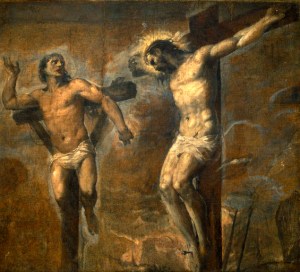
“Jesus, remember me…” Titian, Christ and the Good Thief

Immediately after death, we are with Jesus. In Luke 23:43 Jesus promises the thief on the cross: “Today you will be with me in paradise.” (“Paradise” is a Persian word that has the idea of a beautiful garden—it’s a place of bliss.) In 2 Corinthians 5:8 Paul says that when we are “away from the body” we will be “at home with the Lord.” And in Philippians 1:23 Paul talks about “departing from this flesh” and “being with Christ.”

Other New Testament passages give the same consistent message: after death we are with Jesus. There’s no more detail given than this (Jesus’ parable in Luke 16:19-31 and the vision in Revelation 6:9-11 are probably not to be taken literally as descriptions of what this actually looks like), but for Christians this is intended to be enough: after death we are with Jesus, and by extension with all those who have died “in Jesus” before us.

The ultimate end, however, is being bodily resurrected to live in a renewed earthly creation. The idea is a return to the way God originally created us to be: people with both a soul and a body, living in an earthly creation, enjoying that good creation and caring for it even as it provides for us (that’s Genesis 2:7-15). The New Testament is consistent in looking forward to this, even if it gives different depictions of exactly that might look like. This is what’s behind every future “resurrection” passage (e.g. Romans 8:18-30; 1 Corinthians 15:35-58; 1 Thessalonians 4:13-18; Revelation 20:4-6).

So much for the biblical, basic Christian expectation of life after death (and then life after this life after death!). How do I myself actually imagine this to look like?

I believe that when I die (when my body and brain stop functioning), my “spirit” or “soul” will continue to exist. I imagine feeling a kind of “painless peace” at that moment. I imagine, maybe, a feeling of motion to another place, where I will experience a kind of “waking” in a place suffused with light, as if the light oozes out of everything around me. That feeling of “painless peace” continues, but now is added a feeling of being deeply, perfectly loved, and being intimately connected to everything around me. I imagine, then, in this “place” being reunited with my loved ones who have died—a joyful reunion!—and seeing Jesus for the first time face to face—like coming home after being away for a very long time.

At some point—it might feel immediate, it might feel like time has passed—I believe that God will complete the renewal of creation that Jesus has begun and we have continued. Exactly what this looks like, I’m not sure, but I imagine this same world, this very earth, within this universe—yet without the pollution, the overcrowding, the disease, the war, the disasters, and all the greed and pride and abuse of power and more that has caused all that. It’s a pristine earth, with clear streams and clean air, beautiful flowers and grass and mountains and valleys and prairies and sunsets and twinkling stars.

Jan Richardson, The Best Supper

And at some point—again, not exactly sure what this looks like—I believe that God will resurrect us, bodily. We will live as we do now, as God intended us to live, but with bodies untouched by sin and death. We will plant gardens and make music and share meals and tell stories and live together in harmony—all peoples, every tribe and language and nation—with all creation, as God originally intended us to live.

Much of this imagining I get from stories of people who have had “near-death” experiences and from some of our poets and storytellers in the Christian tradition. J.R.R. Tolkien and C.S. Lewis have been especially influential for me in my imagination of life after death and life after life after death.

I think, for example of Tolkien’s description of Frodo waking up in Minas Tirith after destroying the ring in Mount Doom—that’s how I imagine what happens immediately after death, waking up in Jesus’ presence. And then I imagine the new creation being like Frodo and Sam being back in the Shire, enjoying again the simple pleasures of tilled earth and good companions, but without the threat of evil from the East. Or, I’ve always had a soft spot for Lewis’ description of “heaven” in The Last Battle: just like this earth, only brighter, the colours purer, and with worlds upon worlds to explore “further up and further in!”

Maybe this is too many words. Or maybe it’s too much speculation. But the biblical descriptions of what happens after death do lend themselves to using our imaginations—always remembering, of course, that God “is able to accomplish abundantly far more than all we can ask or imagine” (Ephesians 3:20), and that “no eye has seen, nor ear heard, nor the human heart conceived, what God has prepared for those who love God” (1 Corinthians 2:9). This is in many ways the basis for my hope for “heaven”—that God has given us deep desires to live, to flourish in life here on this good earth, and so God will fulfill those desires beyond our best dreams.