What is Paul’s salvation story?

What is Paul’s salvation story?

No, I don’t mean his personal story of meeting Jesus and being called by him—though for Paul that story is part of the larger story I’m referring to. I mean Paul’s cosmic salvation story, his big-picture narrative of salvation, what it is he believes salvation is all about.

This is important to discern, because for many Christians (especially evangelicals) the Apostle Paul is the go-to for understanding salvation, the GOAT for explaining the gospel. This is not an easy story to discern, however, because Paul never simply lays out a salvation narrative—he’s written a bunch of letters, each of which is dealing with specific situations faced by his first readers and himself. Scholars continue to debate whether we can even discern a larger salvation narrative from Paul’s writings, let alone what that story might be.

However, scholars are pretty well united on what that grand story of salvation for Paul is not—and this isn’t good news for the conservative evangelicals who typically narrate salvation in this way.

Paul’s story of salvation is not that the goal of human existence is to get to heaven when we die, avoiding an eternity of conscious torment in punishment for our sins. It’s not that Jesus came to earth solely to save us from this fate and bring us to heaven after death. It’s not that Jesus took our place on the cross, taking the punishment that was due us, as God poured out God’s wrath on Jesus on the cross. It’s not that this “penal substitutionary atonement” is what allows us to go to heaven after death, if we believe that Jesus did this for us.

That’s not Paul’s salvation story.

I mentioned earlier that Paul’s salvation story was a “cosmic” story. I said that Paul’s salvation story isn’t merely about his own salvation, but that his individual story was part of a larger, cosmic story. This is important to note. Paul wouldn’t recognize the common evangelical Christian salvation story I’ve just told, because it’s far too individualistic—about Jesus dying for my sins on the cross, taking my place, so I can be with Jesus in heaven when I die—and not nearly big enough, not cosmic enough.

Here’s how I see Paul’s cosmic salvation story.

Humanity is under the sway of cosmic powers at work in the world, the greatest of which are sin and its inevitable partner-in-destruction, death. What we need is to be liberated from these powers and brought into a new age, an era where sin and death no longer hold sway, where instead we experience righteousness and life, along with the fruits of these: justice and peace and joy and more. For Paul, this is salvation; this is the kingdom of God.

As God’s Messiah, the Christ, Jesus has come from that new age into our world, to bring about God’s reign, God’s salvation. Though sinless—and thus not under the power of sin and death—he entered into our world of sin and death, and in faithfulness to God willingly suffered under sin and death on the cross. However, God raised Jesus from the dead, overturning death and opening the way for humanity to enter into his kingdom, the new age of righteousness and life, justice, peace, and joy. We become part of this new age as we align our faith with Jesus’ faithfulness, walking in his way of the cross through death into new life.

Our individual stories of salvation are thus part of this cosmic story of salvation. Paul’s come-to-Jesus moment was Paul being swept up into this cosmic story. My come-to-Jesus moment was me being swept up into this cosmic story. And that’s true for everyone who has ever aligned their faith with Jesus’ faithfulness, to walk in his way of the cross, his way of love.

And yes, this story does mean that when I die I can expect to be with Jesus, one day being raised from the dead like Jesus was. But it’s not about being saved from hell, but being liberated from sin and death. And the story of salvation is so much bigger than me being with Jesus someday. It’s cosmic in scope—with, one day, all creation even brought into harmony with Jesus’ way of cruciform love.

Something like this story better explains both the totality of Paul’s theology in his letters and the specific statements Paul makes along the way. It better explains the way Paul talks about the cross and Jesus’ death, as well as his statements on sin and death and Jesus’ resurrection. It also explains justification: we share in Jesus’ vindication (his “justification”) by God through his resurrection from the dead.

So don’t be ashamed of Paul’s gospel! It’s God’s saving power for all who believe, after all, liberation from the powers of sin and death coming for all who walk in Jesus’ faithful way of love. And, understood in this way, it complements well the other salvation stories told in the New Testament.


© Michael W. Pahl

Bishop Curry, Luke and Acts, and “Christianity Lite”

There was a lot of buzz this past weekend about the wedding of Meghan Markle and Prince Harry, now the Duchess and Duke of Sussex. And a good bit of that buzz was about the sermon by Bishop Michael Curry, presiding bishop of the Episcopal Church.

Responses to Bishop Curry’s sermon have ranged from astonishment to amusement, from enthusiastic applause to sharp criticism. Some of that criticism has come from Christians, including a former chaplain to Her Majesty the Queen who claimed that Bishop Curry’s sermon represented a watered down version of Christianity, a kind of “Christianity Lite.” The specific critiques are diverse, but in general they seem to boil down to three things: there was too much love, too much social justice, and not enough cross.

However, if this is “Christianity Lite”—showing compassionate love for all including the unrighteous and unrepentant, seeking equitable justice for all and especially the vulnerable and marginalized and oppressed, and all this without a strong penal substitutionary view of Jesus’ death—then Luke the Evangelist, author of a good 27% of our New Testament, is also implicated.

Yep: Luke and Acts are also “Christianity Lite.”

Consider the cross.

Like Bishop Curry in his sermon, Luke does in fact mention Jesus’ death—dozens of times in the Gospel and Acts. What’s more, Jesus’ death is mentioned at significant points in Luke’s accounts of Jesus and the Apostles: in the Gospel’s creed-like “passion predictions” taken up from Mark’s Gospel, anticipating Jesus’ death yet to come; in the Gospel’s “passion narrative,” as rich in meaning as that of any of the Gospels; and in Acts’ several “evangelistic speeches,” where the saving message about Jesus is proclaimed to those who don’t yet believe. In other words, as with Bishop Curry, the cross is pretty important to Luke’s theology.

However, the cross isn’t talked about by Luke in the way at least some of Bishop Curry’s detractors call for. There’s no “You’re a sinner and you’re going to hell, but—good news!—Jesus has died to pay the penalty for your sins” in Luke or Acts—not even in the Apostles’ evangelistic speeches. In fact, “penal substitution” is entirely absent from Luke’s presentation of Jesus’ death—there is nothing in Luke or Acts indicating that Jesus is punished on the cross for our sins, paying a penalty that should be ours to pay.

For Luke, that “Christ died for our sins” means that “Christ died because of our sins,” and “Christ died to show us the way out of our sins.”

The most common interpretation of Jesus’ death by Luke is this stark contrast: human powers have killed Jesus, but God has raised Jesus from the dead. This idea is found in both the Gospel and Acts, explicitly and repeatedly. This refrain fits a Christus victor view of atonement: God has resurrected the crucified Jesus, thus declaring him to be Lord over all powers. The necessary response? Repentance of our collaboration with the evil powers of this world—rulers and idols alike—and walking in the Way in full allegiance to Jesus, Messiah and Lord. And this, of course, is where the gospel preaching of Acts always goes.

The next most common interpretation of Jesus’ death in Luke-Acts is that of Jesus as example to follow: Jesus has taught the way of nonviolent, self-giving love for both neighbours and enemies, and in his own suffering and death he exemplifies this teaching. This is “the way of peace” anticipated by John the Baptist’s father. These are “the things that make for peace” that Jesus laments the people of Jerusalem have missed. Jesus’ followers are to “deny themselves and take up their cross daily and follow him” in these very ways—following Jesus in bringing about peace through nonviolent, self-giving love.

That’s the cross in Luke’s writings—unlikely to pass inspection from at least some of Bishop Curry’s critics. How about love?

Luke’s Gospel, of course, has the same key references to love found in Mark’s Gospel (which Luke almost certainly used) and Matthew’s (which Luke probably used). Love as the Greatest Commandment that sums up the whole Law of Moses: loving God with our whole being, and loving our neighbour as ourselves. Love of enemy as a distinctive hallmark of Jesus-followers.

But Luke also blends in a good-sized helping of other sayings and stories of Jesus about love.

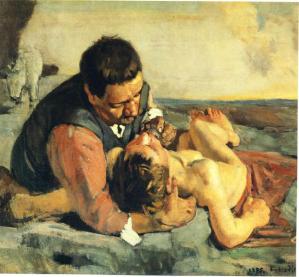
Ferdinand Hodler, The Good Samaritan

It is Luke’s Gospel that fleshes out love of neighbour by telling the story of the Good Samaritan—shockingly making a despised foreigner the epitome of neighbour love. It is Luke’s Gospel that has all three stories of lostness: the lost sheep, the lost coin, and the lost son. In this last story the father’s love for his prodigal son is particularly scandalous: generous from start to finish, watching for the prodigal and running for him without care for propriety, welcoming him home without any amends made or demanded.

Luke’s Gospel has more than the normal quota of stories of Jesus healing people and sharing meals with them, crossing bounds of purity and propriety to do so. He also tells his share of stories about Jesus forgiving sins on God’s behalf—sometimes in response to repentance, sometimes not. And it is Luke’s Gospel (or some manuscripts of it) that has Jesus calling on God to forgive his executioners even as he hangs on the cross, even while they remain ignorant of their heinous sin.

I suspect, then, that Luke’s Gospel has far too much emphasis on love for some—which brings us right to social justice.

One of the strangest criticisms of Bishop Curry’s sermon I’ve seen is that it focused too much on things like racial justice and poverty and the like. The thinking goes like this: the goal of Jesus’ ministry was to bring people into “the kingdom of heaven” (by which is meant simply “heaven,” or “an eternal, spiritual afterlife with God”). His ministry was “spiritual,” not “political”—and, in any case, things like sexism or racism or poverty aren’t really going to change in this world (you know, “the poor you will always have with you”).

But Luke the Evangelist will have none of this.

Leave aside the fact that “kingdom of heaven” is parallel to “kingdom of God,” and that the Jewish expectation of “God’s kingdom” was very much a this-earthly reality. Leave aside the fact that “give to Caesar that which belongs to Caesar and give to God that which belongs to God” would make any devout Jew think, “the earth is the Lord’s and everything in it.” And leave aside the fact that “the poor you will always have with you” is an allusion to Deuteronomy 15:11 where Moses is in fact urging generosity toward the poor.

Quite apart from these things, Luke’s Gospel is explicit in promoting what we today call “social justice,” even specifically along the lines of sex, race, and economics. There’s far too much to mention, so let’s just consider the issue of poverty.

James Tissot, Le magnificat

It is Luke’s Gospel that has Mary sing these words in anticipation of Jesus’ birth: “The Lord has brought down the powerful from their thrones, and lifted up the lowly; he has filled the hungry with good things, and sent the rich away empty.”

It is Luke that makes Isaiah 61 into Jesus’ personal mission statement: “The Spirit of the Lord is upon me, because he has anointed me to bring good news to the poor. He has sent me to proclaim release to the captives and recovery of sight to the blind, to let the oppressed go free, to proclaim the year of the Lord’s favor” (in other words, Jubilee—look it up).

It is Luke that presents Jesus’ beatitudes this way: “Blessed are you who are poor, for yours is the kingdom of God. Blessed are you who are hungry now, for you will be filled.” And he includes some accompanying woes in case we’re tempted to spiritualize this: “But woe to you who are rich, for you have received your consolation. Woe to you who are full now, for you will be hungry.” And just to hammer this home, these are among his following words: “Give to everyone who begs from you.”

It is Luke’s Gospel that says, “When you give a banquet, invite the poor, the crippled, the lame, and the blind.” It is Luke that tells the story of the Rich Man and Lazarus, making sure his hearers know the rich man was being judged for his callous disregard of poor Lazarus at his very gate. It is Luke that tells the story of Zacchaeus, declaring, once Zacchaeus had promised to give half his wealth to the poor and make restitution to any he had defrauded, that “Today salvation has come to this house.”

It is Luke that tells of the early Christians selling their property and giving to the poor among them, even holding all their possessions in common. It is Luke that describes the Apostles’ concern for widows in need, ensuring all received sufficient help regardless of cultural background. It is Luke that mentions the concern of believers in Antioch to provide aid for the poor in Jerusalem affected by famine.

If this is “Christianity Lite”—showing compassionate love for all including the unrighteous and unrepentant, seeking equitable justice for all and especially the vulnerable and marginalized and oppressed, and all this without a strong penal substitutionary view of Jesus’ death—then it’s not just Bishop Curry who is guilty of it. That’s Luke the Evangelist implicated as well, and—at least according to Luke—even Jesus himself.

Not bad company, I’d say.

© Michael W. Pahl

Fifteen Lessons I Learned (or Learned Again) in Teaching on the Cross this Lent

Through Lent this year I taught a Bible study on “The Meaning of the Cross.” We packed a lot into four weeks! We talked about crucifixion in the ancient world and the specific circumstances surrounding Jesus’ execution on a Roman cross. We talked about the theological puzzle this created for the early Christians (“Christ crucified by humans, yet raised from the dead by God—what?!”). We talked about various explanations Christians have given through history of the saving significance of Jesus’ death (“atonement models” or “theories”). This included a particular focus on (and critique of) the dominant model in modern western Protestant circles, Penal Substitution—that on the cross Jesus took our place, taking God’s punishment for our sin and appeasing God’s wrath against us for our sin.

I may create some posts from all this down the road, we’ll see. For now, though, here are fifteen lessons I learned (or learned again) in teaching on the cross through Lent:

Lessons (re)learned in teaching on the cross #1: All atonement metaphors and models reflect the culture in which they were developed. Yes, this includes Penal Substitution. Yes, it also includes recent nonviolent models. It even includes biblical metaphors.

Lessons (re)learned in teaching on the cross #2: How we understand the problem determines how we understand the solution. In the NT the root problem is not “hell” or “guilt” but “sin,” all the ways we harm others/creation. The solution? Rescue from harm, restoration to wholeness.

Lessons (re)learned in teaching on the cross #3: In the OT there are many bases for God’s forgiveness of sins/appeasement of God’s wrath: remorse (Ps 32), persuasion (Num 14), repentance (Jon 3), animal sacrifice (Lev 4-6), and even killing someone with proper zeal (Num 25).

Lessons (re)learned in teaching on the cross #4: There are many different kinds of blood sacrifices in the OT. Several of them had nothing to do with sin—ritual purification, thanksgiving gift, and covenant ratification, for instance.

Lessons (re)learned in teaching on the cross #5: *God did not kill Jesus.* In fact, the NT consistently, emphatically declares that *humans* killed Jesus—*God* raised Jesus from the dead.

Lessons (re)learned in teaching on the cross #6: Rarely if ever does the NT clearly, directly say that Jesus’ death satisfied God’s wrath, or took our punishment, or paid our penalty. One might develop a model that logically requires this, but it’s not stated.

Lessons (re)learned in teaching on the cross #7: The gospel preaching of Acts describes Jesus’ death as something humans did to Jesus, not something Jesus did for us. Forgiveness of sins in Acts is dependent on our repentance, and is based on Jesus’ exaltation not his death.

Lessons (re)learned in teaching on the cross #8: The gospel tradition of 1 Cor 15:3-4, including “Christ died for our sins,” was a kind of “preaching summary” of the apostolic gospel—not a full-blown theology of salvation.

Lessons (re)learned in teaching on the cross #9: In the NT Jesus’ death “for us” or “for our sins” most often simply means “for our benefit” or “in relation to our sins.” Anything more is implied from its context—or read into from our context.

Lessons (re)learned in teaching on the cross #10: The NT uses many different metaphors to describe Jesus’ death. All of them relate Jesus’ death to “our sins” in some way. Most of them, however, don’t do this in a “sacrifice for sins” kind of way.

Lessons (re)learned in teaching on the cross #11: The Gospels don’t give much basis for Penal Substitution: Jesus rejected lethal violence and punitive justice, he agreed with the prophetic critique of blood sacrifice, and he forgave sins freely on God’s behalf—even his own murder!

Lessons (re)learned in teaching on the cross #12: Some Jews in Jesus’ day disputed the legitimacy of the Temple and its sacrifices. All Jews soon after Jesus’ day saw repentance and acts of mercy as “atoning,” no blood sacrifice required. Jesus fits right within this context.

Lessons (re)learned in teaching on the cross #13: The dominant metaphors used by Jesus in the Gospels for interpreting his death were related to liberation from oppressive powers (Passover, Exodus, “ransom/redemption,” “new covenant”).

Lessons (re)learned in teaching on the cross #14: The dominant imagery used by Jesus in the Gospels for applying his death is “identification/participation”: Jesus stands with the sinned-against, and Jesus calls us to follow him in taking up our cross.

Lessons (re)learned in teaching on the cross #15: The dominant interpretation of Jesus’ death in the NT is that it is a revelation of love: it shows God’s (and Jesus’) love for us, and it compels us to respond with love for God and for others—neighbours, strangers, even enemies.

How to put this all together? Check out a couple of other posts of mine on the cross: “The Foolishness of the Cross” and “Atonement and God’s Wrath.”


© Michael W. Pahl

Christianity is Far More Radical than You (or I) Think

Not my family. But that food looks good.

I like having my family gathered together around the table, eating together, just being together. I like the puns that banter to and fro, the laughter and groans that ensue. I like the spontaneous singing that erupts, or the complex table rhythms that generate from one person’s tap-tap-tippety-tap. I like the conversations about life and learning and love.

I like having good food to eat, clean water to drink, fresh air to breathe, comfortable clothes to wear. I like having a spacious home, and I like most of the stuff in it: gizmos and gadgets that cook and bake and clean and entertain and inform and communicate. And books, lots of books.

I like being able to live my life relatively free of fear of violence or destitution. I like being able to meet with whomever I want, to do pretty much whatever we want, including worshiping the God we believe in in the way that we want. I like being able to think and speak freely without thinking someone might harm me or my family (well, I guess there were those two times).

In other words, I like my rights and freedoms. I like my safety and security. I like my comforts. And I’m pretty sure most of us white middle-class Christians in North America feel the same way.

But there’s a problem with this: it keeps us from truly hearing and living out the radical message of Jesus, the radical message of the gospel.

Here’s Jesus, giving the “altar call” of his gospel proclamation:

If any want to become my followers, let them deny themselves and take up their cross and follow me. For those who want to save their life will lose it, and those who lose their life for my sake, and for the sake of the gospel, will save it. For what will it profit them to gain the whole world and forfeit their life? (Mark 8:34-36)

This is no altar call like we might be used to. This is no “pray the Sinner’s Prayer and you’ll be saved,” no “read your Bible and go to church and you’ll get rid of those nasty habits”—but otherwise carry on with your lives, business (and pleasure) as usual.

Every Jew in Jesus’ day knew what it meant to “deny oneself.” They heard it every year in preparation for Yom Kippur, the Day of Atonement. “Denying oneself” was equivalent to “fasting” and related to “Sabbath-keeping.” It meant voluntarily giving up your work and your food, giving up the basic necessities and comforts of life and the means by which those are attained, in devotion to God.

And every Jew—indeed, every conquered people in the Roman Empire—knew what it meant to “take up one’s cross.” They saw it with inhuman frequency outside the major cities on the edges of Empire. “Taking up one’s cross” meant carrying a cross-beam to the outskirts of the city, where one would then be suspended from that beam on a post or tree until one died. It meant condemnation and execution. It meant shameful, painful, and certain death.

And “following Jesus”? It soon became clear what that meant, for not too long after Jesus said these words he himself “denied himself”—gave up his rights and privileges in devotion to God—and “took up his cross”—was executed in condemnation and shame and excruciating pain.

This is Jesus’ “altar call.” This is Jesus’ call for response to the gospel of God’s kingdom.

And it is gospel, it is “good news.” I know, it might not sound like it, not to our modern western ears. But Jesus says that if we do this—if we “lose our lives” in this way—we will in fact gain life. And if we don’t do this—if we instead seek to “preserve our lives,” our lives of comfort and security—we will in fact lose our lives in the end.

It’s a paradox, right at the heart of the gospel. Here’s how I understand this.

We naturally and rightly desire justice, peace, health, security, comfort—flourishing life—for ourselves and those close to us. But fulfilling those desires for ourselves often means impeding others from fulfilling those same basic human desires: our peace and security come at the expense of others’ welfare, our comfortable lives are made possible by others’ lives of hardship, and so on.

In our day, these “others” are often outside our immediate vision. They can even be on the other side of the world. Faceless. Nameless. Poor. Not-white. They suffer so that we might have all the comforts of home.

In the long run this system cannot be sustained. Whether on a personal level or a global scale, in the end the comfortable and well-fed will lose their lives of relative abundance. It’s inevitable. And then the scales will tip, the down will move up, the up will move down, and it starts all over again.

Into this never-ending cycle of inequity, even injustice and oppression, Jesus speaks these words: “Deny yourselves, take up your cross, and follow me. Only if you lose your life in this way will you save it.” It is only if we give up our privileges and comforts for the good of others, only if we let go of our claim to our own rights and freedoms for the good of all, that we can experience the true life God desires for us.

Lentz - Christ of MaryknollIn other words, if we truly want to experience permanent justice, lasting peace, and flourishing life as human individuals, as a human race, and as a planet, the only way forward is to follow the self-denying, self-giving way of love and peace as embodied in Jesus.

If we were to take Jesus’ call seriously, then, we would hold our possessions loosely, living simply. We might even sell all we have and give the money to the poor.

If we were to take Jesus’ call seriously, we would also hold our rights and privileges loosely, living free of expectation and entitlement. We might even stand up for the rights of others at great cost to ourselves.

If we were to take Jesus’ call seriously, we would seek out society’s cast-offs, those clinging to the bottom rung, and lift them up alongside us. We might even, if necessary, switch places with them.

If we were to take Jesus’ call seriously, we would forgive, forgive, and forgive again. We might even walk the extra mile and do good things for those who hate us, even our outright enemies.

I’ll be honest: I don’t think I can do this. We all—myself included—are pretty good at justifying our comfortable existence. And we all—myself included—are pretty well attached to our life of relative ease.

I like my coffee, my housecoat, my family gathered around, my home and clothes and food and drink and health and safety and security and freedom.

Yet Jesus’ gospel call always stands before me. It calls me perpetually to repentance, my self-justified selfishness laid bare. It summons me always, over and over again, to a better way, a better way to be human in the world. It beckons me onward to a life of devoted faith in God, selfless love for others, and enduring hope for justice and peace and abundant life for all.

Atonement and God’s Wrath

Note: This post has been edited since its original version.

———————–

Diego Velázquez, Cristo crucificado

I’ve been thinking a lot about Jesus’ death lately. There are many reasons for this, not least of which is the journey we’ve just been on through Lent, following Jesus to the cross.

As I’ve thought about Jesus’ death, both recently and over the years, I keep coming back to the “gospel tradition” the Apostle Paul received from others before him and passed on to others after him, a tradition that was probably formulated within two or three years of Jesus’ death:

that Christ died for our sins in accordance with the Scriptures,
that he was buried,
that he was raised on the third day in accordance with the Scriptures,
and that he appeared to Cephas and the twelve. (1 Cor 15:3-5)

This tradition shows that very early on Jesus’ death was being interpreted as “for our sins.” But what exactly does this mean?

I’d guess that when most people hear that phrase, “Jesus died for our sins,” they immediately plug in a whole cluster of ideas: we sin by disobeying God’s moral law; God’s holiness therefore bars us from being in God’s presence and God’s justice demands a penalty be paid, the penalty of death; God is justly angry with us. To say, then, that “Jesus died for our sins” means that “Jesus died in our place, paying the penalty for our sins demanded by God’s justice, and thus turned away God’s righteous wrath, bringing us divine forgiveness and allowing us to be in God’s holy presence.” This idea is called “penal substitutionary atonement.”

However, the phrase, “Jesus died for our sins,” doesn’t necessarily mean all those things. For it to mean all those things requires many assumptions to be true about who God is, how God operates, what sin is, what forgiveness involves, how justice works, and so on. These assumptions are never actually stated in any one passage in Scripture, but must be inferred from various passages and then all brought together before being read into this phrase.

In fact, I’d suggest that the phrase from this early tradition, “Christ died for our sins,” simply means that “Christ died with respect to our sins”—Jesus’ death concerns our sins, even “deals with” our sins, somehow, in some way. Exactly how this works, however, is not spelled out in this phrase.

The New Testament uses many different metaphors to try to explain how this works, what it means to say that Jesus’ death “deals with” our sins. Images of animal sacrifice, scapegoating, redemption from slavery, covenant ratification, military victory, martyrdom, friendship, gift-giving and more are used by the New Testament authors to interpret Jesus’ death “for our sins.” None of these ideas, however, imply “penal substitution”—not even the animal sacrifice images, as Andrew Remington Rillera has amply demonstrated.

Is there a better way of making sense of the confession that “Jesus died for our sins”? How do I think about this?

Elsewhere I’ve done some reflection on what some of this kaleidoscope of meaning is related to Jesus’ death. Here I’d like to sketch out a few thoughts that specifically relate to some of the ideas found in the popular notion of “penal substitutionary atonement,” especially the appeasement of God’s wrath against our sin.

One of the common themes of many human religions through history is the idea that our circumstances are a reflection of divine favour or disfavour. If things are going well, our god is happy with us. If things are not going well, our god is not happy with us. In extreme circumstances—facing a severe drought, experiencing a horrible plague, being conquered in war, suffering exile or enslavement—our god is very angry with us for some terrible wrong that we have done.

What’s needed is “atonement.”* Usually this is some sort of sacrificial act, in many ancient religions even the violent, bloody death of some living thing. This blood sacrifice appeases our god’s wrath against us for the great wrong we have committed and returns us to our god’s favour. (Exactly how or why this works is rarely or variously explained. Does it satisfy some “life-for-life” sense of justice? Does it expend the god’s anger? Does it cover or remove the transgression that has been ritually transferred to the victim? Is there something special about “blood”? Does the god simply like the smell?)

This perspective was shared by at least some of the ancient Israelites, and it’s found in their Scriptures (the Christian Old Testament). When terrible things threatened individuals or God’s people as a whole, it was understood to be because God’s wrath had come upon them for their sin. What was needed to atone for their sin and turn aside God’s wrath was a violent, bloody death, a sacrifice of something or someone else, offered out of devotion to God.

The story of Phinehas son of Eleazar gives the most vivid example of this. The story is told in Numbers 25.

In the story a plague has come upon the people of Israel during their wilderness wanderings. This is viewed as God’s wrath against Israel because of their sin—Israelite men have been cozying up to Moabite women, one thing has led to another, and they have ended up bowing down to their gods. A terrible thing has happened, which means God must be very angry because of a great wrong that has been committed. And so God calls on the Israelites to kill those men who have married Moabite women, in order to “turn away” his “wrath,” his “fierce anger.”

But before this can happen, Phinehas hears of an Israelite man who has taken a Midianite wife, he tracks them down to their family tent, he impales them with a spear—and the plague stops. Phinehas is hailed by God as a hero, with these words:

Phinehas son of Eleazar, son of Aaron the priest, has turned back my wrath from the Israelites by manifesting such zeal among them on my behalf that in my jealousy I did not consume the Israelites. Therefore say, ‘I hereby grant him my covenant of peace. It shall be for him and for his descendants after him a covenant of perpetual priesthood, because he was zealous for his God, and made atonement for the Israelites. (Num 25:11-13)

All this sounds like a few elements of “penal substitutionary atonement”: our sin puts us under God’s wrath, and what’s needed is a violent, bloody death offered in devotion to God in order to turn away God’s righteous anger, to make “atonement.” This same language, the same basic ideas, are found in at least one other biblical story.

But there are some problems with this whole way of thinking, problems which the Old Testament itself acknowledges. Not all bad circumstances are because God is angry with us because of our sin, just as not all good circumstances are because God is pleased with us. A blood sacrifice doesn’t actually change the heart, our inner disposition that prompts our outward actions. Even more, a blood sacrifice doesn’t actually change the world; it doesn’t bring true justice within society, or a real and lasting peace, or a full and flourishing life.

There is a prophetic critique throughout the Old Testament which highlights these problems. Here are a few samples; note that these are not critiques of the sacrificial system itself, but an acknowledgment of the limitations of that sacrificial system:

Sacrifice and offering you [God] do not desire,
but you have given me an open ear.
Burnt offering and sin offering
you have not required. (Psalm 40:6)

For I [God] desire steadfast love and not sacrifice,
the knowledge of God rather than burnt offerings. (Hosea 6:6)

“With what shall I come before the Lord [God],
and bow myself before God on high?
Shall I come before him with burnt offerings,
with calves a year old?
Will the Lord be pleased with thousands of rams,
with ten thousands of rivers of oil?
Shall I give my firstborn for my transgression,
the fruit of my body for the sin of my soul?”
He has told you, O mortal, what is good;
and what does the Lord require of you
but to do justice, and to love mercy,
and to walk humbly with your God? (Micah 6:6-8)

When we turn to Jesus in the Gospels, now, we see a few interesting things.

First, Jesus agrees with this prophetic critique. He severs the necessary link between sin and circumstances: while it is true that we generally reap what we sow, with harmful actions leading to harmful consequences, it is not true that all our experiences of harm are the direct result of our sin. Jesus also affirms that outward cleansing rituals don’t change the heart, and he even re-configures “holiness” in terms of acts of mercy and justice. Jesus also quotes some of those Old Testament texts that deny blood sacrifice as a means of full and final atonement for sins: what’s most important, Jesus says, is devoted love of God and self-giving love of neighbour; in other words, “to do justice, and to love mercy, and to walk humbly with your God.”

Second, Jesus forgives sins apart from blood sacrificeThis is startling to the religious leaders in power primarily because, as they say, “only God can forgive sins.” However, Jesus’ action—like John’s “baptism of repentance for forgiveness of sins” before him—could also have raised concerns because there is no reference to Temple sacrifices. This was a live issue in Jesus’ day—the Essenes, for example, seem to have denied the efficacy of the Temple sacrifices and did not look to them for atonement. After another generation, with the destruction of the Temple and the inability to offer blood sacrifices, Judaism as a whole re-imagined atonement in the terms of the prophetic critique of their Scriptures: repentant prayer, bearing fruit in acts of justice and mercy, atones for sin.

Jesus’ forgiveness of sins anticipates this later Jewish development—and stands in line with that prophetic critique noted above through the Jewish Scriptures. Jesus’ forgiveness shows that God does not need blood sacrifice in order to forgive sins. Instead, what Jesus calls for, and thus what God requires, is “repentance”—an inner change of disposition involving a recognition of one’s sin and a commitment to live differently—and “faith”—a devoted trust or allegiance to God expressed in following the way of God in self-giving love.

This leads to the third thing that distinguishes Jesus’ approach to sin, atonement, and especially “sacrifice”: Jesus does not sacrifice something or someone else for his own good; rather, he gives himself for the good of others, even his enemies. Phinehas, a model of that ancient religious view on these things, you’ll recall, atoned for the sin of Israel by committing violence against another, spilling the blood of another, sacrificing another for the good of many. Jesus, by contrast, atones for or “deals with” sin by bearing the violence of others in himself without retaliation, allowing his own blood to be spilled with forgiveness on his lips, giving up his own life for the good of all.

In all this, in Jesus’ life and teachings culminating in his death, Jesus shows us a better way, God’s true way for atoning for sin: through nonviolent, self-giving love for others, even for one’s enemies. This alone is what will bring about true justice within society, a real and lasting peace, a full and flourishing life for all.

Jesus’ death, then, is really a kind of “anti-sacrifice”—in the full, dual meaning of the Greek prefix “anti.”

Jesus’ death is “anti-sacrifice” in that it is “against sacrifice”: it underscores the reality, found already in the Old Testament, that blood sacrifice is not needed for God to forgive, nor does it bring about either the personal change of heart or the wider justice, peace, and life that we need.

And Jesus’ death is “anti-sacrifice” in that it is “instead of sacrifice”: instead of the violent, bloody death of something or someone other than ourselves in order to bring justice and peace and life, what’s needed is the nonviolent giving of ourselves for the good of others, the good of all, including friends, neighbours, and even enemies.

In other words, Jesus’ self-sacrificial death brings an end to blood sacrifice of any kind—animal sacrifice, capital punishment, war death, and more—once and for all.

As I said earlier, there’s much more that can be said about the meaning of Jesus’ death than this. For example, Jesus’ death is a subversion of the evil powers of this age, the unjust powers-that-be in the world that oppress and enslave. Jesus’ death is also a revelation of who God is and the way God works in the world, showing God’s true power and wisdom, showing God’s love. For some thoughts on these things, you can check out my post on “The Foolishness of the Cross.”

———————–

*Andrew Remington Rillera adroitly argues that “atonement” in the Hebrew Scriptures dealt with religious purification. While generally true, this argument doesn’t as easily explain the language of atonement in Numbers 25, for example (I note that Remington Rillera doesn’t address this story in his book). I see my thoughts here not as negating Remington Rillera’s argument, but as supplementing it.


© Michael W. Pahl

“Remember Me”

“Jesus, remember me when you come into your kingdom.”

The words of a thief on a cross.

“Thief” isn’t really the right word, though—he was no pickpocket, no petty thief. He was a violent bandit who had, by his own admission, been “condemned justly.” He was a sinner, and he knew it. He was, as Luke puts it, a “criminal.”

He was right where he was supposed to be, hanging on a cross.

But he also knew that Jesus was not where he was supposed to be. Jesus was not a violent bandit, he was not a criminal, he was not a sinner. He had done nothing wrong, nothing to deserve a cross.

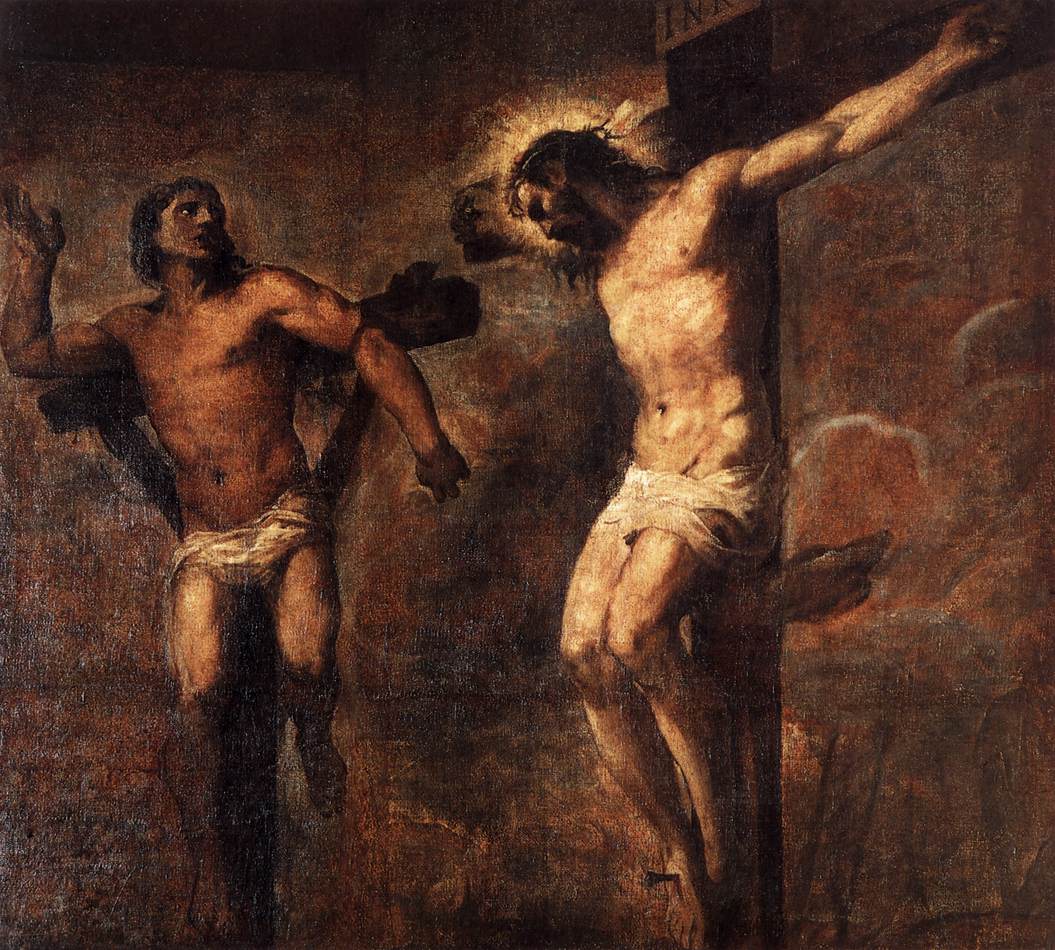
Titian - Christ and the Good TheifAnd so he came to Jesus’ defence when the other criminal on the cross began to mock Jesus, to scorn him. “This man has done nothing wrong,” he rebuked the other bandit. “We deserve what we’re getting, but Jesus doesn’t!”

He knew something was different about Jesus. Could it be true, what they said, that he was the King of the Jews? Could he really be the Messiah, bringing about God’s kingdom? But if so, what was he doing dying on a Roman cross? It made no sense—but still he believed.

And so he called out to Jesus, one crucified man to another: “Jesus! Jesus! When you come into your kingdom, remember me!”

“Jesus, remember me.”

Isn’t this the most basic cry of faith?

“Jesus, I don’t completely understand who you are, I don’t really understand what you are doing, but there is something about you, Jesus, something that points beyond the harsh realities of life and death. Please, remember me!”

Even more, isn’t this the most basic longing of human existence?

When we strip away all our pretence, all the collected debris of our lives, isn’t this what we long for, deep in our souls? To not be forgotten? To be remembered?

Don’t we all, when we breathe our final breaths, want to be assured that someone, somewhere, will remember us? Our names, our stories, our hopes and dreams—that these will not be forgotten, but will live on? Don’t we all, when it comes right down to it, want our lives to matter to someone?

At the deepest level, each one of us is that thief on the cross: we are broken sinners who have broken others, we are desperately in need of mercy, desperately wanting to matter.

And the crucified Jesus looks us right in the eye and says the same words to us that he said to that condemned criminal: “Not only will I remember you—you will be with me.”

We want to be forgiven. Jesus gives us paradise.

We want to be remembered. Jesus gives us his presence.

This post is excerpted from a sermon I preached on November 20, 2016, at Morden Mennonite Church, for Eternity Sunday. Image: Titian, “Christ and the Good Thief.” Cross-posted from http://www.mordenmennonitechurch.wordpress.com. © Michael W. Pahl.

The Foolishness of the Cross

A meditation on the cross which I shared at the Morden Good Friday Community Service, April 18, 2014, slightly revised since. It is based on 1 Corinthians 1:18-25.

A few years ago I was fortunate to be able to go to Israel-Palestine with a study group. It was an amazing experience: hiking in the wadis west of the Dead Sea, climbing in the hills around the Sea of Galilee, baptizing a former student of mine in the Jordan River, listening to stories around a community oven in a Palestinian village, getting violently sick in my first days there. Well, that wasn’t so amazing, but it certainly was memorable!

Olive Wood CrossOf course, I brought back mementos of my trip. Stones from different parts of Israel-Palestine, beverage containers with Hebrew and Arabic on them, a ram’s horn. And some plain wooden crosses like this one, simple, carved out of olive wood.

It’s the universal symbol of Christianity, the cross. We set them outside our churches and everyone can see at a glance that we’re Christians. We have them at the front of our churches, focusing our attention in worship. Many churches in Europe are built in the shape of the cross. We place crosses over our graves. We cast crosses in silver and gold—or carve them in wood—and wear them around our necks.

The cross is pervasive among us Christians as a visual symbol for our faith. But you might be surprised to know that the cross wasn’t widely used as a visual, public symbol by the early Christians, probably for at least two hundred years after Jesus. The reason is a simple one—and it makes you think.

The Scandal of the Cross

You see, the cross was not in any way a positive thing for Jews or Christians in those early centuries of the Church. Even sophisticated, respectable Roman citizens thought crucifixion too distasteful for polite conversation. Cicero, a Roman philosopher and politician who lived just before the time of Jesus, said that “the very word ‘cross’ should be far removed not only from the person of a Roman citizen but from his thoughts, his eyes and his ears…the very mention of [crucifixion]…is unworthy of a Roman citizen and a free man” (Pro Rabirio 16).

A real cross, the kind that people were crucified on, was normally just a rough-hewn beam of wood that the condemned criminal would carry outside the city, right on the busiest road where everyone could see. There it would be attached to something vertical—a post set up for such executions, or even just a tree. The person would be hung from it, arms outstretched, sometimes for days, until they died an excruciating death, usually of asphyxiation. Crosses were not your ordinary punishment; they were reserved for the worst of criminals, for treasonous rebels, for conquered peoples.

A real cross, then, the kind that Jesus died on, was an instrument of death, a horrific thing, an image of deep shame. It was like a giant billboard displaying Rome’s power and highlighting the subjugation of all other peoples. Cicero might not have wanted even to speak of crucifixion, but his Rome was built on the backs of crucified men.

Christians using the cross as a symbol, then, would be like African Americans in the Deep South of the early twentieth century placing a beautifully woven noose at the front of their churches, or like Jews of 1940s Poland casting a miniature golden gas chamber to wear as jewelry.

It’s disturbing to think about, isn’t it?

But once you get this then you can start to appreciate the Apostle Paul’s words in our passage from 1 Corinthians: “The message of the cross is foolishness to those who are perishing…but we proclaim Christ crucified, a stumbling block to Jews and foolishness to Gentiles.”

Christ, of course, is Jesus: Jesus of Nazareth, who walked those dry and dusty roads of Galilee, preaching the kingdom of God and teaching love of God and neighbour, healing the sick and raising the dead. But “Christ” is a title, not a name: it means “Messiah,” or “anointed one,” and refers to the ancient practice of initiating priests and prophets and kings by anointing their head with oil. When Paul calls Jesus “Christ” he is essentially calling him “King,” the promised Messiah in the family line of King David who was to bring about God’s kingdom on earth as it is in heaven.

Of course, for Paul, there’s more going on in Jesus’ story. For Paul, Jesus the Christ was “sent” from God the Father: he perfectly represented God, God’s person and purposes. For Paul, Jesus embodied God in the world: as Colossians puts it, “in [Jesus] all the fullness of God was pleased to dwell” (Col 1:19).

So this is Paul’s claim, then: the man Jesus is the Christ, the Messiah, the promised King come to bring about God’s kingdom, perfectly representing God to us, even embodying God for us—and this God-King has died on a Roman cross, executed in torturous pain and shame and oppression, in utter weakness.

If you were a Jew in Paul’s day, like Paul himself and all the first Christians, what would you think of this? The Messiah, the Son of David, was supposed to liberate God’s people from their oppressors, not succumb to those oppressors! The Messiah was supposed to come with mighty signs and wonders in triumph over God’s enemies, not be crucified by them! There was little room for a suffering and dying Messiah in Jewish thinking of the day.

There was also a persistent view among at least some Jews that those who were crucified were cursed by God; it comes from Deuteronomy 21:23, “Anyone hung on a tree is under God’s curse.” How could the Messiah be under God’s curse? The Messiah is blessed by God, not cursed!

No, a crucified Christ just could not be—and this was an enormous stumbling block for Jews in Paul’s day to believe in Jesus.

Alexamenos GraffitoWhat if you were a Roman? The Romans had their own stories of divine kings. Caesar Augustus and all “good emperors” after him were deified after their death, viewed by many in the Empire as divine kings. Some emperors along the way couldn’t wait until after they died to be deified, and insisted on being considered divine while they were still alive. So the Romans could understand a god-king. But a divine king being crucified at the hands of his enemies? Impossible! Such a king is not worthy of divinity!

And how about the Greeks? In Paul’s day, some at least thought of God as static, unchangeable, immune to shifting human passions and outside the fluctuating tides of human events. For these Greek thinkers, it was impossible that the divine being should experience suffering, let alone suffering on a cross.

But even for Greek thinkers who didn’t view God this way, they still had no room for this. They all liked their tidy system of thought, their sophisticated reason, their seamless, undisturbed way of understanding the world and our place in it. Stories of a crucified god-king? Too messy, too disturbing, too irrational.

No, a crucified Christ just could not be—and this was seen as complete and utter foolishness for many of the Gentiles in Paul’s day.

“We proclaim Christ crucified,” Paul says. Really, it’s hard to imagine any message in his world that could have been more foolish than that.

The Power of the Cross

But here’s the astounding thing: Paul insists that this foolishness is really wisdom, this weakness is really power. God is foolish in our eyes, God is weak—yet it is only through this foolishness that we find true wisdom, and it is only through this weakness that we find true power.

It is one of the most mysterious—and shocking—truths of Christianity: God brings about salvation for the world through a crucified Christ. God rescues humanity and all creation from sin and death through a Jewish king executed on a Roman cross. God overcomes our greatest enemies—our insatiable greed, our arrogant pride, our overpowering selfishness, these deep-rooted distorted desires that push us to hurt others and harm creation—God overcomes this sin and death by bearing the brunt of our sin and giving himself up to death.

It’s as if Jesus on the cross absorbs into himself all the hatred and violence and guilt and shame and pain and suffering that humans can inflict—he absorbs it all. Instead of fighting violence with violence, instead of fighting power with power, like everyone expected a king to do, or even a god to do—Jesus absorbs it all. Jesus takes all these things—all our sin, and this all-encompassing death that results from our sinful attitudes and actions—Jesus takes all this and absorbs it into himself, as if sucking the poison from a snake bite.

Rembrandt Christ on the CrossThrough this Jesus shows us who God really is: God is the God who would rather die than kill, the God who comes in suffering and weakness rather than brazen displays of power, the God who would rather work silently through our distorted wills than enforce his own will on us. God is the God who loves us, who gives himself for us, the God who forgives us, the God who is not against us but for us, on our side, right by our side in our own suffering.

And in the process, Jesus also lays out a path for us to walk: we are to follow in the footsteps of our crucified Messiah, not in power but in weakness, not in glory but in suffering, not in hatred and violence but in love and peace.

The Good News of the Cross

I think we’re more like the Jews and Greeks and Romans of Paul’s day than we care to admit.

We think God comes to deal with our enemies—those other people, flesh and blood people who aren’t like us, who don’t like us. But the cross shows that God comes to deal with the deeper enemies we all face—our own selfishness and greed, our own arrogance and pride, our own sin and the wider evil and injustice that grows out of it.

We think God comes in power and strength, and so we revere strong and powerful people. We think God comes in wise words and clever arguments, and so we admire intelligent people. We think God comes in glittering glory, and so we idolize beautiful people. But the cross shows that God comes in foolishness and weakness, with nothing in his appearance to attract us to him. God comes in a helpless baby and a crucified king, God comes in the poor, the weak, the suffering, the least of these, Jesus’ brothers and sisters.

We think God makes the world a better place through his sheer will, his mighty power, and so we try to do good in the world by force, coercing others to do our will. But the cross shows that God changes the world through his weak power, through self-giving love and radical forgiveness—and so should we.

We think God only works in “God moments,” those times when something spectacular happens, something miraculous, something extraordinary. But the cross shows that God also works when tragedy strikes, when the worst thing you can imagine happens, when pain and suffering and despair and even death hits us. These too can be “God moments,” sometimes even the most powerful “God moments”—as God comes alongside you and walks with you through darkness and disaster.

We think God is unchangeable, unmoved by the ebb and flow of human circumstances and human experiences. But the cross shows that God knows the very depths of human suffering and sin. If there’s a solution to the problem of evil, it is this: God suffers with us.

One scholar has commented on our passage from 1 Corinthians this way: “The ultimate idolatry is that of insisting that God conform to our own prior views as to how ‘the God who makes sense’ ought to do things” (Gordon Fee, First Corinthians). But the cross shatters all our notions of “what God must be like.”

And in that there is genuine good news, for all of us.

If you are wracked by guilt, or overcome by shame for something you’ve done, God is not standing over you, to condemn you. God is standing before you, arms open wide, ready to forgive you, to welcome you home. Receive God’s forgiveness, and in that you can find the strength to seek the forgiveness of others.

If you are walking through pain and suffering—physical sickness, emotional wounds, mental illness, whatever it may be—God is not outside of all that, oblivious to your hurt. God is right there in the midst of it, ready to walk with you through it, to give you just what you need day by day to make it through. Open yourself to God’s love, trust in God to take care of you.

Road-to-the-CrossAnd if you have any kind of relationship to another human being—I think that pretty much covers all of us—remember this: God calls us to walk in the footsteps of Jesus, the crucified Christ. God calls us to love, not to hate. God calls us to peace, not violence. God calls us to be humble with others, not proud. God calls us to forgive, not to harbor resentment or anger. God calls us to the cross, the weak and foolish cross, because it is only through the cross—Jesus’ kind of selfless, self-giving love, that we can find God’s true wisdom and power.

This is why the cross endures as such a powerful symbol of the Christian faith: not because the cross was an instrument of such horrific brutality and terrorizing oppression, but because the cross shows us so clearly who God truly is. The cross shows us God’s deep and abiding love—for me, for you, for all of us.

———————————-

For some reflections on the cross and nonviolent atonement, check out my later post “Atonement and God’s Wrath.”


© Michael W. Pahl