What is the gospel, according to the New Testament?

The central message of Christianity is referred to as the “gospel.” The word means “good news” or “good message”—even “good story.”

Christians look to the New Testament to define what this gospel is. That’s where we see what the earliest Christians viewed as the central message of Christianity which they taught and preached. That doesn’t mean we’re bound by the specific language of the New Testament to describe the gospel—as we’ll see, the New Testament itself shows much flexibility in this—but it does mean that any further descriptions of the gospel should align with the basic New Testament descriptions.

The New Testament uses a few words to refer to the gospel. One is euangelion, the word translated “gospel” or “good news.” There’s also the verb form of this: euangelizō, “preaching the gospel.” A similar word used is katangellō, “proclaiming, announcing.” Another word group is the noun kerugma and verb kerussō, meaning “public proclamation” and “publicly proclaim.” Another pattern is to use “word” language (usually logos, sometimes rhēma), meaning “message”: sometimes simply “word” by itself, but often with a modifying phrase (“word of truth,” “word of salvation,” “word of Christ,” and so on).

What is the content of this gospel message? There are many places in the New Testament where the content is described. Here are some of the most direct of those, from shorter to longer. In many cases there are several other passages that say essentially the same thing.

2 Corinthians 11:4:

“Jesus”

Philippians 1:15-18:

“Christ”

[Note several other passages that describe the gospel as “the gospel of Christ” or “the word of Christ”; note also that “Christ” is a title, meaning “Messiah,” and referring primarily to expectations of a royal messiah in the line of David, bringing about God’s kingdom on earth.]

1 Corinthians 1:23:

“Christ crucified”

Matthew 10:7:

“The kingdom of heaven has come near.”

[Note other passages in the Gospels and Acts that describe the gospel as “the gospel of the kingdom” or “the word of the kingdom”, or simply speak of “proclaiming the kingdom”; note also the connection between these and “gospel” ideas in Isaiah 40:9; 52:7; 61:1-2, that the gospel is about God’s presence, God’s reign, and God’s liberation for the oppressed.]

Acts 4:2:

“in Jesus the resurrection from the dead”

2 Timothy 2:8:

“Jesus Christ, raised from the dead, a descendant of David”

Romans 1:3-4:

“concerning his Son, who was descended from David according to the flesh and was declared to be Son of God with power according to the spirit of holiness by resurrection from the dead, Jesus Christ our Lord”

1 Corinthians 15:3-5:

“that Christ died for our sins in accordance with the scriptures
and that he was buried
and that he was raised on the third day in accordance with the scriptures
and that he appeared to Cephas, then to the twelve”

[Note that this is an oral tradition which Paul received from other apostles before him.]

Acts 10:36-43:

“You know the message he sent to the people of Israel, preaching peace by Jesus Christ—he is Lord of all. That message spread throughout Judea, beginning in Galilee after the baptism that John announced: how God anointed Jesus of Nazareth with the Holy Spirit and with power; how he went about doing good and healing all who were oppressed by the devil, for God was with him. We are witnesses to all that he did both in Judea and in Jerusalem. They put him to death by hanging him on a tree, but God raised him on the third day and allowed him to appear, not to all the people but to us who were chosen by God as witnesses and who ate and drank with him after he rose from the dead. He commanded us to preach to the people and to testify that he is the one ordained by God as judge of the living and the dead. All the prophets testify about him that everyone who believes in him receives forgiveness of sins through his name.”

[Note the other evangelistic speeches of Acts as well. They vary according to context, but most essentially summarize the story of Jesus culminating in his resurrection from the dead and his exaltation as Lord.]

The Gospel of Mark:

“The beginning of the good news of Jesus Christ…”

[I won’t quote the whole Gospel here! But that’s how Mark starts off his story of Jesus—the whole story, including his healings, teachings, sufferings, death, and resurrection, is the “gospel.” This is the basis for all four Gospels eventually being called “Gospels.”]

What can we say about all these New Testament descriptions of the gospel? A few observations:

  • The gospel message of the early Christians was flexible and fluid. There is no single, standard gospel message. Nevertheless, there are commonalities and patterns among these descriptions.
  • The gospel could be summed up in a single word or in a pithy phrase or slogan, it could be distilled to a poetic piece of oral tradition, or it could be expanded to a longer story about Jesus.
  • Every description of the gospel in the New Testament is in some way about Jesus. Most of them are directly about Jesus. But even the gospel proclaimed by Jesus himself is tied to Jesus: the kingdom of God has come near in Jesus, in his life and ministry. In various ways, the story of Jesus—even Jesus himself—is the gospel.
  • Different aspects of Jesus’ life and ministry are highlighted in different contexts. Some focus on Jesus’ death. Some focus on his resurrection, without mentioning his death. Most expanded gospel descriptions include both—but then other aspects of Jesus’ life and ministry can also be included.
  • There is no specific atonement theory described as the gospel in the New Testament. Jesus’ death by crucifixion is important, and some descriptions of the gospel describe Jesus’ death as “for our sins.” But that simply means, “with respect to our sins,” and doesn’t in itself point to any specific atonement theory. To make this plain: popular evangelical understandings of the gospel make it about penal substitution, that Jesus died in our place, taking the punishment we deserved for our sins, turning aside God’s just wrath against us for our sins. Nowhere in the New Testament are these ideas described using gospel language.
  • There is no mention of hell or heaven in the New Testament descriptions of the gospel. These also figure prominently in popular evangelical understandings of the gospel, that we are saved from a post-mortem hell and saved to a post-mortem heaven. These ideas are entirely absent from gospel descriptions in the New Testament.

So, what is the gospel, according to the New Testament? Well, as noted above, there is flexibility and fluidity in the New Testament descriptions of the gospel, with certain aspects highlighted depending on the context. But a fulsome summary of the gospel in the New Testament would be something like this:

The gospel is the good news about Jesus, Messiah and Lord, that through his life, teachings, healings, death, resurrection, and exaltation God has acted in the world to bring about deliverance from sin and death and all evil powers, to bring near God’s reign of justice and peace.

Finally, according to the New Testament, for whom exactly is the gospel “good news”? And what should our response to the gospel be?

The New Testament names a few specific groups for whom the gospel is “good news”: these include the poor, sinners, and all creation. The gospel is good news for all those who are in desperate need, not only spiritually but also materially. It is good news for all those who are under the power of sin and death, even oppressed by evil powers-that-be in the world. And the gospel is good news even for all creation, for “every creature under heaven,” as humans walk in the loving way of Jesus in the world. If we narrow the scope of the gospel to focus purely on spiritual needs, we have missed much of the gospel’s power; likewise if we focus solely on material needs.

In response to the gospel, we are called to “repent,” to turn from our sins, our ways of harm toward others, and “believe,” to walk in trusting commitment to God and God’s ways, the way of Jesus, his way of love. And God promises God’s Spirit—God’s immanent, transformative presence—to all those who do this. Many other benefits are also promised, most notably God’s forgiveness.


If you’re interested, you can check out my gospel tract I put together as an alternative to the popular evangelical gospels tracts out there. There’s even a link to a downloadable version which you can fold up and hand out, if you’re so inclined. See here for some background on that tract.

A Brief Commentary on Colossians

Rembrandt van Rijn, Saint Paul

Over the past few weeks I’ve been teaching an online course on Paul’s letter to the Colossians. As we’ve gone through the letter, I’ve also been noting on social media some insights gained from studying Colossians. It occurred to me at some point that these form a kind of short-hand commentary on the letter. Here are those social media posts, making for A Brief Commentary on Colossians.


Scholars debate whether Paul actually wrote Colossians (Col 1:1), mostly on theological grounds. Pseudonymous writings were known in the ancient world, a devoted disciple writing in their mentor’s name.

I have doubts about other Pauline letters, but I believe Paul directly authorized Colossians.


Colossians—like most of Paul’s letters—begins with an extended prayer (Col 1:3ff.). Typically these prayers merge into a theologically rich section, which forms the basis for practical exhortations.

A helpful pattern: prayerful theologizing lived out practically. Faith lived out in love.


“God-Lord-Spirit” (e.g. Col 1:3-8) is Paul’s incipient trinitarianism—not the full-blown version of later orthodoxy, but a helpful triad for describing God and God’s work in the world.

God the Father works through our Lord Jesus Christ by the Holy Spirit. We come to God through Jesus by the Spirit.


“Faith-Hope-Love” (e.g. Col 1:3-5) is Paul’s triad of core Christian virtues.

“Faith” = trust in God + allegiance to God’s ways

“Hope” = future-focused faith, grounded in Jesus’ resurrection from the dead

“Love” = love in the way of Jesus: self-giving, other-lifting, compassion-in-action


Paul’s prayers (e.g. Col 1:3ff.) are saturated with gratitude. Joyful thanksgiving is a hallmark of Christian prayer.

Yes, we also lament—and so did Paul. But more often than not, our prayers should be marked by humble, joy-filled gratitude for the people in our lives and all that God has given us.


“The word of truth” in Col 1:5 is not the Bible. It’s “the gospel,” the text says, the orally proclaimed message about Jesus. This is true of nearly all “word of x” language in the NT, including “word of God.”

The story of Jesus is God’s good-news word to the world. The Bible bears witness to this.


The fruit of the gospel, the fruit of the Spirit’s work in response to the good news about Jesus, is faith, hope, and love in the way of Jesus (Col 1:3-8).

The seed of the word is planted in the soil of our hearts, and if the soil is good it bears much fruit (Mark 4:20).


Four common themes in Paul’s prayers (e.g. Col 1:3ff.):
1) Gratitude for the other, for their faith, hope, and/or love.
2) For the knowledge of God’s will to be fruitful in doing God’s will.
3) For strength to endure hardships with joyful thanksgiving.
4) For growth in love for one another.

What’s in our prayers?


“From the day you heard the gospel and truly comprehended the grace of God” (Col 1:6).

What a wonderful description of a come-to-Jesus moment! Hearing the good-news story of Jesus and fully grasping the amazing grace of God—and being utterly transformed in the encounter.


Paul makes much of his “co-workers” like Epaphras (Col 1:7), faithful men and women who shared with Paul in bringing the good news of Jesus to the world. Contrary to our imagined lone-ranger image of Paul (like Rembrandt’s famous painting, above), he depended on others, working in community.


Knowledge of God and God’s will is never given by God so we can appear clever or wise in the eyes of others. These are given by God to make us fruitful in good works, the works of faith and hope and love—works which are often unseen by others (Col 1:9-10).


God has “rescued us from the power of shadows and transferred us into the kingdom of God’s beloved Son” (Col 1:14).

In other words, we’ve experienced a profound change in lordship: formerly slaves to evil powers, now committed followers of Jesus and his way of love leading to justice and peace.


Col 1:15-20 is highly poetic, and may be from an early Christian hymn (see also 1 Cor 8:6 and Phil 2:6-11). I love the idea of early Jesus-followers gathering in Ephesus or Colossae, their croaky dawn voices singing off-key, “Praise be Jesus the Christ, the image of the invisible God…”


Jesus is “the image of the invisible God” (Col 1:15). No one has ever seen God in God’s fullness, but when we look to Jesus we see God as God is—faithful, compassionate, merciful, working through weakness, walking in love.


We are created in the image of God (Gen 1:27)—Jesus *is* the image of God (Col 1:15).

This means we who follow Jesus are being re-created in the image of Jesus (Col 3:10-11)—becoming more and more like him in his way of being, his way of living in the world.


Jesus— “all things have been created through him and for him” (Col 1:16). Jesus is the embodiment of divine wisdom, through which God created and sustains all things (Prov 8:22-31). If we want to know what divine wisdom looks like, look to Jesus: pure, peaceable, gentle, merciful… (Jas 3:17).


For the Apostle Paul, the powers of this world are both “visible and invisible” (Col 1:16)—material and spiritual, human and non-human, personal and impersonal. They are humans with power. They are powerful systems and structures. They are the spirit that animates and compels these powers.


The powers of this world—human, systemic, spiritual—were created by God (Col 1:16). When good, we are called to participate with them, using power to serve. When evil, we are called to resist them, nonviolently. Either way, we trust in God’s ultimate reconciliation of these powers (Col 1:20).


Jesus is “the head of the body, the church” (Col 1:18). He is the source of the church’s life, the guiding authority over the church. The church is called to live out the life of Jesus, to continue his reconciling mission in the world (Luke 4:18-19; 19:10; Acts 10:36).


Jesus is both the “firstborn of all creation” and the “firstborn from the dead” (Col 1:15, 18). “Firstborn” is not emphasizing his origins, but his status—in both God’s original creation and God’s new creation, Jesus is Lord, having “first place in everything.”


In Jesus “all the fullness (of God) dwells” (Col 1:19). Everything that is God is found in Jesus. All God’s transcendence-in-immanence, all God’s power-in-weakness, all God’s majesty-in-humility, all God’s sovereignty-in-service, all God’s holiness-in-mercy, all God’s faithfulness-in-love.


Through Jesus “God was pleased to reconcile to God’s self all things” (Col 1:20). This was Jesus’ mission, and he continues this mission through the church and by God’s Spirit in the world. All things—every person, everything in creation—will be renewed, brought to wholeness and harmony!


In Jesus God has reconciled all things, “making peace through the blood of his cross” (Col 1:20). This isn’t penal substitutionary atonement—it’s Christus victor, Jesus through his bloody crucifixion at the hands of the world’s powers disarming these powers and triumphing over them (Col 2:14-15).


Paul uses strong language to describe the way Gentiles live: “hostile in mind, doing evil deeds” (Col 1:21). There’s surely hyperbole here, common early Jewish rhetoric, but it highlights a reality for all of us: we all have habits of harm which can enslave us, from which we need to be liberated.


We who are in Christ are “holy and blameless and irreproachable”—as long as we “continue securely established and steadfast in the faith” (Col 1:22-23). Throughout the NT Christian faith is portrayed as an ongoing journey, growing in our trust in God and our commitment to Jesus’ way of love.


In what sense has the gospel already “been proclaimed to every creature under heaven” (Col 1:23)? Through Jesus’ resurrection from the dead and his exaltation to God’s right hand: these are God’s public declaration of the defeat of sin and death, and of Jesus as Lord over all evil powers.


If “the gospel has been proclaimed to every creature under heaven” (Col 1:23) then all God’s creatures can proclaim the good news back to us—if we have eyes to see and ears to hear.


“God was pleased to reconcile to God’s self all things”; the gospel “has been proclaimed to every creature under heaven” (Col 1:20, 23). The good-news story of Jesus has profound implications for everything God has created, and we as Christians are called to live into the restoration of creation.


Paul on his sufferings: “In my flesh I am completing what is lacking in Christ’s afflictions” (Col 1:24). This is not that Jesus didn’t suffer enough on the cross; it’s that our co-suffering love with and for others is an extension of Jesus’ co-suffering love with and for the world.


Paul is realistic about physical suffering: he calls it a “groaning” with creation and the Spirit, even a “messenger of Satan” (Rom 8; 2 Cor 12). Yet Paul chooses to rejoice in suffering (e.g. Col 1:24) because, even though it’s not from God, God can work through it to bring about God’s good purpose (Rom 8:28-30).


For Paul “the word of God” is not the Bible—it’s the gospel, the good-news story of Jesus. In Col 1:25 it’s specifically the good news that this gospel brings to Gentiles: the “mystery” of how, through Jesus, God has brought us into the people of God, widening the circle of God’s saving mercy.


“Christ in you, the hope of glory” (Col 1:27)—a Pauline gospel summary. We who are “in Christ” have Christ “in us,” Christ’s very Spirit. This gives us “the hope of glory”—the assurance that one day we will fully reflect Christ’s glory, the fullness of Jesus’ character, as children of God (Rom 8).


“So that we may present everyone mature in Christ” (Col 1:28)—this is Paul’s ministry goal for individual people. Being increasingly shaped into the image of Christ, the character of Jesus—his way of faith, his way of love.


“I want their hearts to be encouraged and united in love” (Col 2:2)—this is Paul’s ministry goal for communities of faith. “Encouraging” them—building them up—so that they are “united in love”—not united in particular beliefs, but in following Jesus’ way of love.


In Jesus Christ “are hidden all the treasures of wisdom and knowledge” (Col 2:3). This doesn’t mean there is no knowledge outside of Christ. Rather, it means that in Christ we find the wisdom and knowledge that most matters in life—how to live a life of faith, hope, and love.


“Though I am absent in body, yet I am with you in spirit” (Col 2:5). We’ve all experienced this, the sense of being with someone in spirit even when we can’t be there in person. Paul’s words, though, hold an ambiguity that deepens this for fellow Christians—”I am with you in spirit/the Spirit.”


“Christ Jesus the Lord” (Col 2:6)—two early Christian confessions rolled into one.

Jesus is the Christ, the Messiah, the one who brings about God’s reign of justice and peace and life on earth.

Jesus is Lord, the one who holds our ultimate allegiance, above all other powers of this age.


As Christians we “receive” Jesus as Christ and Lord (Col 2:6)—we gladly welcome him as Christ and Lord, and we learn the traditional Christian teaching about him as Christ and Lord.

This is the same way in which we continue to “walk” in Jesus—as our Messiah and our Lord.


The Christian life is “walking in Jesus” as Christ and Lord—walking with Jesus, walking in his way of life (Col 2:6). We never get beyond this—spiritual maturity is about walking more closely with Jesus, more closely reflecting his character, his motives, his desires.


No, Paul is not against “philosophy” in general (Col 2:8)—he shows evidence of being familiar with, and using, some of the philosophy of his day. Here he’s probably speaking against a kind of “sophistry,” using clever but false arguments, or beautifully sounding but ultimately meaningless rhetoric.


“In Jesus the whole fullness of deity dwells bodily” (Col 2:9). Everything that God is, is found in Jesus. All God’s transcendence-in-immanence, all God’s power-in-weakness, all God’s majesty-in-humility, all God’s sovereignty-in-service, all God’s holiness-in-mercy, all God’s faithfulness-in-love.


For the Apostle Paul, Christians are those who have been crucified with Jesus (dying to our self-focused desires), buried with him (symbolized in baptism), and raised from the dead with him (sharing in his life of faith, hope, and love) (Col 2:12).


In Christ God has “forgiven us all our trespasses” (Col 2:13). This might seem irresponsible of God, not keeping us accountable. But God has also given us God’s Spirit, who works in us a life of repentance from our habits of harm, and a life of faith and love in the way of Jesus.


In crucifying Jesus the powers-that-be thought they were disarming Jesus, publicly humiliating him, triumphing over him. In a surprising twist, however, through the cross—stamped with the approval of his resurrection by God—Jesus has actually done these things to the powers of this age (Col 2:15).


Paul never denounces Jews for keeping kosher or observing Sabbath—he himself was an observant Jew. Rather, his point in Col 2 etc. is that Gentiles do not need to become Jews in order to be part of the messianic people of God—for both Jewish and Gentile Christians, the “fullness” is found in Jesus.


For Paul, the “world” and the “flesh” (e.g. Col 2:20-23) are the collective and individual manifestations respectively of living a self-focused life not centered on Jesus’ way of faith, hope, and love. In their extremes, they can reflect either rigid rule-keeping or wild self-indulgence.


Christians often equate “worldly” with selfish indulgence or rampant immorality. But in Col 2:20-23 Paul describes rigid rule-keeping as equally “of the world.” Legalism is just as worldly as licentiousness. The way of Jesus is neither of these extremes.


It’s something fundamentalisms don’t get: a way of life based on prohibitions cannot actually bring about holiness. This has “an appearance of wisdom” but it fails to deal with the root of the problem: our deeply ingrained habits of harm (Col 2:20-23). We need the Spirit. We need Jesus’ way of love.


For Paul, heaven is not a place we go after we die; it is the realm of God now, where God is most fully present (“the things above,” Col 3:1). In Christian eschatology, heaven comes down to earth; we long for God’s reign to come on earth as it is in heaven—and one day it will (Matt 6:10; Rev 21-22).

Don’t get me wrong. Paul does speak about “life after death,” but it’s not about being “in heaven.” It’s about being “with Christ” (Phil 1:23), “with the Lord” (2 Cor 5:8)—with Jesus. The ultimate goal is the resurrection of the body, living within a renewed creation (Rom 8:18-30).


If heaven/ “the things above” is where God is most fully present, “earthly” things are those which do not reflect God’s presence (Col 3:2, 5). These are not our basic human desires, which are good; they are those harmful or excessive desires we nurture, and the actions that come from them.


For Paul, “sexual immorality” (Col 3:5) refers to harmful or excessive sexual desires, attitudes, and actions: lust, promiscuity, infidelity, idolatry, exploitation, violence. Note: this has nothing to do with sexual orientation, and nothing to do with loving and committed same-sex marriages.


Paul says that greed is a form of idolatry (Col 3:5). A desire to accumulate wealth or power is akin to worshiping another god, one who commands our allegiance—and demands that we sacrifice others along the way. We cannot serve both God and Mammon (Matt 6:24).


Anger is not in itself sin— “Be angry but do not sin,” Eph 4:26 says. But not all anger is righteous, and even righteous anger can fester into rage or malice (Col 3:8). This—harmful or excessive anger—we must guard against, for it does not bring about the righteousness or justice of God (Jas 1:20).


For Christians, “Christ is all and in all” (Col 3:11). “Christ is all”—Jesus is our Messiah and Lord, in whom we find all we need for a life of faith and hope and love. And “Christ is in all”—by the Spirit the risen Jesus is in and among all followers of Jesus, with us to the end of the age.


In our baptism—and day by day throughout the Christian life—we are remade into the image of God, that is, the image of Jesus (Col 3:9-11; see 1:15). In this renewal of God’s image, there is no distinction along lines of ethnicity, culture, language, religious expression, gender, social status…


In our baptism—and day by day throughout the Christian life—we commit to putting off habits of harm and putting on holy habits of love: compassion, kindness, humility, meekness, patience, forbearance, and forgiveness (Col 3:12-14). This is like putting on Jesus, clothing ourselves in his character.


Love in the way of Jesus is the virtue that “binds together” all other Christian virtues (Col 3:14). It is “the more excellent way” (1 Cor 12:31). It is the greatest of the abiding virtues of faith, hope, and love (13:13). “Faith working through love” is “the only thing that matters” (Gal 5:6).

Love in the way of Jesus is the purpose of freedom for the Christian (Gal 5:13). This—loving our neighbour as if their needs were our own—sums up the entire Torah (Rom 13:8-10; Gal 5:14). It is the first of the fruit of God’s Spirit in our lives (Gal 5:22).

“Therefore be imitators of God, as beloved children, and walk in love, as Christ loved us and gave himself up for us” (Eph 5:1-2).


“The peace of Christ” can be inward peace, peace with one another, peace with God, peace within creation. It’s a full shalom.

In Col 3:15, the focus is on peace with one another: “the peace of Christ” is to “rule” or “judge” among us, being the determining factor among us as church communities.


“The word of Christ”: the gospel, the good-news story of Jesus. “Dwell”: make a home in. “You”: a collective plural. “Richly”: abundantly, in fullness.

“Let the word of Christ dwell in you richly”: Let the good-news story of Jesus make itself fully at home among you as a community (Col 3:16).


How does the good-news story of Jesus make itself at home among us? Through our teaching and our worship (Col 3:16). As with believers individually, so with the church collectively—we never move beyond the gospel, we never move beyond Jesus, but maturity is a deepening of life in Jesus (Col 2:6-7).


“Do everything in the name of the Lord Jesus”: do everything as if you were an envoy of Jesus, specially commissioned by him (Col 3:17). That’s a daunting task! But it is our calling as followers of Jesus: to be as Jesus to the world, especially in the way we love.


“Giving thanks to the Father” (Col 1:12). “Abounding in thanksgiving” (2:7). “Be thankful” (3:15). “Giving thanks to God the Father through Jesus” (3:17). “Devote yourselves to prayer, in thanksgiving” (4:2).

Gratitude—and the basic contentment that comes with it—is essential to the Christian life.


Col 3:18-4:1 is a “household code,” similar to the better known one in Eph 5:22-6:9. How should we read these for today?

Household codes, following Aristotle’s example, reinforced patriarchal norms to maintain order and stability in society. In following household codes, the early Christians were reassuring the powers-that-be that Christianity was not a threat to the social order.

Why was this needed? Because Christianity *was* a threat to the social order. After all, Jesus is Lord, not Caesar. And all that “brother/sister” language for fellow believers, and not promoting marriage, de-centered the biological family. The first Christians were not about “family values.”

(By the way, for more on that idea—that the earliest Christians were not “family values”—see my blog post here.)

Yet even the Pauline household codes pushed against the patriarchy: according to Col and Eph, the patriarch of the household had significant obligations to household members, outlined using Christian language of love and equity, reflecting Jesus’ Lordship.

Ephesians’ household code begins by calling on all Christians—including patriarchs—to “submit to one another out of reverence for Christ” (Eph 5:21). Both refer to one of Paul’s axioms: “There is no partiality with God”—God views all people on equal footing (Eph 6:9; Col 3:25).

So how should we read these for today? Christians should always be pushing toward greater equity and egalitarianism. Always. These household codes show us how the early Christians strove to do that, pushing against patriarchal norms even while, at times, having to live within them.


Christians must work against human enslavement, in all its forms. Yet Paul’s words to Christian slaves in his day are good words for all of us as Christians in our work: “Whatever task you do, work as for the Lord and not for humans. You serve the Lord Christ” (Col 3:23-24).


“There is no partiality” with God (Col 3:25); this is one of Paul’s axioms (Rom 2:11; Gal 2:6; Eph 6:9). God regards each person equally, through the eyes of love, regardless of their ethnicity, culture, religion, gender, age, socio-economic status—or any other social distinction we might make.


“Devote yourselves to prayer, with thanksgiving” (Col 4:2).

“Persevere in prayer” (Rom 12:12).

“Pray without ceasing, give thanks in all circumstances” (1 Thess 5:17-18).

Regular, persistent prayer—with thanksgiving—is a fundamental reality of the Christian life. It’s the air we breathe.


I’ll say it again: for Paul “the word” is not the Bible—it’s the gospel, the good-news story of Jesus, “the mystery of Christ” (Col 4:3). As Christians may we all—through our words and through our deeds—”reveal” this mystery clearly (4:4).


Christians: “Conduct yourselves wisely toward outsiders… Let your speech always be gracious” (Col 4:5-6).

I’ll say it again for those in the back of the social media room: Christians are called to let our speech always be gracious toward those who are not Christians.

Gracious. Always.


The ends of Paul’s letters are often skipped over, but in some ways they’re the most interesting parts (e.g. Col 4:7-18). It’s there that we learn about Paul’s coworkers and we get a window onto his closest relationships. We can even glimpse God at work behind the scenes of the NT.


“Onesimus, the faithful and beloved brother, who is one of you” (Col 4:9). This is the same Onesimus who is the runaway slave from Philemon, for whom Paul in that letter advocates. He is to be received “no longer as a slave but more than a slave, a beloved brother” (Philmn 16).


The Colossians have received instructions about “Mark the cousin of Barnabas”; they are to welcome him if he comes (Col 4:10). This is the same Mark that Paul didn’t want to bring along on his second missionary journey (Acts 15:36-39). A reconciliation behind the scenes of the New Testament.


“My coworkers for the kingdom of God” (Col 4:11). As Christians, this is what we are called to be and to do: working together in Jesus’ way of love to see God’s reign come on earth as it is in heaven, God’s reign of true justice and lasting peace and flourishing life for all people.


“Luke, the beloved physician” (Col 4:14). This is the traditional author of the third Gospel and the Acts of the Apostles. We have no solid way of confirming this, but there’s also no good reason to doubt this tradition.


“Nympha and the church in her house” (Col 4:15). Women served as patrons, deacons, teachers, and even apostles in the early church (see Rom 16:1-7). However we understand prohibitions against women having authority (e.g. 1 Tim 2:12), in practice women had much authority—and should still have.


Paul wrote a letter to the Laodiceans, yet we don’t have such a letter (Col 4:16). Was this lost? Or was it, perhaps, the letter to Philemon, or to the Ephesians? Regardless, we know of at least two other letters Paul wrote which have been lost to us, to the Corinthians (see 1 Cor 5:9; 2 Cor 2:3-4).


“I, Paul, write this greeting with my own hand” (Col 4:18). Common practice: hire a scribe to prepare the papyrus and ink, take notes, and write out the letter. The author, then—if able—would write a short greeting in their hand. In Gal 6:11 Paul contrasts his large writing with that of the scribe.


“Grace be with you” (Col 4:18). Paul normally ends his letters with a benediction such as this, often longer. “Grace” is Paul’s shorthand for the unearned gifts of God, given to us in Jesus, given through the presence of the Spirit.

Grace be with you, my friends.


© Michael W. Pahl

Hell, God’s Wrath, and the Gospel

It’s amazing how upset some Christians get when you question God’s wrath.

I posted this on my social media the other day:

If the gospel is that Jesus died to appease God’s wrath against us because of our sin so that we can go to heaven and not to hell, why doesn’t any description of “gospel” in the NT say that? Why don’t any of the gospel proclamations in Acts say that?

Simple answer: because that’s not the gospel.

I thought it would be best not to leave people hanging, so I kindly gave my thoughts on what the New Testament gospel is:

The gospel according to the NT? More like this: God has acted through Jesus of Nazareth, Messiah and Lord—through his life, teachings, death, and resurrection, by the power of the Spirit—to begin to make right all that is wrong in the world because of human sin, to bring about God’s reign of justice and peace and life on earth.

A small ruckus developed over the first of those posts, as people missed the point to point out that Jesus’ death to save us from God’s wrath is indeed found in the New Testament.

I say they “missed the point” because I was being rather precise in my initial post. Let me parse this out by asking, and attempting to answer, two distinct questions.

First, was the idea that Jesus died to appease God’s wrath against us for our sin, or the idea that Jesus saves us from a post-mortem hell to a post-mortem heaven, part of the apostolic gospel proclamation?

The answer to this is, I would say, a pretty resounding “no.”

The language of “gospel” (εὐαγγέλιον, euangelion) or “preaching the gospel” (especially εὐαγγελίζω, euangelizō) occurs over 120 times in the New Testament. It’s used to describe everything from the whole story of Jesus’ public ministry from his baptism to his resurrection (e.g. Mark 1:1), to focusing in on one or more specific aspects of Jesus’ ministry, such as his death and resurrection (e.g. 1 Cor 15:1-5) or simply his death (e.g. 1 Cor 1:17). Other aspects that are highlighted in New Testament gospel descriptions? That Jesus is Messiah and Lord (e.g. Rom 1:1-4; 2 Tim 2:8), that Jesus’ death is “for our sins” (e.g. 1 Cor 15:3), that through Jesus God’s kingdom has come near (e.g. Mark 1:14-15), and that these things were foretold by and are explained by the Jewish Scriptures (e.g. 1 Cor 15:3-4).

Interestingly—and not surprisingly, when you think about it—the evangelistic speeches in Acts confirm these themes. According to Luke in Acts, when the apostles preached the gospel, they told the story of Jesus, Messiah and Lord, who, though his life, teachings, death, resurrection, and exaltation, and in accordance with the Scriptures, has brought about God’s kingdom and offers God’s forgiveness (e.g. Acts 2:14-36; 10:36-43; 13:16-41; see also summaries like 5:42; 8:12, 35; 11:20; 17:18).

Nothing is said in any of this about a post-mortem hell or of God’s wrath against sin, and certainly not in connection with Jesus’ death. Yes, the gospel proclamation could focus on Jesus’ death, and even that Jesus’ death was “for our sins” (again, 1 Cor 15:3). But this simply means that Jesus died “with respect to” our sins in some way—it leaves open to apostolic interpretation exactly how Jesus’ death is “for our sins.” One must make several behind-the-scenes leaps to get from “Jesus died for our sins” to “Jesus died to appease God’s wrath against us for our sins.”

In other words, my social media posts are correct. The gospel proclaimed by the apostles did not include ideas of Jesus’ death appeasing God’s wrath or delivering us from a post-mortem hell. Rather, the apostolic gospel told the story of Jesus, Messianic King and Lord, as God’s good news for the world.

This has immediate implications for how we proclaim the gospel today—which was the implicit point of my online posts.

Most popular understandings of the Christian gospel today focus on Jesus’ death to the exclusion of Jesus’ life, teachings, and often even resurrection. And they focus on Jesus’ death as penal substitutionary atonement: Jesus dying in our place to appease God’s wrath against us for our sins, and to deliver us from hell to heaven after we die. But this is not the gospel. The gospel is much bigger—and much better news—than that.

There’s a second question, though, which many of my online commenters were really getting at. Were these ideas—Jesus’ death appeasing God’s wrath, or delivering us from hell to heaven—part of apostolic teaching? In other words, granted that these were not part of New Testament gospel preaching, they could still have been part of what the apostles believed and taught in explaining Jesus’ death and salvation.

This is less clear—and also wasn’t my point in my social media posts. But here’s where some of my current thinking is at on this question.

The clearest description of what is meant by God’s wrath—not in highly symbolic apocalyptic literature where figurative language abounds—is found in Romans 1. There Paul describes the “wrath of God” being revealed against human sin—and it’s not some future, post-mortem hell. Rather, the wrath of God is God giving humans over to their sin (1:24, 26, 28). In other words, we create our own hell on earth, and God lets us experience the hell we’ve created for ourselves. That’s “God’s wrath.”

This fits well with the language of divine wrath in the Old Testament—it’s individual humans or human societies experiencing the consequences of their own sinful ways, not in some future hell but here on earth, whether in the present or in the future. The most direct parallels to New Testament divine wrath language, for example, describe the destruction of Jerusalem in 586 B.C.E. as a day of God’s wrath (e.g. Lam 1:12). On a related note, see my musings on Jesus’ “hell” language here.

Then there’s the question of whether Jesus’ death appeases God’s wrath. The texts people most frequently point to related to this—whether “propitiation” texts like 1 John 2:2 or more general texts like Romans 5:8-9—aren’t as clear as those folks like to think. Examining those texts is beyond the scope of this already-long blog post; perhaps I’ll tackle that another time. I’m willing to concede that a very few of these texts could be legitimately read as pointing to penal substitution, but New Testament atonement scholars these days acknowledge that at most this is a minor theme among many others in the New Testament used to explain the meaning of Jesus’ death. I’ve given a few thoughts on a non-penal substitution understanding of Jesus’ death as atonement here.

In summary, then: the apostles didn’t proclaim as gospel the idea that Jesus died to appease God’s wrath against us for our sins, to bring us from a hell to heaven—and it’s at least possible they may not have even believed these ideas at all.


© Michael W. Pahl

What is Paul’s salvation story?

What is Paul’s salvation story?

No, I don’t mean his personal story of meeting Jesus and being called by him—though for Paul that story is part of the larger story I’m referring to. I mean Paul’s cosmic salvation story, his big-picture narrative of salvation, what it is he believes salvation is all about.

This is important to discern, because for many Christians (especially evangelicals) the Apostle Paul is the go-to for understanding salvation, the GOAT for explaining the gospel. This is not an easy story to discern, however, because Paul never simply lays out a salvation narrative—he’s written a bunch of letters, each of which is dealing with specific situations faced by his first readers and himself. Scholars continue to debate whether we can even discern a larger salvation narrative from Paul’s writings, let alone what that story might be.

However, scholars are pretty well united on what that grand story of salvation for Paul is not—and this isn’t good news for the conservative evangelicals who typically narrate salvation in this way.

Paul’s story of salvation is not that the goal of human existence is to get to heaven when we die, avoiding an eternity of conscious torment in punishment for our sins. It’s not that Jesus came to earth solely to save us from this fate and bring us to heaven after death. It’s not that Jesus took our place on the cross, taking the punishment that was due us, as God poured out God’s wrath on Jesus on the cross. It’s not that this “penal substitutionary atonement” is what allows us to go to heaven after death, if we believe that Jesus did this for us.

That’s not Paul’s salvation story.

I mentioned earlier that Paul’s salvation story was a “cosmic” story. I said that Paul’s salvation story isn’t merely about his own salvation, but that his individual story was part of a larger, cosmic story. This is important to note. Paul wouldn’t recognize the common evangelical Christian salvation story I’ve just told, because it’s far too individualistic—about Jesus dying for my sins on the cross, taking my place, so I can be with Jesus in heaven when I die—and not nearly big enough, not cosmic enough.

Here’s how I see Paul’s cosmic salvation story.

Humanity is under the sway of cosmic powers at work in the world, the greatest of which are sin and its inevitable partner-in-destruction, death. What we need is to be liberated from these powers and brought into a new age, an era where sin and death no longer hold sway, where instead we experience righteousness and life, along with the fruits of these: justice and peace and joy and more. For Paul, this is salvation; this is the kingdom of God.

As God’s Messiah, the Christ, Jesus has come from that new age into our world, to bring about God’s reign, God’s salvation. Though sinless—and thus not under the power of sin and death—he entered into our world of sin and death, and in faithfulness to God willingly suffered under sin and death on the cross. However, God raised Jesus from the dead, overturning death and opening the way for humanity to enter into his kingdom, the new age of righteousness and life, justice, peace, and joy. We become part of this new age as we align our faith with Jesus’ faithfulness, walking in his way of the cross through death into new life.

Our individual stories of salvation are thus part of this cosmic story of salvation. Paul’s come-to-Jesus moment was Paul being swept up into this cosmic story. My come-to-Jesus moment was me being swept up into this cosmic story. And that’s true for everyone who has ever aligned their faith with Jesus’ faithfulness, to walk in his way of the cross, his way of love.

And yes, this story does mean that when I die I can expect to be with Jesus, one day being raised from the dead like Jesus was. But it’s not about being saved from hell, but being liberated from sin and death. And the story of salvation is so much bigger than me being with Jesus someday. It’s cosmic in scope—with, one day, all creation even brought into harmony with Jesus’ way of cruciform love.

Something like this story better explains both the totality of Paul’s theology in his letters and the specific statements Paul makes along the way. It better explains the way Paul talks about the cross and Jesus’ death, as well as his statements on sin and death and Jesus’ resurrection. It also explains justification: we share in Jesus’ vindication (his “justification”) by God through his resurrection from the dead.

So don’t be ashamed of Paul’s gospel! It’s God’s saving power for all who believe, after all, liberation from the powers of sin and death coming for all who walk in Jesus’ faithful way of love. And, understood in this way, it complements well the other salvation stories told in the New Testament.


© Michael W. Pahl

On the Logos in John 1: God’s Spoken Message Made Flesh

John’s Gospel opens with one of the most beautiful and spectacular theological reflections in all of Scripture. Here are the well-known first few verses:

In the beginning was the Word, and the Word was with God, and the Word was God. He was in the beginning with God. All things came into being through him, and without him not one thing came into being. What has come into being in him was life, and the life was the light of all people. The light shines in the darkness, and the darkness did not overtake it. (1:1-5)

Later we’re told that this Word “became flesh and lived among us” (1:14)—the Word, then, is a description of Jesus, whose story this prologue is introducing.

But what does it mean to describe Jesus as “the Word” (λόγος)? Here’s but a partial glance at this profound description of Jesus. This summary is more technical than most of what I put on my blog—if it’s all Greek to you, just skip it and pretend you never saw it.

First, let’s talk about Old Testament background. Divine word language in the Hebrew Bible has two main specific referents: 1) the Torah or its specific commands as “word(s) (of God/the Lord)”; and 2) individual prophetic oracles as “word (of God/the Lord).” There are also some more general references to a variety of ways in which God speaks “word(s),” most significantly God’s creative/life-giving “word.”

All of these carry with them the idea of “word” (דָּבָר) as a “spoken message”; in some way, God is conceived as speaking out these messages, and they have effect. This relates very strongly, by the way, to the Hebrew conception of obedience as “hearing (the voice)”: if we well and truly hear God’s spoken message, we will obey. Which holds true, incidentally, even with God’s creative/life-giving “word”; God speaks light and life and the creation obeys. This connection of  דָּבָר with orality is likely still present even in other uses of דָּבָר, such as when it simply means a “thing” or a “matter.”

Second, let’s talk about New Testament context. While the OT ideas carry on to some degree, divine word language in the NT—“word (of God/the Lord),” or even “word of (some divine characteristic like ‘grace’ or ‘truth’)”—has one predominant referent: the gospel about Jesus proclaimed orally by the apostles. Again, this carries with it the idea of “word” (usually λόγος but also ῥῆμα, following the interchangeability of these in the Old Greek/LXX translation of דָּבָר,) as a spoken message. And, as with the OT, there’s an element of orality present in pretty much all of the uses of λόγος (and even ῥῆμα) in the NT.

This dominant Scriptural background and context makes it most likely that John 1 uses “word” (λόγος) in the same way: as a divine “spoken message.” This is supported by the echoes of uses of divine word language in the Hebrew Bible, especially allusions to Genesis 1 in John 1:1-4 (cf. God’s creative/life-giving “word” above) and the explicit contrast/comparison with the Torah in John 1:17 (cf, God’s command(s) as “word(s)” above).

This is further supported by the use of λόγος throughout John’s Gospel. If λόγος in John 1 refers to Hellenistic philosophical concepts, such as the Stoic λόγος as the fundamental principle of the cosmos or the Neo-Platonic λόγος as the force which gives matter shape and life, it is very odd that the rest of the Gospel makes no further allusions to these—or at least no clear and indisputable allusions. Instead, it uses divine word language in all the ways noted above, following Hebrew Bible and other early Christian usage.

But isn’t there some resonance with Proverbs’ wisdom hymn (8:22-31)? I think that’s likely. But a direct correspondence with the λόγος in John 1 has a problem: if John’s primary referent for λόγος is Proverbs’ Wisdom, why doesn’t he use σοφία instead? That’s the Old Greek/LXX’s translation of Proverbs’ חָכְמָה, after all. “In the beginning was Wisdom” would make that connection explicit.

The typical solution to this problem is to say that John gets at Proverbs’ wisdom through Hellenistic philosophy: Proverbs’ wisdom got connected in Hellenistic Judaism to Stoicism’s or Neo-Platonism’s λόγος, and John gets his λόγος from Stoicism or Neo-Platonism, with Proverbs’ wisdom thrown in. However, this has problems, especially the one noted above, that no further echoes of a Greek philosophical λόγος can be easily detected in the rest of the Gospel (not to mention the fact that Neo-Platonism, if that’s the perceived background, didn’t emerge for another two centuries).

A related solution to this problem is to invoke Philo of Alexandria, a Jew around Jesus’ time who did try to bring together Judaism and Greek philosophy. Philo makes the connection between the “spirit of God” in Genesis 1:2 and a kind of Platonic understanding of the λόγος. However, this still doesn’t get at the connection with Proverbs’ wisdom. Also, it has the same problem as the general Hellenistic influence theory above: the lack of usage of λόγος in these ways through the rest of John’s Gospel.

A much better way of getting around this problem is a simpler and more direct one: John himself (or someone else in early Judaism/Christianity) did some similar creative work to Philo but in a different direction, making the connection between Proverbs’ wisdom and the Hebrew Bible’s divine word, probably through the link of creation. Proverbs 8 refers to wisdom’s role in creation; λόγος can refer to God’s creative/life-giving word; therefore these can be linked. No Stoicism or Philo required.

By the way, I don’t hold to some notion of a “pure first-century Judaism” that was not Hellenized; all early Judaism was Hellenized to a greater or lesser degree. But that’s the thing: the Hellenization of early Judaism was a bit of a messy spectrum, with various kinds and degrees of influence of Greek culture and thought on early Jewish culture and thought. And I just don’t see a high degree of Hellenistic influence in John’s Gospel (contra Bultmann, who saw it in every nook and cranny).

What’s the upshot of all this? The divine word in John 1, the λόγος, is God’s spoken message, God’s creative and life-giving message, God’s commanding message, God’s prophetic message, God’s good-news message, spoken in the past through the prophets but now spoken pre-eminently through a Son—even made flesh in this beloved Son, Jesus of Nazareth.


© Michael W. Pahl

What is Christian nationalism? And why is it a problem?

There’s a lot of discussion about Christian nationalism these days, and a lot of people are unsure what to make of it, or even what Christian nationalism (CN) is. Some thoughts on what it is and why it’s a problem…

Let’s start with “nationalism.” Encyclopaedia Britannica gets it nicely: “Nationalism is an ideology that emphasizes loyalty, devotion, or allegiance to a nation or nation-state and holds that such obligations outweigh other individual or group interests.” Nationalism is not just patriotism; it’s an elevation of the nation-state to a place of high allegiance, often with a sense of the nation’s superiority over others.

“Christian” nationalism adds the expectation that the nation reflect specific values deemed to be Christian, in its constitution, laws, policies, and so on. Typically it means that these things should be based on biblical laws or teachings, especially the Ten Commandments.

Christian nationalism thus holds the expectation that Christianity be privileged in some way by the state, perhaps even adopted as the state religion. In more extreme forms, CN includes ideas like requiring high-ranking government officials to be Christian or expecting immigrants to adopt Christianity.

If this is hard to imagine, just replace “Christian” with “Islamic” or “Jewish,” and imagine Islamic or Jewish nationalism as the guiding ideology for a nation-state.

So much for what it is. What’s wrong with it? Well, there are several problems with nationalism generally and Christian nationalism in particular. Here are a few…

First, nationalism’s elevation of the nation-state and the sense of the nation’s superiority can lead to interventionist, even expansionist, policies, resulting in increased violence world-wide and (ironically) less security at home.

Now, nationalism is an inherently isolationist ideology. It sees “globalism”—nation-states working together in a way that is perceived to erase national identities—as a threat. However, nationalism can become expansionist. The nation can seek to impose its values on other nations through cultural, economic, military, or other means. This is when nationalism becomes imperialism. Think 400 years of colonization by western European nation-states. Or Russian expansionism now in Ukraine. Or most US foreign policy since WWII.

Second, when this nationalism conflates the nation-state with a particular person, you get cult-like authoritarian regimes, even under the guise of “democracy.” Think Nazi Germany, or Putin’s Russia, or MAGA America. Combine with the previous, and you get war. Even world wars.

Third, an obvious problem with Christian nationalism is this: which Christianity? Inevitably it is a conservative version, mirroring nationalism’s expectation of allegiance and its sense of superiority. Literalist in its reading of Scripture and fundamentalist in its outlook.

And white. And patriarchal. This also needs to be said: Christian nationalism is a white, patriarchalist movement. It’s an attempt to re-create a lost society, a golden era of 1950s white, “family values” suburbia. Think “Leave it to Beaver,” but with more overt Christianity.

But this is only one slice of Christianity, and a relatively recent one at that. Christianity originated on the margins; anything like Christian nationalism was unthinkable for its first 300 years. The “kingdom” Jesus envisioned is “not of this world”: it’s not a political entity, a nation-state.

And the Christianity that grew from Jesus wasn’t white, and it wasn’t patriarchal. Following Jesus’ way, early Christianity was intercultural and egalitarian, sometimes even radically so.

Finally, Christian nationalism seeks to impose religious values on others who do not share those values, even requiring them to live contrary to their own religious (or non-religious) values. Which, of course, is a problem if the nation is striving to be a democracy.

Note: the problem is not having different values, or seeking to persuade others to share one’s values, or even seeking to establish laws for the common good on the basis of one’s values. All this is fundamental to democracy.

The problem is not even that sometimes we have to agree to things deemed to be for the common good which go against our personal values. Again, democracy. Or just, “living together.”

No, the problem is the imposition of one’s values on others, requiring them through a use of power to abide by or even adopt those values themselves, and especially without striving through dialogue, debate, and compromise to determine a “common good.” This is not democracy.

This is also not many Christians’ understanding of Christianity. Jesus didn’t impose. He didn’t coerce. He didn’t use power to make people follow his way. The opposite, in fact.

Jesus gave up his power, he gave up his privilege, in order to serve others, to meet their deepest needs, to love them. This is Philippians 2. This is the Gospels. This is the gospel.

And this is authentic, historic Christianity.


© Michael W. Pahl

Sin, Salvation, and Climate Action

Excerpted from a sermon at Altona Mennonite Church on September 11, 2022, called “The Gospel for All Creation.”

The Apostle Paul speaks of salvation often as “liberation” or “redemption” from “evil powers.”

For Paul these “evil powers” are forces that control us, yet which seem to be beyond our control. And for Paul the most basic of these evil powers is human sin: our individual habits of harm that wound ourselves and others, and our collective systems of harm that do the same but on a larger scale.

Let me name three of these evil powers that are especially strong within us and among us, causing devastation and destruction and death not just for humanity but for all creation: the sins of pride, greed, and violence.

In our pride, we as humanity have centered ourselves within creation and elevated ourselves above creation, instead of centering the Creator and lifting up creation. In our pride we have subjugated creation for our own ends instead of caring for creation as an end in itself.

For centuries now we as a western, industrialized society have sought to master creation in order to extract as many resources as we can out of it, all for our own purposes without any thought of the impact on the rest of creation, or even future generations. Even when we have known better, as we surely have for decades now, in our arrogance we have downplayed or ignored the problem.

As for greed, our greed as a western society is well-known. We have developed deeply ingrained habits of consumption and accumulation, always striving for more and newer and bigger and better. We have developed an entire economic system dependent upon consumption and accumulation.

This has caused tremendous harm to ourselves as human beings. We have objectified each other, seeing our core identity as producers and consumers and even objects to consume rather than as persons created in God’s image, having inherent worth and dignity regardless of our ability to produce or consume.

But our greed has also caused tremendous harm to the rest of creation. Instead of seeing the earth as a sanctuary created by God for the flourishing of life, the earth is viewed as a repository of resources to be extracted in order to sustain the capitalist engine of production and consumption and accumulation.

The consequences to species and ecosystems, and the impact on vulnerable peoples as the earth heats up, are catastrophic.

Out of our hubris and to sustain our greed, we have committed violence against creation and one another, causing destruction and death. We as so-called “developed” nations have exploited and violated the poorest and most vulnerable among us, including vulnerable ecosystems and species, all in order to maintain our lifestyles of convenience built on consumption and accumulation.

Our pride, our greed, and our violence. These are three of the most evil powers of sin at work both in human hearts and in the structures and systems of our society. And, as Paul says in Romans 8, “the wages of sin is death”: our pride, our greed, and our violence has paid as wages a devastating death not just for humans but also for the rest of creation.

But this is the good news of Jesus Christ: that in Jesus we can be liberated from our pride, our greed, and our violence. We can be liberated from these evil powers that dominate and destroy us and the world which is our home.

“The Parable of the Mustard Seed” by James Paterson

Jesus shows us a better way, where we are freed to live in humility and compassion instead of hubris, in simplicity and generosity instead of greed, in ways of justice and peace instead of violence. Jesus taught and lived out these things in resistance to the pride, greed, and violence of his day.

Jesus “humbled himself,” Paul says in another Christ hymn in Philippians 2, “he humbled himself, took on the form of a slave,” and died a slave’s death on a Roman cross.

And this humility was driven by compassion: multiple times the Gospels say that Jesus was “moved by compassion” to respond to the needs of others. Jesus shows us a better way than human pride, a way that prompts us to work together for the good of each other and all creation.

Instead of greed, Jesus taught and lived out simplicity. Freeing ourselves from the need to accumulate more, being freed from the chains of Mammon. Instead, trusting in God for our daily bread: just what we need, no more, just when we need it, not before.

This way of simplicity leads to generosity. Because we can hold our possessions lightly, because we trust that God will provide for us when we need it, we can be generous with what we have when others are in need.

And Jesus taught and lived out the way of nonviolence, living in harmony with one other and all creation: loving both neighbours and enemies, and attending to “the birds of the air” and “the flowers of the field.” This is a way that resists evil non-violently, walking in solidarity with the poor and vulnerable even if that means a cross.

This is the good news of Jesus: that we can be liberated from the evil powers that dominate and destroy us, including our own pride and greed and violence. And the key to experiencing this good news? It is as Jesus himself said when he first came proclaiming the gospel: “Repent and believe.”

We need to turn away from our habits and systems of harm, our ways of pride and greed and violence—we need to repent.

And we need to believe—not simply “believing certain things to be true,” that’s not what biblical faith is. Rather, biblical faith is trusting in God and committing ourselves to God’s way. Walking in Jesus’ way of faith, walking in Jesus’ way of hope, and walking in Jesus’ way of love.

My friends, here is where the good news of Jesus intersects with our eco-mission as a church: when we live out the gospel of Jesus Christ, when we live out the faith and hope and love of Jesus, when we live out our liberation from pride and greed and violence, we will see creation renewed.

My Faith Story

On September 4, 2022, I shared my faith story with my congregation as part of the process of transferring my membership from my previous congregation. Here is what I shared.

If I were to sum up my faith journey in a phrase, it might be this: “Pursuing Jesus who first found me.”

I grew up in a conservative evangelical environment, nominally Anabaptist. I knew my Bible. I knew about Jesus. But I didn’t know Jesus.

In my university days I went on a spiritual quest. I checked out other religions—Hinduism and Buddhism fascinated me for a while. I actively participated in a different church every year of university: Pentecostal, United Church, Lutheran, Baptist. I was baptized in that Baptist church.

Along the way I had a profound spiritual experience that pushed me back to the Bible. I read it like I’d never read it before, in huge chunks: all of Isaiah in one sitting, all of Luke and Acts in another, all of Genesis in a morning, all of John in an afternoon, Romans before bed. I gorged on Scripture.

And that’s how I first met Jesus. I read the Bible and I found Jesus. Or rather, Jesus found me, and I’ve pursued him ever since.

Later, when I was teaching through the New Testament at a small Christian college and working on my Ph.D., I had an epiphany: this Jesus-centred reading of Scripture had made me into an Anabaptist. By reading the Bible to follow Jesus I had become committed to Jesus’ way of nonviolence, his way of just peace, his way of community, his way of love.

And so, when I left this nondenominational college to move into pastoral ministry, it made sense to serve in a Mennonite congregation, one that was thoroughly Anabaptist.

That was 13 years ago, and our journey since then has brought us from Alberta to Ohio to Manitoba, and now into my current role as Executive Minister of Mennonite Church Manitoba, and member of Home Street Mennonite Church. I’m grateful for this congregation, for its commitment to pursue Jesus who first found us.

Last week Ingrid shared about developing a centred-set approach to church instead of a bounded-set approach. I’ve also taught that concept since first coming across missionary anthropologist Paul Hiebert’s use of this idea. And this, to me, is at the centre of this thing we call “Christianity,” and this thing we call “church”: Jesus, and Jesus’ way of love.

Jesus of Nazareth, crucified Messiah and resurrected Lord, and Jesus’ way of devotion for God expressed through compassion for others, especially those the world deems “last,” “least,” or “lost.”

We gather around Jesus and his way of love like people gathering around a bonfire on a cold, dark night. We draw close to Jesus and his love for light and warmth, and as we do so we find ourselves drawing closer to each other.

Around this fire we tell our stories, we sing our songs, we pray our prayers, we share our bread and wine. And we commit ourselves to following Jesus and his way of love as we go out into the world, carrying our candles lit with the fire of Jesus’ love.

As we go we proclaim the greatest revelation Jesus has given us: God is love. We should know this from Scripture, we should know this from observing creation around us, but in Jesus this is confirmed and clarified: God is love.

God always loves. God cannot not love. Everything God does is motivated by love and enacted in love. This means that anything we experience that is not of love is not of God. God is not the author of evil or suffering or harm.

Love is the essence of God in a way that God’s other attributes are not. God’s holiness is a holy love. God’s justice is a just love. God’s wisdom is a wise love. God’s power is a powerful love.

All is being moved by love towards God’s good purposes. Love is stronger than injustice or violence. Love is stronger than every other power. Love is stronger than death. In the end, love will win, and all will be well.

Jesus, and Jesus’ way of love, pointing us to the God who is love.

This is indeed good news.

Christians, Freedom, and Human Rights

Over the past two years, many of us as Christians have forgotten our baptism.

Oh, sure, we might remember when we were baptized, or maybe we have the certificate or pictures to prove it. But we’ve forgotten what we were baptized into. We’ve forgotten what our baptism means.

The Christian understanding of freedom and human rights, like pretty much everything that is meaningfully “Christian,” grows out of our understanding of Jesus: his teachings, his way of life, his death and resurrection.

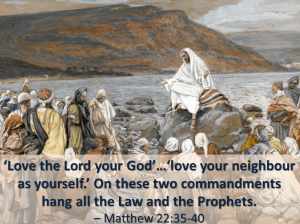
Jesus looked to his Scriptures, the Tanakh (what Christians call the Old Testament), and he read them with a highlighter. He highlighted passages like “Love your neighbour as yourself,” claiming that this was bound up with the command to “Love God with all your heart, soul, mind, and strength.” We show our love for God by loving our neighbours as ourselves.

And Jesus defined our “neighbour” broadly, yet with special emphasis. The neighbours we are to love include anyone we come across as we go through life, even if that includes the stranger or the foreigner—the outsider to our circles, the socially “other.” Yet Jesus, following the Torah and the Prophets, emphasized love for the poor, the widow, the orphan, the enslaved, the downtrodden—those especially vulnerable to harm, the socially powerless.

This comes through in another passage Jesus highlighted in his Scriptures, a passage from the Prophet Isaiah which he took as his life’s mission:

“The Spirit of the Lord is upon me,
because he has anointed me
to bring good news to the poor.
He has sent me to proclaim release to the captives
and recovery of sight to the blind,
to let the oppressed go free,
to proclaim the year of the Lord’s favour.”

Jesus didn’t just teach these things, he lived them.

As the Apostle Paul puts it, Jesus set aside his own divine privileges—his own “rights” as God, you might say—in order to serve humanity in love. He sought out the powerless, he healed the sick, he blessed the poor, he spoke out against oppression and abuse of power against those most at risk. Jesus walked in solidarity with the lowest of the low, even dying a slave’s death, an oppressed and colonized people’s death, executed by the state on a cross. All out of love of neighbour.

This is the basis for a Christian view of freedom and human rights. Human rights are about ensuring basic rights for all people, for all people are created in God’s image. Yet in considering human rights Christians follow Jesus in seeking especially to ensure the rights of those most vulnerable to harm by powerful people and those most prone to oppression or marginalization by the powers that be.

And no, Christians in North America, that’s not us.

And freedom for Christians is about freedom to love our neighbours as ourselves, freedom to walk in Jesus’ way of love, again paying special attention to the socially “other” and the socially powerless. This is what true freedom is: loving others with the liberating love of God, so that they might be freed from all forms of bondage and oppression.

And no, Christians in North America, we are not being oppressed.

Here, then, is where too many of us as Christians have forgotten our baptism.

We have been baptized into Christ to follow the way of Christ, Jesus’ way of love. We have been baptized into Christ to walk in the freedom Jesus brings: liberated from the power of sin, our selfish ways of harm, to walk in Jesus’ way of love. In Christ we have the freedom not to pursue our own self-interest but the interests of others. In Christ we have the freedom to set aside our own rights and privileges to serve one another in love.

If you consider yourself a Christian, I urge you to remember your baptism. Remember the calling to which you were called. Remember the freedom for which Christ has set you free, and don’t settle for some pale imitation of the real thing. There are a lot of Christians right now peddling this fake freedom, and doing so in the name of Christ—don’t buy it, it’s not of Jesus.

Paul’s Impossible Credentials for Ministry

In this coming Sunday’s Epistles reading, the Apostle Paul lays out this impossible list of ministry credentials for servants of God:

We are putting no obstacle in anyone’s way, so that no fault may be found with our ministry, but as servants of God we have commended ourselves in every way: through great endurance, in afflictions, hardships, calamities, beatings, imprisonments, riots, labors, sleepless nights, hunger; by purity, knowledge, patience, kindness, holiness of spirit, genuine love, truthful speech, and the power of God; with the weapons of righteousness for the right hand and for the left; in honor and dishonor, in ill repute and good repute. We are treated as impostors, and yet are true; as unknown, and yet are well known; as dying, and see—we are alive; as punished, and yet not killed; as sorrowful, yet always rejoicing; as poor, yet making many rich; as having nothing, and yet possessing everything. (2 Cor 6:3-10)

It’s quite the list. And, as I said above, it’s rather impossible, at least all the time. Even Paul at times struggled with “patience, kindness, holiness of spirit, genuine love.” It’s also a dangerous list, for without good self-awareness and understanding of wider context, this list can nurture an ego-centric persecution complex that tramples the needs of the genuine poor and vulnerable around us.

Rembrandt, Paul in Prison

But as impossible and dangerous as these kinds of lists might be, they are helpful. They are good for us to reflect on as followers of Jesus. What afflictions have we actually endured for the sake of the gospel? How we have we shown genuine love in our ministry, or truthful speech? Are we too concerned for our reputation to be effective servants of God? Do we have too much, are we too comfortable, to make others rich in Christ out of our poverty?