Jesus and Hell

I preach the good news of Jesus, including Jesus’ way of radical, nonviolent love. As one might expect, I get some pushback on this. “What about sin?” I hear frequently. “What about God’s judgment?” “What about God’s wrath?”

“What about hell?”

Yes, what about hell? After all, Jesus mentions hell more than anyone else in the New Testament. There’s this handy bit of practical advice, for example: “If your hand causes you to stumble, cut it off; it is better for you to enter life maimed than to have two hands and to go to hell, to the unquenchable fire.” Or this lovely bit of encouragement: “You snakes, you brood of vipers! How can you escape being sentenced to hell?”

I’ll admit that my first thought when I hear these kinds of questions is that if anyone thinks my idea of love doesn’t include ideas of sin and its consequences, they aren’t listening. More on point, though, is this: if we want to understand Jesus on hell, we need to read these Gospel teachings carefully, in context, across the Testaments.

Most of the time in the Gospels, the “hell” Jesus mentions is “Gehenna.” The other times when Jesus refers to a hellish judgment, ideas of “Gehenna” are probably still in the background.

“Gehenna” is a reference to a very particular place—and it’s not some location under the earth run by the devil and staffed by his demons. “Ge-henna” refers to the “valley of Hinnom,” a small valley running along the south and west of the Old City of Jerusalem.

Gehenna today

I’ve been there—there’s nothing hellish about it at all. Nor was there in Jesus’ day.

Sometimes you’ll hear that in Jesus’ day there was a perpetually burning garbage dump in the Hinnom valley. But that’s not the case. This idea seems to have originated from a Rabbi centuries after Jesus. In Jesus’ day there was nothing hellish about Gehenna at all.

What was hellish about the valley of Hinnom was its history. There are several Old Testament passages that describe the hellish history of Gehenna. They’re all similar, but to get a taste of hell let’s focus in on one of these—Jeremiah 7, starting with 7:31:

And they [the people of Judah] go on building the high place of Topheth, which is in the valley of the son of Hinnom, to burn their sons and their daughters in the fire—which I [Yahweh, the Lord] did not command, nor did it come into my mind.

Here we learn three key points about Gehenna, the valley of Hinnom.

1) The fires of Gehenna were made by humans, not by God.

In fact, 2) God abhorred the fires of Gehenna.

And why did God so despise the fires of Gehenna? Because 3) they were the epitome of senseless human violence, particularly violence against the most vulnerable.

But there’s more to the story of Jeremiah 7. The people of Judah are appealing to their own special status before God, hoping this will save them from foreign invasion. “The temple of Yahweh is here!” they cry—as if that will help them. “Look,” they say, “we offer all the proper sacrifices!”—as if that will make a difference.

But any special status they think they have is an illusion, all their acts of righteousness are irrelevant, because they are “oppressing the alien, the orphan, and the widow, and shedding innocent blood.” They are committing grave injustices against the most vulnerable among them—of which burning their sons and daughters in the fires of Gehenna was the most horrific.

All this explains why the tables turn at the end of the chapter:

Therefore, the days are surely coming, says the Lord, when it will no more be called Topheth, or the valley of the son of Hinnom, but the valley of Slaughter: for they will bury in Topheth until there is no more room. The corpses of this people will be food for the birds of the air, and for the animals of the earth; and no one will frighten them away. And I will bring to an end the sound of mirth and gladness, the voice of the bride and bridegroom in the cities of Judah and in the streets of Jerusalem; for the land shall become a waste.

Gehenna back in Moloch’s day

It’s a soul-shuddering reference to Jerusalem’s impending doom, the city’s destruction at the hands of the ruthless Babylonian armies. The people’s religiously righteous acts and supposed special status aren’t going to save them.

And all their injustice, all their oppression, all their senseless violence against the most vulnerable? It’s going to rebound against them in equally horrific fashion, until the valley of Hinnom becomes an enduring symbol of God’s judgment on the self-righteous strong who oppress the marginalized weak.

To our three points about Gehenna’s fires above we can now add three more:

4) Gehenna symbolizes God’s judgment, but this divine judgment is not an “angry God directly inflicting violence upon sinners for eternity” judgment.

It’s a 5) “reap what you sow” judgment—if we sow violence, injustice, and oppression, we will reap that violence, injustice, and oppression upon ourselves, in very human, very natural, ways, within human history and not beyond it.

It’s a 6) judgment specifically upon the powerful, those with social or economic or political or religious clout, for the ways in which they oppress and commit violence against the weak, those on the bottom rungs of our social and economic and political and religious hierarchies.

With this background on Gehenna in mind, we can now fully appreciate Jesus’ words on hell in the Gospels.

Jesus isn’t talking about a “literal hell” where unrepentant unbelievers go after they die to be tortured in God’s inferno for all eternity.

He’s talking about the violent consequences of our own violent actions, right here in our lived lives, right here in human history.

He’s talking about such consequences especially for those who use their power to oppress the weak, who live in wealth in indifference to the poor, who have the means to care for the sick and clothe the naked and feed the hungry but refuse to do so, who rest secure in their status and privilege while committing grave injustices against the vulnerable and the marginalized.

And he’s talking in particular to the uber-religious, the people who think they’re on God’s side because they believe the right things or do the right rituals—but they burden others with moral demands while doing nothing to help them, they focus on minor moral issues while neglecting the weightier matters of justice and mercy and allegiance to God above all other powers that be.

These are sobering words, serious warnings, for every age and certainly our own. But all this is right in line with the good news of Jesus and Jesus’ way of love.

After all, there’s nothing more loving, nothing more like Jesus, than standing in solidarity with the powerless, the stepped-upon, the pushed-to-the-side, and standing up to the oppressive powers that be—whatever the cost to ourselves.

And it is this hell of our own harmful actions and their destructive consequences—our sin and all its death—that Jesus has come to save us from. Jesus calls us to leave behind our damaging, violent ways and follow him in his path of compassionate, inclusive, forgiving, self-giving love. If we don’t do this the result will only be death for ourselves, for others, for the world. But if we do this we will find life, full and flourishing life for all.

This is love. This is Jesus. This is good news indeed.


For more on this, see my “Let’s Talk About Hell.”

© Michael W. Pahl

Christianity is Far More Radical than You (or I) Think

Not my family. But that food looks good.

I like having my family gathered together around the table, eating together, just being together. I like the puns that banter to and fro, the laughter and groans that ensue. I like the spontaneous singing that erupts, or the complex table rhythms that generate from one person’s tap-tap-tippety-tap. I like the conversations about life and learning and love.

I like having good food to eat, clean water to drink, fresh air to breathe, comfortable clothes to wear. I like having a spacious home, and I like most of the stuff in it: gizmos and gadgets that cook and bake and clean and entertain and inform and communicate. And books, lots of books.

I like being able to live my life relatively free of fear of violence or destitution. I like being able to meet with whomever I want, to do pretty much whatever we want, including worshiping the God we believe in in the way that we want. I like being able to think and speak freely without thinking someone might harm me or my family (well, I guess there were those two times).

In other words, I like my rights and freedoms. I like my safety and security. I like my comforts. And I’m pretty sure most of us white middle-class Christians in North America feel the same way.

But there’s a problem with this: it keeps us from truly hearing and living out the radical message of Jesus, the radical message of the gospel.

Here’s Jesus, giving the “altar call” of his gospel proclamation:

If any want to become my followers, let them deny themselves and take up their cross and follow me. For those who want to save their life will lose it, and those who lose their life for my sake, and for the sake of the gospel, will save it. For what will it profit them to gain the whole world and forfeit their life? (Mark 8:34-36)

This is no altar call like we might be used to. This is no “pray the Sinner’s Prayer and you’ll be saved,” no “read your Bible and go to church and you’ll get rid of those nasty habits”—but otherwise carry on with your lives, business (and pleasure) as usual.

Every Jew in Jesus’ day knew what it meant to “deny oneself.” They heard it every year in preparation for Yom Kippur, the Day of Atonement. “Denying oneself” was equivalent to “fasting” and related to “Sabbath-keeping.” It meant voluntarily giving up your work and your food, giving up the basic necessities and comforts of life and the means by which those are attained, in devotion to God.

And every Jew—indeed, every conquered people in the Roman Empire—knew what it meant to “take up one’s cross.” They saw it with inhuman frequency outside the major cities on the edges of Empire. “Taking up one’s cross” meant carrying a cross-beam to the outskirts of the city, where one would then be suspended from that beam on a post or tree until one died. It meant condemnation and execution. It meant shameful, painful, and certain death.

And “following Jesus”? It soon became clear what that meant, for not too long after Jesus said these words he himself “denied himself”—gave up his rights and privileges in devotion to God—and “took up his cross”—was executed in condemnation and shame and excruciating pain.

This is Jesus’ “altar call.” This is Jesus’ call for response to the gospel of God’s kingdom.

And it is gospel, it is “good news.” I know, it might not sound like it, not to our modern western ears. But Jesus says that if we do this—if we “lose our lives” in this way—we will in fact gain life. And if we don’t do this—if we instead seek to “preserve our lives,” our lives of comfort and security—we will in fact lose our lives in the end.

It’s a paradox, right at the heart of the gospel. Here’s how I understand this.

We naturally and rightly desire justice, peace, health, security, comfort—flourishing life—for ourselves and those close to us. But fulfilling those desires for ourselves often means impeding others from fulfilling those same basic human desires: our peace and security come at the expense of others’ welfare, our comfortable lives are made possible by others’ lives of hardship, and so on.

In our day, these “others” are often outside our immediate vision. They can even be on the other side of the world. Faceless. Nameless. Poor. Not-white. They suffer so that we might have all the comforts of home.

In the long run this system cannot be sustained. Whether on a personal level or a global scale, in the end the comfortable and well-fed will lose their lives of relative abundance. It’s inevitable. And then the scales will tip, the down will move up, the up will move down, and it starts all over again.

Into this never-ending cycle of inequity, even injustice and oppression, Jesus speaks these words: “Deny yourselves, take up your cross, and follow me. Only if you lose your life in this way will you save it.” It is only if we give up our privileges and comforts for the good of others, only if we let go of our claim to our own rights and freedoms for the good of all, that we can experience the true life God desires for us.

Lentz - Christ of MaryknollIn other words, if we truly want to experience permanent justice, lasting peace, and flourishing life as human individuals, as a human race, and as a planet, the only way forward is to follow the self-denying, self-giving way of love and peace as embodied in Jesus.

If we were to take Jesus’ call seriously, then, we would hold our possessions loosely, living simply. We might even sell all we have and give the money to the poor.

If we were to take Jesus’ call seriously, we would also hold our rights and privileges loosely, living free of expectation and entitlement. We might even stand up for the rights of others at great cost to ourselves.

If we were to take Jesus’ call seriously, we would seek out society’s cast-offs, those clinging to the bottom rung, and lift them up alongside us. We might even, if necessary, switch places with them.

If we were to take Jesus’ call seriously, we would forgive, forgive, and forgive again. We might even walk the extra mile and do good things for those who hate us, even our outright enemies.

I’ll be honest: I don’t think I can do this. We all—myself included—are pretty good at justifying our comfortable existence. And we all—myself included—are pretty well attached to our life of relative ease.

I like my coffee, my housecoat, my family gathered around, my home and clothes and food and drink and health and safety and security and freedom.

Yet Jesus’ gospel call always stands before me. It calls me perpetually to repentance, my self-justified selfishness laid bare. It summons me always, over and over again, to a better way, a better way to be human in the world. It beckons me onward to a life of devoted faith in God, selfless love for others, and enduring hope for justice and peace and abundant life for all.

The Bible, the Gospel, Jesus, and “The Word of God”

Ask Christians today what they think of when they hear the phrase, “The Word of God,” and they’ll probably say, “The Bible.” For many Christians the two are even synonymous: “The Bible” = “God’s Word,” and “God’s Word” = “The Bible.” The idea is that the Bible as a whole is a divine message for humanity, even the divine message for humanity.

I don’t typically use the phrase, “The Word of God,” to describe the Bible, however. That’s not because I don’t believe God speaks to us through the Bible (see here on that). I believe the Bible is inspired or “breathed into” by God and so is useful for teaching, for rebuke, for correction, and for training in God’s ways (that’s 2 Tim 3:16). Most importantly, I believe the Bible witnesses to Jesus and salvation through him (that’s 2 Tim 3:15, often missed when 2 Tim 3:16 gets quoted).

Rather, I avoid describing the Bible as “the Word of God” because the Bible itself doesn’t describe the Scriptures this way.

The Bible speaks of many “words of God,” or “words of the Lord,” to use a phrase that’s roughly parallel in Scripture.

  • Particular commands, promises, and teachings can each be a “word of God” or “word of the Lord.”
  • Specific prophetic utterances can each be a “word of God” or “word of the Lord.”
  • In the New Testament, the gospel, the good news message about Jesus, is frequently called “the word of God,” “the word of the Lord,” or using similar “word” phrases (“word of Christ,” “word of life,” etc.).
  • And, of course, Jesus himself is called “the Word” which came from God and “became flesh” among us.

But nowhere does the Bible clearly use the phrase “the word of God” to refer to a collection of previously written Scriptures.

Sure, some passages can make sense like that. We hear Jesus say to the religious leaders, “You make void the word of God for the sake of your tradition,” and it can make sense to think of that as referring to the Jewish Scriptures, our Old Testament. But in the story Jesus is referring to a specific “word of God,” the particular command to “Honour your father and your mother”—not “the Scriptures” as a whole.

Or, we hear Hebrews say that “the word of God is living and active, sharper than any two-edged sword, piercing until it divides soul from spirit, joints from marrow; it is able to judge the thoughts and intentions of the heart,” and it can make sense to think of that as referring to the Scriptures. However, given the opening words of Hebrews, about God speaking “in many and various ways by the prophets” and now “in these last days…by the Son,” it’s more likely that “the word of God” here refers to any true “message from God.” It may even have the specific sense of “the gospel,” since that’s how the phrase seems to be used elsewhere in Hebrews.

That’s the thing about the uses of “the word of God” or “the word of the Lord” in the Bible—some can make sense to us today as referring to the Bible, but that wouldn’t have made sense to those for whom the Bible was first written. That’s not least because they simply wouldn’t have thought of “a bound collection of written Scriptures” in the way we think of “the Bible”—they didn’t have any “bound collection of written Scriptures.” But it’s also because they tended to think of “word of God” or “word of the Lord” as a discrete “message from God,” a particular divine message given at a particular time for a particular purpose. Furthermore, while these various “words of God” could certainly be compiled together and written down, they were still typically thought of as oral proclamation, as spoken messages.

This is why the earliest Christians so frequently used “the word of God” or “the word of the Lord” or “the word of Christ/life/truth/grace/ salvation/etc.” to describe the gospel message (see lists of passages here, here, here, here, and here). This gospel was an orally proclaimed message from God, with a specific content, given at a specific time in human history and for a specific purpose. This is, in fact, by far the most common use of this kind of “word” language in the New Testament.

And this is what makes John’s description of Jesus as God’s eternal “Word” so interesting. God has spoken many “words,” given many divine messages, in the past: commands, teachings, promises, and prophetic pronouncements. But Jesus is the “Word” behind all those “words,” the Divine Message extraordinaire—and this ultimate Divine Message has been “made flesh and dwelt among us.” The eternal Word behind all those divine words has become embodied in a particular human person, Jesus of Nazareth.

So what’s the upshot of all this? How should we as Christians think about the Bible, the gospel, Jesus, and “the word of God”?

The Bible records many “words of God”: commands, teachings, promises, and prophetic pronouncements, given to particular people in a particular time and place for a particular purpose. We need to pay close attention to those divine messages—they are among those inspired Scriptures that are useful for us to learn God’s ways—but we must recognize that not all of these past “words of God” are directly applicable to us today.

The Bible describes the saving “word of God”: the gospel of Jesus Christ, the good news that in Jesus, the crucified Messiah and risen Lord, God has acted to make right all that has gone wrong in the world because of human sin. We need to hear this gospel well, and repeatedly, and respond to this good news with repentance, faith, and obedience.

And the Bible witnesses to the living “Word of God”: Jesus of Nazareth himself, the embodiment of the eternal Divine Message that stands behind all these messages from God, the one in whom all these “words of God” find their coherence and their fulfillment. We need to look to Jesus as the clearest and most complete revelation of God and God’s will, seeing the eternal message of God embodied in his life, teachings, death, and resurrection, and respond to the living Jesus with loving devotion and faithful allegiance.

———————————————–

For more on how we should think about the Bible, see my post, “What is the Bible, and How Should We Read It?”

For an in-depth, academic examination of the language of “word of God,” “word of the Lord,” and the like, see my JSNT article “The ‘Gospel’ and the ‘Word,’” as well as my LNTS book Discerning the ‘Word of the Lord.’

© Michael W. Pahl

Michael Pahl’s Handy-Dandy Handbook of Christian Words and Phrases

Have you ever had two people understand something you’ve said in two very different ways? It happens to all of us sometime. I’ve had it happen to me when I preach, more than once. This happens even when I use common Christian words or phrases derived from the Bible—maybe especially when I do so. It can be a little disconcerting, to say the least.

Part of this is just me needing to look for ways to communicate more clearly. Part of it, however, is our natural tendency to hear what we expect to hear. When we’re in a church and someone speaks about “faith” or “heaven,” for example, or they say “Jesus saves us from our sins,” we are inclined to hear those things in a particular “churchy” or “Christianese” kind of way.

But many of these words or phrases don’t mean for me what they often mean in popular Christianity. The reason? I don’t think the popular understandings actually reflect the biblical ideas behind these words or phrases, at least not completely.

Well, if you’re ever in doubt about what I might mean when I talk about “salvation,” or when I say, “Jesus is Lord,” I’ve created this nifty little guide: Michael Pahl’s Handy-Dandy Handbook of Christian Words and Phrases. Who knows? Maybe I’ll start handing this out before I preach every Sunday.

God. God is depicted in a myriad of different ways in Scripture. These are all metaphors: God is in some sense comparable to a “Father,” for instance, or a “Mother,” or a “Lord,” or a “Rock,” just to name a few. Even “God” is a metaphor: God is analogous to the “gods” of other nations and religions, comparable to what we typically think of when we think of a “deity.” Some biblical descriptions, however, take a different tack: God is YHWH, “I Am Who I Am,” for instance, or God is “the one in whom we live and move and have our being,” or “God is love.” When I speak of “God,” I’m thinking more along those lines: God is “the ground and source of all being, personhood, and love.” I don’t imagine that God is merely “a being,” a distinct being within the universe, like us only bigger and stronger and immortal and invisible.
heaven. The Bible doesn’t speak of “heaven” as “our eternal home.” The New Testament understanding of life after death is simply being “with the Lord” or “with Christ.” In the end this includes living in transformed bodies in a renewed earthly creation (“resurrection” to a “new heavens and new earth”). In the Bible “heaven” means either 1) “the skies,” 2) “God’s dwelling,” or 3) a roundabout way of saying “God” (e.g. “kingdom of heaven” = “kingdom of God”). I don’t use the word “heaven” very often myself because of how it is misunderstood, but when I do it’s along the lines of 2) above: “the ‘place’ where God is most ‘fully present.’” Usually I use the word to speak of the biblical hope of “heaven” come down to earth, God’s presence being fully realized among us within a renewed creation.

sin. We tend to think of “sin” as “personal moral failure”: we’ve crossed a boundary established by God, and these boundaries are mostly related to our private lives or individual relationships. This way of thinking about sin isn’t wrong, it’s just incomplete, and if this is the only way we think about sin then it can be unhelpful and unhealthy. I think a better (and more holistically biblical) way of thinking about sin is as “all the ways we harm others, ourselves, and the natural world through our settled thoughts, our words, our actions, and our inaction.” This “harm” can be thought of as “preventing or hindering flourishing life.” With regard to people this can most practically be understood as keeping them from having their most basic needs met: needs for clean air and water, nutritious food, basic health, security and freedom, meaningful relationships, love and respect. This sin is more than just “personal moral failure,” then—it also includes collective sins such as systemic injustice, as well as actions that harm the natural world.

salvation. In Scripture the language of “salvation” is most often about “rescue” or “deliverance” from some real-life peril, but it also can include ideas of “healing” and “restoration,” whether physically or relationally, individually or collectively. Then there’s all the related biblical words like “redemption,” “reconciliation,” and so on, which are really variations on the “restoration” idea. When I speak of “salvation” or being “saved” or God as “Saviour,” I mean something along the lines of “God delivering us from all the ways we harm others, ourselves, and the natural world, and bringing about a full and flourishing life for all creation.” I don’t mean “God rescuing us from future eternal torture so that we can live a disembodied existence somewhere else forever with God.”

kingdom of God. In much popular thinking the “kingdom of God” or “kingdom of heaven” is equivalent to “heaven,” which is thought of as “our eternal home” (see “heaven” above). But for early Jews, including Jesus and the authors of the New Testament, “kingdom of God” was a way of referring to “God ruling over God’s people and all the peoples of the earth.” When I use the phrase “kingdom of God,” I’m trying to capture Jesus’ particular understanding of this earthly rule of God, something along the lines of “God’s vision of a world of justice, peace, and flourishing life, which becomes a reality when people live according to God’s way of love.”
Jesus Christ. “Christ” is not Jesus’ second name; “Christ” is a title. And it’s not a title of divinity; it’s a human title. “Christ,” or “Messiah,” was most commonly a way of referring to the human kings in the line of ancient Israel’s King David. Eventually it came to refer to the ultimate Messiah, “the king from David’s dynasty who brings about God’s kingdom on earth.” The phrase “Jesus Christ,” then is a mini-creed: “Jesus is the one who makes real God’s vision of justice, peace, and life on earth.”

Son of God. This phrase has a dual meaning in the New Testament. Some writings, Mark’s Gospel, for example, use “Son of God” in one of its Old Testament senses, as a way of referring to the kings in the line of David. In this sense the phrase is equivalent to “Christ” or “Messiah,” and has no overtones of divinity. Other writings, most notably John’s Gospel, use “Son of God” with a clear implication of divinity. I believe both to be true of Jesus, and how I use this phrase tends to depend on which New Testament books I’m talking about: Jesus is “the one who makes real God’s vision of justice, peace, and life on earth,” and Jesus is “the one who uniquely embodies God, showing us most clearly and completely who God is and how God works in the world.”

Jesus is Lord. This doesn’t mean “Jesus controls everything that happens.” Nor does it merely mean “Jesus is the boss of me.” “Lord” in the ancient world had connotations of “master,” yes, but it was also a common way of speaking of human rulers—kings, emperors, and the like. With none of these was the idea that they controlled a person’s life circumstances; it was that they commanded their obedience or allegiance. To say that “Jesus is Lord,” then, means that “Jesus is greater than all human rulers and any powers-that-be in this world, and so he holds our ultimate allegiance in all things.”
gospel. The New Testament word “gospel” means “good news.” The “gospel” is not merely that “God sent Jesus to die for our sins so that we can be forgiven and go to heaven when we die.” It’s the “good news that God has acted in Jesus—through his life, teachings, death, and resurrection—to make right everything that has gone wrong in the world.” In other words, it’s a way of summing up pretty much everything I’ve described above.

faith. We tend to think of “faith” either as “believing certain things to be true,” or “trusting in someone to do something.” The New Testament language of “faith” includes those ideas, but also others: “faith” (pistis) can mean everything from “belief” to “trust” to “faithfulness” to “fidelity” to “allegiance.” When I use the word “faith” I can mean any or all of those, following the New Testament usage. All of those are the response God desires from us: “believing what God says to be true, trusting in God through all things, being faithful to God and following God’s way of love.”

love. Some people hear “love” and think “affection,” a surge of warmth and fondness toward others. Others hear “love” and think “tolerance,” acknowledging and accepting others and their actions with a kind of benign smilingness. Some, perhaps conditioned by Christianity, hear “love” and think “self-sacrifice.” Others, of course, hear “love” and think “romance” or even “sex”: physical, emotional, even erotic intimacy. None of these are bad, but on their own they are incomplete. In the New Testament, love is consistently portrayed as loving the way Jesus loved. It is more along the lines, then, of “freely giving ourselves for others so that they might experience flourishing life together with us, even if we feel they don’t deserve it, even when it hurts us to do so.” This love, I’m convinced, is at the heart of who God is, what Jesus taught and lived out unto death, and how God’s “salvation,” the “kingdom of God,” comes about.

How do you understand these words? What often-misunderstood “Christian words” would you add?

© Michael W. Pahl

Why I Do Not Cease Teaching and Writing

I have been teaching the Bible and writing about Christian theology in various ways, in a variety of settings, for over twenty years now. This has mostly been a rewarding task. I love learning new things or discovering new ways of seeing things, and I love seeing the same light bulb turn on for others. But this has also, at times, proven to be disheartening, even tremendously discouraging.

So why is it that I keep teaching and preaching? Why do I keep blogging and writing? Well, beyond the basic fascination I have with the Bible and theology, deeper than the enjoyment I get from interacting with others about these things, there is simply this: our world—including we who are Christians—desperately needs the gospel of Jesus Christ.

I am convinced of this: the gospel is our only hope. Jesus offers us the only way to true life.

“Wait a minute, Michael. That sounds so exclusive, so fundamentalist even. I thought you were one of those progressives.”

Well, I don’t know what box I fit into, to be honest. I say a hearty “Amen!” to all the gospel texts—John 3:16, “I am the Way, the Truth, and the Life,” “There is no other name given under heaven by which we can be saved,” “The gospel is the power of God for salvation,” and more. Yet I’m convinced that many modern understandings of the gospel are in fact misunderstandings of the gospel.

While I would be delighted to have more and more people claiming to be followers of Jesus, I’m far more concerned about having more and more people actually following Jesus. While I would be thrilled to have crowds of people claiming the name of Jesus, I’m far more interested in seeing human beings—regardless of their religion—living out the way of Jesus. This is, in fact, the point of the Great Commission: not to make converts to a religion, but to make disciples of Jesus.

And when I hear key Bible words like “salvation” and “life,” I don’t hear these as “salvation from hell to heaven” or “living forever with God after death.” Yes, we have the promise of being “with the Lord” beyond death. But the biblical language of “salvation” is about rescue and restoration: rescuing us from all the ways we harm ourselves, others, and our world (our “sin,” in other words) and restoring us and all humanity and all creation to the way God originally intended things to be. This is why these words, “salvation” and “life,” are so often connected to other key words in the Bible: God’s “kingdom,” “new creation,” “justice,” “peace,” “liberation,” “reconciliation,” and more.

So here’s what I mean when I say “the gospel is our only hope” and that “Jesus offers us the only way to true life”: if we truly want to experience permanent justice, lasting peace, and flourishing life as human individuals, as a human race, and as a planet—salvation, in other words—the only way forward is to follow the way of love and peace as embodied in Jesus.

Jesus’ “gospel of the kingdom” teaching can be summarized with the word “love”: we are to love God with every dimension of our being, and we are to love other persons as we love ourselves. These two loves are inseparable: our love for God is shown by our love for others. Jesus taught that loving others means giving ourselves for their good, even when this means sacrifice or suffering for us. He taught that those whom we are to love include not only persons who are like us, but also those who are different from us, even those who are opposed to us, who may even wish us harm.

Jesus’ gospel teaching on love included the way of peace. This way of peace is the difficult path of nonviolent resistance to sin and evil powers: resisting harmful attitudes, words, and actions both within ourselves individually and among us collectively, in order to effect positive change; but doing so in creative, nonviolent ways that seek restoration and reconciliation and not retribution, ways that may involve the voluntary suffering of oneself in order to bring about a greater good for all.

Jesus’ way of love and peace requires a devoted faith in God: freely committing ourselves to the God who is love, whatever may come. It also requires a resilient hope in God: persistently trusting in God to bring about good even, potentially, through our own suffering and death.

All this Jesus not only taught, he lived it out: forgiving sinners, welcoming outcasts, showing compassion, healing freely, standing up to oppressive powers-that-be, even enduring suffering and death because of sin and evil, ultimately experiencing true justice and peace and flourishing life through death, having been resurrected by God. Jesus taught the gospel, and he lived out the gospel—and so he modeled the gospel and planted the seed of the gospel in the world.

If we truly want to experience permanent justice, lasting peace, and flourishing life as human individuals, as a human race, and as a planet—true salvation—the only way forward is to follow this way of love and peace as embodied in Jesus: loving God through loving others, nonviolently resisting sin and evil both in ourselves and in the world, trusting in God to bring about good among us and in the world through this way of Jesus.

This is what I mean when I say that the gospel is our only hope. This is what I mean when I say that Jesus offers us the only way to true life.

And this is why I do not cease teaching and writing. This is what motivates me to keep on keeping on, even when I get discouraged, even in the face of opposition. Our world is filled with too much bigotry, cruelty, injustice, and oppression, for me to stop speaking the gospel. There are too many different being excluded, too many vulnerable being exploited, too many sick who are dying and poor who are trampled on for me to stop teaching the way of Jesus. There is too much guilt and shame and ignorance and fear for me to stop proclaiming the good news of Jesus Christ.

menno-simonsAll you Mennonite history buffs will know that I’ve pilfered the title of this blog post from Menno Simons himself. He wrote a tract with this title, and some of the themes of my blog post are echoes of the original Menno Simons tract (other themes from his tract I’m happy to leave aside). Let me conclude with a couple of my favourite quotes from the very Menno in Mennonite:

True evangelical faith is of such a nature that it cannot lay dormant; but manifests itself in all righteousness and works of love; it dies unto flesh and blood; destroys all forbidden lusts and desires; cordially seeks, serves and fears God; clothes the naked; feeds the hungry; consoles the afflicted; shelters the miserable; aids and consoles all the oppressed; returns good for evil; serves those that injure it; prays for those that persecute it; teaches, admonishes and reproves with the Word of the Lord; seeks that which is lost; binds up that which is wounded; heals that which is diseased and saves that which is sound. The persecution, suffering and anxiety which befalls it for the sake of the truth of the Lord, is to it a glorious joy and consolation.

And then Simons’ concluding words:

Beloved sisters and brothers, do not deviate from the doctrine and life of Christ.

Amen, brother Menno. Amen.

© Michael W. Pahl

“All Scripture is inspired by God” doesn’t mean “All Scripture is equally important”

I think most Christians assume that the Bible is a monolithic entity, like a seamless cloth or a fissure-free rock.

We may know that there are in fact 66 books, but we view these as essentially different chapters of the same, single book. We may know that there were different human authors in different time periods and cultural settings, but we view this as effectively irrelevant—every book has the same divine author behind them, and that’s what really matters. And since this divine author produced every jot and tittle in the book, every statement is important, even every word.

road-to-nowhere-1For most Christians, in other words, the Bible is a “flat” text: it’s all from God, so you can’t elevate any passages or books above any others, or ignore any passages or books either. It’s all inspired by God, so it’s all equally important—and we need this “whole counsel of God.”

In theory, that is. In practice no Christians actually do this. Every Christian prioritizes some biblical texts or themes above others, whether unknowingly or through some elaborate theological justification. But most won’t admit they do—no one wants to be accused of having a “canon within the canon.”

Well, I’m here to admit to my own “canon within the canon,” and to declare that this is actually okay. In fact, I think the Bible itself points us to this. Here are three reasons why I think “all Scripture is inspired by God” cannot mean that “all Scripture is equally important.”

First, the New Testament authors don’t use all Scripture equally.

Estimates of New Testament citations of the Old Testament vary—there are no quotation marks in the Greek text, so sometimes it can be hard enough to tell for certain that something is a direct quotation, let alone a more indirect allusion. One good estimate, though, is from the United Bible Society’s Greek New Testament (4th edition): 343 direct quotations of some portion of the Old Testament, and 2,309 allusions and verbal parallels to Old Testament texts.

Here’s what’s interesting: there are some clear patterns in all these quotations and allusions, patterns that show that some Old Testament books and ideas were more significant to the New Testament authors than others.

The top five most-used books? By a pretty fair margin it’s the Psalms and Isaiah, followed by Genesis, Exodus, and Deuteronomy. Some of these are, of course, longer books, so you’d expect more quotations from them. But other lengthy Old Testament books are further down the list, not cited nearly as often, including Leviticus and Numbers, Samuel and Kings, Chronicles and Ezra-Nehemiah, Job and Jeremiah and Ezekiel.

But it’s not just that some Old Testament books are cited much more frequently. It’s the way in which they are cited, the particular passages that are used, and how these fit within the New Testament texts.

The “in the beginning” of creation, the creation of humanity “in God’s image,” the Abrahamic covenant, the Exodus of Israel from Egypt, the “love your neighbour” command, the “love God” command, the Davidic and Royal Psalms, the “Servant” and “Good News” passages of Isaiah—these are some of the texts and stories and themes that show up over and over again in the New Testament, that shaped the theologies of the New Testament authors. These, in fact, are what provide the basic plot points of a larger narrative that underlies much early Christian theology.

Other Old Testament passages, including some that many Christians today really like—the “days” of Creation, the Flood story, most of the particular laws of Moses, the Conquest narrative, specific stories of Israel’s kings—these get hardly a mention in the New Testament.

In other words, the New Testament authors prioritized some books and passages over others in their own Scriptures, our Old Testament. They had a “canon within the canon”—a set of biblical texts and themes that stood out from the rest as more significant.

Second, the Gospels portray Jesus as reading Scripture in a selective way, a way that points to himself.

This follows much the same pattern as the rest of the New Testament noted above. In the Gospels Jesus’ ministry is cast primarily in the light of the prophet Isaiah and the Psalms of David. Other prophets—both storied prophets like Elisha and writing prophets like Daniel (especially Daniel’s “son of man”)—also get a strong nod. The Creation of humanity, the Abrahamic covenant, and Moses and the Exodus are important for shaping the life and teachings of Jesus, though these are mostly filtered through the lens of how Isaiah used these stories and themes.

tissot-sermon-of-the-beatitudesBut specific laws of Moses? By and large these are cited by Jesus only to qualify them in some way, or to offer a different interpretation of them than Jesus’ opponents, or even to overturn them entirely if they don’t fit within Jesus’ larger understanding of what God was doing in the world through him. The major exceptions to this? The commands to love God and neighbour.

All this means that when Luke says that “beginning with Moses and all the prophets, Jesus interpreted to the disciples the things about himself in all the Scriptures,” this can’t mean that Jesus is behind every rock or shadow in Scripture. Or that when Matthew says that Jesus has “not come to abolish the Law or the Prophets,” that “not one jot or tittle shall pass from the Law until all is accomplished,” this can’t mean that every command of Moses must be directly applicable to Jesus’ followers.

Third, the New Testament describes Jesus, not Scripture, as the ultimate revelation of God and God’s will for humanity.

The New Testament writings are remarkably unified on this, though they describe this in different ways.

There’s Matthew, picturing the resurrected Jesus as having “all authority in heaven and on earth” and so calling disciples to “obey everything he has commanded” in his teachings—indeed, his teachings are the “rock” upon which his followers are to build their lives. There’s John, calling Jesus the eternal “Word of God” made flesh, the one who has made the invisible God known to humanity, and decrying those who “diligently search the Scriptures” to find salvation without realizing that Jesus, the True and Living Way, stands among them.

There’s Paul, describing the gospel of Jesus the crucified Messiah and resurrected Lord as “of first importance” and the basis of salvation, and declaring Jesus to be “the image of the invisible God” who has supremacy above all things. There’s Hebrews, depicting Jesus as “the radiance of God’s glory and the exact representation of his very being,” the one through whom God has authoritatively spoken in these last days, even in distinction from the Hebrew prophets of old. There’s Revelation, portraying Jesus as the one who speaks God’s word like a sword, bringing encouragement to God’s people and judgment on God’s beastly, death-dealing enemies.

All these New Testament depictions of Jesus point to the same conclusion: Jesus is the ultimate revelation of God and God’s will for humanity, not anything else, not even Scripture. This means, then, that as Christians we read Scripture in order to know Jesus, and then we strive to follow this Jesus whom Scripture has revealed. And this in turn means that there is a natural prioritization within the Bible: those texts that more clearly and directly speak of Jesus have greater priority for Christians than those that speak of Jesus less clearly and directly.

Don’t misunderstand me. I believe that “all Scripture is inspired by God and is useful for teaching, for reproof, for correction, and for training in righteousness” (2 Tim 3:16). We can potentially learn good things for a godly life from any passage in Scripture.

But in terms of fundamentally shaping our worldview, our theology, the essential framework of our faith? In terms of providing the basic lens through which we even read the rest of Scripture? The Bible itself points to a layered “canon within the canon”: first, the New Testament descriptions and interpretations of the life, teaching, death, and resurrection of Jesus; and second, the Old Testament texts and stories and themes that shaped these New Testament understandings of Jesus.

That’s my “canon within the canon,” and I’m not afraid to admit it.

————————-

A few extra notes on this:

1) What I’ve described, of course, is a Christian way of reading the Christian Bible. However, most of the Christian Bible (our “Old Testament”) is also the Jewish Scriptures, the Tanakh, and Jews will naturally read their Scriptures differently than Christians. Although I think the “canon within the canon” approach I’ve described above makes the best sense as a Christian, I see great value in the approach that many Jews take to their Scriptures. A common Jewish approach is not to take the Scriptures as a “flat,” monolithic text either, but rather to see the various biblical texts as diverse voices, even sometimes conflicting voices, within a conversation that we as readers are invited to participate in and learn from.

2) Yes, the “all Scripture” in 2 Timothy 3:16 is the Jewish Scriptures, essentially the Christian Old Testament. However, I think the basic idea applies to all the ancient human writings the historic Church has identified as “Scripture,” including our New Testament: they are all “inspired by God” or “God-breathed,” and therefore “useful” for “teaching, reproof, correction, and training” in the way of God. However, I also think the same basic prioritization I’ve described here also applies to the New Testament: the New Testament writings do not equally clearly or directly point to the life and teachings, death and resurrection of Jesus.

3) For a more scholarly sketch of my approach to these things from a different angle, see my book chapter called “Scripture and Tradition: Seeking a Middle Path.”

Second image: James Tissot, “Sermon of the Beatitudes”

© Michael W. Pahl

My Pastoral New Year’s Resolution

I’m not one for New Year’s resolutions. I’ve tried them in the past, but they’ve never worked. “Resolution” can sounds so decisive, so irrevocable. So guilt-inducing.

Let’s call this my pastoral New Year’s goal, then. Here’s what I’m aiming for as a pastor for 2017: to be patient in love, persistent in prayer, faithful in teaching the Scriptures, and bold in proclaiming the gospel of Jesus Christ.

commitmentIf that sounds like liturgy, that’s because it is. This was the commitment I made before our congregation when I was installed as pastor. Really, then, my 2017 pastoral New Year’s goal is simply re-committing myself to this calling.

I’ve often been distracted from this. To be fair to myself, though, it’s awfully easy to get distracted from this.

Many pastors feel like they have “a hundred bosses,” or whatever the size of their congregation is, because every person in the church has a different, particular understanding of what it means to be a “pastor,” who a pastor is supposed to be and what they are supposed to do. Some want a congregational visitor, others a community activist, some a spiritual guru, others a private therapist, some a thoughtful theologian, others an extroverted evangelist—and that’s only a small sample of the options. Just imagine the multiple personalities required to do all this, let alone the superhuman skills and physics-bending time and energy.

Into this vortex of competing expectations and impossible demands I hear Jesus’ simple call to me as pastor, a call nicely summarized by that installation liturgy: be patient in love, persistent in prayer, faithful in teaching the Scriptures, and bold in proclaiming the gospel of Jesus Christ.

Be patient in love. This is not so much a specific task to do as it is a general orientation for everything I do. And this is as difficult for me as it is for anyone else—contrary to another common expectation, pastors are not inherently “more spiritual” than others. Yet it is an orientation all Christians are called to nurture in Christ by his Spirit. In whatever tasks I do, in whatever roles I take on, in 2017 I want to strive to be patient with others as I seek to love them in the way of Jesus. (Lord, have mercy!)

Be persistent in prayer. Here my pastoral calling starts to become more specific, and in this I have much room for improvement. This is not incidental to my ministry, but central: to persevere in prayer for those among us and around us, to be deliberate in making and taking time to speak the names and stories, joys and sorrows of our congregation and community before God. May this year be a year of rekindled prayer in my life, in every area of my life.

Be faithful in teaching the Scriptures. You’d think this would already be well in place. After all, this is an area of expertise and experience for me, and teaching the Bible is one of the most fulfilling things I’ve ever done. I have a Ph.D. in biblical studies, for goodness’ sake! But for various reasons this has been pushed to the margins in my ministry. No more: in the coming year I am determined to re-claim this calling, to find and create opportunities to teach the Scriptures in all their difficult challenge and inspired insight.

Tissot - Jesus TeachingBe bold in proclaiming the gospel of Jesus Christ. This is something I have been doing—every sermon I preach is a proclamation of the gospel—but I am resolved (yes, on this I’m “resolved”) to do this even more. Our world—and each one of us—desperately needs to hear God’s good news again and again and again. But beware: this is not the gospel many of us grew up with. It’s the gospel of God’s kingdom come on earth, justice and peace and flourishing life for all, brought about through the crucified and resurrected Jesus. It promises true life, abundant life, but it demands our very lives: walking in the cross-shaped footsteps of the resurrected Jesus. In 2017 I intend to preach this gospel of peace at every opportunity.

Of course, this doesn’t mean that these are the only things I’ll be doing as pastor this year. There are all kinds of specific tasks, necessary or urgent or both, that are part of a lead pastor’s role in this day and age. But these are the things I’ll be focusing my time and energy on, for these are the things to which I have been called.

So watch out, world! Look out, Morden Mennonite Church! Pastor Michael is on the loose! Let 2017 be the year in which I take a leap of faith closer to the goal for which I was commissioned: being patient in love, persistent in prayer, faithful in teaching the Scriptures, and bold in proclaiming the gospel of Jesus Christ!

By God’s grace, may it be so.

Cross-posted from http://www.mordenmennonitechurch.wordpress.com. © Michael W. Pahl.

God’s Dream for the World

“I have a dream.”

The words are iconic. I’m sure most of us know the speaker, and the context.

Martin Luther King, Jr. The Lincoln Memorial in Washington, D.C. August 28, 1963.

Ground zero of the African-American civil rights movement.

It had been 100 years since Abraham Lincoln himself had issued the Emancipation Proclamation. Almost 98 years since the U.S. Congress had passed the 13th amendment to the U.S. Constitution, abolishing slavery. A full century, in other words, to bring about full equality under the law for African Americans. But it hadn’t happened.

Three, four generations. And it still hadn’t happened. Bits and pieces, here and there, including a decade of rocky attempts at desegregating schools. But the 100-year old promise of freedom was far from fully realized.

And so African Americans were getting restless. Meetings were held, boycotts were enacted. People marched, people protested. Some began to think all this was not enough. A stronger voice was needed, a more powerful statement. Maybe even violence.

Into this world Martin Luther King came. Supporting Rosa Parks in her refusal to give her seat to a white passenger on an Alabama bus. Instrumental in organizing the civil rights movement. Preaching, speaking, rallying, lobbying. Insisting that, in their struggle for justice, African Americans must not resort to the same tactics as their oppressors: no hatred, no cruelty, no violence.

And this was how Martin Luther King, Jr., ended up on the steps of the Lincoln Memorial in Washington, D.C., on August 28, 1963, in front of 200,000 people.

Ground zero of the African-American civil rights movement.

“I have a dream.”

Powerful words, these. Powerful things, dreams.

“I have a dream that one day this nation will rise up and live out the true meaning of its creed: ‘We hold these truths to be self-evident, that all men are created equal.’”

“I have a dream that my four little children will one day live in a nation where they will not be judged by the color of their skin but by the content of their character.”

“I have a dream that one day every valley shall be exalted, and every hill and mountain shall be made low, the rough places will be made plain, and the crooked places will be made straight; ‘and the glory of the Lord shall be revealed and all flesh shall see it together.’”

Sounds biblical, these words. Sounds like God, these dreams.

And that’s because they are.

Nearly two thousand years earlier another prophet had stood on the other side of the world in very similar circumstances. He, too, had a dream.

His name was Jesus. He was from Nazareth, in Galilee. His people, the Jews, were coming up to 100 years under Roman occupation: nearly a century of economic exploitation, heavy taxation, no freedom to choose their own course. Galilee in particular was a simmering cauldron of unrest, always ready to boil over into outright revolt.

It had happened before. Not long after Jesus was born, after the death of King Herod, several people tried to claim the throne to take a run at Rome. Messiahs grew like wildflowers after a spring rain—but they were ruthlessly cut down.

Ten years later—about the time Luke’s Jesus was turning heads as a child in Jerusalem’s Temple—a man named Judah led an outright revolt against Rome, claiming Rome’s heavy taxes amounted to slavery. He and his followers were brutally crushed by the armies of Rome.

And now here Jesus stands, on those very hills of Galilee.

Ground zero of the Jewish resistance movement.

“I have a dream,” Jesus declares.

“I have a dream of God’s kingdom come, God’s will being done, on earth as it is in heaven. On that day every valley shall be exalted, and every hill and mountain shall be made low, the rough places will be made plain, and the crooked places will be made straight; ‘and the glory of the Lord shall be revealed and all flesh shall see it together.’”

Tissot - Jesus Teaching“I have a dream,” Jesus proclaims to his fellow Galileans buckling under the weight of Rome. “I have a dream that one day those who are now grieving will be comforted, those who are now lowly and downtrodden will be in charge, those who are right now starving for justice will have their craving satisfied. I have a dream that one day those who are humble in their spirit and pure in their motives, those who show mercy toward others, those who make peace instead of inflicting violence and waging war, these will live in the fullness of life.”

“I have a dream today!” The crowd rumbles its agreement.

“I have a dream,” Jesus shouts to the restless masses. “I have a dream that one day the last will be first and the first will be last, everyone on equal footing. The Jew will live alongside the Gentile, the rich will sit down with the poor, men and women and elders and children all will share their lives in mutual care and respect.”

“I have a dream today!” You can hear the “Amen!” shouted in the background.

“I have a dream that one day the lost will be found. The struggling, the sick, the stigmatized, the silent, the sinner, all will be brought in to the banquet of God’s great love, the very least feasting until they are satisfied. I have a dream that one day the poor will hear good news for a change, the unwell will know true healing, the outcasts will be embraced, and those left for dead will experience new life.”

“I have a dream that one day oppression will cease and wars will be no more. The powerful and proud will be humbled and the lowly will be lifted up, swords will be turned into plows and seeds of life will be planted for the flourishing of humanity.”

“I have a dream today!” And the applause echoes out over the waters of the Sea of Galilee.

It might seem strange to think about Jesus’ teaching on the kingdom of God as God’s dream for the world. But that’s essentially the idea: the kingdom of God is God’s vision for the world, what the world would be like if people lived out God’s will, God’s way for humanity. The kingdom of God is the best possible world God can imagine.

This still might seem odd, to imagine God dreaming, to think of God imagining a better world. But remember: God is the Creator of all things, and to speak of God as Creator is to speak of God as imagining. Before anything existed, God imagined it. Everything that is, exists because God imagined it first. To use the Apostle Paul’s words, God is the one who “calls into being the things that do not yet exist.”

But God is not done imagining. God is not done dreaming. God has a dream for a better world. And God’s dream for the world is what Jesus called “the kingdom of God.”

And here’s the thing about God’s dreams: when God dreams something, you know it will become reality, even if it takes an eternity.

In fact, God has provided a way for us to see this dream become a reality: through Jesus. Jesus didn’t just stand on the steps of the halls of power and share God’s dream. He taught how this kingdom of God can come down to earth, and then he lived it out. Think back to the story of Jesus.

Title: The parable of the sower [Click for larger image view]God’s kingdom, Jesus says, starts small, like a mustard seed. God’s dream for the world begins in the insignificant spaces in our lives: the everyday, the ordinary, the mundane. God’s dream for the world starts in the hidden places of our lives: in small, unseen acts of empathy and humility and compassion.

The kingdom of God does not come about through flashy programs and glitzy marketing campaigns, but through the nitty-gritty, down-to-earth, day-by-day, moment-by-moment choices we make to be kind, to be patient, to welcome, to forgive, to trust, to rejoice, to persevere.

God’s kingdom, Jesus says, spreads quietly, like yeast in dough. As we do these ordinary acts of love in the hidden spaces of the world, God’s dream begins to spread. It’s contagious. Grace begets grace. Forgiving others leads to others forgiving. Practising empathy and compassion encourages others to do the same. Joyful hospitality and thankful generosity multiply, spawning a community of open-handed and open-hearted people.

The kingdom of God does not come about through guilt manipulation or aggressive coercion, but through the repeated, repeated, repeated practice of Christ-likeness: humbling ourselves, raising up others, seeking the good of all above our own whiny wants.

And this is where God’s dream gets really hard. Because living into God’s kingdom, Jesus says, requires us to lose our lives in order to truly live. If we really want to seek first God’s kingdom and God’s justice, to see God’s dream become reality, Jesus says we must “deny ourselves and take up our cross and follow him.”

The kingdom of God does not come about by an easy road, a life of comfort and ease, insisting on our rights and privileges. It comes about by a narrow path, the path of willingly putting others’ genuine needs before our own personal preferences, seeking the good of all rather than our own selfish whims, knowing that when we all thrive together, we will each thrive even more.

And this is where God’s dream moves beyond our private lives and into the public domain. Because living into God’s kingdom, Jesus says, requires us to stand fast against evil: both that within ourselves and that in the wider world. God’s dream confronts the nightmare of this world’s evil. It demands that we defy those impulses within ourselves that cause harm to the other, and also those larger patterns of hostility and injustice within our societies that cause harm to whole swaths of people.

Racism, sexism, and bigotry of all kinds. Physical, sexual, and other forms of abuse. Economic exploitation and political repression. All the human rulers and underlying ideologies and prevailing attitudes and social structures that support these and other terrible evils.

To seek first God’s dream for the world means we are committing ourselves to stand firm against all these spiritual forces of evil—but to do so through persuasion and not coercion, through compassion and not cruelty, through mercy and not vengeance, through peaceful means and not violence.

Jesus walked this path himself, this narrow path to God’s kingdom. He did the small things, off in a back corner of the Roman Empire. He lived out the infectious way of welcoming love and selfless compassion and grateful joy. He resisted the evil powers of his day, willing to die rather than kill, giving his own life to seek the good of all.

And through all this Jesus sowed the seed of God’s kingdom in the world. In Jesus this dream was plucked from the fertile imagination of God and planted in the earthy soil of our humanity.

This was why, when Jesus was asked when God’s kingdom would come, when God’s dream would become a reality, Jesus could say: “Don’t look for the big, flashy signs! The kingdom of God is already among you. It’s right here—if you’re ready to see it.”

Do you remember the story of Pentecost? After Jesus’ death and resurrection, after Jesus’ exaltation to his rightful place in the universe, the wind of God moved on the face of the deep, just like it did in the beginning. God’s Spirit came upon that ragtag band of Jesus-followers, all huddled together in hope and fear.

And when it came time for the Apostle Peter to explain what was going on to the bewildered crowds, do you remember what Peter said? He quoted the words of the prophet Joel:

I will pour out my Spirit upon all flesh,
and your sons and your daughters shall prophesy,
and your young ones shall see visions,
and your old ones shall dream dreams.

And so it has been ever since.

God’s daughters and sons are still prophesying, they are still dreaming. The young ones, even the old ones—did you hear that?—are still dreaming God’s dreams for the world.

For two thousand years God’s people have been dreaming the dreams of God, imagining God’s kingdom come, God’s will being done, on earth as it is in heaven. Martin Luther King’s dream is just one of those dreams, still awaiting its full realization. Like the dreams of Syrian refugees, and residential school survivors, and many, many others.

The kingdom of God starts small, like a mustard seed. And it can take an age until its branches provide nests for the birds and shade for all who seek it. The arc of the moral universe is long, but it bends surely toward justice.

But to see this become a reality we must dream the dreams of God. We must imagine the world as it can be, flowing with justice and peace and bursting with flourishing life. Only then can we step out in faith and love and hope in the footsteps of Jesus, and grasp the dream that stands before us.

————————————-

Adapted from a sermon preached on October 30, 2016, at Morden Mennonite Church, as part of the “Stirring Our Imagination” worship series. Watch MLK’s full “I have a dream” speech; or listen to the audio recording. Images: 1) U.S. National Archives and Records Administration; 2) “Jesus Teaches By the Sea” by James Tissot; 3) “Parable of the Sower” by Jesus Mafa.

© Michael W. Pahl

(Re-)Imagining Worship

It’s interesting that the New Testament never gives a detailed description of exactly what went on when the first Jesus-followers gathered together to worship. There’s no divinely inspired “order of service.”

The closing worship service at Mennonite Arts Weekend 2016, Cincinnati, Ohio. Photo by Cara Hummel. Sure, we get some glimpses of early Christian worship here and there: some snippets in the book of Acts, some clues in the New Testament letters. But nowhere in the New Testament do we get a really detailed description of what a “worship service” looked like for the first Christians.

Probably it was different in every place.

Jewish Christians in Jerusalem likely modeled their worship meetings after the synagogue service they were familiar with: Scripture readings, a sermon, singing psalms, prayers. Gentile Christians in Corinth may have modeled their gatherings after religious banquets or society meetings: religious rites, speeches, a shared meal.

The “worship services” in churches planted by Paul in Turkey or Greece probably looked very different from the regular meetings in churches planted by Thomas in India or Philip in Africa—different languages, different music, different food and dress, and, of course, different kinds of people.

In fact, the Bible provides quite a diverse list of the sorts of things that God’s people did when they got together to worship, from the ancestors of Israel all the way through to the earliest Christians:

  • telling stories, reciting poetry, chanting psalms;
  • loud cymbals, drums, and horns; soft harps and lyres; no instruments at all;
  • responsive reading, antiphonal singing, dramatic re-enactments, visual art;
  • kneeling, standing, clapping, dancing, eating, drinking;
  • confessing sins, receiving forgiveness, blessing one another;
  • hearing Scripture, teaching the faith, affirming the faith, proclaiming good news, encouraging one another;
  • praying, praising, thanking, silence.

And then there’s the diverse worship history of the church. Beautiful sacred spaces, from large cathedrals to small parish churches. Stained glass, exquisite art, imposing sculpture. Gorgeous cantatas, plainsong chants, simple hymns, well-known carols.

In our own Mennonite tradition, there has been everything from simple unison singing to full-throated four-part harmony, from plain furnishings to elaborate quilting, from the basic hymns-prayers-Scripture-sermon format to intricate services incorporating ancient liturgies from other traditions.

And beyond our Mennonite tradition, beyond the Western history of the church, there’s a whole world of worship out there from across the globe, from every language and culture and tribe and nation.

We can tend to think that there’s only ever been one way the church has worshiped, or that there’s an obvious “best way” to worship God when we gather together, but clearly that’s not the case. It’s never been the case.

And, in fact, it’s not really healthy for us to get stuck in a rut in our worship, always and only doing everything the same way. There’s a reason the Psalms exhort us multiple times to “sing to the Lord a new song.” It’s because a willingness to try new ways of worshiping is like a willingness to explore new ways of thinking about God or to work out new ways of following Jesus—it is evidence of an authentic faith, a faith that is vibrant and growing and very much alive.

All this is what I mean when I say we need to develop a “liturgical imagination.” We need, to use Paul’s words in Colossians, always to remain grounded in the gospel of Jesus Christ, letting the “word of Christ” dwell among us richly in our teaching and preaching, our singing and music, every “word and deed” of our collective worship. But we need to continually re-imagine what this all looks like.

And we have no shortage of resources to work with. We have the examples of worship throughout the biblical writings. We have models of worship throughout the church’s history and from around the world. And we have rich resources among us a congregation, creative gifts in preaching, teaching, storytelling, poetry, music, visual art, tactile art, culinary art, drama, dance, and so much more.

I wonder: how might God’s Spirit prompt us to “sing a new song” in our worship together, to try out new “words and deeds,” fresh ways of worshiping God?

But “developing a liturgical imagination” is more than just the people up in the front leading us in trying out some new things. Each one of us needs to use our imagination in participating in worship.

When we walk into the sanctuary every Sunday morning we all need to be ready to use our God-given imagination, using our imagination to enter into whole new worlds of worship.

Using our imagination to enter the world of the songwriter when we sing their words. Using our imagination to enter into the world of the biblical author when we read their words. Using our imagination to enter into the world of the worship leader or preacher when we hear their words.

Using our imagination to enter into the presence of God here on earth as it is in heaven.

And in this way, as we teach and sing the gospel of Jesus Christ to each other before God, letting the “word of Christ dwell among us richly,” we can come to believe with ever-increasing faith that we are God’s “holy and beloved” children, “chosen by God” to be more and more like Jesus.

Adapted from a sermon preached at Morden Mennonite Church on October 23, 2016, part of a sermon series called “Stirring Our Imagination.” Cross-posted from http://www.mordenmennonitechurch.wordpress.com. © Michael W. Pahl.

The (S)Word-Wielder

Jesus, coming as a divine warrior to slaughter God’s enemies.

How do we make sense of this vision of judgment in Revelation 19?

Let’s sharpen the question: How can we reconcile this Jesus with the Jesus of Revelation 5, where Jesus the Lion reigns not by slaughtering his enemies but by being the Lamb slain by his enemies? Or the Jesus of Revelation 12, where Jesus the King comes not as invincible and all-conquering but as a vulnerable child?

SeraphOr, to sharpen the question even further: How can we reconcile the Jesus of Revelation 19 with the Jesus of the Gospels? What happened to “Love your enemies” and “Father, forgive them for they know not what they do”? Does God get to the end of human history and say, “Just kidding!”?
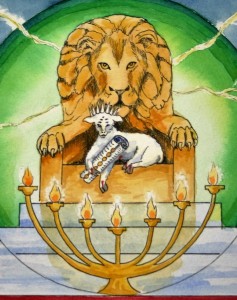
Keep these questions in mind. Let yourself feel some inner tension. Allow yourself to be made uncomfortable by this image of Jesus.

But to help make sense of this vision of Jesus the divine warrior, let me give two things: a thought, and a story.

Here’s the thought: think of the power of the spoken word.

A simple word, like “Thanks.” A phrase, like “I’m sorry.” These can be powerful words.

Or something more, a fuller statement of some kind: an invitation, or a pledge, or a confession, or a command, or an assessment, or an entreaty. These can be powerful things in our lives.

Now expand that thought: think of the way in which a single statement—a declaration, a pronouncement, a promise—can cut two ways, the way a single statement can be received in two completely different ways by different people.

A judicial declaration—“You are acquitted of all charges”—can bring relief and happiness to the person so acquitted, but bitterness and anger to an injured person still seeking justice.

A marriage pronouncement—“I now pronounce you husband and wife”—is a cause for great rejoicing for the couple, but might be a cause of deep anguish for a former spouse who had hoped to be reconciled.

A parental promise—“We will go for ice cream after your concert”—will probably bring excitement to the child, but might cause resentment by another (“Why didn’t we go for ice cream after my concert?”).

The power of the spoken word—and the ways in which a single word can cut two ways. Keep that thought planted in your mind as I tell the story.

It’s a familiar story—the story of Jesus. But it’s the story of Jesus through the lens of the spoken word that cuts two ways.

Here’s the story.

In the beginning was the Word, the Word of God, God’s powerful, spoken message. And this word was light and life. This word was love. This word was good news for all creation.

God spoke this word at many times and in various ways through history, including through the prophets of ancient Israel. Isaiah was one of those prophets.

Isaiah assured God’s people that the divine word, God’s powerful, spoken message, would go out into the world and accomplish God’s purposes—like rain falling from the heavens. God’s word of light will bring light. God’s word of life will bring life. God’s word of love will flood the earth with justice and peace.

Isaiah had a name from the one who would bring this “word of God” to the world: he calls him the “Servant.” Here’s how Isaiah puts it—in the Servant’s own words:

The Lord called me before I was born,
while I was in my mother’s womb he named me.
He made my mouth like a sharp sword

The Lord God has given me
the tongue of a teacher,
that I may know how to sustain
the weary with a word
.

And what is this spoken word that cuts like a sword? What is this spoken word that sustains the weary? It is the “good news” of God’s kingdom, God’s reign over all things. Here again is how Isaiah puts it:

How beautiful upon the mountains
are the feet of the messenger who announces peace,
who brings good news,
who announces salvation,
who says to Zion, “Your God reigns.”

The spirit of the Lord God is upon me,
because the Lord has anointed me;
he has sent me to bring good news to the oppressed,
to bind up the brokenhearted,
to proclaim liberty to the captives,
and release to the prisoners;
to proclaim the year of the Lord’s favour.

This word of God, this spoken message of God, sustains the weary. This gospel of God’s kingdom is good news for the oppressed, comfort for the brokenhearted, freedom for all held captive by the dark powers of this world.

Lion-Lamb 2This word of God is a powerful word—but it cuts two ways. The message of good news for the oppressed means judgment on the oppressors. The word of comfort for the brokenhearted is a denunciation of all who break those hearts. The promise of freedom for all held captive is a blunt warning to their captors.

God has spoken this double-edged message at many times and in various ways through history, including through the prophets of ancient Israel, including Isaiah.

But now, finally, in our own day and age, God has spoken this message through Jesus, the dedicated Servant of God. The Word of God, the very message of God from eternity past, was enfleshed among us and lived among us in Jesus of Nazareth.

Think about how Jesus defined his mission in Luke 4:

The Spirit of the Lord is upon me,
because he has anointed me
to bring good news to the poor.
He has sent me to proclaim release to the captives
and recovery of sight to the blind,
to let the oppressed go free,
to proclaim the year of the Lord’s favour.

That’s Isaiah again, which Jesus says he is in the business of bringing about.

And this is indeed what Jesus does: Jesus speaks the word of God, the message of God from the beginning of the world, the good news of God’s reign. And this word cuts two ways.

Think of how Jesus’ message is summed up in Mark’s Gospel:

Good news! God has come to reign!

But repent! Repent, for God’s kingdom is here!

Trust in God, for God is bringing justice and peace and life! But this means you must repent of your harmful and destructive ways.

A powerful word that cuts two ways.

Or think about how Luke’s Gospel presents Jesus’ beatitudes:

You who are oppressed by rich landowners,
you who are impoverished by greedy tax-collectors,
you who are dealt death by sword-wielding soldiers—
you are the truly blessed by God, and God will make things right.

But that means woe to you wealthy 1%,
woe to you privileged white males,
woe to you nuke-wielding powers that be—
your time is up, for God will make things right.

Words of comfort, words of healing, words of hope. Yet those very same words: challenging words, disturbing words, words of judgment.

A powerful word that cuts two ways.

Jesus carried no sword. He used the metaphor of the sword in his teaching, but that’s what it is: a metaphor. The one time Peter took him literally about carrying a sword, Jesus ended up rebuking him for actually using it and healed the man whom Peter had injured. No, Jesus was not speaking of literal swords.

Jesus carried no sword. To use Paul’s words in 2 Corinthians 10, Jesus did not use the weapons of this world, because he was not waging the war of this world. Rather, he used powerful and persuasive speech, seeking to (as Paul puts it) “destroy arguments and every proud obstacle raised up against the knowledge of God, to take every thought captive to obey Christ.”

Jesus carried no sword. To borrow from Paul again, this time in Ephesians 6, Jesus did not fight against flesh and blood, against any human persons, even his enemies. Rather, he was waging war on the oppressive powers of this world, the rulers who wielded their power for their own gain. He was waging war on (as Paul puts it) “the rulers, the authorities, the cosmic powers of this present darkness, the spiritual forces of evil.”

Jesus carried no sword. Rather, his word was his sword: the eternal message of God, the good news of God’s reign, the word of love, the word that brings light and life.

This word is a sharp sword: “living and active, sharper than any two-edged sword, piercing until it divides soul from spirit, joints from marrow; it is able to judge the thoughts and intentions of the heart.” Menno Simons echoed this when he declared that “We know of no sword, nor commotion in the kingdom or church of Christ, other than the sharp sword of the Spirit, God’s word.”

This spoken word of God cuts to the heart—and it cuts two ways. The gospel proclaimed and embodied by Jesus comforts the disturbed but disturbs the comfortable. It is blessing for the poor and oppressed but judgment for the wealthy oppressors. It is light for those in darkness and life for those walking in the shadow of death, but it is condemnation for those who dole out darkness and deal in death.

Once we’ve grasped this thought set within the story of Jesus, we can step back into Revelation 19 and make sense of this difficult image of Jesus the divine warrior.

Heaven opens, and out comes Jesus, “Faithful and True,” riding on a white horse to bring “justice.”

He himself is called “the Word of God.” He is himself God’s message, spoken from eternity past, God’s message of light and life, God’s message of love—and so God’s message that condemns all hatred and violence and darkness and death.

And from his mouth comes a sharp sword, by which these enemies are defeated. He speaks God’s message, and the evil powers of this world—beasts of empires, beasts of oppressive systems and unjust structures, followed slavishly by the powers that be, the kings of the earth—all these evil powers are condemned in one fell swoop.

This, then, is Jesus the divine warrior. This, then, is the judgment of God.

Not a sword, but a word: a powerful word, a word that names and condemns evil among us while also bringing justice and peace and flourishing life for all.

Not a sword, but a word: the word of the gospel, the Word which is Jesus himself.


Here’s the final post in this series on Revelation: “The Lord’s Prayer Fulfilled”

All images are from a mandala of Revelation 4-5 created by Margie Hildebrand.

© Michael W. Pahl