What is “Pacifism”?

Pacifism is on the way out in some circles, even as it’s trending in others.

I’m certainly not the first or the only one to have noticed this. Many churches and individuals with historic or traditional ties to pacifism are shrugging off that label, while many others are trying pacifism on for size, and liking the fit very much.

A large part of what’s going on in all this is that “pacifism” means different things to different people.

For some it is associated almost entirely with “conscientious objection,” refusing to participate in military service or specifically combat roles. For many it is understood to be all about “nonresistance,” passively accepting harm done to you even if unjustly deserved. Most of the people that I’ve talked to who have rejected pacifism have understood it in one of these ways.

However, those who are newly embracing pacifism—the “new pacifists,” one might say—see these understandings of “pacifism” as far too narrow, and perhaps even missing the point. In fact, because of those common understandings of the term—along with connotations of “cowardice” and the like—many neo-Anabaptists and other “new pacifists” prefer not to use the word “pacifism” at all.

I’m one of those “new pacifists” or neo-Anabaptists. Sure, I grew up going to an evangelical Anabaptist church, but my thinking there was shaped more toward evangelicalism than Anabaptism. It was not until much later, when I began studying and teaching the New Testament in an academic context, that I found myself articulating an Anabaptist theology—including pacifism.

So what do I mean when I talk about “pacifism”? If it’s more than “conscientious objection,” if it’s not about “nonresistance,” if it’s got nothing to do with “cowardice,” what is it?

Here’s my attempt to encapsulate “pacifism” in a nutshell—more technically, this is a “theistic pacifism,” even a “Christian pacifism” shaped very much by my understanding of Jesus and the Christian gospel:

God’s goal for all things is a comprehensive peace: humans living in harmony with God, one another, and the rest of creation, together experiencing the flourishing life of God. God uses peaceful means to achieve that goal, and calls us to do the same: resisting evil nonviolently, including the sin within us, the sins against us, and the systemic or structural sin among us as human societies; seeking reconciliation with others across all divisions and despite all harms; and building relationships and social structures and systems that promote harmony and well-being and flourishing life for all people and all creation.

Cross-posted from http://www.mordenmennonitechurch.wordpress.com. © Michael W. Pahl

“Confess and believe, and you will be saved!”

If you confess with your lips that Jesus is Lord and believe in your heart that God raised him from the dead, you will be saved. For one believes with the heart and so is justified, and one confesses with the mouth and so is saved. (Romans 10:9-10)

This is one of those classic evangelistic texts, the kind that get painted on signs and propped up on billboards, like John 3:16. It’s a gospel text, a mission text, a conversion text: it gets right down to the core of what we should believe, and it promises salvation for those who do.

Here’s how I used to understand these verses. I used to think they are telling us what we need to do to be saved from God’s eternal punishment for our sin. We need to confess with our mouth and believe with our whole heart: we need to confess our own personal sin and confess Jesus as our own personal Saviour, and we need to believe in our hearts that Jesus died on the cross for our sins.

The problem is, that’s not what these verses actually say.

Check it out again: “if you confess that Jesus is Lord and believe that God raised him from the dead, you will be saved.”

No mention of sin.

No mention of Jesus as personal Saviour.

No mention of the cross at all, let alone of Jesus dying on the cross for our sins.

Paul does talk elsewhere about some of these things. Sin and the cross are even pretty important to Paul. But why doesn’t Paul specifically mention them here, in this “classic evangelistic text”? How exactly can this particular “confession” and “belief” bring about “salvation”?

“You will be saved…”

Well, to make sense of this the first thing we have to get right is what Paul means by “salvation.” And to get that right, we need to go back to Paul’s Scriptures, our Old Testament. And a good place to start there is with the biblical writings Paul most quotes here in Romans 10: Deuteronomy and Isaiah.

Take Deuteronomy 30. Moses is speaking to the ancient Israelites before they enter into the Promised Land. Through Moses God promises to bring the Israelites blessings and life if they keep the commandments of the covenant. But God also warns them of curses and death if they disobey—in particular, being conquered by foreign armies and being sent into exile among the nations.

And then Moses makes this prediction: Israel will in fact fail to keep the covenant (which they did), they will be exiled (which they were), but if they return to the Lord they will be “saved”—they will be rescued from their exile and restored to their land to thrive once again.

This, then, is “salvation” according to Deuteronomy. Salvation is about God delivering God’s people from the powers of the world that have oppressed them, restoring them after they have experienced the consequences of their collective sin, bringing them back to where they can again experience life and liberty.

van Gogh - BibleThen take Isaiah 52. Isaiah speaks of God’s “messenger” who announces God’s “salvation”: “How beautiful are the feet of those who announce peace, who bring good news, who announce salvation, who say to Zion, ‘Your God reigns!’”

This, like Moses’ promise of God’s future salvation, is a message of salvation to the exiled people of Israel a few hundred years before Christ, scattered as slaves and refugees throughout the world. And the message of salvation is this: God is returning to his throne to reign over all, and God’s reign will bring peace and justice once again for God’s people.

Now back to Romans 10. This is what Paul is talking about when he talks about “salvation”: he’s referring to Israel’s promised salvation, drawing on these and other Old Testament passages.

But Paul says something new, something completely unexpected. He says this promised salvation is not just for Israel, but it’s also for the nations, for the Gentiles—for everyone. As he puts it: “For there is no distinction between Jew and Greek; the same Lord is Lord of all and is generous to all who call on him. For, ‘Everyone who calls on the name of the Lord shall be saved.’”

This, then, is the salvation that Paul promises to those who confess and believe: God’s reign of justice and peace has arrived through Jesus, bringing deliverance from oppressive powers and restoration to flourishing life.

“…if you confess and believe.”

But what does it mean then to “confess that Jesus is Lord”? What does it mean to “believe that God raised him from the dead”? And how does this confession and belief bring about that salvation? To get at these questions we need to put ourselves in the sandals of those first Christians in Rome.

For us, it seems pretty simple to say, “Jesus is Lord.” But for those first Christians in Rome, confessing that “Jesus is Lord” was not mere words.

No, in Paul’s day, to confess that “Jesus is Lord” was a bold declaration of allegiance.

As Paul points out in 1 Corinthians 8, there were many “lords” and “gods” in the ancient world, many “powers that be” that called for allegiance. And at the very top of the heap, king of the castle, was the Roman Emperor, Caesar. For good Romans—and anyone who cared about their lives—this was one of the most self-evident truths around: Caesar is Lord, master over any and all other powers that be. For them, this was the most fundamental confession: “Caesar is Lord.”

So to confess that “Jesus is Lord” was potentially a dangerous act, a revolutionary act, a radical commitment. It wasn’t something that slipped easily off the lips. This explains why Paul can say in 1 Corinthians 12, “No one can say ‘Jesus is Lord’ except by the Holy Spirit”—you would need the Spirit’s boldness to confess such a thing!

Jesus is Lord.

He is Lord over any and all other lords and gods, any other powers that be in the world: whether Caesar or the President or Prime Minister Trudeau, whether nation states or church structures or social norms, whether Supreme Courts or vigilante militias, whether ISIS or the UN, whether constitutions or confessions of faith, whether the boss at work or the bully in the playground.

Any power at work in the world you can think of, Jesus is Lord over it.

Jesus is Lord over all—and so Jesus commands our ultimate allegiance.

But Jesus is not like any other powers that be, whether back then or today. And that’s where the next part comes in: “believe in your heart that God raised him from the dead.”

Our Lord that we confess, the One to whom we hold fast with total allegiance, is a man who was executed by the powers that be, but was vindicated by God by raising him from the dead.

Love DisciplesThat’s the point of the resurrection. The powers of this world have assessed Jesus and vilified him; but God has assessed Jesus and vindicated him. The resurrection is God’s loud shout of “Amen!” to everything about Jesus: his teachings, his way of life, his self-giving suffering, his selfless death.

So we confess that “Jesus is Lord,” Jesus is Master over all, including us. But we follow a Lord who gave himself for us. We obey a Master who taught us to love one another, and who showed us what that love looks like. And we follow this Lord and Master because he is the one whom God has given his “Yes” to, he is the one whom God has stamped with his full approval, confirming that Jesus’ way is the only way to true blessing and real life.

It’s easy to say the words, “Jesus is Lord.” But it’s hard to truly “confess that Jesus is Lord,” that the way of Jesus is the only way to true life, and so we need to commit ourselves fully to Jesus’ way of self-giving love.

But that’s what it means to “confess that Jesus is Lord.”

It’s easy to agree with the words, “God raised Jesus from the dead.” But it’s hard to truly “believe that God raised Jesus from the dead,” that God has given his resounding “Yes!” to a man who spent his time with misfits and sinners, to a man who embraced the sick and the poor and the outcasts and the enemy others, to a man who would rather die than kill, to a man who willingly gave up his life for others—even if it meant being pronounced a blasphemer and condemned as a criminal and executed by the state.

But that’s what it means to “believe that God raised Jesus from the dead.”

And this, Paul insists, is the only way to true salvation. This is the only way for all of us together to experience true justice and peace, to experience the flourishing life God desires for all humanity: following our resurrected Lord in his cross-shaped footsteps.

© Michael W. Pahl

“The Things that Make for Peace”

“Peace? Sure, we have peace. Jesus brings us peace with God. But no more war? Not in this world!”

I can’t tell you how many times I’ve heard this sentiment. Not necessarily in those exact words, but the idea has been repeated so many times it’s become a truism.

“Yes, Jesus came to bring peace: peace with God and peace with each other. But while we can have peace with God now, which gives us peace in our hearts, and while we should strive for peace with each other, we need Jesus to come back before that ‘no more conflict, no more violence, no more war’ thing can become reality.”

Hogwash, I say.

Jesus has given us everything we need for peace now, peace in every way. Either we just don’t realize it, or we don’t really believe it.

At least, that’s how Luke describes things.

In the first chapter of Luke’s Gospel is the well-known Advent-y story of John the Baptist’s birth. His father, the priest Zechariah, had been struck dumb during Elizabeth’s pregnancy. But now that the child is born and named he bursts out in praise of God. In the middle of all the hubbub, Zechariah speaks this prophecy:

And you, child, will be called the prophet of the Most High;
for you will go before the Lord to prepare his ways,
to give knowledge of salvation to his people
by the forgiveness of their sins.
By the tender mercy of our God,
the dawn from on high will break upon us,
to give light to those who sit in darkness and in the shadow of death,
to guide our feet into the way of peace.

Zechariah’s prophecy is linking back to Isaiah 40, the “Comfort, comfort my people” passage. And that prophecy, Isaiah 40, is written for Israel in Exile, scattered among the nations, immersed in a world of violence and oppression and injustice and fear. A world, in other words, that needed peace.

So here’s what Isaiah promised, and what Zechariah repeats: Good news! Yahweh, the God of Israel, is coming! The Lord, the Most High, is coming, and we must get ready! His coming will be like the coming of the dawn for a dark and dying world! His coming will bring salvation from our most ominous enemies, forgiveness from our most devastating and destructive sins! He will guide us in the way of peace!

What a promise! Imagine if, in our world of darkness and death, our world of genocide and carpet bombs, our world of armed robberies and hate crimes, our own hearts soaked in fear and anxiety—imagine if those words were said to us today. Don’t worry! Someone is coming who will show you how to have peace—peace within you, peace among you!

This is the first of Luke’s peace prophecies—exactly what that world needed, exactly what our world needs.

Simonet - Jesus Weeps Over JerusalemBut jump ahead now to a second peace prophecy, this one in Luke 19. It’s the story of Jesus’ triumphal entry into Jerusalem. After years of intense ministry, Jesus is coming to his God-ordained end. And as he sees the city and its glorious temple, the jewel of his people, Jesus weeps. He weeps, and speaks this prophecy:

If you, even you, had only recognized on this day the things that make for peace! But now they are hidden from your eyes. Indeed, the days will come upon you, when your enemies will set up ramparts around you and surround you, and hem you in on every side. They will crush you to the ground, you and your children within you, and they will not leave within you one stone upon another; because you did not recognize the time of your visitation from God.

Jesus is speaking of the future destruction of Jerusalem, which happened within a generation of his prediction. The Roman armies indeed set up ramparts around Jerusalem and laid siege to the city. The citizens of Jerusalem were indeed crushed to the ground, they and their children within them. The city and its glorious temple were indeed pulled down, stone by stone by massive stone.

And why did that happen? According to Jesus here in Luke, because the people “did not recognize the time of their visitation from God.” They did not recognize “the things that make for peace.”

Luke is linking Jesus’ prophecy here to Zechariah’s prophecy back in chapter one. There, God is coming, God’s visitation is near. Here, God’s visitation has happened, but they’ve missed it. There, God in his coming would “guide their feet into the way of peace.” Here, God has come, but they have missed “the things that make for peace”—and so they would find themselves on the wrong side of a bloody, destructive war.

These two passages—one looking ahead to Jesus’ ministry, the other looking back at it—suggest that the “way of peace,” the “things that make for peace,” have in fact already been revealed during Jesus’ earthly ministry. According to Luke, then, if we want to know the “things that make for peace,” if we want to know God’s “way of peace” for the world, we need to look back at all those peace-making things Jesus has already done.

Here’s just a few of these “lessons in the way of peace” Luke’s Jesus has taught.

Luke 3: Jesus is baptized by John, anointed by the Spirit and appointed by God. He is God’s Son, the Messiah, the King who will bring in God’s kingdom, but he is also the well-pleasing Servant of Isaiah, who will bring about God’s purposes through suffering and death. The lesson? The way of peace is a path of self-giving, maybe even suffering.

Luke 4: Jesus is tempted in the wilderness, three times. He says no to satisfying his own needs through his power. He says no to keeping himself safe because of his special status. He says no to ruling over the world if it means venerating evil. The lesson? The way of peace requires us to resist the temptation to bring about even good things through raw power or evil means, or by putting our own provision and protection ahead of others.

Luke 5-6: Jesus heals any who are sick, laying hands on them, touching them in compassion in spite of any regulations about clean and unclean, in spite of any laws about Sabbath and holy days. The lesson? The way of peace is a way of compassion, choosing compassion over fear, choosing compassion over rules, choosing compassion regardless of what society thinks.

Tissot - Jesus TeachingLuke 6: Jesus pronounces both blessings and woes, and it’s absolutely the opposite of what we expect: the poor, the hungry, the weeping, are the blessed ones, while the rich, the full, the laughing, are warned with woe. And then Jesus keeps the surprises coming: “Love your enemies. Do good to those who hate you. Give to everyone who asks. Do not judge, but instead forgive. In everything, do to others as you would have them do to you.” The lesson? The way of peace requires us to embrace the other, even the completely opposite other, with generous love.

Luke 11: Jesus teaches his followers to pray. “Father, you are holy. May your rule be established on earth. Provide for all of us, all our daily needs. Forgive all of us, all our sins, as we forgive each other. Protect all of us, from every evil.” The lesson? The way of peace means recognizing that we’re all in this together, one humanity under God, and basic provision and security and mercy for one requires provision and security and mercy for all.

Luke 12: Jesus teaches his followers to trust, and not to fear. “Don’t put your trust in riches, things that spoil and fade! Don’t be afraid of those who can kill the body but not touch the soul! Don’t worry about what you will eat or what you will wear! Trust in God, who watches over even the smallest sparrow and clothes even the simplest flower.” The lesson? The way of peace is a path of faith, patiently trusting in God for all things and through all things.

These, and more, are Jesus’ lessons in the “way of peace.” Show compassion. Be generous. Reject violence and fear. Don’t judge others. Forgive them. Remember, we’re all in this together. In all things, trust in God.

In Luke’s Gospel these “things that make for peace” are repeated over and over, in many different ways. Deny yourself and take up your cross, daily. Love others like a good Samaritan. Joyfully embrace repentant sinners like a father of a prodigal son returned. Attend to those on the lowest rungs of society: the poor man outside your gates, the children sitting along the edges. Trust in God for the long haul, like a farmer patiently waiting for that little mustard seed to grow, like a baker patiently waiting for that yeast to do its work.

Simple things, but so hard to put into practice moment by moment and day by day. They go against the grain of our “fight or flight” instincts. They run counter to our inclination to fear, to judge, to lash out, to look out for number one. Yet these are the “things that make for peace,” these are God’s “way of peace,” peace within us, and peace among us.

Jesus has already brought everything we need for peace, in every way. And yet here we are, two thousand years later, still fighting wars and telling rumours of wars, still engaged in global conflicts and petty catfights, still resorting to physical and psychological and verbal and emotional violence against one another.

Will we learn “the things that make for peace”? Will we learn God’s “way of peace” through Jesus?

Or does Jesus weep over us as he wept over Jerusalem, because we too refuse to recognize the time of God’s visitation two thousand years ago, bringing God’s way of peace?

This post is adapted from a sermon preached at Morden Mennonite Church on December 20, 2015. For more from this sermon see my follow-up post, “MLK and ‘The Things that Make for Peace.'” Cross-posted from http://www.mordenmennonitechurch.wordpress.com. © Michael W. Pahl

Politics and Power, the Jesus Way

Politics.

I saw you cringe. It’s one of those topics not fit for polite conversation. It may be entertaining for some, intensely interesting for others, but for many it’s one of those “change the subject” kind of subjects.

Cartoon of crumbling Greek buildingBut politics are everywhere. There are politics any time we humans organize ourselves in order to make decisions for our collective interest. Actually, that’s pretty much the definition of “politics.”

And any time we are talking about making decisions, we’re talking about power: the ability to bring about change. Where there’s politics, there’s power.

Yep, there are even politics and power dynamics in church. Yep, even your church.

Politics and power are inevitable in collective human life. They are neither good nor bad; they just are.

But I sure do understand that feeling of “Ugh!” when you hear the word “politics.” After all, so much of the way we do politics—you might say “the politics of the world”—is just not very nice.

We polish up our résumés and show off our good sides: all strength, no weakness allowed.

We shore up support through strategic relationships and backroom deals and hollow promises.

We appeal to our base through polarizing rhetoric: it’s “us” versus “them.”

We listen to those who agree with us, and we ignore—or even disdain—those who don’t.

We appeal to truth—when it’s convenient for us. Otherwise it’s half-truths, sometimes a full-on lie.

We manipulate emotions through sugary, empty rhetoric. Our only harsh words are for our opponents.

We take control whenever we can, holding all the crucial resources and making all the important decisions.

We do all this either consciously (“That’s just politics!”) or subconsciously (our capacity for self-deceit is astonishing).

And we do all this, we like to think, for the ultimate good of all. We know what is best, and we’ll do whatever it takes to bring about that ultimate good. In the politics of the world, the ends justify the means.

I bet you think I’ve just described politics in Canada or America. That may be, but what I actually had in mind was politics in the church.

Go back through the list again. That, all too often, is church politics. That, folks, is just politics, whether in the church or in society.

But Jesus calls us to another way. Jesus calls us to a radically different politics, a radically different power.

The gospel—and the Gospels—are shot through with Jesus’ upside-down politics and power.

Jesus is anointed by God’s Spirit and appointed by God’s decree: “You are my beloved Son (my chosen Messianic King, in other words); with you I am well-pleased (my chosen Suffering Servant, that is).” Jesus is King, but he’s not like other kings. Jesus brings in a kingdom, but not the way other kingdoms come.

Jesus then immediately and persistently follows through on this: he resists the temptation to seize power through evil or idolatrous means, to establish God’s kingdom through the use of overwhelming force or meticulous control—in stark contrast to the ways and means of the world.

Instead Jesus teaches love of God, love of neighbour, even love of despised enemies—and then he goes out and does it: embracing those on the fringe, exhorting those at the centre, attending to the weak, admonishing the powerful.

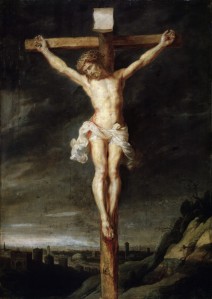
Rubens - Jesus on CrossSince his followers are slow to get the point, he states it bluntly: “You know that the rulers of the Gentiles lord it over them, and their great ones are tyrants over them. It will not be so among you; but whoever wishes to be great among you must be your servant, and whoever wishes to be first among you must be your slave; just as the Son of Man came not to be served but to serve, and to give his life a ransom for many.”

And finally, in the penultimate end, Jesus is enthroned on a cross. He gives his life for the good of others, he embraces utter weakness and relinquishes total control, he refuses right to the bitter end to respond with raw power or naked force. In the politics of Jesus, the means—the ways of the cross—are the ends.

In the middle of all this is a familiar story that sums up Jesus’ approach to politics and power.

In the story Peter declares that Jesus is indeed the Messianic King. Jesus accepts his declaration, but immediately emphasizes that the way to his throne is the way of the cross. Peter then rebukes Jesus: That’s not the way kingdoms are won! That’s not how the world changes! Everyone knows this, Jesus!

And in turn, Jesus rebukes Peter, with words that should strike holy fear in the heart of anyone who claims to be a Christian: “Get behind me, Satan! For you are not thinking the way God thinks about such things, but the way the world thinks.”

You are not thinking the way God thinks about such things—about kings and kingdoms, about politics and power—but the way the world thinks.

The world’s politics are about “strong power.” Overwhelming physical presence. Personal charisma and authority. Psychological intimidation and emotional manipulation. Coercive words, polarizing rhetoric, and subtle deceit. Full control.

Jesus’ politics are about “weak power.” Humility, not pride. Compassion, not apathy or antipathy. Persuasion, not coercion. Forgiveness, not blame. Persevering faith, not fear. Self-giving love, not self-serving self-interest.

The world’s politics are tempting, to be sure. You can get quicker results when you force your way through, when you unilaterally push your agenda for a better world. And the longer you spin your wheels trying to achieve a goal without results, or the more pressure there is to bring about a certain objective, not now, but right now—the more tempting it is to resort to strong power.

But the history of humanity—and the smaller stories in our own lives—show over and over again that these “good” results through strong power simply do not last, and they’re often more damaging in the long run. Even in the short run, there are almost always innocent victims, physical or psychological or emotional casualties left in our wake.

Jesus’ politics take longer to achieve any good thing—like small seeds growing, or yeast working through dough—and they demand much more of us—our very lives, in fact. But the end result is shalom for all involved: wholeness, harmony, justice, and abundant life.

So what does all this have to do with church politics? What (gulp) might this even have to do with politics of any kind?

Everything, in every way.

We must resist the temptation to bring about change, even positive change, through strong power. Strong-arm tactics, passive-aggressive behaviour, divisive fearmongering, meticulous control, and more, have no place—no place at all—among followers of the crucified Jesus, whether in the church or beyond it. We need to have a patient, persevering faith, truly trusting that God’s way, the way of weak power, is in fact best.

We must repent of the ways we have engaged in strong-power politics. Again, our capacity for self-deception and self-justification is truly astonishing. This is especially so when we are convinced that our way is the best way, or that we hold the morally superior or theologically correct position. We need constant, rigorous self-monitoring and self-examination—and the humility to accept correction by others.

We must embrace Jesus’ way of weak-power politics. Seeking to persuade rather than coerce: speaking truth to power, showing compassion for weakness. Serving others in humility, not posturing before others to gain status or controlling others to ensure the change we want to see. Forgiving others when they fail, not pouncing on their faults for political leverage. Patiently pursuing long-term shalom rather than short-term gain.

In particular, we must always attend to those on the margins. Always. Even when the margins shift, and those on the outside become those at the centre, and others are now on the margins. And especially when we’re the ones at the centre—along with our friends and family and all our favourite people. Any power for change we possess—through position, wealth, education, whatever—must be used in the way of the cross for those without such power, especially the most vulnerable and unjustly treated.

In other words, we must set aside our cultural brand of Christianity with its ways of the world and respond to Jesus’ radical call to discipleship: “If any want to become my followers, let them deny themselves and take up their cross daily and follow me. For those who want to save their life will lose it, and those who lose their life for my sake, and for the sake of the gospel, will save it.”

This is politics and power, the Jesus way. And it’s the only way to find real life: for you, for the other, for all.

Cross-posted from http://www.mordenmennonitechurch.wordpress.com. © Michael W. Pahl.

(Im)Possible Joy

I’ve always struggled with joy.

If I were an ancient Roman, sitting in the office of the famed physician Galen, he would have diagnosed me as a “melancholic,” having an excess of black bile in my body. Likely he would have prescribed a treatment of leeches. Leaving aside the black bile and leeches, he would have got the “melancholic” right: serious-minded, introverted, cautious, focused, conscientious—and susceptible to moodiness and sadness.

But melancholic or not, at some point life catches up with everyone. The rose-coloured glasses begin to fade. The half-full glass looks more and more empty.

Disappointments pile up, rejections and dead-ends and broken-down dreams. Injury or illness enters, disease takes up residence. A friend dies, or a sibling, or a parent—or a spouse, or a child.

And we become more aware of the world, more aware that there are seven billion other selves who are each experiencing these things—and far worse. Horrific abuse. Horrendous violence. Utter poverty. Plagues of disease. Cataclysmic natural disasters. Waves of war.

Yes, at some point, for all of us, life catches up with us. And it gets harder and harder to “rejoice in the Lord always” or “consider it nothing but joy whenever you face trials of any kind.”

What is joy? And how do we experience it? Can we truly experience it?

Let me start with this: “Rejoice always” cannot mean “be happy all the time.” Having “the joy of the Lord” cannot mean that we are perma-smiling, always happy, bubbling over with joy, every minute of every day.

You see, we are commanded by the Apostle Paul not just to “rejoice” but also to “mourn.” We are assured by Jesus that those who mourn are blessed by God. And then there’s the Psalms: filled with the whole range of human emotions, from deep sadness and despair to overwhelming delight and celebration.

These biblical commands and promises and descriptions reflect the full depths of the human soul, the whole spectrum of human experience. We are created for all these things: sorrow and gladness, sadness and joy, and everything in between. It’s no coincidence that the most enduring art, the most soul-touching music, the most profound ideas, have been produced by artists and thinkers who fully experienced the full range of human emotions.

As with Jesus himself.

Tissot - Jesus WeptAt least half a dozen times in the Gospels we hear of Jesus being filled with compassion for the suffering of others: compassion, empathy, entering into their suffering. Three times the New Testament describes Jesus weeping: at the death of his friend Lazarus, at Jerusalem’s rejection of his ways of peace, and as he faced his own suffering.

At Gethsemane Jesus confesses to his disciples: “My soul is overwhelmed with sorrow to the point of death.” At Golgotha Jesus cries out to God: “My God, my God, why have you forsaken me?” Isaiah certainly gets it right when he speaks of the coming Servant as “a man of sorrows, and acquainted with grief.”

So, no: “rejoice always” cannot mean we are to “be happy all the time.” That way of thinking about joy just doesn’t make sense of human experience, of the Bible, of Jesus himself.

In fact, very often in the Bible “joy” isn’t simply tied to feelings of happiness. “Joy” is more of a posture of joy, a settled disposition of joy, that opens us up to moments of joy, those feelings of joy.

The posture of joy is what we are called by God to develop, even when the feelings of joy are not there. This posture of joy is the “joy” that is the Spirit’s fruit in our lives, it’s the “joy” that characterizes God’s kingdom. This posture of joy is what Paul is getting at when he calls Christians to “rejoice in the Lord always.”

The “in the Lord” is the key. This posture of joy is grounded in the assurance of God’s work in the world through Christ and by the Spirit. It is rooted in the gospel, the good news that brings great joy for all people. God has already entered our world in Jesus, the crucified Jesus has been raised from the dead, and this means that every good thing is possible, even when the worst is happening.

This posture of joy, then, means having an underlying sense of love, trusting that God loves us thoroughly and deeply and wants us to experience all that is good and beautiful and true.

This posture of joy means having an underlying sense of hope, believing in the always-open possibility that God will do a good thing even in the midst of terrible things.

This posture of joy is this kind of settled disposition. It’s a Spirit-cultivated faith in the good news of God: hoping in God, trusting in God’s love, and so always being open to those moments of joy when they arrive.

And those moments of joy are there, if we have eyes to see them.

Rembrandt ProdigalMoments of joy in celebration. Celebrating achievements, whether yours or others. Celebrating the overcoming of obstacles, whether big or small. Celebrating milestones, birthdays and anniversaries and baptisms and more.

Moments of joy in delight. Delighting in a picturesque snowfall, a stunning sunset, the northern lights on display. Delighting in the laughter of a child, a good meal, a loved one’s warm embrace. Delighting in both the spectacular wonders of the world and the simple pleasures of life.

“Rejoicing in the Lord,” then, does not mean we have these feelings of joy all the time. The “joy of the Lord” is not about constant happiness, having a permanent smile on our face and laughter on our lips.

Instead, cultivate a posture of joy, regardless of whether the feelings are there or not. Practise faith and hope and love, until that becomes a settled disposition, the way you look at the world. This will open you up to those moments of joy when they come, those occasions of celebration and delight. You will see these moments of joy around you—and when you do, grab hold of them, fully experience them, cherish them. Enjoy them.

Hey, if it can work for this incurable melancholic, it’s worth a try, right?

This post is excerpted from my sermon preached at Morden Mennonite Church on Third Advent, Dec. 13, 2015. In my sermon I noted an important distinction between the sadness that everyone experiences, and depression. Depression can include feelings of deep sadness, but it can also include things like apathy, loss of energy, change of sleeping and eating patterns, and self-loathing—over an extended period of time. See the CMHA website for more information. If you think you may be suffering from depression, please talk to someone or even see your doctor.

Cross-posted from http://www.mordenmennonitechurch.wordpress.com. © Michael W. Pahl.

Love, in the Flesh

We are created to love and be loved in the flesh. Heard. Seen. Touched. Held. Through thick and thin.

You can think of the story of Scripture as the story of exactly this kind of love.

In the beginning, God creates human beings to love and be loved, in the flesh, through thick and thin—by God, by each other.

The claim in Genesis 2 that “it is not good for the Human to be alone” is not primarily about marriage, but about human companionship—the animals couldn’t be the equal partner the Human needed, so another Human was made, crafted from bone-of-bone and flesh-of-flesh. And then there’s that simple, powerful image in Genesis 3: God, seeking out the Human, to walk with them in the cool of the day in the shade of a garden.

But these first humans choose a different path. They choose proud selfishness over humble, trusting love, and the results are devastating: guilt and shame, futility and suffering, hostility and exclusion, everything that is not-love, everything that is not-life.

We’ve been choosing that path ever since. All too often, we follow in these tragic footsteps of our forebears, choosing self and separation over love and life. Danielle Lierow’s awful story is like a microcosm of our larger human story—exclusion, isolation, made for love yet untouched by it.

We often do this to others, whether in extreme ways like Dani’s case, or on a smaller scale with our everyday harms, or on a massive scale with our violent extremisms and weaponized war zones. Unlike Dani’s story, we often also do this to ourselves.

This is the story of Eden: humans banished from God’s paradise, isolated from God’s loving presence, not because of God’s desire, but because of our own distorted, selfish desires.

Salvi - Virgin and ChildAnd yet, as the stories of Scripture unfold, the story of God’s love continues on. God seeks out unlikely dance partners, everyone from Noah to Abraham, from Hagar to Jacob to Moses to Ruth. God handpicks David, the runt of the litter, and calls him King, and promises an enduring kingdom, God’s kingdom on earth.

God woos Israel like a lover. God nurses Israel like a mother. This is God’s hesed, Yahweh’s faithful love: unexpected, undeserved, unending.

Still the separation continues: Israel goes their own way, like sheep gone astray, and the nations follow. The edges of our God-created love are frayed; the seams that bind us together are split, hanging by a thread.

It seems impossible. Hopeless.

And then love steps in.

God created human beings to love and be loved, in the flesh—and so God comes in the flesh. In Jesus God becomes one of us: from beating-heart fetus to swaddling-clothed baby to rambunctious boy to full-grown man. In Jesus God takes on our hopes and fears, our joys and sorrows, our deepest desires and greatest longings.

God created human beings to love and be loved, through thick and thin—and so God enters the thickest and thinnest times of human life. In Jesus God walks our path: birth and health and sickness and fear, laughter and weeping and loneliness and temptation, stress and anger and spasms of joy. In Jesus God walks with us through death, through death into resurrection life.

This, all this, is love.

No more separation, no more distance, no more isolation. God has opened the door and stepped in, swept away the filth and swept us up in his arms.

We are created to love and be loved in the flesh. Heard. Seen. Touched. Held. Through thick and thin.

And this is exactly what Scripture says has happened in Jesus. Listen to these words from 1 John:

We declare to you what was from the beginning, what we have heard, what we have seen with our eyes, what we have looked at and touched with our hands, concerning the word of life—this life was revealed, and we have seen it and testify to it.

God is love. God’s love was revealed among us in this way: God sent his only Son into the world so that we might live through him.

Beloved, since God loved us so much, we also ought to love one another. No one has ever seen God; if we love one another, God lives in us, and his love is perfected in us.

The mystery of God’s love is revealed in Jesus, in the flesh, through thick and thin. And when we ourselves love in the way of God, the way of Jesus—loving and being loved, in the flesh, through thick and thin—the mystery of God’s love is revealed among us afresh.

It has always been so. During this Advent season and beyond, may it be so for us again.

This post is excerpted from my sermon preached at Morden Mennonite Church on Second Advent, Dec. 6, 2015. Cross-posted from http://www.mordenmennonitechurch.wordpress.com. © Michael W. Pahl.

Christians Need to Be More Conservative, Not Less

It’s happened again.

The other day someone casually referred to me as “liberal” (don’t worry, Peter, I don’t hold it against you). Every time that happens I kind of smile to myself—if it’s said innocently—or else I cringe inwardly—if it’s said pejoratively.

It’s not that I particularly mind being called “liberal.” In some circles that’s the worst thing anyone can be. But the word can be a wonderful compliment: think of a doctor who is “liberal” with their time, or a wealthy person who is “liberal” with their charitable giving. (Or maybe a Christian who is “liberal” with their love, “liberal” in the grace and mercy they show to others…?)

It’s more that the word doesn’t really fit me in the way people seem to think.

Most often people seem to think I am theologically “liberal.” That’s very strange.

They might mean (though I doubt it) that I hold to classic liberal theology, that I’m a disciple of Friedrich Schleiermacher or Adolf von Harnack. But I don’t, and I’m not.

Or they might mean (more likely) that I don’t believe in the classic doctrines of Christianity, that I am not theologically “orthodox.” But I do, and I am.

I believe in the Trinity, one God in three persons. I believe that Jesus is truly God and truly man. I hold fast to the good news of salvation through Jesus, Messiah and Lord and Son of God, who died for our sins and was bodily resurrected. I look to the Scriptures as divinely inspired and authoritative for Christian belief and practice. I can recite the Apostles’ and Nicene Creeds without batting an eye or crossing my fingers behind my back—pretty much the definition of being “theologically orthodox.”

In other words, I’m actually quite conservative, theologically speaking. Within the whole spectrum of Christian beliefs through history and around the globe, I’m pretty securely on the conservative side of things.

Here’s the real issue, it seems to me: I don’t fit a lot of people’s culturally conditioned notions of how “conservative Christians” act, or what else they believe.

Beliefs like biblical inerrancy or young earth creationism or penal substitutionary atonement or the rapture have crept into Christian thinking over the past few centuries, and have become part of the package of “conservative Christianity”—but they are actually recent theological innovations, not historical Christian orthodoxy.

Likewise, things like upholding “family values” or “traditional marriage,” or being a “Christian nation,” or supporting war efforts or gun rights or free-market capitalism, or abstaining from alcohol, have become part and parcel of “conservative Christianity”—but they have actually grown out of our particular Western culture, with nothing timeless or universal about them.

Some of these sorts of things I may agree with in one sense or to a certain degree, but I hold them loosely. Other things, well beyond these examples, I have questioned and continue to wonder about. Many of these sorts of things I simply don’t believe in or agree with. Some I’m even convinced are actually harmful distortions of genuine Christian faith.

But in many “conservative Christian” circles, these kinds of beliefs and ideas and behaviours tend to get all lumped together with genuine Christian orthodoxy: believing in biblical inerrancy is on par with believing in the Trinity, upholding heterosexual marriage is on the same level as upholding the gospel, and so on.

liberalYou’ll have noticed the quotation marks around “conservative Christians” through all this. That’s not because I don’t think these folks are truly Christian. It’s partly because that’s just the common phrase used to describe Christians who hold to these kinds of views. But it’s also because I’m not convinced they really are all that conservative.

Yes, you’ve heard it here first: “conservative Christians” are not conservative enough. They need to be more conservative, not less.

They need to go back to genuine, generous, historic Christian orthodoxy—and hold fast to it, being wary of all those trendy theological innovations like biblical inerrancy or young-earth creationism.

They need to go back to the original, apostolic, gospel story of Jesus—and hold fast to it, being cautious of all those recent cultural accretions like “family values” or teetotalism.

They need to go back to our sacred Scriptures, that diverse collection of ancient human writings inspired by God—and hold fast to it, being suspicious of all those simplistic assertions of right and wrong.

We Christians—all of us—need to be more conservative, not less.

And if we do so, we might actually find ourselves becoming truly liberal—in the best senses of the word.

© Michael W. Pahl

“All you ever do is talk about Jesus and love. Why don’t you preach the gospel?”

Okay, so I’ve never heard it put quite that starkly. And I don’t hear this in quite the critical tone of that title, at least not directly. (What’s said about me when I’m not around, well, that may be a different story!)

But I do hear some version of these kinds of questions fairly frequently, especially related to my preaching, mostly in a sort of puzzled tone:

“Why do you talk about Jesus and love all the time?”

sometimes juxtaposed up against

“Why don’t you preach the gospel?”

When that happens, I can’t help but smile to myself.

Many Christians have a particular idea of what it means to “preach the gospel.” For them it means to preach an “evangelistic sermon.” It means giving a Billy Graham-esque explanation of the gospel: that Jesus died on the cross in our place, taking the punishment that we deserved for our sin, and that if we confess our sins to God and believe in this message we can be saved, given the assurance of eternal life with God even beyond the grave. This gospel preaching is often completed with an altar call, an appeal to pray a particular prayer confessing one’s sins and expressing belief in this message.

If I don’t do these things, then, according to many Christians, I’m not “preaching the gospel.”

The problem is, this way of thinking about “preaching the gospel” is not really all that biblical.

Sure, it uses some biblical terms and ideas, words like “gospel” and “sin” and “Jesus” and “cross” and “belief” and “confession” and “salvation” and “eternal life.” But many of those words don’t mean what this popular notion of “preaching the gospel” means by them, and the way those terms and ideas are put together in this popular perspective doesn’t reflect the way the New Testament authors put those terms and ideas together.

Take a look at a few New Testament summaries of the “gospel” or “good news”:

“The beginning of the good news of Jesus Christ, the Son of God…” introducing Mark’s entire story of Jesus. (Mark 1:1)

“Jesus came to Galilee, proclaiming the good news of God, and saying, ‘The time is fulfilled, and the kingdom of God has come near; repent, and believe in the good news.’” (Mark 1:14-15)

Jesus “unrolled the scroll and found the place where it was written: ‘The Spirit of the Lord is upon me, because he has anointed me to bring good news to the poor. He has sent me to proclaim release to the captives and recovery of sight to the blind, to let the oppressed go free, to proclaim the year of the Lord’s favor’…Then he began to say to them, ‘Today this scripture has been fulfilled in your hearing.’” (Luke 4:16-21)

“…the gospel of God, which he promised beforehand through his prophets in the holy scriptures, the gospel concerning his Son, who was descended from David according to the flesh and was declared to be Son of God with power according to the spirit of holiness by resurrection from the dead, Jesus Christ our Lord, through whom we have received grace and apostleship to bring about the obedience of faith among all the Gentiles for the sake of his name.” (Rom 1:1-5)

“Now I would remind you, brothers and sisters, of the good news that I proclaimed to you, which you in turn received, in which also you stand, through which also you are being saved… For I handed on to you as of first importance what I in turn had received: that Christ died for our sins in accordance with the scriptures, and that he was buried, and that he was raised on the third day in accordance with the scriptures, and that he appeared to Cephas, then to the twelve…Whether then it was I or they, so we proclaim and so you have come to believe.” (1 Cor 15:1-11)

“Remember Jesus Christ, raised from the dead, a descendant of David—that is my gospel.” (2 Tim 2:8)

That’s just a sample—the noun “gospel” or “good news” (euangelion) and the verb “preaching the gospel/good news” (euangelizomai) together occur about 125 times in the New Testament, and several of those sketch out what this “gospel” message is that’s being preached.

For sure, some of these passages can be read to fit the popular, Billy Graham-esque idea of the “gospel” I’ve described above. But many, if not most, just don’t make sense in that understanding of the gospel.

The gospel is about all of Jesus’ life, not just his death on the cross?

The gospel is about the kingdom of God?

The gospel is good news for the poor, the blind, the imprisoned, the oppressed?

The gospel is about Jesus being a descendant of David?

The gospel is about Jesus being Lord?

Many of these ideas are prevalent in New Testament descriptions of the gospel, or of the early Christians’ gospel preaching in Acts, yet they are conspicuously absent from the popular Christian notion today of what the gospel is and what it means to “preach the gospel.”

Yet any understanding of the “gospel” we have must try to make sense of the entire witness of the New Testament to the gospel, not just a few ideas read into a few select passages. This means, also, that any understanding of the “gospel” we have must be flexible enough to allow for the varied descriptions of the gospel we find in the New Testament.

The “gospel” is euangelion, it is “good news,” a “good message,” a message of good things, a message that should bring joy to its hearers.

The “gospel” is “according to Scripture,” anticipated by and in continuity with the Jewish Scriptures, the Christian Old Testament.

The “gospel” is about God, the one true and living Creator, the one in whom all things exist, the one in whom we live and move and have our being, the one who works in and through all things to bring about good purposes.

The “gospel” is about the man Jesus of Nazareth, about his life, teachings, good deeds, miracles, death on a Roman cross, and resurrection from the dead.

The “gospel” is about Jesus, that this crucified and resurrected Jesus of Nazareth is the Jewish “Messiah” or “Christ,” the “Son of God,” who is the promised King descended from David who fulfills ancient Israel’s longings for God’s eternal reign of justice and peace and flourishing life for the Jews, for all people, and for all creation.

The “gospel” is about Jesus, that this crucified and resurrected Jesus of Nazareth is therefore “Lord,” the rightful ruler over God’s people, all people, the entire world.

The “gospel” is about “salvation” from “sin,” God rescuing the world through this crucified and resurrected Jesus of Nazareth from all the ways we humans harm each other and the rest of creation through our attitudes, words, and actions, and so work against God’s purposes and desires for us and all creation.

Simply put, the gospel is the good news that God has acted in Jesus to make right all that has gone wrong in the world because of human sin.

This “act of God in Jesus” is an act of grace and mercy, an act of undeserved favour, an act of restorative, self-giving love. And God calls us to respond to this divine love by persistently turning from our harmful, destructive ways (“repentance”), resolutely declaring our allegiance to the world’s true Lord, the crucified and risen Messiah Jesus (“faith”), and daily following in his footsteps of restorative, self-giving love for others and all creation (still “faith”).

Read the Gospels—there’s no “four spiritual laws.” The gospel is not about individual sinners being saved from hell to heaven, but about a sinful world being redeemed so that God’s reign of life and justice and peace might come on earth.

Read Acts—there’s no “sinner’s prayer.” The gospel addresses human sin, right down at its roots, but it does so in a way that impacts not just personal sins but also social sins, systemic sins, all the ways we harm and destroy.

Read Paul’s letters—there’s no “altar call.” The gospel does call for a response, but it’s a summons of allegiance to one who has given himself in humble, selfless love.

And all this is why, when I hear someone say something like, “All you ever do is talk about Jesus and love. Why don’t you preach the gospel?”—I smile to myself.

Yes, all I talk about is Jesus and Jesus’ way of love.

That’s because I’m preaching the gospel.

© Michael W. Pahl

Love, Above All

Love is All We NeedScripture and Jesus on Love | What is Love?
Love, Above All | How Should We Then Love?

In my first post I got on my soapbox and boldly declared: “Love is all we need, folks! All we need is love!”

Image: Stephen Hopkins

In our complex, chaotic, confusing world, we Christians don’t need greater certainty about our particular brand of doctrine. We don’t need to find the latest and greatest or oldest and truest form of worship. We don’t need more political engagement, more activism for the Christian cause.

Theology, liturgy, politics, and more are not inherently wrong, of course, and can even be very good, even vitally important—but none of these is the one thing we need more than anything else.

We need to love each other.

All we need is love.

Love is all we need.

Sounds simplistic and naïve, I know. Sounds idealistic, and darn near impossible. Sounds suspiciously like some liberal agenda, or some trendy “spiritual-but-not-religious” kick.

But I say, “Love is all we need,” because I believe Scripture points us to this. I believe Jesus points us to this. That was part two.

I say, “Love is all we need,” because I believe the love Scripture and Jesus point to is not mere tolerance, or mere affection, but something far more, far more substantial, far more necessary. That was part three.

And now I say, “Love is all we need,” because I believe all other divine commands and human virtues—including holiness and truth-speaking—are subsumed under love, governed by love, even defined by love.

Think back to the way the Bible, and particularly the New Testament, speaks about love. Jesus and Paul agree that the whole point of Scripture is love: every command, every promise, every story, every poem in the Bible hangs on the hook of love, loving God and loving others (Matt 22:35-40; Rom 13:8-10). John concurs, affirming that this love is the defining characteristic of the true life of God, truly knowing God, truly being a disciple of Jesus (1 John 3:11-20; 4:7-21; John 13:35).

Paul talks about love as the virtue that “binds together” all other virtues, including the virtues of moral holiness and truthful speech (Col 3:5-14). Love for others, Paul says, is more important than seeking true knowledge, or striving for sinless purity, or having great faith. There are three things that “abide,” he stresses: “faith, hope, and love—but the greatest of these is love” (1 Cor 12:31-13:13).

Underlying these and similar biblical texts is the notion that every ideal humans are to strive for, every virtue Christians are to cultivate, is subsumed under love, governed by love, even defined by love.

How does this work? A few musings—and be prepared, this is the most abstract and “theological” of all these posts on love.

Love incorporates all the other Christian virtues. Again, I’m not talking about a sentimental affection or a clinical self-sacrifice, a benign tolerance or an intense intimacy. I’m talking about the love that God shows us in Jesus, the love that freely gives oneself for the good of the other, to share together in the flourishing life of God. Any human ideal or Christian virtue you can conceive of is subsumed under this love.

You can trust someone without loving them, but you can’t love in this way without trust. You can hope without love, but this Jesus-love includes hope. It’s possible to have justice without love, but not love without justice. Peace, patience, courage, faithfulness, self-control, joy, and more—they’re all the same, woven into the fabric of a Christ-like love.

Clothe in LoveLove defines and governs all the other Christian virtues. If one ever seeks a justice that is not loving toward all involved, then one has not found true justice. If one strives for a faithfulness that is not compassionate or charitable toward others, then one has not found true faithfulness. If we ever feel a tension between holiness and love, or between truth and love, or between any other ideal or virtue and love, we must choose love—because it is in love that we will realize the potential of all other virtues and ideals.

Love precedes and supersedes moral holiness, being “separate from sin.” Before sin was in the world, before moral holiness was even a thing, there was love. After sin and death are dealt their final blow, when moral holiness is no longer a thing, there will still be love.

This is why holiness—in the sense of moral holiness, separation from sin—cannot be the central, most essential attribute of God. God is eternally holy, in the sense of being utterly distinct from all else, wholly other. But moral holiness is not an eternal attribute of God, unless we wish to say sin and evil are eternal.

God’s eternal holiness, God’s distinctness, God’s otherness, is shown first and foremost and always in love. It is, in fact, because God is distinct and other that God can love: love requires a distinction in personhood, an I and a thou, a self and an other, before it can give the self for the other, before it can love the other as it loves itself. Classic Christian theology understands God to have been loving in this way for an eternity as three persons in one God, and God’s love for humanity and all creation is simply an extension of this eternal love within the Trinity.

God is love. This is the essential nature of God’s character, God’s person. And so it is the defining feature of God’s ultimate self-revelation, Jesus Christ. And so it is to be the essential nature and defining feature of those created in God’s image, those being re-created in Christ’s image, God’s new humanity. Just as God’s holiness is manifest first and foremost and always in love, so it is with the holiness God calls Christians to. Our holiness, our distinctiveness, is seen in our love.

Love fulfils truth; it completes it. Love puts flesh on truth. It is truth put into proper practice. By itself, truth—in the sense of “correct knowledge about reality”—has no virtue. It is neither inherently good nor bad. Truth only becomes virtuous, it only becomes good, when it is used in good ways for good ends.

This doesn’t mean that truth has no value. It is valuable and necessary, even in relation to love. Love should be guided by a right perception of reality, as best as we can discern that—recognizing that our knowledge of the truth is always incomplete (1 Cor 13:9-12).

But, while love without knowledge can still be virtuous, knowledge without love never is: it is as a resounding gong or clanging cymbal, it is as nothing at all (1 Cor 13:1-3). Such knowledge risks simply puffing us up in pride, while love—even ignorant love—always builds up others (1 Cor 8:1-3).

These ideas are behind the most significant dimension of a Christian understanding of “truth,” the idea that truth is not just about “correct knowledge of reality,” but that truth is ultimately about a Person, a Person who shows us a certain Way, a Way that leads to Life. Jesus is this Truth, and his Way is love, and this Jesus-love leads to Life (John 14:6).

In all this we’re circling around something very profound, and crucially important: love is at the heart of the gospel, and so at the centre of Christian theology and ethics.

The God who is love has, out of love, come in the person of Jesus, who taught an ethic of love and lived out a life of love, and who suffered in love for us in order to bring us with him into flourishing life, a life energized by the Spirit of Jesus and characterized in its very essence by our love for God and others. We might spend millions of pages and thousands of lifetimes exploring this trinitarian gospel of Jesus-love, but if we ever lose this focus in our theology and ethics, then we no longer have a theology or ethic worthy of being called “Christian.”

It’s love all the way through, no matter how you slice it. It’s love all the way down, from top to bottom. It’s love from beginning to end and everywhere in between.

I’ve sometimes heard people say that calling for love is somehow being wishy-washy. That somehow saying, “We need to love each other,” is being soft on holiness or truth. “Just take a stand, won’t you! Get off the fence on this issue, or that issue, or the next issue. Stand up for truth! Demand holiness!”

Well, here I stand. I can do no other. I give you the strongest moral imperative there is, the most profound truth one could ever declare:

We need to love each other.

All we need is love.

Love is all we need.

If we get this one thing right, everything else will fall into place. If we don’t get this right, nothing else will matter.

Up next, some concluding reflections on putting this love into practice.

Love is All We NeedScripture and Jesus on Love | What is Love?
Love, Above All | How Should We Then Love?

Cross-posted from http://www.mordenmennonitechurch.wordpress.com. © Michael W. Pahl.

“From sea to sea”: On Canada, the Church, and the Kingdom of God

This post is adapted from my sermon this past Sunday. It was prompted by the reading from Zechariah 9:9-12 in light of both Canada Day and the Mennonite Church Canada Assembly this past week.


A mari usque ad mare. “From sea to sea.”

That’s Canada’s motto, a symbol of our national unity from the Atlantic to the Pacific to the Arctic.

Canada Flag 2Most Canadians probably know the motto, but they might not know it comes from Psalm 72. It’s a psalm that was likely part of the coronation liturgy of ancient Israel. It’s a prayer for each new king in David’s dynasty, expressing all the hopes and dreams of the people of Israel with each successive king:

Give the king your justice, O God,
and your righteousness to a king’s son.
May he judge your people with righteousness,
and your poor with justice.
May the mountains yield prosperity for the people,
and the hills, in righteousness.
May he defend the cause of the poor of the people,
give deliverance to the needy,
and crush the oppressor.
May he live while the sun endures,
and as long as the moon, throughout all generations.
May he be like rain that falls on the mown grass,
like showers that water the earth.
In his days may righteousness flourish
and peace abound, until the moon is no more.
May he have dominion from sea to sea,
and from the River to the ends of the earth… (Ps 72:1-8)

It’s quite the prayer, whether for ancient Israel or for twenty-first century Canada. In fact, ancient Israel and modern Canada have a few things in common: both relatively young nations in their eras, both small nations in the shadow of giants, both with big dreams for a glorious future.

While most Canadians might know our nation’s motto, and some might know its biblical origins, I suspect very few are aware that it also comes up in a later biblical book, in a much different setting.

The book is Zechariah, and in Zechariah’s day things were not at all like they used to be. Israel has been divided and conquered, their grand hopes for the future crushed. The people have been cast into exile, and a few have just recently returned from that exile to re-build Jerusalem’s walls and temple.

In many ways this ragged band of Jewish returnees felt much like many Christians feel in Canada today: the glory days are behind us, the days of a sanctuary bursting at the seams, bustling with worshipers and filled with choirs. Like the old-timers in Zechariah’s day who remembered the original temple of Solomon, many among us today remember the old days, and weep (Ezra 3:12).

But here’s what Zechariah does: he takes this ancient song of Israel’s kings and uses it as a powerful symbol of hope for the future:

Rejoice greatly, O daughter Zion!
Shout aloud, O daughter Jerusalem!
Lo, your king comes to you;
triumphant and victorious is he,
humble and riding on a donkey,
on a colt, the foal of a donkey.
He will cut off the chariot from Ephraim
and the war-horse from Jerusalem;
and the battle bow shall be cut off,
and he shall command peace to the nations;
his dominion shall be from sea to sea,
and from the River to the ends of the earth. (Zech 9:9-10)

One day, Zechariah promises, God will come again among his people. One day there will again be an anointed king of Israel who will fulfill those ancient hopes. One day the prayer of Psalm 72 will be answered.

Jesus is this king. So we as Christians believe. The prayer of Psalm 72, the promised answer to that prayer in Zechariah 9—these are fulfilled in Jesus.

Jesus is the world’s true Lord and King. Jesus has come to bring justice to the world and peace on earth, the full shalom of God. Jesus has come to bring flourishing life to all God’s creation: a healing of wounds, a restoration of brokenness, a very reversal of death. Jesus is this promised king, who brings in God’s promised kingdom, God’s will done on earth as it is in heaven.

This is what the New Testament means when it declares that “Jesus is the Christ,” the Messiah, or “Jesus is the Son of God.” This is what it means when it proclaims that “Jesus is Lord.” This is what the gospel is all about, “the gospel of the kingdom” or “the gospel of Jesus Christ.”

But while God’s kingdom will come on earth, this kingdom is not “of this world” (John 18:36). It’s not like any kingdom this world has ever seen, unlike any nation on earth. It operates by a different set of rules, values that are upside-down compared to the values of earthly realms.

God’s kingdom is a realm where the last are first, the least are feasted, the lost are found.

God’s kingdom is a realm where the poor are richly blessed, where the sick are freely healed, where the outcasts are at the center.

God’s kingdom is a realm where enemies are loved as neighbours, where neighbours are loved as ourselves, where our selves are denied for the sake of others.

God’s kingdom is a realm where the king is a servant who suffers in love, and that sets the agenda for everything else.

But God’s kingdom is also a realm where real life is found, resurrection life, through that self-giving love.

God’s kingdom is a realm where parties break out when the lost are found, where banquets are laid out for the last and the least.

God’s kingdom is a realm where water for ceremony is turned into wine for celebration.

God’s kingdom is a realm where the whole world is invited: from Jerusalem to the ends of the earth, Jew and Gentile, rich and poor, slave and free, men and women and children of every tribe and nation.

In fact, God’s kingdom is not any nation at all, nor any organization. It’s a perpetual grassroots movement, starting with a ragged band of followers: a tiny seed that grows into a world-shading tree. God’s kingdom is the dynamic reign of God, the Creator God ruling over all creation in love and faithfulness, bringing justice and peace and flourishing life.

MC Canada doveWhat does this all have to do with Canada’s future, and with the future of the church in Canada? Just this: our hope for the future lies in Jesus, the one who truly answers the Psalmist’s prayer and fulfills Zechariah’s expectation, the one who has truly been given all authority from sea to sea.

Our hope for the future does not lie in any nation, even one as glorious and free as Canada—may God keep it so. Should Canada fade from history, should the world map be radically re-drawn, God’s kingdom would remain. Jesus would still be Lord.

The kingdom of God cannot be identified with any nation. A nation can reflect kingdom values to a greater or lesser degree, but no nation is the kingdom of God.

God’s kingdom is bigger than any nation—it has no borders, in fact it breaks down borders of geography and race, economics and social status. God’s kingdom is outside the power structures we create, our governments, our laws, our law enforcement, judicial system—because however good those things may be, they are inevitably abused and corrupted, always in danger of supporting systemic evil.

God’s kingdom is among us as people, not among us as a nation.

Our hope for the future does not lie in any church organization, whether globally or nationally or regionally—or even us locally. Should Mennonite Church Canada or Manitoba be dissolved, should Morden Mennonite Church cease to be, God’s kingdom would remain. Jesus would still be Lord.

The church is not the kingdom of God.

The church is called to be a witness to God’s kingdom, a signpost of the kingdom, pointing people to God’s dream for the world. Local churches like Morden Mennonite are to be a kind of outpost of God’s kingdom on earth, nurturing the upside-down values of the kingdom, a test plot showing what the kingdom of God can be like.

But God’s kingdom is bigger than any local church, broader than any particular denomination—it encompasses the world.

Our hope for the future lies with Jesus, the world’s true Lord and King. And this means our hope for the future lies in the extent to which we follow the way of Jesus, the way of God’s kingdom.

Do we truly want to follow the way of Jesus, the way of God’s kingdom? Do we really want to seek first God’s kingdom and God’s justice? Then let’s count the cost. Let’s ask ourselves some hard questions—as a nation, and as a church.

Who are the last and the least among us? The vulnerable, the marginalized, those outside our white, middle-class, heterosexual norm? Who are the lost? The doubting, the confused, the spiritually seeking, even the most egregious sinners?

To the extent that we first the last, feast the least, and find the lost, God’s kingdom is among us—as a nation, and as a church.

Who are the poor among us? The needy in our community, the homeless in our cities? Who are the sick? The dying, the mentally ill? Who are the outcasts? The elderly, the lonely, the disabled? The refugees, the immigrants, Indigenous peoples? The convicted criminals, the shamed victims?

To the extent that we richly bless the poor, freely heal the sick, and center ourselves on the outcasts, God’s kingdom is among us—as a nation, and as a church.

Who are our enemies? Our theological enemies, our political enemies, those difficult people who seem to always be against us, those who seek to harm us? Who are our neighbours? The people next door, the people down the street, the people in that other church, the people in that city next door?

To the extent that we love our enemies as neighbours, and love our neighbours as ourselves, denying ourselves for the sake of others, God’s kingdom is among us—as a nation, and as a church.

These things have nothing to do with how many people we have in our pews or how many programs we have in our church. They have nothing to do with how closely our society’s laws parallel our sexual ethics, or how well Canada’s economy is going. These may well be good things, but they are not signs of the kingdom.

Rather, Jesus says the signs of the kingdom are these: “the blind receive their sight, the lame walk, the lepers are cleansed, the deaf hear, the dead are raised, and the poor have good news brought to them” (Matt 11:5). In other words, the last are first, the least are feasted, the lost are found, enemies and neighbours are loved alike.

To the extent that we do these things as a church and as a nation, God’s kingdom is among us—and Jesus, the world’s true King, reigns from sea to sea to sea, a mari usque ad mare.

May it be so.


© Michael W. Pahl