
“Heaven” in the Bible is never used to talk about “where we go when we die.” It usually means either “the heavens” (“the skies”) or it means something like “where God is most present.” Sometimes, because of this, it is used as a roundabout way of saying “God,” as in “kingdom of heaven” meaning “kingdom of God,” kind of like how we might say, “Thank heavens!” when we mean “Thank God!”
But still, when we talk about “heaven” we typically mean “where we go after death.” So, here’s how I think about “heaven” in this way, what happens after we die.
The Old Testament moves from basically no belief in life after death, to a belief in she’ol (a kind of shadowy existence without any substance or colour), to a belief in a future resurrection of the body (e.g. Daniel 12:2, 13). The New Testament picks up on this “resurrection” idea and fleshes it out in a pretty consistent way, even if the details vary from passage to passage.
The consistent New Testament expectation is this: immediately after death, we are with Jesus; and then, at some point, we are bodily resurrected to live in a renewed earthly creation. So, you could say, as N.T. Wright puts it, first there’s “life after death” with Jesus, and then there’s “life after life after death” in a new creation.

“Jesus, remember me…” Titian, Christ and the Good Thief
Immediately after death, we are with Jesus. In Luke 23:43 Jesus promises the thief on the cross: “Today you will be with me in paradise.” (“Paradise” is a Persian word that has the idea of a beautiful garden—it’s a place of bliss.) In 2 Corinthians 5:8 Paul says that when we are “away from the body” we will be “at home with the Lord.” And in Philippians 1:23 Paul talks about “departing from this flesh” and “being with Christ.”
Other New Testament passages give the same consistent message: after death we are with Jesus. There’s no more detail given than this (Jesus’ parable in Luke 16:19-31 and the vision in Revelation 6:9-11 are probably not to be taken literally as descriptions of what this actually looks like), but for Christians this is intended to be enough: after death we are with Jesus, and by extension with all those who have died “in Jesus” before us.
The ultimate end, however, is being bodily resurrected to live in a renewed earthly creation. The idea is a return to the way God originally created us to be: people with both a soul and a body, living in an earthly creation, enjoying that good creation and caring for it even as it provides for us (that’s Genesis 2:7-15). The New Testament is consistent in looking forward to this, even if it gives different depictions of exactly that might look like. This is what’s behind every future “resurrection” passage (e.g. Romans 8:18-30; 1 Corinthians 15:35-58; 1 Thessalonians 4:13-18; Revelation 20:4-6).
So much for the biblical, basic Christian expectation of life after death (and then life after this life after death!). How do I myself actually imagine this to look like?
I believe that when I die (when my body and brain stop functioning), my “spirit” or “soul” will continue to exist. I imagine feeling a kind of “painless peace” at that moment. I imagine, maybe, a feeling of motion to another place, where I will experience a kind of “waking” in a place suffused with light, as if the light oozes out of everything around me. That feeling of “painless peace” continues, but now is added a feeling of being deeply, perfectly loved, and being intimately connected to everything around me. I imagine, then, in this “place” being reunited with my loved ones who have died—a joyful reunion!—and seeing Jesus for the first time face to face—like coming home after being away for a very long time.
At some point—it might feel immediate, it might feel like time has passed—I believe that God will complete the renewal of creation that Jesus has begun and we have continued. Exactly what this looks like, I’m not sure, but I imagine this same world, this very earth, within this universe—yet without the pollution, the overcrowding, the disease, the war, the disasters, and all the greed and pride and abuse of power and more that has caused all that. It’s a pristine earth, with clear streams and clean air, beautiful flowers and grass and mountains and valleys and prairies and sunsets and twinkling stars.

Jan Richardson, The Best Supper
And at some point—again, not exactly sure what this looks like—I believe that God will resurrect us, bodily. We will live as we do now, as God intended us to live, but with bodies untouched by sin and death. We will plant gardens and make music and share meals and tell stories and live together in harmony—all peoples, every tribe and language and nation—with all creation, as God originally intended us to live.
Much of this imagining I get from stories of people who have had “near-death” experiences and from some of our poets and storytellers in the Christian tradition. J.R.R. Tolkien and C.S. Lewis have been especially influential for me in my imagination of life after death and life after life after death.
I think, for example of Tolkien’s description of Frodo waking up in Minas Tirith after destroying the ring in Mount Doom—that’s how I imagine what happens immediately after death, waking up in Jesus’ presence. And then I imagine the new creation being like Frodo and Sam being back in the Shire, enjoying again the simple pleasures of tilled earth and good companions, but without the threat of evil from the East. Or, I’ve always had a soft spot for Lewis’ description of “heaven” in The Last Battle: just like this earth, only brighter, the colours purer, and with worlds upon worlds to explore “further up and further in!”
Maybe this is too many words. Or maybe it’s too much speculation. But the biblical descriptions of what happens after death do lend themselves to using our imaginations—always remembering, of course, that God “is able to accomplish abundantly far more than all we can ask or imagine” (Ephesians 3:20), and that “no eye has seen, nor ear heard, nor the human heart conceived, what God has prepared for those who love God” (1 Corinthians 2:9). This is in many ways the basis for my hope for “heaven”—that God has given us deep desires to live, to flourish in life here on this good earth, and so God will fulfill those desires beyond our best dreams.
 God. God is depicted in a myriad of different ways in Scripture. These are all metaphors: God is in some sense comparable to a “Father,” for instance, or a “Mother,” or a “Lord,” or a “Rock,” just to name a few. Even “God” is a metaphor: God is analogous to the “gods” of other nations and religions, comparable to what we typically think of when we think of a “deity.” Some biblical descriptions, however, take a different tack: God is YHWH, “I Am Who I Am,” for instance, or God is “the one in whom we live and move and have our being,” or “God is love.” When I speak of “God,” I’m thinking more along those lines: God is “the ground and source of all being, personhood, and love.” I don’t imagine that God is merely “a being,” a distinct being within the universe, like us only bigger and stronger and immortal and invisible.
 heaven. The Bible doesn’t speak of “heaven” as “our eternal home.” The New Testament understanding of life after death is simply being “with the Lord” or “with Christ.” In the end this includes living in transformed bodies in a renewed earthly creation (“resurrection” to a “new heavens and new earth”). In the Bible “heaven” means either 1) “the skies,” 2) “God’s dwelling,” or 3) a roundabout way of saying “God” (e.g. “kingdom of heaven” = “kingdom of God”). I don’t use the word “heaven” very often myself because of how it is misunderstood, but when I do it’s along the lines of 2) above: “the ‘place’ where God is most ‘fully present.’” Usually I use the word to speak of the biblical hope of “heaven” come down to earth, God’s presence being fully realized among us within a renewed creation.
 sin. We tend to think of “sin” as “personal moral failure”: we’ve crossed a boundary established by God, and these boundaries are mostly related to our private lives or individual relationships. This way of thinking about sin isn’t wrong, it’s just incomplete, and if this is the only way we think about sin then it can be unhelpful and unhealthy. I think a better (and more holistically biblical) way of thinking about sin is as “all the ways we harm others, ourselves, and the natural world through our settled thoughts, our words, our actions, and our inaction.” This “harm” can be thought of as “preventing or hindering flourishing life.” With regard to people this can most practically be understood as keeping them from having their most basic needs met: needs for clean air and water, nutritious food, basic health, security and freedom, meaningful relationships, love and respect. This sin is more than just “personal moral failure,” then—it also includes collective sins such as systemic injustice, as well as actions that harm the natural world.
 salvation. In Scripture the language of “salvation” is most often about “rescue” or “deliverance” from some real-life peril, but it also can include ideas of “healing” and “restoration,” whether physically or relationally, individually or collectively. Then there’s all the related biblical words like “redemption,” “reconciliation,” and so on, which are really variations on the “restoration” idea. When I speak of “salvation” or being “saved” or God as “Saviour,” I mean something along the lines of “God delivering us from all the ways we harm others, ourselves, and the natural world, and bringing about a full and flourishing life for all creation.” I don’t mean “God rescuing us from future eternal torture so that we can live a disembodied existence somewhere else forever with God.”
 kingdom of God. In much popular thinking the “kingdom of God” or “kingdom of heaven” is equivalent to “heaven,” which is thought of as “our eternal home” (see “heaven” above). But for early Jews, including Jesus and the authors of the New Testament, “kingdom of God” was a way of referring to “God ruling over God’s people and all the peoples of the earth.” When I use the phrase “kingdom of God,” I’m trying to capture Jesus’ particular understanding of this earthly rule of God, something along the lines of “God’s vision of a world of justice, peace, and flourishing life, which becomes a reality when people live according to God’s way of love.”
 Jesus Christ. “Christ” is not Jesus’ second name; “Christ” is a title. And it’s not a title of divinity; it’s a human title. “Christ,” or “Messiah,” was most commonly a way of referring to the human kings in the line of ancient Israel’s King David. Eventually it came to refer to the ultimate Messiah, “the king from David’s dynasty who brings about God’s kingdom on earth.” The phrase “Jesus Christ,” then is a mini-creed: “Jesus is the one who makes real God’s vision of justice, peace, and life on earth.”
 Son of God. This phrase has a dual meaning in the New Testament. Some writings, Mark’s Gospel, for example, use “Son of God” in one of its Old Testament senses, as a way of referring to the kings in the line of David. In this sense the phrase is equivalent to “Christ” or “Messiah,” and has no overtones of divinity. Other writings, most notably John’s Gospel, use “Son of God” with a clear implication of divinity. I believe both to be true of Jesus, and how I use this phrase tends to depend on which New Testament books I’m talking about: Jesus is “the one who makes real God’s vision of justice, peace, and life on earth,” and Jesus is “the one who uniquely embodies God, showing us most clearly and completely who God is and how God works in the world.”
 Jesus is Lord. This doesn’t mean “Jesus controls everything that happens.” Nor does it merely mean “Jesus is the boss of me.” “Lord” in the ancient world had connotations of “master,” yes, but it was also a common way of speaking of human rulers—kings, emperors, and the like. With none of these was the idea that they controlled a person’s life circumstances; it was that they commanded their obedience or allegiance. To say that “Jesus is Lord,” then, means that “Jesus is greater than all human rulers and any powers-that-be in this world, and so he holds our ultimate allegiance in all things.”
 gospel. The New Testament word “gospel” means “good news.” The “gospel” is not merely that “God sent Jesus to die for our sins so that we can be forgiven and go to heaven when we die.” It’s the “good news that God has acted in Jesus—through his life, teachings, death, and resurrection—to make right everything that has gone wrong in the world.” In other words, it’s a way of summing up pretty much everything I’ve described above.
 faith. We tend to think of “faith” either as “believing certain things to be true,” or “trusting in someone to do something.” The New Testament language of “faith” includes those ideas, but also others: “faith” (pistis) can mean everything from “belief” to “trust” to “faithfulness” to “fidelity” to “allegiance.” When I use the word “faith” I can mean any or all of those, following the New Testament usage. All of those are the response God desires from us: “believing what God says to be true, trusting in God through all things, being faithful to God and following God’s way of love.”
 love. Some people hear “love” and think “affection,” a surge of warmth and fondness toward others. Others hear “love” and think “tolerance,” acknowledging and accepting others and their actions with a kind of benign smilingness. Some, perhaps conditioned by Christianity, hear “love” and think “self-sacrifice.” Others, of course, hear “love” and think “romance” or even “sex”: physical, emotional, even erotic intimacy. None of these are bad, but on their own they are incomplete. In the New Testament, love is consistently portrayed as loving the way Jesus loved. It is more along the lines, then, of “freely giving ourselves for others so that they might experience flourishing life together with us, even if we feel they don’t deserve it, even when it hurts us to do so.” This love, I’m convinced, is at the heart of who God is, what Jesus taught and lived out unto death, and how God’s “salvation,” the “kingdom of God,” comes about.
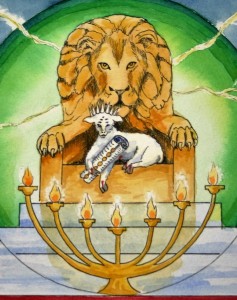
 And this vision of Revelation is loaded with language and imagery that points to the people of God in the presence of God.
 The tree of life hasn’t been seen since the city was a garden, back at creation, in
  Michael Pahl