What is Love?

Love is All We NeedScripture and Jesus on Love | What is Love?
Love, Above All | How Should We Then Love?

In my first post I got on my soapbox and boldly declared: “Love is all we need, folks! All we need is love!”

diversityIn our complex, chaotic, confusing world, we Christians don’t need greater certainty about our particular brand of doctrine. We don’t need to find the latest and greatest or oldest and truest form of worship. We don’t need more political engagement, more activism for the Christian cause.

Theology, liturgy, politics, and more are not inherently wrong, of course, and can even be very good, even vitally important—but none of these is the one thing we need always and forever.

We need to love each other.

All we need is love.

Love is all we need.

I say this, because, as I outlined in my last post, I believe Scripture points us to this. I believe Jesus points us to this.

But what is this love? What does it look like?

Some people hear “love” and think “affection,” a surge of warmth and fondness toward others. Some people hear “love” and think “tolerance,” acknowledging and accepting others and their actions with a kind of benign smilingness. Some, perhaps conditioned by Christianity, hear “love” and think “self-sacrifice.” Some, of course, hear “love” and think “romance” or even “sex”: physical, emotional, even erotic intimacy.

But the love I’m talking about is not merely affection for others, though feelings of affection are good and beautiful. This love is not merely tolerance of others, though it is important that we acknowledge and accept others’ differences. This love cannot be reduced to simple self-sacrifice, though it is true that we need to break through our selfishness and give of ourselves to others. And although physical and emotional intimacy is a necessary, God-given gift, by itself this is not the love that saves us.

Acceptance. Affection. Self-sacrifice. Intimacy.

Each of these is good and necessary. Each of these gives a glimpse of love, one angle on a multi-faceted love. But none of these by itself is the love we need.

When the biblical authors attempt to describe “love” they consistently point to God’s love for us. In the New Testament, more particularly, they point to God’s love for us in Jesus. To get even more specific, the New Testament often points to Jesus’ suffering and death to portray what true love is all about.

Image: NASA

Image: NASA

So, for example, in the Hebrew Bible we hear of God’s hesed, Yahweh’s loyal love for ancient Israel, standing at the very centre of God’s self-revelation (e.g. Exod 34:6; Ps 145:8-9). We see this loyal love in action from creation on, Yahweh providing and protecting, giving and forgiving, rescuing and restoring, time and time and time again.

In the Gospels we hear Jesus speaking of an Abba Father who cares for the least and last, who seeks the lost, who loves sinners with a ring-and-robe and fatted-calf-feast kind of love (e.g. Luke 15). In the Epistles we hear that “God shows his love for us in that while we still were sinners Christ died for us” (Rom 5:8), that “we know love by this, that Jesus laid down his life for us—and we ought to lay down our lives for one another” (1 John 3:16), and that we are to be “imitators of God” by “living in love, just as Christ loved us and gave himself up for us” (Eph 5:1-2).

“God is love,” we are told, and Jesus comes as “the image of the invisible God,” the “exact imprint of God’s very being,” the ultimate revelation of the God who is love (1 John 4:8, 16; Col 1:15; Heb 1:3; John 1:18).

So in light of God’s love for us, and especially God’s love for us in Jesus, what is this love, this one thing we really need? A few reflections, and then a summary description.

Love starts with a stance of openness. It doesn’t stand aloof, arms crossed in suspicion or scorn, waiting for the other to prove themselves. Love steps forward with arms open wide, even running toward the other. It sees the other as a person, inherently worthy of welcome, of compassion, of affection, of respect. It sees these things, even when the other person cannot see it themselves.

Love is freely given. It is “freely given” in that it is voluntary, not coerced. A forced “love” is no love at all. It is also “freely given” in that it expects nothing in return. That is barter or bribery, or crass capitalism—it is not love.

Love is a giving of oneself. Our time, our attention, our listening ear, our gracious words, our empathy, our loyalty, our experiences, our material resources—all the things that make us who we are as persons, all the things we value as humans, given for the other person. This puts us in a precarious position, because we love without knowing how our love will be perceived, without knowing how it will be received. There is always risk in love.

Love is given whether the recipient deserves it or not. It is loving anyone we cross paths with day by day, our “neighbours.” It is loving “strangers” or “sinners,” those who are different than us in any way, even in ways we vehemently disagree with. It is loving even those who oppose us in anything, even if they do so violently: our “enemies.”

Love is given even when it hurts the giver. This is not an excuse for abuse—remember, love is freely given, never coerced, never forced. This is not the weak being oppressed by the strong, but the strong giving themselves for the weak. Love, at one time or another, in one way or another, will always suffer for the other person. To love is to suffer.

The goal of this love is mutual flourishing, giver and receiver together. The objective is life shared together: not merely surviving but thriving. It is the opposite of what Christians call “sin,” those attitudes and actions that cause harm to others and ourselves.

Think of our most basic needs as human beings. We’ve got those basic physical needs, what we need just to exist: clean air and water, nourishing food, adequate warmth in clothing and shelter, simple health and safety. Then there are those basic psychological, emotional, and social needs we all have, without which we are diminished as persons: positive relationships with others, a sense of belonging in a group, a sense of meaning or purpose, of experiencing and contributing to beauty, truth, and goodness in the world.

These are universal human needs. They can give us a minimal, rough sketch of what “flourishing life” can look like. Which means they can give us a working description of what love should strive for: ensuring others have these basic human needs met, meeting these basic needs for others, for one another together.

This, then, is love: freely giving ourselves for others so that they might experience flourishing life together with us, even if we feel they don’t deserve it, even when it hurts us to do so.

Let that sink in a little.

Go back and read that again.

As you do, pause to think about different people in your life, people you encounter day by day—those you’re close to, those you’re not, those you like, those you don’t.

What would it look like to love them like this?

What would our world be like if we loved one another like this?

Stay tuned for part four.

Love is All We NeedScripture and Jesus on Love | What is Love?
Love, Above All | How Should We Then Love?

Cross-posted from http://www.mordenmennonitechurch.wordpress.com. © Michael W. Pahl.

Scripture and Jesus on Love

Love is All We Need | Scripture and Jesus on Love | What is Love?
Love, Above All | How Should We Then Love?

In my first post I got on my soapbox and boldly declared: “Love is all we need, folks! All we need is love!”

reg_div_typeIn our complex, chaotic, confusing world, we Christians don’t need greater certainty about our particular brand of doctrine. We don’t need to find the latest and greatest or oldest and truest form of worship. We don’t need more political engagement, more activism for the Christian cause.

Theology, liturgy, politics, and more are not inherently wrong, of course, and can even be very good, even vitally important—but none of these is the one thing we need over and above anything else.

We need to love each other.

All we need is love.

Love is all we need.

Let’s start with a quick survey of some biblical texts. It’s not just that “love” is mentioned a lot in the Bible—that’s true, but it’s more than that. It’s the way love is talked about in the Bible that’s so significant.

Take the Great (or Greatest) Commandment. Here’s Matthew’s version of the story:

A lawyer asked Jesus a question to test him. “Teacher, which commandment in the law is the greatest?” He said to him, “‘You shall love the Lord your God with all your heart, and with all your soul, and with all your mind.’ This is the greatest and first commandment. And a second is like it: ‘You shall love your neighbor as yourself.’ On these two commandments hang all the law and the prophets.” (Matt 22:35-40; cf. Mark 12:28-34; Luke 10:25-28; Deut 6:4-5; Lev 19:18)

Jesus’ response is right in line with similar teachings from other great Rabbis (e.g. Hillel), and the first part is straight out of the Shema, the daily recitation of devout Jews. But Jesus does something distinctive if not novel: he binds a second command to the “greatest and first,” he connects loving people with loving God. These two loves go hand in hand—you can’t have one without the other.

The final statement is crucial. All the Law and the Prophets, the Jewish Scriptures, the entire Old Testament—every command, every promise, every story, every poem—hangs on the hook of these two commandments. This two-dimensional love—vertical love for God, horizontal love for others—is the point of everything in Scripture, it is Scripture’s end goal. If we read anything in Scripture in a way that does not lead us to greater love for God and love for others, we have not read Scripture correctly.

The earliest Christians got this. Take Paul in Romans 13:

Owe no one anything, except to love one another; for the one who loves another has fulfilled the law. The commandments, “You shall not commit adultery; You shall not murder; You shall not steal; You shall not covet”; and any other commandment, are summed up in this word, “Love your neighbor as yourself.” Love does no wrong to a neighbor; therefore, love is the fulfilling of the law. (Rom 13:8-10; cf. Gal 5:14)

What’s the one thing we owe each other? The one, single thing? Love.

And what sums up every commandment God has ever given? I mean, every single one—including commands like “Be holy” or “Speak the truth”? Love.

And what is it that expresses the underlying intention and overarching goal of the Law of Moses, that brings the whole Torah to fruition? Love.

Sounds a whole lot like Jesus to me.

Interesting, too, to note why these things are true: because “love does no wrong to a neighbor.” Love does not cause harm to others. Put the other way, love brings good to others. Love is life-giving. That’s why love is the fulfillment of the Torah, whose purpose was to bring God’s people life (Deut 30:11-20).

Then take 1 John. This is hard to quote and summarize because these themes of love are woven throughout the letter, but some key texts are 1 John 3:11-20 and 4:7-21. A few highlights:

We know that we have passed from death to life because we love one another. Whoever does not love abides in death.

Beloved, let us love one another, because love is from God; everyone who loves is born of God and knows God. Whoever does not love does not know God, for God is love.

No one has ever seen God; if we love one another, God lives in us, and his love is perfected in us.

Those who say, “I love God,” and hate their brothers or sisters, are liars; for those who do not love a brother or sister whom they have seen, cannot love God whom they have not seen. The commandment we have from him is this: those who love God must love their brothers and sisters also.

Strong words, all of them. Yet they are right in line with Jesus’ Great Commandment teaching: love is at the essence of life, at the heart of God’s will for us, and our love for God is inseparable from our love for others. No wonder another text of John’s depicts Jesus saying that love is the hallmark of true disciples of Jesus (John 13:35).

There’s more. Much more.

There’s Jesus teaching on love throughout the Gospels, in all the Gospels. Loving neighbours the same way a Samaritan does (Luke 10:25-37). Loving enemies the same way the Creator does (Matt 5:43-48; cf. Luke 6:27-31). Loving prodigal sinners and self-righteous brothers the same way a Father does (Luke 15:11-32). Loving fellow disciples the same way Jesus does (John 13:34-35).

There’s Paul speaking of love in his letters. That love is the “most excellent way,” a far greater way than seeking knowledge of right doctrine, or pursuing mountaintop spiritual experiences, or striving for an ascetic, avoid-it-all, moral purity (1 Cor 12:31-13:13; cf. 8:1-3). That the “only thing that counts,” the thing that really matters most, is “faith working—or being expressed—through love” (Gal 5:6). That love is the virtue that is “over all” other virtues, that “binds together” all other virtues (Col 3:14), including the virtues of moral holiness and truthful speech (3:5-14).

There’s John’s three-layered love theology that circles through his writings over and over again: the Father loves the Son, the Father loves us through the Son, and so we are to love one another in the way of the Son (e.g. John 15:9-12). There’s James’ Jesus-like description of “fulfilling the royal law found in Scripture, ‘You shall love your neighbor as yourself’” (Jas 2:8). There’s Peter’s Paul-like summary: “Above all, maintain constant love for one another, for love covers a multitude of sins” (1 Pet 4:8).

It’s everywhere. This bottom-line, heart-of-the-matter, sums-it-all-up kind of perspective on love is everywhere in the New Testament, weaving together threads of love that run through the Old Testament.

Love really is all we need.

But what is this love? What does it look like? That’s the next post.

Love is All We Need | Scripture and Jesus on Love | What is Love?
Love, Above All | How Should We Then Love?

Cross-posted from http://www.mordenmennonitechurch.wordpress.com. © Michael W. Pahl.

Mary on the Margins

Yesterday I preached on John 20:1-18, focusing on Jesus’ encounter with Mary Magdalene. We don’t know much about the historical Mary Magdalene, but the little we get from the Gospels indicates she was a significant person in Jesus’ life and ministry.

You’d be hard pressed to find an early Christian with as impressive a résumé as she had. Consider this:

  • Mary was with Jesus throughout his ministry after being healed of demon possession, traveling with Jesus and the Twelve disciples, one of a group of women who supported them out of their own pockets (Luke 8:1-3).
  • Mary witnessed the three central gospel events: Jesus’ death, his burial, and his resurrection (Matt 27:55-56, 61; 28:1-10).
  • Mary was the first person commissioned by the risen Jesus to bear witness to his resurrection (John 20:17-18; Mark 16:9-11).
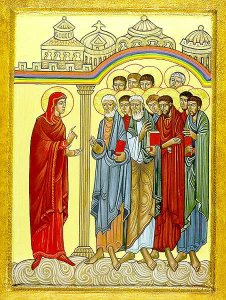
Mary Magdalene Announces

Mary Preaching to the Apostles

As I noted in my sermon, Mary thus fit the criteria for being an apostle: she had been with Jesus through his ministry, and she was the star witness to his resurrection (see Acts 1:21-22). It is not surprising, then, that she has been called “Apostle to the Apostles” in the Western Church, and “Equal to the Apostles” in the East.

However, through much of Church history Mary has been pushed to the margins.

From early on she was ignored. In the New Testament she disappears after the Gospels, and she’s left off the “official apostolic list” of resurrection witnesses in 1 Corinthians 15.

And then she was maligned. As the centuries passed she was identified with the unnamed woman who anointed Jesus’ feet, who, in Luke’s Gospel, is identified only as a “sinner.” In the medieval imagination this morphed into Mary being a prostitute, and a particularly lascivious one at that. Paintings of a later era often show her in a provocative pose even in penitence, taunting the viewer with her brazen sexuality.

None of this, however, is even hinted at in the Gospels. Mary Magdalene is never identified as the woman who anointed Jesus’ feet. She is never described as a “sinner,” let alone as a prostitute or adulteress. She was as I described her above: healed of demon possession, and then a faithful disciple of Jesus, an important person in Jesus’ life and ministry, and a crucial witness to Jesus’ death, burial, and resurrection.

Mary Magdalene, faithful disciple and first witness of the crucified and resurrected Jesus, was first ignored, and then maligned. Mary was shoved to the margins—all because she was a woman.

Yet this was not Jesus’ perspective on women. Of course, Jesus was no modern feminist. He chose twelve men to be his first apostles, after all, a nod to the patriarchy of his ancient Jewish world: the Twelve represent the twelve tribes of Israel, the sons of Jacob, as Jesus is re-making the people of God.

Yet along the way Jesus undermined that patriarchal mindset. He is remembered across the Gospels as sticking a burr under the saddle of patriarchy, a barb here, a bristle there, until the male-dominated world gets mighty uncomfortable. Consider this:

  • Jesus talks to women as equals, not as inferiors—like the Samaritan woman at the well (John 4:1-42).
  • Jesus even accepts a rebuke by a woman, and commends her for it—the Gentile woman from the region of Tyre and Sidon (Matt 15:21-28).
  • Jesus frequently praises women for their faith and piety—the poor widow with her meagre offering (Luke 21:1-4), the bleeding woman who touched his garment in the crowd (Mark 5:25-34), the ten virgins waiting faithfully for the bridegroom to come (Matt 25:1-13), and more.
  • Jesus heals women in ways that show concern for their unique difficulties in society, or that elevate them to places of honour—raising the widow of Nain’s only son so that she would be cared for (Luke 7:11-17), or healing the woman bent double and calling her a “daughter of Abraham” (Luke 13:10-17, the only place that phrase is used in the New Testament).
  • Jesus speaks of women as his “disciples,” his true “mothers” and “sisters” who do God’s will—unusual if not unprecedented for a Rabbi of the day (Matt 12:46-50).
  • Jesus even highlights another Mary, Martha and Lazarus’ sister, as the ideal disciple learning from her Rabbi (Luke 10:38-42).

And when the resurrected Jesus appears, he appears first to the faithful one on the margins, the one whose testimony would be suspect simply because she was a woman: Mary Magdalene. Jesus doesn’t marginalize Mary—he brings her right into the centre of God’s work in the world, first witness to the dawn of a new creation.

How well are we following Jesus in this way? Are we men following Jesus in drawing women into the centre of God’s work in the world, deliberately creating space for women among us to use their gifts and share their voice, allowing them to create this space for themselves, sharing this co-created space as full equals?

And what about others on the margins? What about those who have God-given gifts to share, God-given voices to use, but whom we hold at arm’s length, keeping them on the sidelines, in the shadows?

Jesus looks to the last in the world, the least in society, those who have lost their way. He sees them. He sees their gifts, he hears their voice. He seeks them, he finds them. He draws them in, and lifts them up, and empowers them to use their God-given gifts, to speak with their God-given voice.

May we who claim to follow Jesus do the same.


In a moment of inspiration last week I wrote a poem (it is still National Poetry Month, after all). It’s a poem about Mary Magdalene, Mary on the margins, Mary brought into the centre of God’s work in the world. It is simply called, “With.”

With

I stand among them,
yet not with them.
Their number is fixed:
signs of the heavens,
tribes of the father
—no girls allowed.

I learn among them,
yet not with them.
Hearing good news,
kingdom come
and will be done
—first for the Jew.

I walk among them,
yet not with them.
Preaching good news,
feeding poor mouths,
healing disease
—cast out with the demons.

Where have they gone?
Why have they fled?
The cross before me,
the tomb behind me,
the garden around me:
he is with me
—and I am with him.

© Michael W. Pahl

What Did Og Ever Do to You?

The Lord struck down many nations
and killed mighty kings—
Sihon, king of the Amorites,
and Og, king of Bashan,
and all the kingdoms of Canaan—
and gave their land as a heritage,
a heritage to his people Israel.

This was part of our morning prayers this week, this snippet from Psalm 135. It’s a psalm of praise to God, declaring the worship-worthiness of Yahweh. Yahweh is good and gracious! Yahweh is great and powerful! Yahweh’s goodness and greatness are shown in his awesome deeds!

Awesome deeds like killing Egypt’s firstborn, destroying nations and annihilating peoples, and slaying kings like Og, king of Bashan.

Yep.

Og's Bed

Og’s bed

And what did Og do to deserve such a fate? Simply this: he stood up on behalf of his people against an invading army, which just happened to be the army of ancient Israel, who just happened to be Yahweh’s tribe. And so, the original story goes, the Israelites “killed him, his sons, and all his people, until there was no survivor left; and they took possession of his land” (Num 21:33-35).

Ugh.

Not my favourite way to reflect on God’s gracious goodness. And not my favourite way to prompt prayer and worship on a bleary-eyed morning.

But yet I read it. And I reflected on it. And I prayed to God based on it. How in the world could I do that?

I’ve offered many thoughts already on this blog about how we as Christians should read the Bible, including the Old Testament. In general terms it boils down to this: the Bible points us to Jesus, and we follow Jesus.

That’s all well and good, and I’m convinced it is the right way for us as Christians to think about the Bible and how this collection of God-inspired, ancient human writings should function as authoritative Scripture for us.

But how do we then read specific passages, especially passages that make us go “ugh”?

What do we do with Og?

Well, here’s what I do with these biblical passages, and what I did Tuesday morning when the psalmist’s Schadenfreude over Og’s fate zapped me out of my comfortable morning fog.

First, I recognize these stories and songs for what they are: reflections of an ancient tribal culture with its contexts of tribal gods, tribal enemies, and tribal warfare. For me, this doesn’t in any way negate the divine inspiration of these texts—it certainly affects my understanding of how the inspiration of Scripture works, but not that the biblical texts are divinely inspired. I’ve written on this elsewhere, so I won’t belabour the point here: any notion we have of Scripture’s inspiration must take into account the simple realities of what these ancient writings are.

And what we have here is stark tribalism at work. Us versus them. Our god versus their gods. We win, they lose. Our god is greater than their gods. Yay for us! All praise to our god!

Sounds pretty pathetic when I put it just like that. Yet that’s the logic at work here, and we do ourselves no favours when we try to ignore it or deny it.

And it would be pathetic—and tragic—if we stopped there. But we’re not done yet.

I then read these stories and songs through the lens of other Scripture, especially later Scripture, especially the New Testament, and most especially Jesus. Throughout the Bible you have strong hints that this kind of tribalistic perspective is not really the best perspective to have, that it’s not really what God is looking for.

From the creation narratives pointing through Israel to all humanity, to stories of non-Israelites playing key roles in God’s work in the world, to the Hebrew prophets pointing beyond Israel’s present to God’s wider work among the nations—the Old Testament itself deconstructs its own tribalism.

This trajectory continues in the New Testament, centred on Jesus: through Jesus, Israel’s Messiah, God’s kingdom comes on earth for all peoples. The tribes of the earth become reflections of delightful diversity, not reasons for death and destruction.

All this points to a re-thinking of our “enemies.” Human, flesh-and-blood “enemies” are not our true enemies after all. Rather, humanity is united against a common enemy: our own sin and its resulting death. Og is not the problem. We’re the problem: our recycled attitudes and actions of harm against ourselves, others, our world, and ultimately God.

God's Bed

God’s bed

And all this points to a re-thinking of “God.” God is not like us only bigger. God doesn’t mirror our prejudices and dogmas. God doesn’t happen to hate all the people we hate. God loves the world—all of us, every tribe, every nation, every person. Even Og. And God comes to lift us out of our sin and death, to lift us out of our cycles of violence and harm, not through ever-greater displays of power and force but through ever-deeper expressions of selfless love.

Finally, I pray these stories and songs in this re-thought way, and seek to live in light of God’s fuller revelation of himself in Jesus. As I prayed this clip of Psalm 135 this week, in my mind I was converting the words about flesh-and-blood enemies into words about humanity’s real enemies. I read “Sihon and Og” but thought “Sin and Death.”

God has looked past our tribalism to our humanity, and through the crucified and risen Jesus God conquers our cruelty, our deceit, our prejudice, and more. God is greater than our fears! God is mightier than our hatred! Yay for all of us! All praise to our Creator God!

But this, of course, is not all, these joyful praises in private prayer. As I left our morning prayers Tuesday morning, my thoughts lingered in that space.

How do we continue to perpetuate that ancient tribalistic mindset? (Us versus them, our god versus their gods, we win, they lose, our god is greater than their gods.)

How do we do that as groups of people? (Mennonites, Christians, Straight-White-Males, Canada, The West.)

How do I do that in my everyday life? (My rights, my privileges, my little kingdom, mine, mine, mine.)

Ugh.

It was so much easier to just blame Og.

© Michael W. Pahl

Why in the World Do I Believe in Jesus’ Resurrection?

Alice laughed. “There’s no use trying,” she said: “one can’t believe impossible things.”

“I daresay you haven’t had much practice,” said the Queen. “When I was your age, I always did it for half-an-hour a day. Why, sometimes I’ve believed as many as six impossible things before breakfast.”

— Lewis Carroll, Through the Looking-Glass

The resurrection of Jesus from the dead is an utterly impossible event.

I’m serious. It is truly impossible.

When we make it into something that is “possible”—whether historically or scientifically—then we’ve stripped it of its power. When we make it into something that is “possible,” we miss the nature of “resurrection” as new creation invading the old, the transformative redemption of the old into something radically new. As I note in From Resurrection to New Creation, all this is rather scandalous for Christian faith: Jesus’ resurrection demands historical investigation at the same time that it defies historical investigation.

So why then do I believe in Jesus’ resurrection from the dead? Why do I believe in something that is truly impossible?

After all, I don’t make a habit of believing in impossible things. Sure, we all believe things that may well be improvable, but that’s different from believing in things which are impossible. So why do I believe in this particular impossible claim, that something happened to the corpse of Jesus of Nazareth such that he was resurrected from the dead to a transformed bodily existence?

PrintIn From Resurrection to New Creation, I note that this “scandal of the empty tomb” places Christians in the “risky realm of faith—trusting in the primitive testimony of those very first witnesses as found in ancient traditions in later written records, and believing in the history-demanding yet history-defying claim that Jesus of Nazareth was ‘raised from the dead on the third day,’ transformed to an immortal bodily existence untouched by sin and death” (12).

I do think this is the most fundamental basis for belief in Jesus’ resurrection: the apostolic gospel, the “kerygma,” the message of salvation to which the Spirit through the Scriptures and the Church bears witness, calls us to faith in Jesus’ resurrection. But this is a general reality, a common thread which runs through billions of diverse experiences of faith.

So why do I—I, and not all Christians—believe in the impossible: Jesus’ resurrection from the dead?

Belief is a funny thing. We very often continue to hold to a belief for different reasons than we came to believe in the first place; the way we attain belief is not always the same as the way we sustain that belief. So it is that my own belief in Jesus’ resurrection was first prompted by the faith of others: my primary social community in my formative years of childhood and adolescence believed in Jesus’ resurrection, and they passed on that faith to me as well.

This “faith in the faith of my faith community” is still an important dimension of my belief in Jesus’ resurrection, but it is not in itself enough to sustain that belief for me. So, my own belief in Jesus’ resurrection is sustained by a few other things as well.

I have had several experiences of the “transcendent” or “supernatural” in my life—situations where things happened in an unusual and beneficial way, or impressions of something or someone “completely other” and “utterly beyond” engaging me in some way in my “inner being,” or the like.

I’m sure these can all be explained as coincidence in a chaotic world, or neurological processes in response to some subconsciously perceived external stimuli, or whatever. But there’s something about many of these experiences for which those explanations are—however true—not enough. Undoubtedly this simply reflects the fact that I want to believe there is someone somewhere out there who is “completely other” and “utterly beyond.” In any case, these experiences in many ways lay the groundwork for more specific belief.

Rembrandt EmmausI also have an ongoing and growing conviction that no other explanation than Jesus’ resurrection fully does justice to the texts and ideas, events and experiences of those first Jesus-followers after the death of Jesus of Nazareth on the cross. Grave robbing and hallucinations, fainting and reviving, myth-creating and -telling, natural evolution of socio-religious ideas—none of these or similar explanations makes good sense to me of the specific traditions, writings, convictions, ministries, and deaths of those first followers of Jesus.

Now this is not the same as saying Jesus’ resurrection is “provable” according to the standards of historical criticism—I don’t think it is. Rather, it is more along the lines of saying—with deepest apologies to Sherlock and Sir Arthur for completely skewing a maxim of Holmesian logic—that when you have eliminated the improbable, whatever remains, however impossible, may well be the truth.

Nor is this simply another way of saying the same thing as I said above, that belief in Jesus’ resurrection is faith in the apostolic kerygma. This is rather what you might call a historical-but-not-critically-historical reason for cautious conviction that Jesus was resurrected from the dead.

Also significant for my belief in Jesus’ resurrection is seeing individual lives and faith communities transformed by this belief, seeing Christian faith work in the daily grind of real life.

Again, alternative explanations are possible—people can make major, positive changes in their lives for a variety of reasons and from within (or apart from) a variety of faith traditions. And there’s no doubt that many who claim belief in Jesus’ resurrection see very little positive change in their lives, and can in fact do some pretty horrible things. But still, I can’t deny that this particular belief in this particular God who raised this particular Jesus from the dead has had some very positive effects on many individuals, communities, and even crucial moments in human history.

A not-unrelated factor is this: to me, a broadly Christian worldview works better epistemically than the alternatives, allowing me to make sense of my perceptions and experiences in the world in a way that is coherent and meaningful. And a crucial dimension of that Christian worldview is the belief that God raised Jesus from the dead, that God is a God who gives life to the dead and calls into being that which does not exist, a hopelessly optimistic notion that God alone provides hope for real, lasting change.

All these factors—my personal experiences of the transcendent, my heritage of faith and my faith community, the coherence of a Christian worldview for me, the positive change I’ve seen in the lives and communities of believers, my dissatisfaction with alternative explanations for the empty tomb and the resurrection appearances, and ultimately, the Scripture- and Church-witnessed apostolic kerygma—all these factors come together to prompt and sustain my belief in the impossible claim that the crucified Jesus was resurrected from the dead.

And this, in turn, changes everything.

—————–

This post is adapted from a post written in 2010 on a previous blog of mine. As a companion to this, you might want to check out my post, “Do Christians Really Need to Believe in Jesus’ Resurrection?” The answer is more complex than you might think!


© Michael W. Pahl.

The Foolishness of the Cross

A meditation on the cross which I shared at the Morden Good Friday Community Service, April 18, 2014, slightly revised since. It is based on 1 Corinthians 1:18-25.

A few years ago I was fortunate to be able to go to Israel-Palestine with a study group. It was an amazing experience: hiking in the wadis west of the Dead Sea, climbing in the hills around the Sea of Galilee, baptizing a former student of mine in the Jordan River, listening to stories around a community oven in a Palestinian village, getting violently sick in my first days there. Well, that wasn’t so amazing, but it certainly was memorable!

Olive Wood CrossOf course, I brought back mementos of my trip. Stones from different parts of Israel-Palestine, beverage containers with Hebrew and Arabic on them, a ram’s horn. And some plain wooden crosses like this one, simple, carved out of olive wood.

It’s the universal symbol of Christianity, the cross. We set them outside our churches and everyone can see at a glance that we’re Christians. We have them at the front of our churches, focusing our attention in worship. Many churches in Europe are built in the shape of the cross. We place crosses over our graves. We cast crosses in silver and gold—or carve them in wood—and wear them around our necks.

The cross is pervasive among us Christians as a visual symbol for our faith. But you might be surprised to know that the cross wasn’t widely used as a visual, public symbol by the early Christians, probably for at least two hundred years after Jesus. The reason is a simple one—and it makes you think.

The Scandal of the Cross

You see, the cross was not in any way a positive thing for Jews or Christians in those early centuries of the Church. Even sophisticated, respectable Roman citizens thought crucifixion too distasteful for polite conversation. Cicero, a Roman philosopher and politician who lived just before the time of Jesus, said that “the very word ‘cross’ should be far removed not only from the person of a Roman citizen but from his thoughts, his eyes and his ears…the very mention of [crucifixion]…is unworthy of a Roman citizen and a free man” (Pro Rabirio 16).

A real cross, the kind that people were crucified on, was normally just a rough-hewn beam of wood that the condemned criminal would carry outside the city, right on the busiest road where everyone could see. There it would be attached to something vertical—a post set up for such executions, or even just a tree. The person would be hung from it, arms outstretched, sometimes for days, until they died an excruciating death, usually of asphyxiation. Crosses were not your ordinary punishment; they were reserved for the worst of criminals, for treasonous rebels, for conquered peoples.

A real cross, then, the kind that Jesus died on, was an instrument of death, a horrific thing, an image of deep shame. It was like a giant billboard displaying Rome’s power and highlighting the subjugation of all other peoples. Cicero might not have wanted even to speak of crucifixion, but his Rome was built on the backs of crucified men.

Christians using the cross as a symbol, then, would be like African Americans in the Deep South of the early twentieth century placing a beautifully woven noose at the front of their churches, or like Jews of 1940s Poland casting a miniature golden gas chamber to wear as jewelry.

It’s disturbing to think about, isn’t it?

But once you get this then you can start to appreciate the Apostle Paul’s words in our passage from 1 Corinthians: “The message of the cross is foolishness to those who are perishing…but we proclaim Christ crucified, a stumbling block to Jews and foolishness to Gentiles.”

Christ, of course, is Jesus: Jesus of Nazareth, who walked those dry and dusty roads of Galilee, preaching the kingdom of God and teaching love of God and neighbour, healing the sick and raising the dead. But “Christ” is a title, not a name: it means “Messiah,” or “anointed one,” and refers to the ancient practice of initiating priests and prophets and kings by anointing their head with oil. When Paul calls Jesus “Christ” he is essentially calling him “King,” the promised Messiah in the family line of King David who was to bring about God’s kingdom on earth as it is in heaven.

Of course, for Paul, there’s more going on in Jesus’ story. For Paul, Jesus the Christ was “sent” from God the Father: he perfectly represented God, God’s person and purposes. For Paul, Jesus embodied God in the world: as Colossians puts it, “in [Jesus] all the fullness of God was pleased to dwell” (Col 1:19).

So this is Paul’s claim, then: the man Jesus is the Christ, the Messiah, the promised King come to bring about God’s kingdom, perfectly representing God to us, even embodying God for us—and this God-King has died on a Roman cross, executed in torturous pain and shame and oppression, in utter weakness.

If you were a Jew in Paul’s day, like Paul himself and all the first Christians, what would you think of this? The Messiah, the Son of David, was supposed to liberate God’s people from their oppressors, not succumb to those oppressors! The Messiah was supposed to come with mighty signs and wonders in triumph over God’s enemies, not be crucified by them! There was little room for a suffering and dying Messiah in Jewish thinking of the day.

There was also a persistent view among at least some Jews that those who were crucified were cursed by God; it comes from Deuteronomy 21:23, “Anyone hung on a tree is under God’s curse.” How could the Messiah be under God’s curse? The Messiah is blessed by God, not cursed!

No, a crucified Christ just could not be—and this was an enormous stumbling block for Jews in Paul’s day to believe in Jesus.

Alexamenos GraffitoWhat if you were a Roman? The Romans had their own stories of divine kings. Caesar Augustus and all “good emperors” after him were deified after their death, viewed by many in the Empire as divine kings. Some emperors along the way couldn’t wait until after they died to be deified, and insisted on being considered divine while they were still alive. So the Romans could understand a god-king. But a divine king being crucified at the hands of his enemies? Impossible! Such a king is not worthy of divinity!

And how about the Greeks? In Paul’s day, some at least thought of God as static, unchangeable, immune to shifting human passions and outside the fluctuating tides of human events. For these Greek thinkers, it was impossible that the divine being should experience suffering, let alone suffering on a cross.

But even for Greek thinkers who didn’t view God this way, they still had no room for this. They all liked their tidy system of thought, their sophisticated reason, their seamless, undisturbed way of understanding the world and our place in it. Stories of a crucified god-king? Too messy, too disturbing, too irrational.

No, a crucified Christ just could not be—and this was seen as complete and utter foolishness for many of the Gentiles in Paul’s day.

“We proclaim Christ crucified,” Paul says. Really, it’s hard to imagine any message in his world that could have been more foolish than that.

The Power of the Cross

But here’s the astounding thing: Paul insists that this foolishness is really wisdom, this weakness is really power. God is foolish in our eyes, God is weak—yet it is only through this foolishness that we find true wisdom, and it is only through this weakness that we find true power.

It is one of the most mysterious—and shocking—truths of Christianity: God brings about salvation for the world through a crucified Christ. God rescues humanity and all creation from sin and death through a Jewish king executed on a Roman cross. God overcomes our greatest enemies—our insatiable greed, our arrogant pride, our overpowering selfishness, these deep-rooted distorted desires that push us to hurt others and harm creation—God overcomes this sin and death by bearing the brunt of our sin and giving himself up to death.

It’s as if Jesus on the cross absorbs into himself all the hatred and violence and guilt and shame and pain and suffering that humans can inflict—he absorbs it all. Instead of fighting violence with violence, instead of fighting power with power, like everyone expected a king to do, or even a god to do—Jesus absorbs it all. Jesus takes all these things—all our sin, and this all-encompassing death that results from our sinful attitudes and actions—Jesus takes all this and absorbs it into himself, as if sucking the poison from a snake bite.

Rembrandt Christ on the CrossThrough this Jesus shows us who God really is: God is the God who would rather die than kill, the God who comes in suffering and weakness rather than brazen displays of power, the God who would rather work silently through our distorted wills than enforce his own will on us. God is the God who loves us, who gives himself for us, the God who forgives us, the God who is not against us but for us, on our side, right by our side in our own suffering.

And in the process, Jesus also lays out a path for us to walk: we are to follow in the footsteps of our crucified Messiah, not in power but in weakness, not in glory but in suffering, not in hatred and violence but in love and peace.

The Good News of the Cross

I think we’re more like the Jews and Greeks and Romans of Paul’s day than we care to admit.

We think God comes to deal with our enemies—those other people, flesh and blood people who aren’t like us, who don’t like us. But the cross shows that God comes to deal with the deeper enemies we all face—our own selfishness and greed, our own arrogance and pride, our own sin and the wider evil and injustice that grows out of it.

We think God comes in power and strength, and so we revere strong and powerful people. We think God comes in wise words and clever arguments, and so we admire intelligent people. We think God comes in glittering glory, and so we idolize beautiful people. But the cross shows that God comes in foolishness and weakness, with nothing in his appearance to attract us to him. God comes in a helpless baby and a crucified king, God comes in the poor, the weak, the suffering, the least of these, Jesus’ brothers and sisters.

We think God makes the world a better place through his sheer will, his mighty power, and so we try to do good in the world by force, coercing others to do our will. But the cross shows that God changes the world through his weak power, through self-giving love and radical forgiveness—and so should we.

We think God only works in “God moments,” those times when something spectacular happens, something miraculous, something extraordinary. But the cross shows that God also works when tragedy strikes, when the worst thing you can imagine happens, when pain and suffering and despair and even death hits us. These too can be “God moments,” sometimes even the most powerful “God moments”—as God comes alongside you and walks with you through darkness and disaster.

We think God is unchangeable, unmoved by the ebb and flow of human circumstances and human experiences. But the cross shows that God knows the very depths of human suffering and sin. If there’s a solution to the problem of evil, it is this: God suffers with us.

One scholar has commented on our passage from 1 Corinthians this way: “The ultimate idolatry is that of insisting that God conform to our own prior views as to how ‘the God who makes sense’ ought to do things” (Gordon Fee, First Corinthians). But the cross shatters all our notions of “what God must be like.”

And in that there is genuine good news, for all of us.

If you are wracked by guilt, or overcome by shame for something you’ve done, God is not standing over you, to condemn you. God is standing before you, arms open wide, ready to forgive you, to welcome you home. Receive God’s forgiveness, and in that you can find the strength to seek the forgiveness of others.

If you are walking through pain and suffering—physical sickness, emotional wounds, mental illness, whatever it may be—God is not outside of all that, oblivious to your hurt. God is right there in the midst of it, ready to walk with you through it, to give you just what you need day by day to make it through. Open yourself to God’s love, trust in God to take care of you.

Road-to-the-CrossAnd if you have any kind of relationship to another human being—I think that pretty much covers all of us—remember this: God calls us to walk in the footsteps of Jesus, the crucified Christ. God calls us to love, not to hate. God calls us to peace, not violence. God calls us to be humble with others, not proud. God calls us to forgive, not to harbor resentment or anger. God calls us to the cross, the weak and foolish cross, because it is only through the cross—Jesus’ kind of selfless, self-giving love, that we can find God’s true wisdom and power.

This is why the cross endures as such a powerful symbol of the Christian faith: not because the cross was an instrument of such horrific brutality and terrorizing oppression, but because the cross shows us so clearly who God truly is. The cross shows us God’s deep and abiding love—for me, for you, for all of us.

———————————-

For some reflections on the cross and nonviolent atonement, check out my later post “Atonement and God’s Wrath.”


© Michael W. Pahl

Jesus Was a Peacenik After All

This past weekend I hosted my seminar on Jesus in history called, “Was Jesus Married? …and other awkward questions.” (The answer to that one, by the way, was, “Almost certainly not—though it is not historically impossible, and shouldn’t be theologically problematic.” Can you say, “can of worms”?)

But one of those other “awkward questions” was this one: “Was Jesus actually a violent revolutionary (and not a peacenik)?” As I conceded in the seminar, a good prima facie case can be made for Jesus’ revolutionary tendencies.

Those tendencies were undeniably “in the air” in Jesus’ day. There was a proud history of zeal for Torah among Jews of Jesus’ day, including for some a willingness to do violence against foreigners and even fellow Jews in order to uphold “righteousness” according to the Law of Moses. There was also a “zealot” movement that developed against Rome that had roots going back to Galilee in the early first century A.D., right where and when Jesus grew up.

And then there’s what Jesus himself said and did. Jesus proclaimed the imminent kingdom of God, a reality commonly understood as a political kingdom that could well require military effort to bring about. Jesus said things one could interpret as promoting violence, things about bringing and buying swords. Jesus entered Jerusalem in messianic procession and caused a disturbance in the Temple. And to top it all off, Jesus was crucified by Rome, probably for treason.

So, at first blush, the idea of Jesus as a wannabe revolutionary can seem pretty compelling. However, it collapses under the cumulative weight of a host of sayings and deeds of Jesus.

Jesus’ ethical teachings, such as in Matthew 5-7, and his mission teachings, like those in Matthew 10, are among the best attested teachings of Jesus we have. We find many of them in both Matthew and Luke in slightly different versions, we see them reflected in Paul’s writings before the Gospels were even written (e.g. Romans 12-13; 1 Corinthians 9), and we hear them in other early Christian writings of the first century (e.g. James 5, Didache 1).

Tissot - Lord's PrayerIt’s in these teachings that we find Jesus’ strongest words of peace and non-violence. “Love your neighbour,” “love your enemies,” “do not hate your brother,” “turn the other cheek,” “bless those who persecute you,” “blessed are the peacemakers,” and more are found in his ethical teachings, all connected to the “kingdom of God” which we are to pray for and to seek first. Among his mission teachings are calls for Jesus’ followers to proclaim God’s kingdom and heal the sick, giving freely and living simply. If they are rejected they are not to retaliate but simply to “shake the dust off their feet” and move on, leaving the rejecters to God’s judgment.

Other teachings of Jesus may be less widely attested in earliest Christianity, but fit snugly within these basic contours. Jesus’ kingdom parables, for example, repeatedly emphasize the idea that God’s kingdom does not come about suddenly—by force, you might say—but is planted in the world and grows quietly and slowly until its fruition. Or, for instance, Jesus’ controversies with religious leaders include the famous “Give to Caesar what is Caesar’s, but give to God what is God’s”—a recognition of human authorities in this age, yet a declaration that God holds our ultimate and total allegiance. And running through the Synoptic Gospels is a recurring focus on the “least,” the “last,” and the “lost” as who God’s kingdom is for, as those who inhabit God’s kingdom—not the powerful or mighty but the meek and the humble, not the violent and coercive but the gentle and those who serve.

All told, the whole thrust of Jesus’ teaching is that God’s kingdom—God’s universal reign of justice and peace—is being established on earth, brought about through his, and his followers’, self-giving, suffering love for the other. This involves both love for God and for other people, including love for those marginalized among us and for those deemed to be hostile to us.

Jesus’ actions were fully in line with these teachings. One of the regular activities of Jesus widely acknowledged among historians is his practice of “communal meals.” These he viewed as symbolic of God’s kingdom, and the guest lists included repentant sinners, the socially marginalized, and other outsiders—the “least,” the “last,” and the “lost” who inherit God’s kingdom. Likewise, Jesus’ healings—he was certainly acknowledged as a healer, even if his opponents questioned the source and legitimacy of his healings—were also seen as signs of God’s kingdom, and focused on things like mercy over strict Sabbath observance, compassion over ritual purity, and inclusion of the marginalized in God’s kingdom.

Then there’s Jesus’ suffering and death. At least some early Christians viewed Jesus’ death as the crucial event for establishing God’s kingdom on earth (e.g. Mark). Certainly the manner of Jesus’ suffering and death reflected the teachings he had given—he walked the talk. He “turned the other cheek,” standing up to the powers that be and refusing to retaliate, thus exposing their violence and injustice for the evil that it was. He gave himself for the good of others, even through extreme suffering. He modeled the love he commanded.

The overwhelming portrayal of Jesus in our earliest and most extensive sources is that of one who proclaimed and lived out a counter-cultural kingdom of God—one not characterized by violence, but by non-violence, even active peacemaking.

What do we do, then, with the few anomalies, those sayings and actions of Jesus that don’t seem to fit the mould? Well, let’s take a closer look.

The “I have not come to bring peace but a sword” saying (Matt 10:34-36) is part of Jesus’ mission teaching, instructions for his disciples as they preach the gospel and heal the sick. “Sword” here is used figuratively to describe the turmoil that will result from Jesus’ kingdom message and way of life. His point—evident from the surrounding context of this statement—is simply that his kingdom message and actions will provoke resistance from the world, so his followers should be prepared for this and persevere through it.

Rembrandt Christ on the CrossWhat about “Those who do not have a sword should sell their cloak and buy one” (Luke 22:35-38)? Jesus has just alluded to his previous mission teaching, but now intensifies it: this is, once again, a warning about coming resistance to Jesus’ kingdom way. That Luke understands the particular statement as figurative is evident from the way the narrative continues. First, Jesus responds to the disciples that two swords is “enough”—rather ludicrous if Jesus was speaking literally about arming themselves either for rebellion or for defense. (You can almost hear Jesus sigh at their obtuseness.) And second, when the disciples ask about literally using the sword to fight the mob and one of them cuts off the ear of the high priest’s servant, Jesus responds with “No more of this!,” heals the man’s ear, and says, “Have you come out with swords and clubs as if I were a lēstēs (brigand, revolutionary)?” (In other words, “I’m not a lēstēs, people.”) Matthew’s account gets at the gist of Jesus’ real feelings about this, stripped of all irony: “Those who live by the sword will die by the sword” (26:52).

Then there’s the “temple cleansing,” as it is often called. Yes, Jesus does exhibit violence here, something that should caution us against an unrealistic ideal of non-violence. But it’s important to temper that concession with a few other thoughts.

First, none of the Gospels indicate that Jesus committed physical violence against human persons—only John describes the “whip,” and he states this was used to “drive out” the animals. Second, scholarly consensus is that Jesus’ temple action was symbolic and prophetic, like the symbolic-prophetic actions of Ezekiel, for example. Jesus was not realistically going to stop the temple sales of animals with a one-man temple tantrum, but he could symbolically highlight the problems he saw and prophetically pronounce God’s judgment. And third, this action was motivated by a desire for justice and inclusion in the face of injustice and exclusion. Poor Jews, especially non-Judeans who had traveled from around the Empire, relied upon the animals sold in the temple courts for their sacrifices. The temple merchants, it seems, were taking advantage of their situation, keeping the temple from being a “house of prayer for all nations.”

In sum, then, Jesus’ kingdom teaching was overwhelmingly non-violent and constructive in orientation, Jesus’ kingdom actions were overwhelmingly non-violent and restorative in nature, and these realities need to govern how seemingly contradictory realities are understood.

It’s important to note that none of this makes Jesus into a modern pacifist. Jesus doesn’t use his interactions with Roman soldiers to rail against military violence—in this he followed the example of John the Baptist (we Mennonites need to pause and reflect on this more). He doesn’t focus his energies on organizing his followers toward collective acts of resistance against the powers that be or their acts of violence (notwithstanding his “protest march” into Jerusalem on Palm Sunday). He doesn’t develop a program of restorative justice in contrast to the retributive models of justice around him. He doesn’t establish hospitals or schools in war torn areas in order to build a peaceful society.

Nevertheless, Jesus was a thoroughgoing peacenik—and his teachings and example provide the building blocks for a robust, active Christian pacifism that includes all these things, and more.

© Michael W. Pahl

“So, you’re a pastor…”

It’s one of those conversation stoppers.

“So, what is it you do?” they ask.

“I’m a pastor,” I say.

They nod slowly, eyes dimming. Awkward pause. I can hear the next question, even though it’s left unspoken. It’s the same question as the first: “So, then…what is it you do?”

Good question. What exactly do I do? What does it mean for me to be a “pastor”?

I’m not a corporate CEO, or a business owner, or a franchise manager. I’m not the president of a local club, or the director of a local charity. I’m not a leader in the way the world thinks of leadership—casting visions, setting agendas, running the show, being “the decider.” I’m not here to make money or raise funds or establish a profile or bring in a crowd.

I’m a pastor.

But what does it mean for me to be a “pastor”?

If you asked ten pastors this question, you’d probably get a dozen answers. If you asked their parishioners, you’d probably get a hundred more. But here’s what it means for me to be a pastor.

As a Christian I am called to follow Jesus. As a pastor I am called to encourage others on this path, to follow Jesus in ever-increasing faith, hope, and love.

That’s it. That’s the sum total of my pastoral call.

Or, to put this another way, more in the words of the Apostle Paul: As a Christian I am “in Christ,” defined by Christ, seeking to become more and more like Christ by the power of his Spirit. As a pastor I am called to build up Christ’s body, those who are in Christ, into greater Christlikeness.

That’s my job description as a pastor. When I start my day, each and every day, that’s the task that is before me.

Of course, this has some more specific dimensions to it.

Jesus Good Shepherd catacombsI’ve always liked how Mark’s Gospel describes the calling of the Twelve apostles: “Jesus went up the mountain and called to him those whom he wanted, and they came to him. And he appointed twelve, whom he also named apostles, to be with him, and to be sent out to proclaim the message, and to have authority to cast out demons” (Mark 3:13-15).

They were first and foremost “to be with him,” to know Jesus and talk to him and learn from him and walk with him. They were to do life with Jesus, their Rabbi. Then they were to “proclaim the message,” preaching and teaching the gospel, the good news of God’s kingdom of justice and peace, planted in the soil of this world through Jesus. And they were to “cast out demons,” to be instruments of kingdom liberation and healing to those in bondage to sin and evil, doubt and fear, guilt and shame, darkness and death.

Sure, this is the apostles we’re talking about. But I think this nicely encapsulates the mission of the Church, the calling of all Christians. It also summarizes the way the rest of the New Testament speaks of “pastors,” those “elders” who shepherd God’s people.

As a pastor I am called first and foremost to be with Jesus, in studying Scripture, in prayer, in daily communion with the risen Jesus by his Spirit.

And out of that communion with Christ I am to preach and teach the gospel, declaring and explaining and dialoguing about the good news of what God has done through Christ and continues to do by the Spirit.

And along with that I am to come alongside the infirm, the weak, the outcast, the downtrodden, the guilty, the fearful, the doubting, the despairing, to be an instrument of God’s healing and liberation. It is not the healthy who need a doctor, but the sick; it is the lost who need to be found, the least who need to be feasted, the last who need to be made first.

I agree, it’s not very glamorous. And it doesn’t make a whole lot of sense in the eyes of the world, all this prayer and Bible-reading and preaching, all this time spent away from the limelight with needy people.

But let others cast visions and set agendas. Let others run the show, be “the decider.” Others can make money and raise funds and establish a profile and bring in the crowds.

Me? I’m called to encourage others on this path of following Jesus. I’m called to build the body of Christ to become more like Christ. I’m called to be with Jesus, to preach the gospel, and cast out demons—and urge others to do the same.

I’m a pastor.

Cross-posted from http://www.mordenmennonitechurch.wordpress.com. © Michael W. Pahl.

Things Jesus Didn’t Say

This morning I got thinking about ways in which we ignore or distort Jesus’ teachings (note the “we” there – that’s me implicated as well!). Why do we do this? Well, to put it bluntly, Jesus’ teachings are hard!

Bloch Sermon MountJesus’ teachings are sometimes hard to understand, but even when they’re pretty clear, they are even harder to put into practice. They make us uncomfortable. They might make us unpopular. They force us to confront our fears and prejudices, or face up to our own sin, or otherwise dig deep into the darkest parts of our hearts. They force us to action, to not just speak about loving others, but to actually love others in the way of Jesus.

Well, I had a little fun with all that on Twitter this morning, tweeting a few #ThingsJesusDidntSay:

#ThingsJesusDidntSay “Anyone who is angry with a brother or sister will be subject to judgment – but be as passive aggressive as you want.”

#ThingsJesusDidntSay “If your right eye causes you to sin by looking lustfully at a woman, insist that she dress more modestly.”

#ThingsJesusDidntSay “Do not turn away from the one who wants to borrow from you – as long as they’ve got a good credit rating.”

#ThingsJesusDidntSay “I tell you, demonize your enemies and dehumanize those who oppose you. Much easier to keep things straight that way.”

#ThingsJesusDidntSay “Love your neighbour as yourself – except for the one that looks different, or thinks differently, or…”

#ThingsJesusDidntSay “Pray this way: ‘My Father, my own special Father, no one else’s Father…”

#ThingsJesusDidntSay “Pray this way: ‘Our political and economic empire come, our will be done, on earth as it is in [insert nation here].”

#ThingsJesusDidntSay “Pray this way: ‘Give me for the rest of my life all the luxuries that Madison Avenue tells me I need.”

#ThingsJesusDidntSay “Pray this way: ‘Forgive us our sins, whether we forgive others or not.'”

#ThingsJesusDidntSay “Judge others, or you will be judged. It’s not about compassionate concern for the other, it’s about truth!”

#ThingsJesusDidntSay “In everything, do to others what they have done to you.”

#ThingsJesusDidntSay “Not everyone who says to me, ‘Lord,’ will enter the kingdom, but only those who have the right doctrine.”

I say this was a bit of fun, but of course there’s a serious side to it. Many of us, especially as Mennonites who grew up on the Sermon on the Mount, are so used to Jesus’ teachings that we actually miss their radical significance. We’ve made them comfortable – for ourselves, that is, not for others. We may think they’re about some special religious realm, when in fact they’re about life right now, right here, God’s kingdom coming on earth, God’s will being done on earth.

So what did Jesus actually say about these things? Check out Matthew’s rendering here – but be careful, because you might just have to change the way you think and live.

Cross-posted from http://www.mordenmennonitechurch.wordpress.com. © Michael W. Pahl.
The Lord’s Prayer

“Lord, teach us to pray.”

That’s how Luke’s Gospel introduces the prayer that we today call the Lord’s Prayer: Jesus’ disciples so moved by Jesus’ own praying that one of them asks Jesus to teach them to pray.

Tissot - Lord's PrayerAnd so Jesus does. He gives his disciples a prayer to pray. But it is also a pattern for prayer, a way of praying. It highlights the attitudes and perspectives we should have in prayer, it sketches out the kinds of things we should focus on in our prayers—and in our lives.

When we pray the Lord’s Prayer thoughtfully and patiently, we find ourselves becoming more and more aligned with Jesus, more and more in tune with Jesus’ way of seeing things and doing things. We not only learn how to pray in the way of Jesus, we are also shaped by this prayer into the image of Jesus.

Centered on God, Focused on God’s Kingdom

Jesus begins his prayer by centering on God:

Our Father in heaven,
hallowed be your name.

Prayer is directed to God. It’s not merely inward reflection or meditation—as helpful as those things can be, and as much as those things can even be a part of prayer. But prayer itself is centered on God, not ourselves, not our world. It is a looking to God, turning our thoughts toward God, the one in whom we live and move and have our being.

This is a very personal prayer. Jesus called God “Father,” “Abba.” That’s an Aramaic word that both young children and grown-up children used to refer to their fathers. It’s a term of endearment, a term that combines affection with respect. Calling God our Abba, our Father, highlights the fact that prayer is a very personal thing: we as persons relate to our Creator as a person.

But this is also a collective prayer, even a universal prayer. You see this throughout the Lord’s Prayer: it’s not “my Father,” it’s not “I” and “me” throughout. It’s “our Father,” it’s about “we” and “us.” This loving Creator is the mothering Father of us all on earth: all humanity, every nation, every tribe, every culture, in every time and place.

If “our Father in heaven” highlights this as a universal prayer to the Creator, “hallowed be your name” emphasizes that our Creator is the God of ancient Israel in particular. In the Old Testament, God’s “name” is YHWH, and this name was viewed as sacred, never to be used “in vain,” that is, in empty, meaningless ways (Exod 20:7).

But this idea is not just about God’s name being special, as if there’s something magical about the name YHWH. It’s a way of saying that God himself is holy: God is utterly unique, completely unlike anything or anyone else. It’s a reminder that we are not merely praying to someone who is like us, only bigger and better; we are praying to God, the one in whom and through whom and for whom we exist.

The whole prayer is God-centered: it’s a prayer to YHWH, the God of Abraham, Isaac, and Jacob, the everlasting I Am, who is the personal, loving Creator of all peoples. Jesus calls us to center our prayer on this God, the one true and living God.

But the prayer is also kingdom-focused.

The kingdom of God is the consistent theme of Jesus’ teaching. His miracles are like signposts pointing to God’s kingdom. Everything Jesus says and does is connected to the kingdom of God. Indeed, his whole mission given by God was to be the Messiah, the promised King, to bring about God’s kingdom on earth, to establish God’s rightful reign as King over all things, a reign characterized by love, life, justice, and peace—true shalom.

And so it’s no surprise at all that, after that opening address to God, Jesus’ prayer begins and ends by referring to God’s kingdom.

Your kingdom come.
Your will be done,
on earth as it is in heaven.

“Your kingdom come, your will be done.” These are equivalent phrases: God’s “kingdom” is God’s “will”; God’s kingdom “coming” is God’s will “being done.” God’s will for all things is flourishing life, a life filled with love and peace—and this is exactly what God’s kingdom is all about.

“On earth as it is in heaven.” The biblical authors can use the language of “heaven” or (more often) “the heavens” to refer to the sky above us in contrast to the earth below. However, when they speak of God in connection to “heaven,” as here, the word “heaven” is more about being in God’s immediate presence, wherever that might be.

Here’s the point of Jesus’ prayer, then: it suggests that God’s reign, God’s will for justice and peace, is eternally evident in “heaven,” in God’s immediate presence, but it is not always evident on “earth,” in human experience and human history.

This explains a lot, doesn’t it? We long for life and love because God is life and love—God’s kingdom, God’s will, is fully manifest in his presence, for which we are created. Yet we don’t always experience flourishing life and genuine love because there are things about the human condition—sin and evil—that keep us from fully experiencing the life and love of God.

But here’s the thing: Jesus has planted the seed of God’s kingdom in the soil of earth, and it is growing slowly but surely until it will be fully present on earth, like a mustard seed growing into a plant that provides shade for all. And this is what we long for, what we pray for, what we strive for.

Concerned with Provision, Forgiveness, Protection—for All

Bloch Sermon MountThe Lord’s Prayer is God-centered and kingdom-focused, all the way through. This means that when we get to the petitions at the heart of the prayer we’re still centered on God and focused on God’s kingdom. Provision, forgiveness, and protection—these are kingdom matters, wrapped up in God. And again, note the “us” in all these: provision, forgiveness, and protection are not just for each of us individually, but for us collectively, as Jesus’ followers and as a human race.

Give us this day our daily bread.

The Greek word for “bread” here is a rare word—in the New Testament it’s only found in the Lord’s Prayer. It’s so rare no one is sure exactly what it means, but it probably has the idea of “what is necessary.” It’s not talking about extra things, luxuries in life, but life’s most basic necessities: food, water, clothing, shelter.

Using the word “bread” to translate this rare word is not a bad idea. It evokes a particular story that can help to appreciate what Jesus is saying here: the story of the ancient Israelites, wandering in the desert, collecting manna, bread from heaven, each day. God only gave them enough for one day at a time: if they tried to save it for two days (apart from the Sabbath) the manna spoiled.

“Give us this day our daily bread.” In other words, “God, give us just what we need, just when we need it.”

Again, though, remember the collective “we” here. We don’t all get just what we need, just when we need it. The reality is that some of us get more than we need and others less. But God does give us, collectively, just what we need. We have a responsibility to each other, then: when we have more than we need, we are called to share with those who do not have what they need; and when we do not have enough, we are encouraged to accept generosity from those who have more than enough.

And forgive us our debts,
as we also have forgiven our debtors.

We often separate out God’s forgiveness of our sins with our forgiveness of others’ sins against us. But Jesus brings them inseparably together. “For if you forgive others their trespasses,” Jesus goes on to say in Matthew’s Gospel, “your heavenly Father will also forgive you; but if you do not forgive others, neither will your Father forgive your trespasses.”

Strong words! We cannot expect God to forgive us if we don’t forgive others. Hard words! But we need to hear them. Just as God has forgiven us so freely, so largely, so also are we called to forgive others: family, friends, strangers, even enemies.

If you think about it, this is just another angle on the Greatest Commandment. Jesus says that the greatest commandment is to “Love God with all your heart and with all your soul and with all your mind and with all your strength.” But he’s quick to point out that there’s a second commandment attached to it: “Love your neighbor as yourself.” Love of God is inseparable from love of others. Likewise, forgiveness from God is inseparable from forgiveness for others.

And do not bring us to the time of trial,
but rescue us from the evil one.

We think of this as “temptation,” and most of us probably think of being tempted to do some private, personal sin. But the word here is more general than that. It means “trial” or “testing, not just “temptation”—it’s any weakness we may have, any hardship we may endure, any wrong desire we may experience.

This points to the reality of sin and evil in the world—in our own hearts, yes, but also the larger and wider sins and evils that are out there. Not just inward sins like lust, but social sins like materialism, systemic evils like racism, natural evils like cancer. These are all wrong, they are all outside God’s kingdom, God’s will, and so we pray for God to protect us—each of us, all of us—from these wrongs, or at least to preserve us through them.

Provision, forgiveness, and protection. These are at the heart of Jesus’ prayer, they’re at the heart of God’s kingdom. And these are the things our world so desperately needs. Provision for all of humanity’s most basic needs, not hoarding what we don’t need but sharing with all. Forgiveness of harms done against each other, not perpetuating the cycles of violence and vengeance. Protection from suffering and evil, especially for the most vulnerable, the most innocent in our world.

Centered on God, Focused on God’s Kingdom

Jesus’ prayer ends right where it began, centered on God, focused on God’s kingdom:

For the kingdom and the power and the glory
are yours forever. Amen.

We think these are ours, or we strive to achieve them. Having power over other people, over our circumstances. Our will being done, getting things our way. Receiving honour, fame, glory for how great we are, how good we are.

Yet these things are God’s, not ours. And it’s a good thing, too, because we humans have shown time and again that whenever we build our own kingdoms or pursue our own power or seek our own glory, we only increase the evil and suffering of this world.

God shows us a different way in Jesus: building a kingdom through self-giving love for the other, through weakness and humility. And it is only in this way that a kingdom can be built that will last forever, a kingdom of love, and life, and justice, and peace.

May God’s kingdom come, God’s will be done, on earth as it is in heaven.

Starting with you and me, right now, following in Jesus’ footsteps, shaped by this very prayer.


Check out also “The Lord’s Prayer for All People,” an expanded version of the Lord’s Prayer which incorporates the themes described here.

© Michael W. Pahl