Mary, Did You Know?

Domenico Ghirlandaio, Visitazione

Advent always brings us to Mary, the mother of Jesus. As we await Jesus’ birth, we naturally walk with Mary as she awaits Jesus’ birth, as told primarily in Luke’s Gospel. We listen in on the Annunciation, the angel Gabriel’s announcement to Mary of what was to come. We eavesdrop on the Magnificat, as Mary sings to Elizabeth about what God has done through these miraculous events. We journey with Mary and Joseph to Bethlehem, where the long-awaited Christ child will be born.

Advent also brings us to a perennial (and at least mildly annoying) debate over a song about Mary, called “Mary, Did You Know?” Written by Mark Lowry and Buddy Greene in 1991, the song has become a favourite Christmas song for many. I like the song myself, and have sung it for more than one Christmas Eve service. As an expression of wonderment at the birth of the Christ child, it’s a heartstring-puller.

The song repeats the question, “Mary, did you know…?” filling in the ellipsis with a series of claims about Jesus. “That your baby boy will one day walk on water?” “That your baby boy will give sight to a blind man?” “That your baby boy has walked where angels trod? And when you kiss your little baby you’ve kissed the face of God?”

And here’s where the debate comes in. What exactly did Mary know? In a rare show of unity, conservative evangelicals and feminist exvangelicals agree that Mary did know all these things, thank you very much. After all, it’s all right there in Luke’s Gospel—the Annunciation, the Magnificat, the story of Jesus’ birth. And don’t question Mary—she’s had enough mansplaining over the centuries.

As a historically trained biblical scholar and long-time church minister, for me this debate represents an opportunity. It’s a chance for us to peel back the layers of Luke’s Gospel—both the Gospel itself, and its interpretations over the years—and talk about how we get at what it means for us.

And so, I waded into the 2024 “Mary Did You Know Wars” with this post on social media:

[whispers] even if luke’s gospel relied on mary’s recollections, the magnificat is a lukan creation

[looks around] and luke’s theology isn’t the high christology of john

[awkward pause] so mary probably didn’t know

[cough] bright side, luke especially highlights women, including mary

[backs away slowly]

Let me unpack this a little.

Here’s what I imagine is going on with Luke’s infancy narrative. Luke follows prompts from Jesus’ first biography, Mark, in telling the story of Jesus in parallel to and in contrast with stories of Roman emperors and the like. It’s a messianic Christology by comparison and contrast, if you will. This includes Luke’s infancy narrative, which has exactly these kinds of parallels and contrasts of miraculous conceptions, divine signs at birth, and so on, in birth stories of Roman emperors. For Luke, these highlight the significance of Jesus: he is the world’s true Saviour and Lord, though he is these things in a very different way than the world’s emperors and kings.

Now, I happen to think it’s likely Luke had some reminisces of Mary at hand when he crafted his narrative. I don’t know exactly what those might have been, but I think the historical Mary may well have believed something special, something out of the ordinary, had happened with Jesus’ conception and birth. Regardless, Luke has taken that kernel and, following the practices of ancient historians, wrapped it in some solid mythos (a royal or imperial mythos, couched in language and style familiar to readers of the Jewish Scriptures awaiting a Davidic messiah). And all of this is to achieve his purpose as a biographer of Jesus of Nazareth: to highlight the significance of Jesus for the reader, again, that Jesus is the world’s true Saviour and Lord—a Saviour and Lord for the whole world, not just the Jewish people.

There’s a distinction, then, it seems to me, between “what Mary thought about who Jesus was” and “who Jesus was”—the same distinction we can (in fact, must) make between “what Jesus himself thought about who he was” and “who he was.” These do not need to be the same thing (I believe it was Roman Catholic scholar Raymond Brown who helpfully noted this). We don’t need the historical Jesus, let alone the historical Mary, to have viewed Jesus as God the Son, “truly God and truly man,” “true God from true God, begotten, not made; of the same essence as the Father,” for those things to be true about him.

So, no, the Lukan Mary didn’t know, and the historical Mary probably didn’t know, the high Christology of the much-loved and oft-despised song, “Mary, Did You Know?”

Luke’s Mary knew that Jesus would be the promised Messiah, that is, “the Son of God,” bringing in God’s reign of justice and peace on earth, but she (that is, her narrator, Luke) would not have understood this to mean “God through whom all things were created, come in the flesh as a human being.”

And since our earliest interpretations of Jesus (Paul, Mark, Matthew, Luke) adopt this “high royal messianic Christology” but not a “high incarnational Christology” (like that of John, expanded in the later creeds) it seems unlikely the historical Mary knew anything more than the messianic Christology of Luke at most, and possibly no more than that her son, Jesus, was in some way special, and specially called by God.

Yet none of this prevents us from agreeing with Luke, and later John, and still later the Nicene and Chalcedonian creeds, as to exactly how it is that Jesus is “in some way special, and specially called by God.” He is indeed the Messiah, the Son of God, the world’s true Saviour and Lord, as well as God the Son come in the flesh as a human being, and so true God and true man, embodying both God in perfect reflection of the divine and humanity in perfect fulfillment of our promise as those created in God’s image.

Leonardo Da Vinci, Annunciazione


© Michael W. Pahl
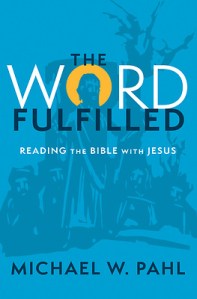
The Word Fulfilled: Reading the Bible with Jesus

How did Jesus read his Bible, and what does that mean for how we should read ours?

That’s the basic question behind The Word Fulfilled: Reading the Bible with Jesus, my latest book and my first in thirteen years. It builds on a simple idea: as Christians we are followers of Jesus, learning from his teachings and his way of life—and this should include his way of reading Scripture.

Now, anyone who knows even a little about early Judaism (Jesus’ Jewish context) will know that Jesus didn’t have a “Bible,” at least not like we do. For one thing, Jesus’ Scriptures were not the Christian Old and New Testaments, but rather the Jewish Tanakh: the Law of Moses, the Prophets, and the Writings (including the Psalms). For another, there was no book that collected all these writings of Scripture together. That kind of “Bible” was many centuries away.

I explore all this in The Word Fulfilled, along with some implications of this for how we think about our Bible as Christians. Then, I look at seven particular passages from the Jewish Scriptures which Jesus highlights in the Gospel accounts, exploring how Jesus read them. As part of this I also describe broader trends in how Jesus in the Gospels (and the New Testament as a whole) uses Scripture: his favourite biblical books, his posture in reading Scripture generally, and so on. All this has significant implications for how we should read the Bible today.

The book is written in a conversational style. I’ve deliberately avoided excessive notes. To make up for this (since it is important to “show your work”), I’ve included a “Digging Deeper” section at the end of the book which explores the historical and cultural context of Jesus and the Gospels. There’s also a study guide for those who might want to use the book for small group discussions.

This conversational style also includes what is perhaps the most distinctive feature of the book. Each of the core chapters (focusing on the seven scriptural passages) includes a vignette, a fictional story of Jesus growing up in his context, engaging with his Scriptures. These were fun to write, and they’ve been well-received when I’ve used them in preaching and teaching settings. I hope every reader enjoys these pieces of “Gospels fan faction” as much as I enjoyed writing them!

A Jesus-Centred Christianity

We’re hearing more about “Jesus-centred Christianity.” At least, I am. And I’m realizing that there are some very different understandings out there of what this means. How do I understand this? And what difference does this make?

James Tissot, The Sermon of the Beatitudes

It needs to be said up front that all Christianity is in some way “Jesus-centred.” It’s in the name, after all: “Christianity,” those who believe in Jesus, whom we hold to be the “Christ” or Messiah anticipated in the Psalms and the Prophets. Every stream of Christianity in one way or another grounds its faith and life in Jesus.

So, what I’m describing as Jesus-centred Christianity shouldn’t be taken to mean that other forms of Christianity are not in some way centred on or grounded in Jesus. They are. Rather, what I’m describing is a particular way in which Christian faith and life is centred on Jesus.

First, Jesus-centred Christianity is centred on the person and ministry of Jesus of Nazareth, primarily (but not exclusively) as presented to us in the four Gospels. Some versions of Christianity focus on Jesus’ death in a way that can feel like Jesus’ life and teaching is irrelevant. Others focus on Jesus’ teachings in a way that can feel like they are divorced from his life and death. What I’m talking about is a holistic view of Jesus: his birth, baptism, teachings, actions, suffering, death, resurrection, and promise of his return.

Second, this kind of centring on Jesus leads to some characteristic beliefs and practices. Discipleship, or intentionally learning from Jesus as presented to us in the Gospels. Being prompted and empowered by the Spirit. Shared meals, including the Lord’s Supper. Free healing. Nonviolent peacemaking. Generous simplicity. Gentle compassion. Persistent prayer. Merciful forgiveness. Humble faith. Suffering in solidarity with the powerless. Bringing resurrection life to the world. And above all, love—loving God pre-eminently by loving others as if their needs were our own.

Third, the kind of Jesus-centred Christianity I’m talking about means being radically centred on Jesus. It means not letting anything else draw attention away from this focus on Jesus. There are diverse beliefs and practices that can support this Jesus focus—a robust Trinitarian theology, for instance, or a particular way of baptizing or doing the Lord’s Supper or organizing as a church—but this approach doesn’t allow any other beliefs or practices or people or ideas to move into the centre with Jesus. It’s about a radical allegiance to Jesus and his way of being, his way of life, his way of love.

So what difference does this make? Why choose this kind of Jesus-centred Christianity over other versions of Christianity?

One key reason is the unifying power of a Jesus-centred Christianity. Often accompanying the language of “Jesus-centred Christianity” is an understanding of what’s called “centred-set” Christianity versus “bounded-set.” This language comes from mathematics via missionary anthropologist Paul Hiebert, and it’s been articulated well for Christianity and the church by scholars such as Mark Baker.

The idea is this: rather than focusing on defining and guarding the boundaries of Christianity, who’s in and who’s out—a “bounded-set” Christianity—we should focus on what draws us together toward the centre, with boundaries being irrelevant—a “centred-set” Christianity. Jesus-centred Christianity holds that Jesus, as described above, is what is at the centre, drawing us in. The result is a way of being Christian that allows for tremendous diversity in belief and practice while still recognizing a unifying, gravitational force at the centre.

Yet this Jesus-centred Christianity is not free of disagreement and dispute. There are many important and difficult questions still open for discernment. The advantage of a Jesus-centred approach, however, is that it helps us to focus the questions and narrow the possible answers. It keeps us from being distracted by the variety of ways Scripture or our culture addresses these questions—we are always forced to ask, “But what about Jesus?” and “What does a Jesus-way of approaching this look like?” And we are more likely to be able to discern together in a way that is characterized and defined by love. This is not merely theoretical—I’ve seen this difference in action.

But the primary reason for myself and many others for holding to a Jesus-centred Christianity as I’ve described it is simply that it makes the best sense to us of what authentic Christian faith and life should be. It’s what we see in the beliefs and practices of the earliest Christians as found in the New Testament—and for the first few centuries of the church, and throughout church history along the margins of Christendom. Any time there has been a revival or reformation in Christian history, it has included something more or less approximating the kind of Jesus-centred Christianity I’ve described above. That should be instructive for us.

I don’t particularly care which denomination a Christian is identified with, though I do think some denominations are more compatible with a Jesus-centred Christianity than others (cough Mennonites cough). But I do pray that we as Christians, regardless of our denomination, can re-claim a Jesus-centred Christianity that confesses with the early church: Jesus—the Christ from Nazareth who taught love, lived love, suffered and died and rose again in love—is Lord.


© Michael W. Pahl

On the Logos in John 1: God’s Spoken Message Made Flesh

John’s Gospel opens with one of the most beautiful and spectacular theological reflections in all of Scripture. Here are the well-known first few verses:

In the beginning was the Word, and the Word was with God, and the Word was God. He was in the beginning with God. All things came into being through him, and without him not one thing came into being. What has come into being in him was life, and the life was the light of all people. The light shines in the darkness, and the darkness did not overtake it. (1:1-5)

Later we’re told that this Word “became flesh and lived among us” (1:14)—the Word, then, is a description of Jesus, whose story this prologue is introducing.

But what does it mean to describe Jesus as “the Word” (λόγος)? Here’s but a partial glance at this profound description of Jesus. This summary is more technical than most of what I put on my blog—if it’s all Greek to you, just skip it and pretend you never saw it.

First, let’s talk about Old Testament background. Divine word language in the Hebrew Bible has two main specific referents: 1) the Torah or its specific commands as “word(s) (of God/the Lord)”; and 2) individual prophetic oracles as “word (of God/the Lord).” There are also some more general references to a variety of ways in which God speaks “word(s),” most significantly God’s creative/life-giving “word.”

All of these carry with them the idea of “word” (דָּבָר) as a “spoken message”; in some way, God is conceived as speaking out these messages, and they have effect. This relates very strongly, by the way, to the Hebrew conception of obedience as “hearing (the voice)”: if we well and truly hear God’s spoken message, we will obey. Which holds true, incidentally, even with God’s creative/life-giving “word”; God speaks light and life and the creation obeys. This connection of  דָּבָר with orality is likely still present even in other uses of דָּבָר, such as when it simply means a “thing” or a “matter.”

Second, let’s talk about New Testament context. While the OT ideas carry on to some degree, divine word language in the NT—“word (of God/the Lord),” or even “word of (some divine characteristic like ‘grace’ or ‘truth’)”—has one predominant referent: the gospel about Jesus proclaimed orally by the apostles. Again, this carries with it the idea of “word” (usually λόγος but also ῥῆμα, following the interchangeability of these in the Old Greek/LXX translation of דָּבָר,) as a spoken message. And, as with the OT, there’s an element of orality present in pretty much all of the uses of λόγος (and even ῥῆμα) in the NT.

This dominant Scriptural background and context makes it most likely that John 1 uses “word” (λόγος) in the same way: as a divine “spoken message.” This is supported by the echoes of uses of divine word language in the Hebrew Bible, especially allusions to Genesis 1 in John 1:1-4 (cf. God’s creative/life-giving “word” above) and the explicit contrast/comparison with the Torah in John 1:17 (cf, God’s command(s) as “word(s)” above).

This is further supported by the use of λόγος throughout John’s Gospel. If λόγος in John 1 refers to Hellenistic philosophical concepts, such as the Stoic λόγος as the fundamental principle of the cosmos or the Neo-Platonic λόγος as the force which gives matter shape and life, it is very odd that the rest of the Gospel makes no further allusions to these—or at least no clear and indisputable allusions. Instead, it uses divine word language in all the ways noted above, following Hebrew Bible and other early Christian usage.

But isn’t there some resonance with Proverbs’ wisdom hymn (8:22-31)? I think that’s likely. But a direct correspondence with the λόγος in John 1 has a problem: if John’s primary referent for λόγος is Proverbs’ Wisdom, why doesn’t he use σοφία instead? That’s the Old Greek/LXX’s translation of Proverbs’ חָכְמָה, after all. “In the beginning was Wisdom” would make that connection explicit.

The typical solution to this problem is to say that John gets at Proverbs’ wisdom through Hellenistic philosophy: Proverbs’ wisdom got connected in Hellenistic Judaism to Stoicism’s or Neo-Platonism’s λόγος, and John gets his λόγος from Stoicism or Neo-Platonism, with Proverbs’ wisdom thrown in. However, this has problems, especially the one noted above, that no further echoes of a Greek philosophical λόγος can be easily detected in the rest of the Gospel (not to mention the fact that Neo-Platonism, if that’s the perceived background, didn’t emerge for another two centuries).

A related solution to this problem is to invoke Philo of Alexandria, a Jew around Jesus’ time who did try to bring together Judaism and Greek philosophy. Philo makes the connection between the “spirit of God” in Genesis 1:2 and a kind of Platonic understanding of the λόγος. However, this still doesn’t get at the connection with Proverbs’ wisdom. Also, it has the same problem as the general Hellenistic influence theory above: the lack of usage of λόγος in these ways through the rest of John’s Gospel.

A much better way of getting around this problem is a simpler and more direct one: John himself (or someone else in early Judaism/Christianity) did some similar creative work to Philo but in a different direction, making the connection between Proverbs’ wisdom and the Hebrew Bible’s divine word, probably through the link of creation. Proverbs 8 refers to wisdom’s role in creation; λόγος can refer to God’s creative/life-giving word; therefore these can be linked. No Stoicism or Philo required.

By the way, I don’t hold to some notion of a “pure first-century Judaism” that was not Hellenized; all early Judaism was Hellenized to a greater or lesser degree. But that’s the thing: the Hellenization of early Judaism was a bit of a messy spectrum, with various kinds and degrees of influence of Greek culture and thought on early Jewish culture and thought. And I just don’t see a high degree of Hellenistic influence in John’s Gospel (contra Bultmann, who saw it in every nook and cranny).

What’s the upshot of all this? The divine word in John 1, the λόγος, is God’s spoken message, God’s creative and life-giving message, God’s commanding message, God’s prophetic message, God’s good-news message, spoken in the past through the prophets but now spoken pre-eminently through a Son—even made flesh in this beloved Son, Jesus of Nazareth.


© Michael W. Pahl

I’m fully affirming. How can I support non-affirming churches?

I get this question a lot.

I am fully affirming of LGBTQ+ people and support equal marriage. That’s no secret. I made a video describing my “conversion” on this (it’s soooo 2020 🙄, but still gets at the essence of my thinking on this), and this video has made the rounds in Mennonite Church circles. (I’ve learned not to be surprised when I’m in another province and someone comes up to me and says, “Thank you for that video…”)

However, in my role as executive minister of a regional church denomination, most of the congregations I serve are not affirming, and many of those may never become affirming.

And so, very understandably, people ask the question: “You’re fully affirming. How can you support non-affirming churches?” In a surprising show of unity, it’s a question I get asked by people on both “sides”—for different reasons, of course. So here’s my attempt to describe how I hold these seemingly contradictory things together.

Here’s a strong personal conviction of mine: affirming queer people and supporting equal marriage is a faithful expression of the gospel of Jesus Christ. In fact, I would say it more strongly: I think this is a more faithful expression of the gospel than a non-affirming view. For reasons why I think this, you can check out that dated video (or the accompanying written materials).

However, here’s another strong personal conviction of mine: congregations need to discern together how they are going to faithfully live out the gospel of Jesus Christ in their context. That’s a congregational prerogative and responsibility—and it’s not up to the denomination to determine.

In our polity, congregations come together voluntarily to create regional churches, covenanting together to support each other and do wider ministry together. Yes, we come together around some common values—especially Anabaptist values such as centering on Jesus, nurturing community, and working toward peace—but how these core values get worked out locally is up to each congregation to discern together.

Congregational autonomy and discernment is not just something stated in our denominational constitution which I must follow, though that is true; it is also a strong conviction of mine. It’s not difficult for me to allow congregations to discern differently than I would about how they should live out the gospel in their context; it’s to be expected, since I don’t live in their context.

Let me share another strong personal conviction of mine, however: while I don’t expect congregations to discern in alignment with my own convictions around queer affirmation and inclusion, I do expect congregations to strive to show Jesus’ love for all who are marginalized and mistreated—and this so often includes LGBTQ+ people. Jesus’ way of love is an open-hearted, open-handed, open-armed self-giving for the good of the other, for the good of all—and this includes our queer siblings in Christ and neighbours in the world.

This means that regardless of what a congregation discerns about whether queer folks can become members or Sunday school teachers or pastors, or whether they will marry two people of the same biological sex, I will always exhort our congregations to treat LGBTQ+ people among them and around them with humility, grace, and compassion. I will call on our congregations to speak of queer people with respect and empathy, and to offer as much welcome and inclusion of LGBTQ+ people as their communally discerned “position” allows. (As an aside, a congregation formally adopting an affirming position is no guarantee that they will actually treat queer people any differently. My comments here truly apply to all our congregations.)

I fully realize that, for many queer Christians and allies, this is not enough. They believe affirmation is a direct expression of the gospel, and not simply a matter for congregational discernment. They believe this is a matter of justice, that we must push through the injustice of this inequality and aim for full affirmation and inclusion. I get that, and I often feel the frustration.

But the reality is that I cannot force congregations to become affirming even if I wanted to (see above), and, even if I could, not every congregation would become affirming. And in every one of these congregations, LGBTQ+ Christians would continue to worship and fellowship and serve, remaining in non-affirming churches for a variety of personal reasons. My desire to see these flesh-and-blood siblings in Christ treated with as much compassion and care as possible outweighs my desire for a general justice—especially when there are affirming church options among us for those who need them.

The upshot of all this is that in my role as executive minister in service of the church, I can and do in good conscience support each of our congregations, regardless of their discernment around LGBTQ+ affirmation and inclusion. Regardless of the church, regardless of the need, I come to the congregation with open hands and an open heart, ready to support them as they seek to follow Jesus in their community.

And regardless of the church, regardless of their discerned position on queer affirmation and inclusion, I will always push for us to grow in our Christlike love—open-hearted, open-handed, open-armed, self-giving love—for all those among us and around us, especially those often mistreated and marginalized, including our queer siblings and neighbours.


© Michael W. Pahl

A Tale of Two Funerals

“There was a rich man who was dressed in purple and fine linen and who feasted sumptuously every day. And at his gate lay a poor man named Jack, covered with sores, who longed to satisfy his hunger with what fell from the rich man’s table; even the dogs would come and lick his sores. The poor man died and was carried away by the angels to be with Abraham. The rich man also died and was buried…”

Okay, my story is more complicated than Jesus’ tale of The Rich Man and Lazarus. For one thing, in my story, a story that actually happened, the rich man has a name. His name was Phil.

And, while Phil was indeed a rich man, he didn’t live in luxury—at least not by modern standards of wealth. Sure, he had a nice home, and the family did go on regular vacations to warmer climes. But nothing excessive. Nothing beyond an idealized Canadian middle class lifestyle.

Another difference between Jesus’ story and mine: Jack didn’t live at Phil’s gate. If he had, I’m quite sure Phil would have helped him out. Phil was that kind of guy: wealthy, yes, but generous with his wealth, and kind to everyone. Including—maybe even especially—those who were down and out.

No, Jack lived in another city. He was Inuit, an Inuk from Rankin Inlet, now living in Winnipeg. Living on the street in Winnipeg. Not covered with sores, as far as I know, but certainly poor. Certainly among the down and out, a world away from Phil.

In my story, a story that actually happened, the rich man and the poor man did indeed die within a few hours of each other—and their deaths were as different as their lives.

Phil died in his mid-80s after a lengthy illness, surrounded by his family.

Hundreds of people attended his funeral, including dozens of family members. It was a wonderful service, honouring a kind and generous man, a man of deep Christian faith. We sang and prayed and were bathed in glorious music—Phil was a lover of music, a patron of education and the arts. While most there were not nearly as wealthy as Phil, rumour suggested some were even wealthier than he was. Everyone there certainly seemed to be well-fed. I’m quite sure they all had slept in a warm bed the night before.

Jack, in his mid-40s, was murdered. On the street. Alone. In the middle of the night.

It happened in the alley outside our church. We held a memorial service at the church, where maybe a dozen of Jack’s friends from the street joined a couple dozen church members. We sang and prayed and lit candles in the church basement, where Jack had often come Sunday mornings for coffee and conversation. Jack, too, was kind to everyone—the tributes were as consistent as Phil’s. We then scattered flower petals down the back alley where Jack had died, defiantly reclaiming the space from violence, reclaiming it for love.

I said Jack died alone. That’s not actually true. Someone had found him; paramedics had taken him to the hospital. Like the Lazarus of Jesus’ story, there were angels with Jack when he died. I’m convinced he, too, was carried to Abraham’s side.

Jack shared in our prayer time at church not that long ago. His life had been hard long before he met the streets of Winnipeg. He had been taken to a church-run residential school as a child, robbed of his connection to his family and his culture. Yet in his twenties, despite this childhood introduction to Christianity’s God, he had experienced a vision: Jesus came to him, and filled him with such a profound sense of love that Jack’s faith was well-anchored through all the hardships that would come. This was what he shared with us that Sunday morning.

What’s the moral of this Tale of Two Funerals, my story of The Rich Man and Jack?

Jesus’ story might be simpler to decipher, and his stories are not known for their straightforwardness. “If people won’t listen to Moses and the Prophets,” Jesus says at the end of his tale, “neither will they be convinced even if someone rises from the dead.” That’s one lesson of Jesus’ story: not even a resurrection—of a Lazarus, or of Jesus—would convince some people of the need to care for the poor at their gates when they already have the Torah and the Prophets and refuse to heed their words.

My story is more complicated. Because Phil the rich man would surely have cared for Jack the poor man if he had known him. He would have given him a helping hand up, maybe even a job in his company. Maybe Jack would have become like the man I met after Phil’s funeral over raisin buns and farmer sausage, coming up on 40 years working at Phil’s company, well-cared for by a generous employer.

And yet, despite the presence of Phils in this world, there are still too many Jacks.

I suppose that’s the lesson for us. That’s the moral of this tragic tale. The problems of poverty and homelessness, of systemic racism and violence and more, cannot be solved by having more Phils in the world. There are not enough Phils to go around, and there are far too many Jacks.

These collective problems—which stem from our sins as surely as individual acts of greed and lust and violence—require collective solutions. And not just church solutions, but societal solutions. Which means they require all of us coming together—churches, community groups, corporations, governments (a.k.a. our taxes), First Nations, wealthy patrons, society’s impoverished, the comfortable middle-class—all coming together to address these collective problems, to find collective solutions.

Because we might not all be a rich man, ignoring the poor man at our gate. But collectively we are rich, and our community gates are filled with Jacks—and Jackies, and Janes, and Jonases, all of them as Jesus, if we have eyes to see him.


© Michael W. Pahl

Let’s Talk About Hell

Recently I posted the following on social media:

I’m a Christian, a follower of Jesus. Of course I believe in hell.

But do I believe in a post-mortem lake of fire where people are tortured eternally for not believing the right things? Absolutely not. That’s utterly unchristian and foreign to the way of Jesus.

But I was being tricksy.

I was intentionally trying to get a reaction from both the “fundamentalists” and the “progressives.” Christian fundamentalists, of course, believe exactly what I deny in the second part, and they think this belief is the historically orthodox, biblical, properly Christian understanding of hell (it isn’t). And Christian progressives—or at least the most progressive of progressives—don’t believe in any kind of hell at all. Some ultra-progressives don’t even have any place for sin in their theological framework.

But it’s really hard to be a “follower of Jesus” in any meaningful way and deny the reality of hell. After all, Jesus talks about it quite a bit in the Gospels, mostly as gehenna, and given the location of that concept historically—and even geographically—it’s quite likely this memory accurately reflects the historical Jesus of Nazareth.

This is not hell.

But there’s also nothing in Jesus’ teaching in the Gospels that supports the idea that God sends people to a place of eternal torture because they don’t believe the right things about Jesus or God or salvation. In spite of the prooftexts that some might trot out.

So what do I think about hell? A few thoughts.

First, for Jesus in the Gospels, “hell” is pretty consistently for those who abuse their power by harming those who have less power.

A few examples:

“If your right eye causes you to sin, tear it out and throw it away; it is better for you to lose one of your members than for your whole body to be thrown into hell. And if your right hand causes you to sin, cut it off and throw it away; it is better for you to lose one of your members than for your whole body to go into hell” (Matt 5:28-29).

This ⬆️ is for men who lust after women—in a patriarchal culture where men have power over women and women have little power over men. It’s telling, then, that Jesus doesn’t command women to “dress modestly”; rather, he calls out men for their objectification and sexualization of women’s bodies.

“If your hand or your foot causes you to sin, cut it off and throw it away; it is better for you to enter life maimed or lame than to have two hands or two feet and to be thrown into the eternal fire. And if your eye causes you to sin, tear it out and throw it away; it is better for you to enter life with one eye than to have two eyes and to be thrown into the hell of fire” (Matt 18-8-9).

This ⬆️ is for those who cause children to “stumble”—probably at least a reference to keeping children from coming to Jesus, though possibly a more sinister reference to child abuse. Either way, it’s an abuse of power over those without power, again in a patriarchal culture where men were at the top of the heap and children among those at the bottom.

“The rich man also died and was buried. In hell, where he was being tormented, he lifted up his eyes and saw Abraham far away with Lazarus by his side” (Luke 16:23).

This ⬆️ is Jesus’ story of the rich man and Lazarus—and the rich man is in hell (here “Hades,” the realm of the dead) because he had refused to help the poor man at his gates. “Woe to you rich,” Jesus has already warned in Luke’s Gospel, “for you have received your consolation. Who to you who are full now, for you will be hungry.” (6:24-25).

“Then he will answer them, ‘Truly I tell you, just as you did not do it to one of the least of these, you did not do it to me.’ And these will go away into eternal punishment but the righteous into eternal life” (Matt 25:45-46).

This ⬆️ is Jesus’ story of the sheep and the goats—and the “goats” who go to “eternal punishment” are those who have the means to care for the poor, the stranger, the sick, and the imprisoned, and yet they refuse to do so.

You get the idea.

Second, for Jesus in the Gospels, “hell” is most often a translation of the word gehenna—and for those instances where that’s not the case, the idea of gehenna is probably not far away.

I’ve got a separate blog post on this, but here’s the executive summary.

Gehenna is a reference to the Valley of Hinnom, a literal valley on the south side of Old Jerusalem. It was the place where, at particularly horrible times in ancient Israel, children were burned in sacrifice to other gods—epitomizing the depths of injustice present in Israelite society at the time. These “fires of gehenna” were not lit by God but by people with power pursuing idolatry and injustice. Yet God warned that one day this valley would burn with the corpses of these violent powers-that-be, when the Babylonian empire came a-conquering. And so gehenna came to be a symbol of God “turning the tables” on abusers of power, abusers of the powerless.

Are you seeing a theme?

This is also not hell.

Third, for Jesus in the Gospels, even this “hell-as-gehenna, as a just punishment for abusers of power over others” probably involves some good ol’-fashioned symbolism and hyperbole.

As a teacher of wisdom, Jesus was not averse to hyperbole. Right in the context of the first example above you’ve got exaggeration for effect: eyes being gouged out and hands being cut off. And as an apocalyptic prophet, he was not averse to apocalyptic-prophetic imagery, which was highly symbolic. Beasts are not literal beasts, multiple heads are not literal heads, and “eternal fires of hell” are neither literal fires, nor literally without end.

Don’t misunderstand: neither hyperbole nor symbolism mean that the thing they are describing is “not real” or “not true.” Rather, they are telling the truth, but telling it slant, to borrow from Emily Dickinson.

The hyperbole and vivid imagery catch your attention. They tell you, “This is important, listen up!” They point to some very real truths—in this case how much God hates it when people abuse their power and harm those under their power, and that one day these abusers will face the consequences. But it’s not in a literal lake of fire, being eternally tormented.

I would say that, generally, this understanding of “hell” holds true for later, similar descriptions of “hell” in the New Testament, where the word gehenna is not directly used. Regardless, this is what “hell” meant for Jesus.

So yes, as a follower of Jesus I believe in hell. And, like Jesus, I say woe to you who are abusing your wealth and power, causing harm to those without wealth and power—you’ve got a hellish time coming your way, whatever that might look like. For the sake of those you are harming—and your own sake—turn from your wicked ways, make restitution to those you have harmed, and follow Jesus in his way of love.


© Michael W. Pahl

What is Christian nationalism? And why is it a problem?

There’s a lot of discussion about Christian nationalism these days, and a lot of people are unsure what to make of it, or even what Christian nationalism (CN) is. Some thoughts on what it is and why it’s a problem…

Let’s start with “nationalism.” Encyclopaedia Britannica gets it nicely: “Nationalism is an ideology that emphasizes loyalty, devotion, or allegiance to a nation or nation-state and holds that such obligations outweigh other individual or group interests.” Nationalism is not just patriotism; it’s an elevation of the nation-state to a place of high allegiance, often with a sense of the nation’s superiority over others.

“Christian” nationalism adds the expectation that the nation reflect specific values deemed to be Christian, in its constitution, laws, policies, and so on. Typically it means that these things should be based on biblical laws or teachings, especially the Ten Commandments.

Christian nationalism thus holds the expectation that Christianity be privileged in some way by the state, perhaps even adopted as the state religion. In more extreme forms, CN includes ideas like requiring high-ranking government officials to be Christian or expecting immigrants to adopt Christianity.

If this is hard to imagine, just replace “Christian” with “Islamic” or “Jewish,” and imagine Islamic or Jewish nationalism as the guiding ideology for a nation-state.

So much for what it is. What’s wrong with it? Well, there are several problems with nationalism generally and Christian nationalism in particular. Here are a few…

First, nationalism’s elevation of the nation-state and the sense of the nation’s superiority can lead to interventionist, even expansionist, policies, resulting in increased violence world-wide and (ironically) less security at home.

Now, nationalism is an inherently isolationist ideology. It sees “globalism”—nation-states working together in a way that is perceived to erase national identities—as a threat. However, nationalism can become expansionist. The nation can seek to impose its values on other nations through cultural, economic, military, or other means. This is when nationalism becomes imperialism. Think 400 years of colonization by western European nation-states. Or Russian expansionism now in Ukraine. Or most US foreign policy since WWII.

Second, when this nationalism conflates the nation-state with a particular person, you get cult-like authoritarian regimes, even under the guise of “democracy.” Think Nazi Germany, or Putin’s Russia, or MAGA America. Combine with the previous, and you get war. Even world wars.

Third, an obvious problem with Christian nationalism is this: which Christianity? Inevitably it is a conservative version, mirroring nationalism’s expectation of allegiance and its sense of superiority. Literalist in its reading of Scripture and fundamentalist in its outlook.

And white. And patriarchal. This also needs to be said: Christian nationalism is a white, patriarchalist movement. It’s an attempt to re-create a lost society, a golden era of 1950s white, “family values” suburbia. Think “Leave it to Beaver,” but with more overt Christianity.

But this is only one slice of Christianity, and a relatively recent one at that. Christianity originated on the margins; anything like Christian nationalism was unthinkable for its first 300 years. The “kingdom” Jesus envisioned is “not of this world”: it’s not a political entity, a nation-state.

And the Christianity that grew from Jesus wasn’t white, and it wasn’t patriarchal. Following Jesus’ way, early Christianity was intercultural and egalitarian, sometimes even radically so.

Finally, Christian nationalism seeks to impose religious values on others who do not share those values, even requiring them to live contrary to their own religious (or non-religious) values. Which, of course, is a problem if the nation is striving to be a democracy.

Note: the problem is not having different values, or seeking to persuade others to share one’s values, or even seeking to establish laws for the common good on the basis of one’s values. All this is fundamental to democracy.

The problem is not even that sometimes we have to agree to things deemed to be for the common good which go against our personal values. Again, democracy. Or just, “living together.”

No, the problem is the imposition of one’s values on others, requiring them through a use of power to abide by or even adopt those values themselves, and especially without striving through dialogue, debate, and compromise to determine a “common good.” This is not democracy.

This is also not many Christians’ understanding of Christianity. Jesus didn’t impose. He didn’t coerce. He didn’t use power to make people follow his way. The opposite, in fact.

Jesus gave up his power, he gave up his privilege, in order to serve others, to meet their deepest needs, to love them. This is Philippians 2. This is the Gospels. This is the gospel.

And this is authentic, historic Christianity.


© Michael W. Pahl

Why (and How) Do I Trust the Gospels?

Although I don’t believe in Scripture’s inerrancy, I do believe in its inspiration, that God “breathed into” the ancient writings that comprise the anthology we Christians call Scripture, enlivening them to make them “useful” for teaching and training us in God’s ways, the way of Jesus (2 Tim 3:15-17). And although I have spoken out against fundagelical “bibliolatry” (venerating the Bible in the place of God, acting as if the Bible and not Jesus is Lord), it is certainly true that, as I’ve also said, we need to “read the Bible to follow Jesus.”

But how do I fit this all together? If the biblical writings—and the Gospels in particular—are not inerrant, how are they reliable for teaching us about Jesus and his way?

Here’s how I make sense of this.

I agree with scholars who determine that the Gospels are a form of ancient biography (bios), along the lines of those by Suetonius or Plutarch. These bioi are similar to modern biographies in that they tell the story of a historical person of some significance. Like modern biographies, bioi rely on prior sources for the story they create: written sources, oral traditions, and personal testimony.

Of course, ancient biographers didn’t have the advantages of their modern counterparts—video and audio recordings, extensive libraries and archives, the internet. They worked with the sources they had, which often wasn’t much. Because of this, ancient biographers felt freedom to paraphrase or expand or summarize their sources, and even fill in gaps with their own creations. In fact, rhetorical education of the day provided opportunities to practice this.

Ancient biographers included fantastical elements like cosmic portents at the subject’s birth or death, or miracles performed by the person or because of their presence. Some of these may have been prompted by an actual event of some kind (not necessarily “supernatural” or “miraculous”), but these were seen as signs of the person’s significance regardless of whether or not they actually happened as described. And ancient biographers were unconcerned with an accurate order of events or even necessarily providing what we might today consider basic biographical information.

In short, an ancient bios was a story about a historical person deemed to have public significance, using prior sources but with freedom to “play with” those sources, in order to enlighten the reader about the person’s significance and encourage the reader to learn from their life and characteristic ideas.

This is the canonical Gospels. This understanding of the Gospels itself suggests that Jesus was a historical person and that the Gospels reflect a variety of sources, however much each of the Gospel authors “played with” those sources to portray Jesus in a particular way. And this in turn prompts me to read them through two different sets of lenses.

The first set of lenses is a critical historical one: I read through the Gospels (and other sources) to learn who Jesus was as a person in history.

Now, this is a whole blog post in itself (a book, really, or a set of them). But in summary, I think Jesus of Nazareth would have seen himself as a prophet, sort of a cross between Elijah/Elisha and Isaiah. More specifically, and roughly in line with a wide cross-section of historical Jesus scholars, I think that:

  • Jesus of Nazareth announced that Isaiah’s promised “reign of God” was imminent—God’s reign of true justice and lasting peace on earth, bringing flourishing life for God’s people and all creation, in contrast to the “kingdoms” of this world.
  • Jesus gathered disciples and taught them his interpretation of the Torah, focusing moral obligations around loving God pre-eminently by loving others, including neighbours, strangers, and enemies.
  • Influenced by Isaiah’s “peaceable kingdom” visions, Jesus taught and lived out a form of nonviolent resistance to evil oppressors.
  • Jesus, like Elijah and Elisha, paid special attention to the poor, widows, children, and others impoverished in power.
  • Jesus shared meals with those deemed “sinners” as well as the religiously powerful.
  • Jesus, following Elijah’s/Elisha’s footsteps, became known as a healer (whether or not these healings were miraculous, Jesus’ reputation as a healer is one thing even ancient non-Christian references to Jesus highlight).
  • At some point, Jesus began to take on a messianic mantle, presenting himself as Isaiah’s “servant” who would bring about God’s reign in its fullness (note: “messiah” does not in itself imply “deity”).
  • Jesus lived and taught these things in such a way that he was deemed an enemy of powerful people, including the Roman state, and so was crucified.

There’s more to this “Jesus as prophet” picture one gets through critical historical means, some of which is troubling (e.g. his anti-“family values” teachings) and some of which was wrong (e.g. predicting the fulfilment of God’s reign within a generation). But I do find this Jesus of Nazareth compelling—enough to read the Gospels through a second set of lenses.

This second set of lenses is a historical-theological one: I read the Gospels to learn how each of them interpreted the stories and traditions of Jesus they had inherited to understand Jesus for their own time.

This is another blog post (or book, or book series), but here are a few summary thoughts. In general, each of the Gospels emphasizes different aspects of Jesus of Nazareth, and in some respects they highlight those aspects beyond what I imagine Jesus himself would have found comfortable.

  • Mark highlights Jesus as the “messianic servant” of Isaiah, especially emphasizing Jesus’ suffering and death as critical for understanding Jesus’ messianic identity and the nature of God’s reign.
  • Matthew builds on Mark, but also highlights Jesus as the “messianic teacher” who authoritatively interprets Torah for his followers in the messianic age.
  • Luke builds on (and to an extent critiques) Mark and Matthew, but highlights Jesus as “messianic peacemaker” who shows the way of peace and brings about inclusion for the marginalized and justice for the oppressed.
  • John mostly (but not entirely) ignores Mark, Matthew, and Luke, and highlights Jesus as “divine messiah” who reveals God to the world and draws the world to God.

The Gospel authors, then, use the genre of ancient bioi to present their portraits of Jesus. They “play with” their sources—paraphrasing, expanding, summarizing, re-ordering, and embellishing them, but still relying on them—to present a particular angle on Jesus of Nazareth, to enlighten their readers about what Jesus said and did and why he is significant.

This also means the cosmic portents they describe at Jesus’ birth and death highlight Jesus as true messianic king in contrast to the line of Caesars. The healing miracles show him to be a true prophet like Elijah and Elisha. The nature miracles point to his divine mission or even, in the case of John’s Gospel, his divine origin. Whether or not those things actually happened is less important than what they signify.

Here’s the thing for me: I not only find the historical Jesus of Nazareth to be a compelling person, I find the canonical Gospels’ bioi of Jesus to be compelling interpretations of Jesus’ life and teaching and larger significance. And this—along with other factors such as my own spiritual experience—compels me to believe in Jesus as Messiah bringing about God’s reign on earth, as Lord owning our allegiance above all other powers of this world, as Saviour bringing about justice and peace and flourishing life for all, and even as God incarnate revealing God as God truly is.

Will this convince others? I don’t presume to think so. All I can say is, along with the late Rachel Held Evans, “The story of Jesus is the story I’m willing to risk being wrong about.”

———————-

There’s a massive amount of scholarly literature on the Gospels and Jesus. The following are just a few examples, including both more technical volumes and more popular works.

The classic study of the canonical Gospels as ancient biographies is Richard A. Burridge, What Are the Gospels? A Comparison with Graeco-Roman Biography (3rd ed.; Baylor University Press, 2020).

The best works on the relationship of the Gospels to each other are E. P. Sanders and Margaret Davies, Studying the Synoptic Gospels (Trinity Press, 1989); Mark Goodacre, The Synoptic Problem: A Way through the Maze (T&T Clark, 2001); Mark Goodacre, The Case Against Q: Studies in Markan Priority and the Synoptic Problem (Trinity Press, 2002); Mark Goodacre, Thomas and the Gospels: The Case for Thomas’s Familiarity with the Synoptics (Eerdmans, 2012).

Good representative works on the historical Jesus reflecting a cross-section of author backgrounds and perspectives: E. P. Sanders, Jesus and Judaism (Fortress, 1985); John P. Meier, A Marginal Jew: Rethinking the Historical Jesus (5 vols.; Doubleday, 1991-2016); E. P. Sanders, The Historical Figure of Jesus (Penguin, 1993); N. T. Wright, Jesus and the Victory of God (Fortress, 1996); Dale C. Allison, Jesus of Nazareth: Millenarian Prophet (Fortress, 1998); Bart D. Ehrman, Jesus: Apocalyptic Prophet of the New Millennium (Oxford University Press, 1999); Paula Fredriksen, Jesus of Nazareth, King of the Jews: A Jewish Life and the Emergence of Christianity (Vintage, 1999); Dale C. Allison, Constructing Jesus: Memory, Imagination, and History (Baker, 2010); N. T. Wright, Simply Jesus: A New Vision of Who He Was, What He Did, and Why He Matters (HarperOne, 2011); Anthony Le Donne, Historical Jesus: What Can We Know and How Can We Know It? (Eerdmans, 2011); Helen K. Bond, The Historical Jesus: A Guide for the Perplexed (T&T Clark, 2012).

© Michael W. Pahl

Whose side are you on?

In Joshua 5, we come across one of those wonderfully strange biblical stories that shakes our preconceptions and leaves us with more questions than answers.

Israel is encamped at Gilgal, preparing to besiege Jericho at God’s command—so they firmly believe. Suddenly Joshua sees a man whom he does not recognize standing in front of him, sword drawn.

“Whose side are you on?” Joshua asks. A reasonable question in the circumstances.

“Neither,” the man replies. “I have come as commander of God’s armies.”

Wait a second. Isn’t God on Israel’s side? God has delivered them from slavery in Egypt, covenanted with them at Sinai and led them to the Promised Land. If God is not on Israel’s side, who is?

As I write this, modern-day Israel’s armies are besieging and bombing Gaza, preparing to root out the Palestinian terrorist group Hamas. This is a response to Hamas’ horrific rampage of violence, slaughtering and kidnapping Israeli civilians. To this point, over 1,300 Israelis have been killed by Hamas. In response, over 1,500 Palestinians, nearly half of them children, have been killed by Israel.

Here in Canada we as Christians are asked, “Whose side are you on?” A reasonable question in the circumstances. How should we respond?

The way of Jesus helps guide us to an answer. In a world of complex and thorny questions, an increasingly polarized world where we are urged to take sides for and against, Jesus’ way provides the nuance we need and the moral clarity we require.

Jesus, I’m convinced, would give the same answer as the commander of God’s armies gave to Joshua—but still with a strong sense of standing with particular people. For Jesus does take a side. It’s just that the side he takes doesn’t necessarily match up with the binary choices we create.

In the Gospels, we never see Jesus taking the side of a political faction or a nation-state, certainly not one armed and ready for slaughter. Rather, Jesus is consistently on the side of people—real, living, flesh-and-blood people, especially those considered by the world to be “last” or “least” or “lost” (Jesus’ words).

Jesus stands on the side of the broken sinner, ready to repent, and offers forgiveness. Jesus stands on the side of the indebted poor, exploited by wealthy landowners, and offers good news.

Jesus stands on the side of the oppressed, occupied by a foreign power, and offers the earth. Jesus stands on the side of the sick and disabled, physically and financially dependent, and offers healing.

James Tissot, The Healing of Ten Lepers

Jesus stands on the side of the widow in her economic distress, the children ignored and powerless, the foreigner in an unfamiliar land, the leper outcast and feared by society, the humble faithful under the thumb of powerful religious leaders, the woman easily divorced by her husband to be left in shame and poverty, the insurgent hanging on a Roman cross, crying out for mercy.

In other words, Jesus consistently stands with the vulnerable-to-harm and the impoverished-in-power, those cast out and pressed down, those too easily and too often crushed and broken.

But for Jesus this does not create categories of people whom he supports (or opposes) as a block, blindly and without question. Again, Jesus stands on the side of real, living, flesh-and-blood people.

While standing with his fellow Jews under Rome’s occupation, he shows grace to a Roman centurion, healing his servant, and calls his compatriots to love their Roman enemies. While standing with the humble faithful under the thumb of some powerful religious leaders, he meets with one of these leaders by night, urging this seeker to be born again to see God’s reign of justice and peace and life.

This is the nuance we need to navigate a complex world. This is the moral clarity we require to enable us to know when, and with whom, and how to take a stand—and with whom to sit and share a meal.

We find Jesus in the “least of these”—the naked, the hungry, the stranger, the imprisoned, Israelis slaughtered by Hamas and Palestinians displaced and occupied and bombed by Israel—and there we stand, with Jesus. We see God’s image in the person right in front of us, regardless of their affiliation or allegiance, and there we sit with them, in grace.


Published in Canadian Mennonite 27, no. 21 (2023).

© Michael W. Pahl