Love will win. Love must win, or we all lose.

I was getting ready for a busy Sunday at church when I saw something on my news feed about a “shooting in Orlando.” I thought little more than “Here we go again” as I put the finishing touches on my sermon. A sermon on the Greatest Commandment, as it happens, the command to love.

At church someone mentioned it to me, saying it looked like the worst mass shooting in American history. I raised my eyebrows at this with a “Really?” and knew I’d have to check it out once the church day was done.

APTOPIX Nightclub Shooting FloridaBy the time I heard the full story it was already late afternoon. My mind was filled with Sunday school wrap-up, church picnic and races, church people’s stories and faces—and my sermon from the morning, that sermon on the Greatest Commandment, the command to love.

It’s a strange feeling, that grief you feel for someone you never knew. Especially when it’s multiplied 50 times, then multiplied again for their parents, sisters, brothers, and friends, then multiplied yet again for the injured, the traumatized, and all their kith and kin.

I was numbed into silence, this strange grief an ever-present aura even as we went about a normal Sunday evening as a family. Talking, teasing, laughing. Eating, cleaning up, singing. Playing games, watching hockey, praying. That’s what we did. And always in the back of my mind—all those families, what were they doing?

Mourning. Weeping. Consoling each other. Seeking answers. Demanding an end to all this death.

No doubt some were ashamed. Ashamed of their child, where they were found. No doubt some of these felt a pang of guilt at their flush of shame, maybe even greater guilt at the way they had treated their child, the things they had said, or left unsaid.

I can’t think of any recent tragedy this close to home visited by so many of the scourges currently plaguing humanity. Homophobia. Religious extremism. Gun violence.

When will we repent of our stark greed, our desire for power over others, our willful ignorance and fear of the other, our propensity toward violence in word and deed? We who have power and privilege—especially middle-aged, white, straight males like myself—when will we be willing to set aside our own desires and needs, to give up our own rights and privileges, to ensure a better future for all of us together?

In other words, when will we be willing to follow Jesus?

I grieve that strange grief for those I do not know, those who have died, those who have been injured, all their families and friends. But I grieve another grief as well, a grief for those touched more indirectly—yet just as truly—by this tragedy.

I grieve for LGBTQ+ persons, who have already borne the brunt of so much misunderstanding, rejection, and violence, even in places that should be safe spaces, like homes and churches. O God, may you keep them safe in the aftermath of this horrific act of hate.

Among the American Muslims to denounce the terror attack at a gay night club in Orlando was Muhammad Musri, the imam of the Islamic Society of Central Florida.I grieve for Muslims, the vast majority of whom simply want to live in peace and safety with their families and friends, able to practise their religion and work an honest living and watch their children and grandchildren grow up. O God, may you keep them safe from backlash to this horrific act of hate.

And I grieve for all humanity, sometimes even despairing for the human race, until I am reminded of God’s relentless love, and the moral universe’s long-bending arc toward justice, and the many times in human history when heaven has broken through the hell of earth, resurrection bursting out from death. O God, may your kingdom come, your will be done, your kingdom without borders, your will for justice and peace, on earth as it is in heaven.

Love will win. Love must win, or we all lose.

One of the scribes came near and heard them disputing with one another, and seeing that he answered them well, he asked him, “Which commandment is the first of all?”

Jesus answered, “The first is, ‘Hear, O Israel: the Lord our God, the Lord is one; you shall love the Lord your God with all your heart, and with all your soul, and with all your mind, and with all your strength.’ The second is this, ‘You shall love your neighbor as yourself.’ There is no other commandment greater than these.”

Then the scribe said to him, “You are right, Teacher; you have truly said that ‘he is one, and besides him there is no other’; and ‘to love him with all the heart, and with all the understanding, and with all the strength,’ and ‘to love one’s neighbor as oneself’—this is much more important than all whole burnt offerings and sacrifices.”

When Jesus saw that he answered wisely, he said to him, “You are not far from the kingdom of God.” (Mark 12:28-34)

© Michael W. Pahl

The Lord’s Prayer Fulfilled

What do we see when we read Revelation 21-22?

“Streets of gold,” “no more tears”—sounds like “heaven,” by which we mean “where we go when we die, where we will spend eternity.” But is that what’s really going on here?

What do we see in Revelation 21-22? What should we see?

In Revelation 21-22, we see the Lord’s Prayer fulfilled.

You probably know the Lord’s Prayer: “Our Father, who art in heaven. Hallowed by your name. Your kingdom come, your will be done, on earth as it is in heaven.

There it is, the overarching desire of the whole prayer. Not, “May we enter your kingdom in heaven.” But rather, “May your kingdom come on earth.” God, may you fully reign, may your will be fully realized, here on earth just as it already is in heaven, in your immediate presence.

That’s the goal of all things: God’s kingdom coming on earth, God reigning over all things on earth, God’s good desires for all things being brought about on earth.

Put another way: God does not want to take us from earth to heaven; God wants to bring heaven down to earth.

And this is in fact what we find in Revelation 21—here are the opening verses:

Then I saw a new heaven and a new earth; for the first heaven and the first earth had passed away, and the sea was no more. And I saw the holy city, the new Jerusalem, coming down out of heaven from God, prepared as a bride adorned for her husband. And I heard a loud voice from the throne saying, “See, the home of God is among mortals. He will dwell with them; they will be his peoples, and God himself will be with them.

In Revelation 21 and 22, we see God dwelling among us on earth, God’s immediate presence among us on earth.

In other words, we see heaven come down to earth. We see God’s kingdom come on earth.

We see the Lord’s Prayer fulfilled.

In Revelation 21-22, we see God’s people beatified.

Okay, that word might seem a little strange—but I use it intentionally. The word “beatitude” means “divine blessing,” and it’s usually associated with the eternal blessing of God’s people in God’s glorious presence.

Elder 2And this vision of Revelation is loaded with language and imagery that points to the people of God in the presence of God.

The new Jerusalem, the city of God come down from heaven, is described as “the bride, the wife of the Lamb.” It is prepared as a bride on her wedding day, arrayed in beautiful gems and sparkling jewels and glittering gold.

The bride of Christ? This should be enough of a clue what’s going on.

But then we’re told that the city has 12 gates named for the 12 tribes of Israel; its wall has 12 foundations named for the 12 apostles of Christ.

All Israel and the whole Church represented? That clinches it.

The city is not a literal city. The city is not where God’s people live—the city itself is God’s people, Jews and Gentiles together united with Christ.

There is no temple among God’s people, no special place where God meets with them—because God dwells among all of them, among all people on earth. God is immediately present among God’s people, God’s glory shining like a light for all the earth.

And God’s people “will see God’s face,” Revelation 22 says. Think of that: throughout Scripture we’re told we cannot see God’s face, at most we can catch glimpses of God, until Jesus comes and we see the face of God in Jesus. And here, in this new creation, God’s people see God’s face—they are eternally blessed by God in God’s glorious presence. They are “beatified.”

But there’s another reason I use the word “beatified” to describe what’s going on here. I want to recall the “Beatitudes”—Jesus’ specific promises of divine blessing in the Sermon on the Mount. Here at the end of Revelation, we see God’s people “beatified”—experiencing the fulfillment of those Beatitude promises.

Those who were lowly and poor in spirit—God’s kingdom is now theirs.

Those who mourned—they are now comforted.

Those who were meek—they have now inherited the earth.

Those who hungered and thirsted for justice—they are now eating and drinking their fill of it.

Those who were pure in heart—they are now seeing God.

Those who were peacemakers—they are now pronounced God’s children.

Those who were persecuted and oppressed and unjustly treated for the sake of justice—God’s kingdom is now theirs.

In Revelation 21 and 22, we see God eternally blessing God’s people in God’s glorious presence.

In other words, we see all wrongs made right, all injustices overturned, all oppression ceasing, all who have yearned for God’s kingdom being finally and fully satisfied in the immediate presence of God.

We see God’s people beatified.

In Revelation 21-22, we see the nations of the earth healed.

After the people of God are described as this beautiful city, with God’s glorious presence immediately among them, we hear these words:

The nations will walk by its light, and the kings of the earth will bring their glory into it. Its gates will never be shut by day—and there will be no night there. People will bring into it the glory and the honor of the nations.

“Nations” here doesn’t mean “nation states,” but more “peoples,” “tribes,” all the different ethnic groups of the world with their distinctive languages and cultures. In this new creation, the “nations,” all the “peoples of the earth,” live by the light of God and the Lamb. In this new creation, the peoples of the earth bring their glory and honour into the city of God—the cultural riches of all peoples are woven into the life of God’s people.

And so the nations of the earth are healed.

Listen to the way Revelation 22 starts:

Then the angel showed me the river of the water of life, bright as crystal, flowing from the throne of God and of the Lamb through the middle of the street of the city. On either side of the river is the tree of life with its twelve kinds of fruit, producing its fruit each month; and the leaves of the tree are for the healing of the nations.

Lion-Lamb 2The tree of life hasn’t been seen since the city was a garden, back at creation, in Genesis 2-3. There humans were banned from eating of the tree of life because of their sin. But here again, in this new creation, the tree of life is accessible once more—and its leaves are for the healing of the nations.

In Revelation 21 and 22, we see God dwelling gloriously among God’s people—yet this is not just for our benefit. It is for the benefit of all peoples of the earth, who are made whole by the tree of life sustained by the waters of life.

In other words, we see justice and peace and flourishing life for all the peoples of the earth, every tribe and language, from Anishinaabe to Chokwe to Faroese to Han to Kurds to Maori to Tatars to Zhuang—and everyone in between.

We see the nations of the earth healed.

In Revelation 21-22, we see all creation renewed.

Revelation 21 opens with the vision of a “new heavens and earth,” a brand new creation. The “first heaven and earth” are no more—the world saturated by human sin, the world permeated with powers that be gone wrong, that world is gone. Creation needs a new start, a new beginning.

In this new world, Revelation 21 says, “Death will be no more; mourning and crying and pain will be no more, for the first things have passed away.” In a nutshell: “There will be no more curse.” All the harms we inflict on one another, on ourselves, on our world, all the devastating consequences of our human sin and evil—all this will be done away with.

“Behold,” God says, reigning from the throne, “I am making all things new.”

All things. Humans and nations, persons and peoples. But also rivers, lakes, and streams. Oceans and seas. Mountains and trees and valleys. Fish and fowl, flora and fauna. All renewed, entire ecosystems cleansed from the tragic effects of our human selfishness, pride, and greed.

All creation, made whole again.

What a vision! This is so much more than “where we go when we die, where we will spend eternity.”

This is a vision of heaven come down to earth, God’s kingdom come on earth, the Lord’s Prayer fulfilled.

This is a vision of God’s people eternally blessed in God’s glorious presence, God’s people beatified.

This is a vision of all peoples experiencing justice and peace and flourishing life, the nations of the earth healed.

This is a vision of all creation made new, restored to glow with the glory of God.

And as Revelation 1:19 promised, this is a vision of both the present and the future, both “what is now, and what will be.”

What is now—because, as Jesus says, “The kingdom of God is among you.”
What is now—because, as Paul says, “If anyone is in Christ, there is a new creation.”
What is now—here, right now, heaven can come to earth if we seek it, if we let it.

What will be—because, as Jesus teaches, we continue to pray, “May your kingdom come on earth as it is in heaven.”
What will be—because, as Paul teaches, we groan along with all creation, along with God’s Spirit, for creation’s full liberation and our complete redemption.
What will be—when Jesus comes to finish what he started, to renew all things.

May God give us the strong assurance that we will always be with the Lord, both in life and in death. May there be no doubt about that.

But may God give us an equally strong assurance, an assurance of faith that gives birth to the yearning of hope, that God is at work even now to bring about God’s new creation, God’s reign of justice and peace and flourishing life, heaven come down to earth.

“The one who testifies to these things”—Jesus the Alpha and the Omega, the beginning and the end, the end which is a new beginning—“The one who testifies to all these things says, ‘Surely I am coming soon.’ Amen. Come, Lord Jesus!”


All images are from a mandala of Revelation 4-5 created by Margie Hildebrand.

© Michael W. Pahl

Why Worship? Why Worship Together?

It’s Sunday morning, and we gather together as Christians to worship God.

The specific experiences are as varied as the number of churches, but most worship services have a few things in common.

We sing together—sometimes off-key, sometimes hymns too slowly, sometimes choruses too repetitively, too repetitively, too repetitively.

We pray together—sometimes faltering, sometimes mumbling, sometimes with too little genuine feeling, sometimes with too much “Lord, we just, Lord, want to just ask, Lord…”

We break bread together—not all of us every Sunday, not always in a ritual, sometimes with too little ritual.

We read Scripture and reflect on it together—sometimes with poor exegesis, sometimes with too little Jesus, sometimes going past noon with dinner waiting in the crockpot.

Why exactly do we do all these things, worshiping in these and other ways Sunday morning after Sunday morning? And is this “worship” really all that important?

Revelation 4-5 speaks directly to these kinds of questions—and gives us some surprising and challenging answers.

Let’s start with the big picture, stating the obvious: Revelation 4-5 is all about worship. (That much at least everyone can agree on.)

But notice where this vision is in the book of Revelation. Revelation 1 is introduction, setting up the rest of the book. Revelation 2-3 are specific letters to the seven specific churches Revelation is written to—in a sense still introduction, setting the stage for the main act. And then we hit Revelation 4-5—the first major vision John sees, determining the course of everything else that follows.

The first major vision at the heart of the book—and it’s all about worship.

This tells us that worshiping God is an essential activity. And not just worshiping God individually—worshiping God collectively, gathering together with others in worship, is essential. It grounds our way of life. It sets the tone for everything else.

But why is this? And how exactly does this work?

Let’s focus in on some of the details of this vision.

At the centre of it all, the object of all this worship, is God, seated on his heavenly throne, ruler over all creation. God, the Indescribable One, only imagined in colours and light.

Elder 2Four “living creatures” are immediately around the throne, one on each side: a lion, an ox, a human being, and a flying eagle. These represent all living things—later they are heard saying “Amen” to the declaration of “every creature in heaven and on earth and under the earth and on the sea, and all that is in them” (that’s pretty comprehensive). All creatures of our God and king, giving honour and praise to God.

Twenty-four “elders” surround them, seated on thrones, dressed in white robes with golden crowns on their head. These represent all God’s people, the twelve tribes of Israel and the twelve apostles of Christ—as we hear later when the twelve tribes and twelve apostles are brought together in the gates and foundations of the New Jerusalem. All God’s people, bowing in reverence to God, singing God’s praises.

All creation, all God’s people, from the beginning of the world until its end, worshiping God.

So here’s one answer to our question of “why worship God”: Our collective worship is a participation in something fundamental to all creation, something that all creation is intrinsically engaged in.

The birds of the air, the flowers of the field—they honour their Creator simply by being what God created them to be, doing what God created them to do. Simply by being as God made them to be, existing as God made them to exist, all living things worship God.

Likewise, humans honour our Creator simply by being the way God made us to be, living the way God made us to live. We glorify God in our humanness, by being fully human. Simply by being as God made us to be, existing as God made us to exist, we worship God.

This ceaseless praise of God is intrinsic to creation; it is the very grain of the universe.

And so we are encouraged to see our worship together as a participation in this eternal, ceaseless worship of God by all creation and all God’s people. We are encouraged to see our worship together as giving voice to this never-ending, underlying rhythm of worship that is happening all around us.

But there’s more.

As we keep moving through this vision in Revelation 4-5, we hear some very specific declarations of praise. As the elders and living creatures give voice to the worship of all creation, their voice says some specific things.

God is holy. God is other. God is unlike any other. God is unique.

God is almighty. God is the source of all true power, power that creates and gives life.

God is eternal. God was. God is. God will be.

God is Creator. All that is, is because God is.

God is Redeemer. All that is good, is good because God loves.

Elder 1Here, then, is a second answer to our question of “why worship God”: Our collective worship is worldview-shaping, crafting the lenses through which we see our world and understand our place in it.

Good worship—worship in both spirit and in truth—is instructive. It teaches us; we learn from it.

Through our worship together we understand God’s role in the world as Creator and Redeemer. All things exist because God is. And although there is hurt and brokenness in our world, and in ourselves, all things can be redeemed because God loves. We learn this in part through our worship together.

Through our worship together we understand the world as God’s beloved creation. God does not hate us. God does not despise the work of his hands. God loves all creation, and imbues it with his grace and glory. We learn this in part through our worship together.

And through our worship together we understand our role as redeemed priest-kings and priestess-queens extending God’s reign throughout the earth. God calls us as God’s people to a particular task, a particular way of being in the world. God calls us to faith, to hope, to love. We learn this in part through our worship together.

Revelation 4-5 gives us a third answer to the question of “why worship God,” and it’s the most surprising one of all: Our collective worship is a profoundly political act; it is a powerful statement about how we should order our lives as human societies.

It’s all too easy for us to pass over the significance of the “throne.” For us, thrones are something from ancient times or fairy tales, or from the Bible. Of course God sits on a throne! God is king, after all!

But when was the last time you saw a king or a queen or an emperor or empress actually sitting on a throne, wielding some real power?

The “throne” doesn’t really mean much to us. But no one in the time of Revelation would miss the significance: the throne was a thoroughly political symbol, even the most potent political symbol one could use. And, in a world filled with absolute claims to absolute power, it was also about as subversive as you could get.

“Worship” is about “ascribing worth”; it is about declaring value. Worship is an expression of devotion and commitment, an expression of allegiance. When we come together and “worship God,” then, we are declaring our allegiance to God above all other claims to power and authority in the world.

But this vision is even more politically subversive than that.

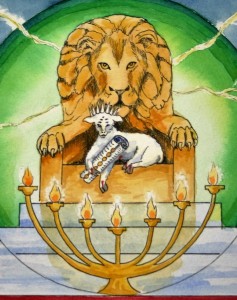
Lion-Lamb 2In Revelation 5 we see a scroll, and we’re told that “no one can open the scroll”—no one in heaven or on earth or even under the earth, no creature, no human being, no human ruler, no angelic being. It’s not clear what the scroll represents—the title deed to the universe, perhaps, or the unfolding of human history. Either way, it’s the kind of thing that any good Roman would expect the emperor to rightfully possess and be able to open at will.

Yet it is the “Lion of the tribe of Judah” who alone can open it—Israel’s Messiah, Israel’s promised king from the tribe of Judah, descendant of king David. This is as any Jew in Revelation’s day would expect—but there’s another twist.

The “lion” is in fact a “lamb,” a “lamb who has been slaughtered.” The Messiah, Israel’s king, has not gained the right to rule by crucifying his enemies, but by being crucified. The true Lord and Ruler of the cosmos has not changed the tides of human history by killing his enemies, but by being willing to die for them.

God reigns not as a tyrant, not as a bully, not through coercion or violence or any other form of raw power. God reigns through the humble, self-giving, suffering servant, who gives himself for the world. God reigns through forgiveness and compassion. God reigns in love.

When we come together and worship God, then, we are saying “no” to any other way of being in the world, any other way of ordering our lives as human societies. We are saying that no human society that will stand the test of time, no civilization that will last, can be built on deceit or corruption or coercion or violence or injustice of any kind.

When we come together and “worship God” we are worshiping the God who exercises power and authority through self-giving love. We are declaring our allegiance to this God above all other claims to power and authority in the world.

So the next Sunday you’re in church and the person next to you is singing that hymn a little off-key, or the organist is dragging a little, or you’re on your twenty-fourth time through the chorus of “Oceans,” or the Scripture reader stumbles over “Melchizedek,” or the preacher is droning on while the roast is drying out, remember this: there’s more going on here than meets the eye.

You are participating in the worship of all creation. You are giving voice to the wordless praise of all living things.

Your mind and heart, your very soul, is being shaped by God. God is training you to see the world differently, preparing you to step out and find your God-ordained role in this world.

You are making a declaration of allegiance. You are standing unequivocally with the God who loves, the God who brings life, the God who gives his life in love.

Come, let us sing to the Lord. Come, let us worship and bow down.

Together.


Here’s the next post in this series on Revelation: “The Horrors of the Apocalypse”

All images are from a mandala of Revelation 4-5 created by Margie Hildebrand.

© Michael W. Pahl

Entering the Apocalypse

What comes to mind when you hear the word “Revelation,” as in the last book in the Bible?

Chances are pretty good you think about “end times prophecy” in some way, Revelation as depicting the end of the world at the end of human history. Probably a “rapture” comes to mind, with all the Christians being snatched up to heaven. There’s likely an “Antichrist” in the mix along with some “tribulation”—you know, with the “mark of the beast” inscribed on people’s foreheads (or micro-chipped under their skin). Almost certainly there’s an all-out “Armageddon” of war and a cataclysmic destruction of the world or “apocalypse” involved.

But these popular ideas about Revelation—and there is no easy way to say this—are simply wrong.

New Testament scholars have pretty much come to consensus on this: while Revelation may well culminate in a vision of a future new creation, the book for the most part is describing realities that were present at the time it was written in the first century Roman Empire. How do they know this?

Lion-Lamb 2First, Revelation is written as a letter: “John to the seven churches that are in Asia: Grace to you and peace…” A man named John wrote this as a letter to seven actual churches, seven ancient churches in Asia Minor or what is now western Turkey (1:4). It is, in other words, much like all the other letters we have in the New Testament—written as a message for specific people at a specific time long past.

And Revelation directly says as much. In describing what John “has seen” in his visions it is portraying both “what is”—realities during the time he was writing at the end of the first century—and “what will happen after this”—in the time that immediately followed (1:19).

Second, Revelation is a kind of ancient literature that historians now know quite a bit about, what is called “apocalyptic literature.” These ancient Jewish writings have similar kinds of images in them: terrifying multi-headed beasts, unusual heavenly creatures, and significant numbers like 3 and 4 and 7 and 12. And all of these are symbolic. This doesn’t mean they are not true—they point to something real, something true, but they do so through symbol and metaphor. All these images and numbers mean something.

And in all these ancient Jewish apocalyptic writings—whether it’s 1 Enoch or 4 Ezra or 2 Baruch or Revelation itself—what these images and numbers point to are realities before or during the time the particular apocalypse was written, with at most a glorious glimpse of an anticipated final future.

So if Revelation is not about some future end-time tribulation and antichrist world leader and total cataclysmic world destruction, what is it all about? What can we expect to find when we read Revelation responsibly? Here are three broad themes that tie in to the original purpose of the book and have profound relevance to us today.

Revelation gives us a critique of power and evil in the world. Structures and systems of power—political, economic, religious, and more—can become inhuman, corrupt and cruel, perpetuating injustice and bringing more death than life. (That’s what the “beasts” are all about.) And we can ourselves participate in these “evil powers” by turning a blind eye to their corruption and injustice in order to maintain our way of life. (That’s what the “mark of the beast” is all about.)

Elder 1Revelation gives us a vision of God’s reign over all things. God reigns as Creator and Sustainer and Redeemer, working out God’s purposes even through all the chaos and conflict on earth. God’s reign of justice and peace through the crucified and risen Jesus is the alternative to the evil powers of our world. (That’s what the “divine throne” and “Lion/Lamb” stuff is all about.)

And so Revelation invites us to worship God, to be devoted to God and God’s ways, and not to swear allegiance to the ways of the world. Revelation calls us to live under the reign of God, seeking justice and mercy even if it means our own suffering, even as we live in a world of human rulers and authorities and powers that often go astray. And Revelation calls us to trust in God, even through our own suffering, even through our own death, that God will bring about true life.

Revelation gives us a unique encounter with Jesus. The word “apocalypse” actually means “revelation,” an “unveiling” of something previously concealed, and this is what the book’s opening statement announces it is: “A revelation of Jesus Christ.” From this opening declaration to the book’s closing benediction, Revelation shows us Jesus—in ways unlike any other portrait of Jesus we find in the New Testament.

We see Jesus as a majestic Lion that rules as a slaughtered Lamb. We see Jesus born as a child-king on earth while all hell breaks loose in the heavens. We see Jesus as a terrifying warrior on his warhorse, wielding a sword which turns out to be a word. We see Jesus as the light of heaven come down to earth, illuminating the nations in a never-ending festival of celebration.

It is Jesus who shows us who God is. It is Jesus who brings about God’s kingdom on earth, who shows us what it means to say “our God reigns.” Jesus, as Revelation states at its beginning and repeats at its end, is “the first and the last.”

The following posts dive into a few key chapters of Revelation, drawing these three threads together: the evil powers of the world, replaced by God’s reign of justice and peace, through Jesus the crucified Lamb and risen Lord.


This series is adapted from a sermon series preached at Morden Mennonite Church in 2016. All images are from a mandala of Revelation 4-5 created by Margie Hildebrand.

© Michael W. Pahl

“Confess and believe, and you will be saved!”

If you confess with your lips that Jesus is Lord and believe in your heart that God raised him from the dead, you will be saved. For one believes with the heart and so is justified, and one confesses with the mouth and so is saved. (Romans 10:9-10)

This is one of those classic evangelistic texts, the kind that get painted on signs and propped up on billboards, like John 3:16. It’s a gospel text, a mission text, a conversion text: it gets right down to the core of what we should believe, and it promises salvation for those who do.

Here’s how I used to understand these verses. I used to think they are telling us what we need to do to be saved from God’s eternal punishment for our sin. We need to confess with our mouth and believe with our whole heart: we need to confess our own personal sin and confess Jesus as our own personal Saviour, and we need to believe in our hearts that Jesus died on the cross for our sins.

The problem is, that’s not what these verses actually say.

Check it out again: “if you confess that Jesus is Lord and believe that God raised him from the dead, you will be saved.”

No mention of sin.

No mention of Jesus as personal Saviour.

No mention of the cross at all, let alone of Jesus dying on the cross for our sins.

Paul does talk elsewhere about some of these things. Sin and the cross are even pretty important to Paul. But why doesn’t Paul specifically mention them here, in this “classic evangelistic text”? How exactly can this particular “confession” and “belief” bring about “salvation”?

“You will be saved…”

Well, to make sense of this the first thing we have to get right is what Paul means by “salvation.” And to get that right, we need to go back to Paul’s Scriptures, our Old Testament. And a good place to start there is with the biblical writings Paul most quotes here in Romans 10: Deuteronomy and Isaiah.

Take Deuteronomy 30. Moses is speaking to the ancient Israelites before they enter into the Promised Land. Through Moses God promises to bring the Israelites blessings and life if they keep the commandments of the covenant. But God also warns them of curses and death if they disobey—in particular, being conquered by foreign armies and being sent into exile among the nations.

And then Moses makes this prediction: Israel will in fact fail to keep the covenant (which they did), they will be exiled (which they were), but if they return to the Lord they will be “saved”—they will be rescued from their exile and restored to their land to thrive once again.

This, then, is “salvation” according to Deuteronomy. Salvation is about God delivering God’s people from the powers of the world that have oppressed them, restoring them after they have experienced the consequences of their collective sin, bringing them back to where they can again experience life and liberty.

van Gogh - BibleThen take Isaiah 52. Isaiah speaks of God’s “messenger” who announces God’s “salvation”: “How beautiful are the feet of those who announce peace, who bring good news, who announce salvation, who say to Zion, ‘Your God reigns!’”

This, like Moses’ promise of God’s future salvation, is a message of salvation to the exiled people of Israel a few hundred years before Christ, scattered as slaves and refugees throughout the world. And the message of salvation is this: God is returning to his throne to reign over all, and God’s reign will bring peace and justice once again for God’s people.

Now back to Romans 10. This is what Paul is talking about when he talks about “salvation”: he’s referring to Israel’s promised salvation, drawing on these and other Old Testament passages.

But Paul says something new, something completely unexpected. He says this promised salvation is not just for Israel, but it’s also for the nations, for the Gentiles—for everyone. As he puts it: “For there is no distinction between Jew and Greek; the same Lord is Lord of all and is generous to all who call on him. For, ‘Everyone who calls on the name of the Lord shall be saved.’”

This, then, is the salvation that Paul promises to those who confess and believe: God’s reign of justice and peace has arrived through Jesus, bringing deliverance from oppressive powers and restoration to flourishing life.

“…if you confess and believe.”

But what does it mean then to “confess that Jesus is Lord”? What does it mean to “believe that God raised him from the dead”? And how does this confession and belief bring about that salvation? To get at these questions we need to put ourselves in the sandals of those first Christians in Rome.

For us, it seems pretty simple to say, “Jesus is Lord.” But for those first Christians in Rome, confessing that “Jesus is Lord” was not mere words.

No, in Paul’s day, to confess that “Jesus is Lord” was a bold declaration of allegiance.

As Paul points out in 1 Corinthians 8, there were many “lords” and “gods” in the ancient world, many “powers that be” that called for allegiance. And at the very top of the heap, king of the castle, was the Roman Emperor, Caesar. For good Romans—and anyone who cared about their lives—this was one of the most self-evident truths around: Caesar is Lord, master over any and all other powers that be. For them, this was the most fundamental confession: “Caesar is Lord.”

So to confess that “Jesus is Lord” was potentially a dangerous act, a revolutionary act, a radical commitment. It wasn’t something that slipped easily off the lips. This explains why Paul can say in 1 Corinthians 12, “No one can say ‘Jesus is Lord’ except by the Holy Spirit”—you would need the Spirit’s boldness to confess such a thing!

Jesus is Lord.

He is Lord over any and all other lords and gods, any other powers that be in the world: whether Caesar or the President or Prime Minister Trudeau, whether nation states or church structures or social norms, whether Supreme Courts or vigilante militias, whether ISIS or the UN, whether constitutions or confessions of faith, whether the boss at work or the bully in the playground.

Any power at work in the world you can think of, Jesus is Lord over it.

Jesus is Lord over all—and so Jesus commands our ultimate allegiance.

But Jesus is not like any other powers that be, whether back then or today. And that’s where the next part comes in: “believe in your heart that God raised him from the dead.”

Our Lord that we confess, the One to whom we hold fast with total allegiance, is a man who was executed by the powers that be, but was vindicated by God by raising him from the dead.

Love DisciplesThat’s the point of the resurrection. The powers of this world have assessed Jesus and vilified him; but God has assessed Jesus and vindicated him. The resurrection is God’s loud shout of “Amen!” to everything about Jesus: his teachings, his way of life, his self-giving suffering, his selfless death.

So we confess that “Jesus is Lord,” Jesus is Master over all, including us. But we follow a Lord who gave himself for us. We obey a Master who taught us to love one another, and who showed us what that love looks like. And we follow this Lord and Master because he is the one whom God has given his “Yes” to, he is the one whom God has stamped with his full approval, confirming that Jesus’ way is the only way to true blessing and real life.

It’s easy to say the words, “Jesus is Lord.” But it’s hard to truly “confess that Jesus is Lord,” that the way of Jesus is the only way to true life, and so we need to commit ourselves fully to Jesus’ way of self-giving love.

But that’s what it means to “confess that Jesus is Lord.”

It’s easy to agree with the words, “God raised Jesus from the dead.” But it’s hard to truly “believe that God raised Jesus from the dead,” that God has given his resounding “Yes!” to a man who spent his time with misfits and sinners, to a man who embraced the sick and the poor and the outcasts and the enemy others, to a man who would rather die than kill, to a man who willingly gave up his life for others—even if it meant being pronounced a blasphemer and condemned as a criminal and executed by the state.

But that’s what it means to “believe that God raised Jesus from the dead.”

And this, Paul insists, is the only way to true salvation. This is the only way for all of us together to experience true justice and peace, to experience the flourishing life God desires for all humanity: following our resurrected Lord in his cross-shaped footsteps.

© Michael W. Pahl

“All you ever do is talk about Jesus and love. Why don’t you preach the gospel?”

Okay, so I’ve never heard it put quite that starkly. And I don’t hear this in quite the critical tone of that title, at least not directly. (What’s said about me when I’m not around, well, that may be a different story!)

But I do hear some version of these kinds of questions fairly frequently, especially related to my preaching, mostly in a sort of puzzled tone:

“Why do you talk about Jesus and love all the time?”

sometimes juxtaposed up against

“Why don’t you preach the gospel?”

When that happens, I can’t help but smile to myself.

Many Christians have a particular idea of what it means to “preach the gospel.” For them it means to preach an “evangelistic sermon.” It means giving a Billy Graham-esque explanation of the gospel: that Jesus died on the cross in our place, taking the punishment that we deserved for our sin, and that if we confess our sins to God and believe in this message we can be saved, given the assurance of eternal life with God even beyond the grave. This gospel preaching is often completed with an altar call, an appeal to pray a particular prayer confessing one’s sins and expressing belief in this message.

If I don’t do these things, then, according to many Christians, I’m not “preaching the gospel.”

The problem is, this way of thinking about “preaching the gospel” is not really all that biblical.

Sure, it uses some biblical terms and ideas, words like “gospel” and “sin” and “Jesus” and “cross” and “belief” and “confession” and “salvation” and “eternal life.” But many of those words don’t mean what this popular notion of “preaching the gospel” means by them, and the way those terms and ideas are put together in this popular perspective doesn’t reflect the way the New Testament authors put those terms and ideas together.

Take a look at a few New Testament summaries of the “gospel” or “good news”:

“The beginning of the good news of Jesus Christ, the Son of God…” introducing Mark’s entire story of Jesus. (Mark 1:1)

“Jesus came to Galilee, proclaiming the good news of God, and saying, ‘The time is fulfilled, and the kingdom of God has come near; repent, and believe in the good news.’” (Mark 1:14-15)

Jesus “unrolled the scroll and found the place where it was written: ‘The Spirit of the Lord is upon me, because he has anointed me to bring good news to the poor. He has sent me to proclaim release to the captives and recovery of sight to the blind, to let the oppressed go free, to proclaim the year of the Lord’s favor’…Then he began to say to them, ‘Today this scripture has been fulfilled in your hearing.’” (Luke 4:16-21)

“…the gospel of God, which he promised beforehand through his prophets in the holy scriptures, the gospel concerning his Son, who was descended from David according to the flesh and was declared to be Son of God with power according to the spirit of holiness by resurrection from the dead, Jesus Christ our Lord, through whom we have received grace and apostleship to bring about the obedience of faith among all the Gentiles for the sake of his name.” (Rom 1:1-5)

“Now I would remind you, brothers and sisters, of the good news that I proclaimed to you, which you in turn received, in which also you stand, through which also you are being saved… For I handed on to you as of first importance what I in turn had received: that Christ died for our sins in accordance with the scriptures, and that he was buried, and that he was raised on the third day in accordance with the scriptures, and that he appeared to Cephas, then to the twelve…Whether then it was I or they, so we proclaim and so you have come to believe.” (1 Cor 15:1-11)

“Remember Jesus Christ, raised from the dead, a descendant of David—that is my gospel.” (2 Tim 2:8)

That’s just a sample—the noun “gospel” or “good news” (euangelion) and the verb “preaching the gospel/good news” (euangelizomai) together occur about 125 times in the New Testament, and several of those sketch out what this “gospel” message is that’s being preached.

For sure, some of these passages can be read to fit the popular, Billy Graham-esque idea of the “gospel” I’ve described above. But many, if not most, just don’t make sense in that understanding of the gospel.

The gospel is about all of Jesus’ life, not just his death on the cross?

The gospel is about the kingdom of God?

The gospel is good news for the poor, the blind, the imprisoned, the oppressed?

The gospel is about Jesus being a descendant of David?

The gospel is about Jesus being Lord?

Many of these ideas are prevalent in New Testament descriptions of the gospel, or of the early Christians’ gospel preaching in Acts, yet they are conspicuously absent from the popular Christian notion today of what the gospel is and what it means to “preach the gospel.”

Yet any understanding of the “gospel” we have must try to make sense of the entire witness of the New Testament to the gospel, not just a few ideas read into a few select passages. This means, also, that any understanding of the “gospel” we have must be flexible enough to allow for the varied descriptions of the gospel we find in the New Testament.

The “gospel” is euangelion, it is “good news,” a “good message,” a message of good things, a message that should bring joy to its hearers.

The “gospel” is “according to Scripture,” anticipated by and in continuity with the Jewish Scriptures, the Christian Old Testament.

The “gospel” is about God, the one true and living Creator, the one in whom all things exist, the one in whom we live and move and have our being, the one who works in and through all things to bring about good purposes.

The “gospel” is about the man Jesus of Nazareth, about his life, teachings, good deeds, miracles, death on a Roman cross, and resurrection from the dead.

The “gospel” is about Jesus, that this crucified and resurrected Jesus of Nazareth is the Jewish “Messiah” or “Christ,” the “Son of God,” who is the promised King descended from David who fulfills ancient Israel’s longings for God’s eternal reign of justice and peace and flourishing life for the Jews, for all people, and for all creation.

The “gospel” is about Jesus, that this crucified and resurrected Jesus of Nazareth is therefore “Lord,” the rightful ruler over God’s people, all people, the entire world.

The “gospel” is about “salvation” from “sin,” God rescuing the world through this crucified and resurrected Jesus of Nazareth from all the ways we humans harm each other and the rest of creation through our attitudes, words, and actions, and so work against God’s purposes and desires for us and all creation.

Simply put, the gospel is the good news that God has acted in Jesus to make right all that has gone wrong in the world because of human sin.

This “act of God in Jesus” is an act of grace and mercy, an act of undeserved favour, an act of restorative, self-giving love. And God calls us to respond to this divine love by persistently turning from our harmful, destructive ways (“repentance”), resolutely declaring our allegiance to the world’s true Lord, the crucified and risen Messiah Jesus (“faith”), and daily following in his footsteps of restorative, self-giving love for others and all creation (still “faith”).

Read the Gospels—there’s no “four spiritual laws.” The gospel is not about individual sinners being saved from hell to heaven, but about a sinful world being redeemed so that God’s reign of life and justice and peace might come on earth.

Read Acts—there’s no “sinner’s prayer.” The gospel addresses human sin, right down at its roots, but it does so in a way that impacts not just personal sins but also social sins, systemic sins, all the ways we harm and destroy.

Read Paul’s letters—there’s no “altar call.” The gospel does call for a response, but it’s a summons of allegiance to one who has given himself in humble, selfless love.

And all this is why, when I hear someone say something like, “All you ever do is talk about Jesus and love. Why don’t you preach the gospel?”—I smile to myself.

Yes, all I talk about is Jesus and Jesus’ way of love.

That’s because I’m preaching the gospel.

© Michael W. Pahl

Jesus Was a Peacenik After All

This past weekend I hosted my seminar on Jesus in history called, “Was Jesus Married? …and other awkward questions.” (The answer to that one, by the way, was, “Almost certainly not—though it is not historically impossible, and shouldn’t be theologically problematic.” Can you say, “can of worms”?)

But one of those other “awkward questions” was this one: “Was Jesus actually a violent revolutionary (and not a peacenik)?” As I conceded in the seminar, a good prima facie case can be made for Jesus’ revolutionary tendencies.

Those tendencies were undeniably “in the air” in Jesus’ day. There was a proud history of zeal for Torah among Jews of Jesus’ day, including for some a willingness to do violence against foreigners and even fellow Jews in order to uphold “righteousness” according to the Law of Moses. There was also a “zealot” movement that developed against Rome that had roots going back to Galilee in the early first century A.D., right where and when Jesus grew up.

And then there’s what Jesus himself said and did. Jesus proclaimed the imminent kingdom of God, a reality commonly understood as a political kingdom that could well require military effort to bring about. Jesus said things one could interpret as promoting violence, things about bringing and buying swords. Jesus entered Jerusalem in messianic procession and caused a disturbance in the Temple. And to top it all off, Jesus was crucified by Rome, probably for treason.

So, at first blush, the idea of Jesus as a wannabe revolutionary can seem pretty compelling. However, it collapses under the cumulative weight of a host of sayings and deeds of Jesus.

Jesus’ ethical teachings, such as in Matthew 5-7, and his mission teachings, like those in Matthew 10, are among the best attested teachings of Jesus we have. We find many of them in both Matthew and Luke in slightly different versions, we see them reflected in Paul’s writings before the Gospels were even written (e.g. Romans 12-13; 1 Corinthians 9), and we hear them in other early Christian writings of the first century (e.g. James 5, Didache 1).

Tissot - Lord's PrayerIt’s in these teachings that we find Jesus’ strongest words of peace and non-violence. “Love your neighbour,” “love your enemies,” “do not hate your brother,” “turn the other cheek,” “bless those who persecute you,” “blessed are the peacemakers,” and more are found in his ethical teachings, all connected to the “kingdom of God” which we are to pray for and to seek first. Among his mission teachings are calls for Jesus’ followers to proclaim God’s kingdom and heal the sick, giving freely and living simply. If they are rejected they are not to retaliate but simply to “shake the dust off their feet” and move on, leaving the rejecters to God’s judgment.

Other teachings of Jesus may be less widely attested in earliest Christianity, but fit snugly within these basic contours. Jesus’ kingdom parables, for example, repeatedly emphasize the idea that God’s kingdom does not come about suddenly—by force, you might say—but is planted in the world and grows quietly and slowly until its fruition. Or, for instance, Jesus’ controversies with religious leaders include the famous “Give to Caesar what is Caesar’s, but give to God what is God’s”—a recognition of human authorities in this age, yet a declaration that God holds our ultimate and total allegiance. And running through the Synoptic Gospels is a recurring focus on the “least,” the “last,” and the “lost” as who God’s kingdom is for, as those who inhabit God’s kingdom—not the powerful or mighty but the meek and the humble, not the violent and coercive but the gentle and those who serve.

All told, the whole thrust of Jesus’ teaching is that God’s kingdom—God’s universal reign of justice and peace—is being established on earth, brought about through his, and his followers’, self-giving, suffering love for the other. This involves both love for God and for other people, including love for those marginalized among us and for those deemed to be hostile to us.

Jesus’ actions were fully in line with these teachings. One of the regular activities of Jesus widely acknowledged among historians is his practice of “communal meals.” These he viewed as symbolic of God’s kingdom, and the guest lists included repentant sinners, the socially marginalized, and other outsiders—the “least,” the “last,” and the “lost” who inherit God’s kingdom. Likewise, Jesus’ healings—he was certainly acknowledged as a healer, even if his opponents questioned the source and legitimacy of his healings—were also seen as signs of God’s kingdom, and focused on things like mercy over strict Sabbath observance, compassion over ritual purity, and inclusion of the marginalized in God’s kingdom.

Then there’s Jesus’ suffering and death. At least some early Christians viewed Jesus’ death as the crucial event for establishing God’s kingdom on earth (e.g. Mark). Certainly the manner of Jesus’ suffering and death reflected the teachings he had given—he walked the talk. He “turned the other cheek,” standing up to the powers that be and refusing to retaliate, thus exposing their violence and injustice for the evil that it was. He gave himself for the good of others, even through extreme suffering. He modeled the love he commanded.

The overwhelming portrayal of Jesus in our earliest and most extensive sources is that of one who proclaimed and lived out a counter-cultural kingdom of God—one not characterized by violence, but by non-violence, even active peacemaking.

What do we do, then, with the few anomalies, those sayings and actions of Jesus that don’t seem to fit the mould? Well, let’s take a closer look.

The “I have not come to bring peace but a sword” saying (Matt 10:34-36) is part of Jesus’ mission teaching, instructions for his disciples as they preach the gospel and heal the sick. “Sword” here is used figuratively to describe the turmoil that will result from Jesus’ kingdom message and way of life. His point—evident from the surrounding context of this statement—is simply that his kingdom message and actions will provoke resistance from the world, so his followers should be prepared for this and persevere through it.

Rembrandt Christ on the CrossWhat about “Those who do not have a sword should sell their cloak and buy one” (Luke 22:35-38)? Jesus has just alluded to his previous mission teaching, but now intensifies it: this is, once again, a warning about coming resistance to Jesus’ kingdom way. That Luke understands the particular statement as figurative is evident from the way the narrative continues. First, Jesus responds to the disciples that two swords is “enough”—rather ludicrous if Jesus was speaking literally about arming themselves either for rebellion or for defense. (You can almost hear Jesus sigh at their obtuseness.) And second, when the disciples ask about literally using the sword to fight the mob and one of them cuts off the ear of the high priest’s servant, Jesus responds with “No more of this!,” heals the man’s ear, and says, “Have you come out with swords and clubs as if I were a lēstēs (brigand, revolutionary)?” (In other words, “I’m not a lēstēs, people.”) Matthew’s account gets at the gist of Jesus’ real feelings about this, stripped of all irony: “Those who live by the sword will die by the sword” (26:52).

Then there’s the “temple cleansing,” as it is often called. Yes, Jesus does exhibit violence here, something that should caution us against an unrealistic ideal of non-violence. But it’s important to temper that concession with a few other thoughts.

First, none of the Gospels indicate that Jesus committed physical violence against human persons—only John describes the “whip,” and he states this was used to “drive out” the animals. Second, scholarly consensus is that Jesus’ temple action was symbolic and prophetic, like the symbolic-prophetic actions of Ezekiel, for example. Jesus was not realistically going to stop the temple sales of animals with a one-man temple tantrum, but he could symbolically highlight the problems he saw and prophetically pronounce God’s judgment. And third, this action was motivated by a desire for justice and inclusion in the face of injustice and exclusion. Poor Jews, especially non-Judeans who had traveled from around the Empire, relied upon the animals sold in the temple courts for their sacrifices. The temple merchants, it seems, were taking advantage of their situation, keeping the temple from being a “house of prayer for all nations.”

In sum, then, Jesus’ kingdom teaching was overwhelmingly non-violent and constructive in orientation, Jesus’ kingdom actions were overwhelmingly non-violent and restorative in nature, and these realities need to govern how seemingly contradictory realities are understood.

It’s important to note that none of this makes Jesus into a modern pacifist. Jesus doesn’t use his interactions with Roman soldiers to rail against military violence—in this he followed the example of John the Baptist (we Mennonites need to pause and reflect on this more). He doesn’t focus his energies on organizing his followers toward collective acts of resistance against the powers that be or their acts of violence (notwithstanding his “protest march” into Jerusalem on Palm Sunday). He doesn’t develop a program of restorative justice in contrast to the retributive models of justice around him. He doesn’t establish hospitals or schools in war torn areas in order to build a peaceful society.

Nevertheless, Jesus was a thoroughgoing peacenik—and his teachings and example provide the building blocks for a robust, active Christian pacifism that includes all these things, and more.

© Michael W. Pahl

The Lord’s Prayer

“Lord, teach us to pray.”

That’s how Luke’s Gospel introduces the prayer that we today call the Lord’s Prayer: Jesus’ disciples so moved by Jesus’ own praying that one of them asks Jesus to teach them to pray.

Tissot - Lord's PrayerAnd so Jesus does. He gives his disciples a prayer to pray. But it is also a pattern for prayer, a way of praying. It highlights the attitudes and perspectives we should have in prayer, it sketches out the kinds of things we should focus on in our prayers—and in our lives.

When we pray the Lord’s Prayer thoughtfully and patiently, we find ourselves becoming more and more aligned with Jesus, more and more in tune with Jesus’ way of seeing things and doing things. We not only learn how to pray in the way of Jesus, we are also shaped by this prayer into the image of Jesus.

Centered on God, Focused on God’s Kingdom

Jesus begins his prayer by centering on God:

Our Father in heaven,
hallowed be your name.

Prayer is directed to God. It’s not merely inward reflection or meditation—as helpful as those things can be, and as much as those things can even be a part of prayer. But prayer itself is centered on God, not ourselves, not our world. It is a looking to God, turning our thoughts toward God, the one in whom we live and move and have our being.

This is a very personal prayer. Jesus called God “Father,” “Abba.” That’s an Aramaic word that both young children and grown-up children used to refer to their fathers. It’s a term of endearment, a term that combines affection with respect. Calling God our Abba, our Father, highlights the fact that prayer is a very personal thing: we as persons relate to our Creator as a person.

But this is also a collective prayer, even a universal prayer. You see this throughout the Lord’s Prayer: it’s not “my Father,” it’s not “I” and “me” throughout. It’s “our Father,” it’s about “we” and “us.” This loving Creator is the mothering Father of us all on earth: all humanity, every nation, every tribe, every culture, in every time and place.

If “our Father in heaven” highlights this as a universal prayer to the Creator, “hallowed be your name” emphasizes that our Creator is the God of ancient Israel in particular. In the Old Testament, God’s “name” is YHWH, and this name was viewed as sacred, never to be used “in vain,” that is, in empty, meaningless ways (Exod 20:7).

But this idea is not just about God’s name being special, as if there’s something magical about the name YHWH. It’s a way of saying that God himself is holy: God is utterly unique, completely unlike anything or anyone else. It’s a reminder that we are not merely praying to someone who is like us, only bigger and better; we are praying to God, the one in whom and through whom and for whom we exist.

The whole prayer is God-centered: it’s a prayer to YHWH, the God of Abraham, Isaac, and Jacob, the everlasting I Am, who is the personal, loving Creator of all peoples. Jesus calls us to center our prayer on this God, the one true and living God.

But the prayer is also kingdom-focused.

The kingdom of God is the consistent theme of Jesus’ teaching. His miracles are like signposts pointing to God’s kingdom. Everything Jesus says and does is connected to the kingdom of God. Indeed, his whole mission given by God was to be the Messiah, the promised King, to bring about God’s kingdom on earth, to establish God’s rightful reign as King over all things, a reign characterized by love, life, justice, and peace—true shalom.

And so it’s no surprise at all that, after that opening address to God, Jesus’ prayer begins and ends by referring to God’s kingdom.

Your kingdom come.
Your will be done,
on earth as it is in heaven.

“Your kingdom come, your will be done.” These are equivalent phrases: God’s “kingdom” is God’s “will”; God’s kingdom “coming” is God’s will “being done.” God’s will for all things is flourishing life, a life filled with love and peace—and this is exactly what God’s kingdom is all about.

“On earth as it is in heaven.” The biblical authors can use the language of “heaven” or (more often) “the heavens” to refer to the sky above us in contrast to the earth below. However, when they speak of God in connection to “heaven,” as here, the word “heaven” is more about being in God’s immediate presence, wherever that might be.

Here’s the point of Jesus’ prayer, then: it suggests that God’s reign, God’s will for justice and peace, is eternally evident in “heaven,” in God’s immediate presence, but it is not always evident on “earth,” in human experience and human history.

This explains a lot, doesn’t it? We long for life and love because God is life and love—God’s kingdom, God’s will, is fully manifest in his presence, for which we are created. Yet we don’t always experience flourishing life and genuine love because there are things about the human condition—sin and evil—that keep us from fully experiencing the life and love of God.

But here’s the thing: Jesus has planted the seed of God’s kingdom in the soil of earth, and it is growing slowly but surely until it will be fully present on earth, like a mustard seed growing into a plant that provides shade for all. And this is what we long for, what we pray for, what we strive for.

Concerned with Provision, Forgiveness, Protection—for All

Bloch Sermon MountThe Lord’s Prayer is God-centered and kingdom-focused, all the way through. This means that when we get to the petitions at the heart of the prayer we’re still centered on God and focused on God’s kingdom. Provision, forgiveness, and protection—these are kingdom matters, wrapped up in God. And again, note the “us” in all these: provision, forgiveness, and protection are not just for each of us individually, but for us collectively, as Jesus’ followers and as a human race.

Give us this day our daily bread.

The Greek word for “bread” here is a rare word—in the New Testament it’s only found in the Lord’s Prayer. It’s so rare no one is sure exactly what it means, but it probably has the idea of “what is necessary.” It’s not talking about extra things, luxuries in life, but life’s most basic necessities: food, water, clothing, shelter.

Using the word “bread” to translate this rare word is not a bad idea. It evokes a particular story that can help to appreciate what Jesus is saying here: the story of the ancient Israelites, wandering in the desert, collecting manna, bread from heaven, each day. God only gave them enough for one day at a time: if they tried to save it for two days (apart from the Sabbath) the manna spoiled.

“Give us this day our daily bread.” In other words, “God, give us just what we need, just when we need it.”

Again, though, remember the collective “we” here. We don’t all get just what we need, just when we need it. The reality is that some of us get more than we need and others less. But God does give us, collectively, just what we need. We have a responsibility to each other, then: when we have more than we need, we are called to share with those who do not have what they need; and when we do not have enough, we are encouraged to accept generosity from those who have more than enough.

And forgive us our debts,
as we also have forgiven our debtors.

We often separate out God’s forgiveness of our sins with our forgiveness of others’ sins against us. But Jesus brings them inseparably together. “For if you forgive others their trespasses,” Jesus goes on to say in Matthew’s Gospel, “your heavenly Father will also forgive you; but if you do not forgive others, neither will your Father forgive your trespasses.”

Strong words! We cannot expect God to forgive us if we don’t forgive others. Hard words! But we need to hear them. Just as God has forgiven us so freely, so largely, so also are we called to forgive others: family, friends, strangers, even enemies.

If you think about it, this is just another angle on the Greatest Commandment. Jesus says that the greatest commandment is to “Love God with all your heart and with all your soul and with all your mind and with all your strength.” But he’s quick to point out that there’s a second commandment attached to it: “Love your neighbor as yourself.” Love of God is inseparable from love of others. Likewise, forgiveness from God is inseparable from forgiveness for others.

And do not bring us to the time of trial,
but rescue us from the evil one.

We think of this as “temptation,” and most of us probably think of being tempted to do some private, personal sin. But the word here is more general than that. It means “trial” or “testing, not just “temptation”—it’s any weakness we may have, any hardship we may endure, any wrong desire we may experience.

This points to the reality of sin and evil in the world—in our own hearts, yes, but also the larger and wider sins and evils that are out there. Not just inward sins like lust, but social sins like materialism, systemic evils like racism, natural evils like cancer. These are all wrong, they are all outside God’s kingdom, God’s will, and so we pray for God to protect us—each of us, all of us—from these wrongs, or at least to preserve us through them.

Provision, forgiveness, and protection. These are at the heart of Jesus’ prayer, they’re at the heart of God’s kingdom. And these are the things our world so desperately needs. Provision for all of humanity’s most basic needs, not hoarding what we don’t need but sharing with all. Forgiveness of harms done against each other, not perpetuating the cycles of violence and vengeance. Protection from suffering and evil, especially for the most vulnerable, the most innocent in our world.

Centered on God, Focused on God’s Kingdom

Jesus’ prayer ends right where it began, centered on God, focused on God’s kingdom:

For the kingdom and the power and the glory
are yours forever. Amen.

We think these are ours, or we strive to achieve them. Having power over other people, over our circumstances. Our will being done, getting things our way. Receiving honour, fame, glory for how great we are, how good we are.

Yet these things are God’s, not ours. And it’s a good thing, too, because we humans have shown time and again that whenever we build our own kingdoms or pursue our own power or seek our own glory, we only increase the evil and suffering of this world.

God shows us a different way in Jesus: building a kingdom through self-giving love for the other, through weakness and humility. And it is only in this way that a kingdom can be built that will last forever, a kingdom of love, and life, and justice, and peace.

May God’s kingdom come, God’s will be done, on earth as it is in heaven.

Starting with you and me, right now, following in Jesus’ footsteps, shaped by this very prayer.


Check out also “The Lord’s Prayer for All People,” an expanded version of the Lord’s Prayer which incorporates the themes described here.

© Michael W. Pahl

“Turn the Other Cheek” ≠ “Be a Doormat”

This past Sunday I taught our adult Sunday Study class. As always, it turned into a wide-ranging discussion only remotely connected to the topic, in which we noted and immediately solved all the world’s problems. (Just kidding, of course. It took us at least 45 minutes to solve them all.)

Turn Other CheekOne of the things that came up along the way was Jesus’ famous “turn the other cheek” command. It was suggested that maybe this and other commands like it are for an ideal, future “kingdom of God” and aren’t expected to work in the real world right now. Or, maybe these sorts of commands are simply for our individual relationships and not for our wider social relationships.

“Turn the other cheek.” Yep, it’s a hard one. It seems utterly unrealistic, unworkable in the real world of playground bullies or abusive spouses or oppressive regimes or violent extremists.

Here’s the text from Matthew’s Gospel:

You have heard that it was said, ‘An eye for an eye and a tooth for a tooth.’ But I say to you, Do not resist an evildoer. But if anyone strikes you on the right cheek, turn the other also; and if anyone wants to sue you and take your coat, give your cloak as well; and if anyone forces you to go one mile, go also the second mile. (Matt 5:38-41)

This is immediately followed by another seemingly impossible command:

You have heard that it was said, ‘You shall love your neighbor and hate your enemy.’ But I say to you, Love your enemies and pray for those who persecute you, so that you may be children of your Father in heaven; for he makes his sun rise on the evil and on the good, and sends rain on the righteous and on the unrighteous…Be perfect, therefore, as your heavenly Father is perfect. (Matt 5:43-48)

What do we do with these commands? Is it true that they’re just for our individual relationships, or maybe that they’re simply for some time down the road, when God’s eternal kingdom comes to fruition?

To the idea that these commands are not intended for the real world right now, we have to say an unequivocal “No.” At least, that’s not the way Matthew sees them. The Sermon on the Mount concludes with Jesus’ emphatic declaration that he expects his followers to “hear these words of mine and act on them” (Matt 7:24-29), and the Gospel as a whole concludes with Jesus’ call for his followers to make disciples who will “obey everything that I have commanded you” (Matt 28:18-20). Everything. Even the hard bits.

But there’s something else from these teachings themselves that suggests these are not simply for some ideal “heavenly kingdom”: in that ideal kingdom there would be no need for these commands, because no one would strike you on the cheek to begin with. In fact, these commands of Jesus only make sense at the place where the kingdom of God collides with the kingdoms of this world. These commands only make sense in a world where there are oppressive enemies and violent retribution—clashing with a new world in which there are no enemies and there is no vengeance.

How would Jesus’ first disciples have heard these words? Who were their “enemies” who struck their cheeks or made them give up their cloaks or forced them to walk a mile? Probably, as time passed, there were several “enemies” who could be named. But for those first Jesus-followers the “enemies” that would have immediately come to mind were the Romans.

The Romans. Seen by many (by no means all) first-century Jews as godless oppressors, Gentile dogs trampling on God’s holy people all over God’s holy turf. And the immediate, flesh-and-blood symbol of this imperial oppression? The Roman soldier, with the power to knock heads and commandeer cloaks and force burden-bearing marches.

Suddenly Jesus’ commands here take on new meaning. “Turn the other cheek”? “Love your enemies”? This isn’t for some idealized future, nor is it just for our everyday relationships. This is about a clash of empires, a collision of kingdoms, two worlds coming head-to-head—and affecting all our real-world right-now relationships, from individuals to families to communities to societies to nation-states.

Think about this: if someone in a position of power over you “strikes you on the right cheek,” what are your options?

One option is to fight back, to strike them on the cheek, to go all “eye for eye” on them—but they have all that raw power behind them, and this is only going to get ugly fast. Violence, even “justified violence,” always, inevitably, begets violence—on you, on them, on innocent others.

A second option is to back away in abject submission, to be a “doormat.” This is what people typically think Jesus means here—just take your licks and accept your lot in life. But just as Jesus does not say, “If someone strikes you on the cheek, strike them back,” so also Jesus does not say, “If someone strikes you on the cheek, bow down to them in subjection.”

No, Jesus commands a third way, a way that is neither the “return evil with evil” way nor the “passively submit to evil” way. Jesus commands his followers to stand up with dignity, look the oppressor in the eye, and challenge them to expose their injustice and inhumanity by inflicting another gratuitous blow.

In other words, Jesus advocates what Walter Wink calls “defiant vulnerability,” or what Tom Yoder Neufeld perhaps better calls “creative non-violent resistance”: “creative” because giving the extra garment or walking the extra mile are outside the normal rules of enemy engagement (Killing Enmity, 25). Glen Stassen and David Gushee go even further, saying Jesus’ commands here are “transforming initiatives”: they “take a nonviolent initiative that confronts injustice and initiates the possibility of reconciliation” (Kingdom Ethics, 139).

Creative, transforming, non-violent resistance. Just like all those in recent history who, inspired to various degrees by Jesus’ life and teachings, initiated some of the most momentous changes ever seen toward more just societies: Mahatma Gandhi in British colonial India; Martin Luther King, Jr. in the Jim Crow-era southern United States; Lech Wałęsa and Karol Józef Wojtyła (later Pope John Paul II) in Soviet Communist Poland; post-imprisonment Nelson Mandela under South Africa’s Apartheid.

It’s counter-intuitive, for sure. But contrary to popular opinion, “redemptive violence” is a myth while “turn the other cheek”—rightly understood—actually works.

It’s important to get this right. This is not a command to an abused wife that she should just stay with her husband and submissively accept the blows, whether physical or otherwise. This is not a command to terrorized Iraqi Christians that they should just accept what’s happening to them as God’s will. This is not a command to the boy being bullied after school that he should just take the black eye and slink away in fear. These kinds of things are most emphatically not what Jesus is saying here.

Rembrandt Christ on the CrossIt’s helpful to look to Jesus’ own example. It is clear in Matthew’s Gospel that the many things Jesus commands his followers to do in the Sermon on the Mount, he demonstrates for them as he goes to the cross. Turn the other cheek? Check. Love your enemies? Check. Pray for your persecutors? Check.

But here’s the thing: Jesus does not do these things for himself, but for others. For all the “poor in spirit” who are in “mourning,” for the “meek” who “hunger and thirst for justice” (Matt 5:3-6), Jesus steps into their place as “merciful peacemaker,” “persecuted for justice’s sake” (Matt 5:7-11).

Jesus becomes the champion of the oppressed, taking the blow aimed at them, standing up for them with dignity, looking the oppressor in the eye and exposing their injustice and inhumanity with every gratuitous blow—and this becomes the spark for true justice and lasting peace and flourishing life.

This is what the bullied child, the abused spouse, the oppressed people, need. They need a champion. And not a champion who will strike back blow for blow, and just make the problem worse. They need a champion who will stand up to their oppressor on their behalf, who will expose the oppressor’s injustice and inhumanity and initiate the process toward justice and peace and new life, whatever the cost.

So how do we “turn the other cheek”? Not by being a “doormat,” passively submitting to violence or oppression or abuse over and over again, spiraling downward until all involved are de-humanized and eventually destroyed.

We “turn the other cheek” with creative, transforming, non-violent resistance in the footsteps of Jesus—which means imagining and enacting ways to expose evil and injustice which maintain our dignity, which do not demonize our “enemies” but instead show compassion toward them, and which open the door to possibilities of reconciliation and a better future.

We “turn the other cheek” with creative, transforming, non-violent resistance in the footsteps of Jesus—on our own behalf if there is no one else to take up our cause, and certainly on behalf of others who are beaten down and need a champion.

None of this makes Jesus’ commands to “Turn the other cheek” and “Love your enemies” any easier. If anything it makes them harder—because it commits us to not just speak of justice, not just pray for justice, but to actually step out and work for justice.

Maybe I should go back to solving the world’s problems with my Sunday school class. This “walking in the way of Jesus” thing is way too convicting, way too challenging, way too hard. Kind of like walking on a really narrow way

—————————————

A special note for abused spouses and children… Please hear this clearly: You are under no obligation to remain with your abusive partner or parent. “Turn the other cheek” does not mean that, neither does “Wives, submit to your husbands” or “Children, respect your parents,” and if someone tells you otherwise they are wrong. Contact an organization like Genesis House that can provide advice and shelter for you and initiate the process of healing for you and any others involved. I know this is easy to say and hard to do, and if you are unable to take this step then I pray you will know God’s sufficient grace through your suffering and God’s power through your weakness—and that you will again consider taking this step if the abuse continues.

© Michael W. Pahl

Christians and Israel (3) – God’s Kingdom is for All Peoples

This series is adapted from a sermon I preached on August 3, 2014, “What should we think about Israel?” See here for part one, “Describing the Crisis,” and here for part two, “Modern Israel is not Biblical Israel.” Follow the links throughout for sources and more information.


In the last post I claimed that modern Israel is not the heir to the biblical promises to ancient Israel. That claim is controversial among some Christians, to be sure, but I trust that my claim in this post will not be. At least, it shouldn’t be controversial, but all too often it seems that Christians act as if they don’t really believe it.

Here’s my second claim: as followers of Jesus seeking first God’s kingdom and God’s justice we are called to seek the good of all peoples, including both Israelis and Palestinians equally.

Jesus teaches us that we are to “seek first God’s kingdom and God’s justice” (Matt 6:33). This is a call to allegiance: Jesus is saying that our allegiance to God’s kingdom and God’s way of justice stands over and above our allegiance to any earthly kingdom or any worldly way of justice.

And God’s kingdom transcends borders, it transcends our geographical and political boundaries, it embraces our ethnic and cultural differences. God’s kingdom includes all peoples equally: every tribe, every nation, even all creation. To believe otherwise is, to be frank, not just un-Mennonite, it’s un-Christian—it is even anti-Christ, in opposition to Jesus and the global and cosmic scope of his reconciling work (e.g. Col 1:13-23; Rev 7:9-17).

So when Jesus calls us to “seek first God’s kingdom and God’s justice,” he is calling us to give our allegiance to the reign of God that transcends national borders and includes all peoples, and to seek justice for all within God’s shalom.

This means that we are called to seek the good of all peoples, including both Israelis and Palestinians, both Jews and Muslims.

This means that we are called to denounce violence wherever it is found, whether in Hamas rockets killing a 4-year old Israeli boy playing in the living room of his kibbutz home or in Israeli missiles killing Palestinian children playing soccer on the beach.

This means that we are called to put a spotlight on injustice and oppression, those situations where there is an imbalance of power leading to an abuse of power—as there certainly is in Israel taking over land in the West Bank for Israeli settlements, or in Israel’s disproportionate response to the horrific murders perpetrated by Hamas on October 7, 2023 (and no, the “human shields” argument doesn’t hold water).

1054px-Israel-Palestine_peaceThis means that we are called always to strive for the things that make for peace. There are many average Israelis and average Palestinians who do not want war, who want to share the land and live in peace. There are many Palestinians who do not support Hamas and its violent ways. There are many Israelis who oppose Israel’s offensive in Gaza, or even Israel’s settlements in the West Bank. There must be a better way forward, and as citizens of God’s kingdom we must encourage the search for that way, to be peacemakers, true children of God (Matt 5:9).

Christians here in North America don’t help the situation when we blindly support Israel in all its policies. Given the horrible history of antisemitism, there is good reason for supporting an Israeli state that makes special provision for citizenship of ethnic Jews. But there is no good biblical or historical basis for seeing modern Israel as the rightful heir to the land. And, in any case, our ultimate allegiance is not to any nation state on earth, but to God’s kingdom and God’s justice—and thus we must seek the good of all peoples, including both Israelis and Palestinians equally.

I invite you to conclude this series the way we concluded the original sermon on which the series is based: by praying the Lord’s Prayer, reflecting on it as a prayer for all people.

Our Father in heaven, in whose image all people have been created, hallowed be your name. May Your kingdom come, your will be done, your kingdom without borders, your will for justice and peace, on earth as it is in heaven…

Amen. Come, O Lord.


For some other Anabaptist perspectives and initiatives related to Israel and Palestine, check out these websites: Mennonite Church Canada Palestine Israel NetworkMennonite Palestine Israel NetworkCommunity Peacemaker Teams.

© Michael W. Pahl