Michael Pahl’s Handy-Dandy Handbook of Christian Words and Phrases

Have you ever had two people understand something you’ve said in two very different ways? It happens to all of us sometime. I’ve had it happen to me when I preach, more than once. This happens even when I use common Christian words or phrases derived from the Bible—maybe especially when I do so. It can be a little disconcerting, to say the least.

Part of this is just me needing to look for ways to communicate more clearly. Part of it, however, is our natural tendency to hear what we expect to hear. When we’re in a church and someone speaks about “faith” or “heaven,” for example, or they say “Jesus saves us from our sins,” we are inclined to hear those things in a particular “churchy” or “Christianese” kind of way.

But many of these words or phrases don’t mean for me what they often mean in popular Christianity. The reason? I don’t think the popular understandings actually reflect the biblical ideas behind these words or phrases, at least not completely.

Well, if you’re ever in doubt about what I might mean when I talk about “salvation,” or when I say, “Jesus is Lord,” I’ve created this nifty little guide: Michael Pahl’s Handy-Dandy Handbook of Christian Words and Phrases. Who knows? Maybe I’ll start handing this out before I preach every Sunday.

God. God is depicted in a myriad of different ways in Scripture. These are all metaphors: God is in some sense comparable to a “Father,” for instance, or a “Mother,” or a “Lord,” or a “Rock,” just to name a few. Even “God” is a metaphor: God is analogous to the “gods” of other nations and religions, comparable to what we typically think of when we think of a “deity.” Some biblical descriptions, however, take a different tack: God is YHWH, “I Am Who I Am,” for instance, or God is “the one in whom we live and move and have our being,” or “God is love.” When I speak of “God,” I’m thinking more along those lines: God is “the ground and source of all being, personhood, and love.” I don’t imagine that God is merely “a being,” a distinct being within the universe, like us only bigger and stronger and immortal and invisible.

heaven. The Bible doesn’t speak of “heaven” as “our eternal home.” The New Testament understanding of life after death is simply being “with the Lord” or “with Christ.” In the end this includes living in transformed bodies in a renewed earthly creation (“resurrection” to a “new heavens and new earth”). In the Bible “heaven” means either 1) “the skies,” 2) “God’s dwelling,” or 3) a roundabout way of saying “God” (e.g. “kingdom of heaven” = “kingdom of God”). I don’t use the word “heaven” very often myself because of how it is misunderstood, but when I do it’s along the lines of 2) above: “the ‘place’ where God is most ‘fully present.’” Usually I use the word to speak of the biblical hope of “heaven” come down to earth, God’s presence being fully realized among us within a renewed creation.

sin. We tend to think of “sin” as “personal moral failure”: we’ve crossed a boundary established by God, and these boundaries are mostly related to our private lives or individual relationships. This way of thinking about sin isn’t wrong, it’s just incomplete, and if this is the only way we think about sin then it can be unhelpful and unhealthy. I think a better (and more holistically biblical) way of thinking about sin is as “all the ways we harm others, ourselves, and the natural world through our settled thoughts, our words, our actions, and our inaction.” This “harm” can be thought of as “preventing or hindering flourishing life.” With regard to people this can most practically be understood as keeping them from having their most basic needs met: needs for clean air and water, nutritious food, basic health, security and freedom, meaningful relationships, love and respect. This sin is more than just “personal moral failure,” then—it also includes collective sins such as systemic injustice, as well as actions that harm the natural world.

salvation. In Scripture the language of “salvation” is most often about “rescue” or “deliverance” from some real-life peril, but it also can include ideas of “healing” and “restoration,” whether physically or relationally, individually or collectively. Then there’s all the related biblical words like “redemption,” “reconciliation,” and so on, which are really variations on the “restoration” idea. When I speak of “salvation” or being “saved” or God as “Saviour,” I mean something along the lines of “God delivering us from all the ways we harm others, ourselves, and the natural world, and bringing about a full and flourishing life for all creation.” I don’t mean “God rescuing us from future eternal torture so that we can live a disembodied existence somewhere else forever with God.”

kingdom of God. In much popular thinking the “kingdom of God” or “kingdom of heaven” is equivalent to “heaven,” which is thought of as “our eternal home” (see “heaven” above). But for early Jews, including Jesus and the authors of the New Testament, “kingdom of God” was a way of referring to “God ruling over God’s people and all the peoples of the earth.” When I use the phrase “kingdom of God,” I’m trying to capture Jesus’ particular understanding of this earthly rule of God, something along the lines of “God’s vision of a world of justice, peace, and flourishing life, which becomes a reality when people live according to God’s way of love.”

Jesus Christ. “Christ” is not Jesus’ second name; “Christ” is a title. And it’s not a title of divinity; it’s a human title. “Christ,” or “Messiah,” was most commonly a way of referring to the human kings in the line of ancient Israel’s King David. Eventually it came to refer to the ultimate Messiah, “the king from David’s dynasty who brings about God’s kingdom on earth.” The phrase “Jesus Christ,” then is a mini-creed: “Jesus is the one who makes real God’s vision of justice, peace, and life on earth.”

Son of God. This phrase has a dual meaning in the New Testament. Some writings, Mark’s Gospel, for example, use “Son of God” in one of its Old Testament senses, as a way of referring to the kings in the line of David. In this sense the phrase is equivalent to “Christ” or “Messiah,” and has no overtones of divinity. Other writings, most notably John’s Gospel, use “Son of God” with a clear implication of divinity. I believe both to be true of Jesus, and how I use this phrase tends to depend on which New Testament books I’m talking about: Jesus is “the one who makes real God’s vision of justice, peace, and life on earth,” and Jesus is “the one who uniquely embodies God, showing us most clearly and completely who God is and how God works in the world.”

Jesus is Lord. This doesn’t mean “Jesus controls everything that happens.” Nor does it merely mean “Jesus is the boss of me.” “Lord” in the ancient world had connotations of “master,” yes, but it was also a common way of speaking of human rulers—kings, emperors, and the like. With none of these was the idea that they controlled a person’s life circumstances; it was that they commanded their obedience or allegiance. To say that “Jesus is Lord,” then, means that “Jesus is greater than all human rulers and any powers-that-be in this world, and so he holds our ultimate allegiance in all things.”
gospel. The New Testament word “gospel” means “good news.” The “gospel” is not merely that “God sent Jesus to die for our sins so that we can be forgiven and go to heaven when we die.” It’s the “good news that God has acted in Jesus—through his life, teachings, death, and resurrection—to make right everything that has gone wrong in the world.” In other words, it’s a way of summing up pretty much everything I’ve described above.

faith. We tend to think of “faith” either as “believing certain things to be true,” or “trusting in someone to do something.” The New Testament language of “faith” includes those ideas, but also others: “faith” (pistis) can mean everything from “belief” to “trust” to “faithfulness” to “fidelity” to “allegiance.” When I use the word “faith” I can mean any or all of those, following the New Testament usage. All of those are the response God desires from us: “believing what God says to be true, trusting in God through all things, being faithful to God and following God’s way of love.”

love. Some people hear “love” and think “affection,” a surge of warmth and fondness toward others. Others hear “love” and think “tolerance,” acknowledging and accepting others and their actions with a kind of benign smilingness. Some, perhaps conditioned by Christianity, hear “love” and think “self-sacrifice.” Others, of course, hear “love” and think “romance” or even “sex”: physical, emotional, even erotic intimacy. None of these are bad, but on their own they are incomplete. In the New Testament, love is consistently portrayed as loving the way Jesus loved. It is more along the lines, then, of “freely giving ourselves for others so that they might experience flourishing life together with us, even if we feel they don’t deserve it, even when it hurts us to do so.” This love, I’m convinced, is at the heart of who God is, what Jesus taught and lived out unto death, and how God’s “salvation,” the “kingdom of God,” comes about.

How do you understand these words? What often-misunderstood “Christian words” would you add?

© Michael W. Pahl

Atonement and God’s Wrath

Note: This post has been edited since its original version.

———————–

Diego Velázquez, Cristo crucificado

I’ve been thinking a lot about Jesus’ death lately. There are many reasons for this, not least of which is the journey we’ve just been on through Lent, following Jesus to the cross.

As I’ve thought about Jesus’ death, both recently and over the years, I keep coming back to the “gospel tradition” the Apostle Paul received from others before him and passed on to others after him, a tradition that was probably formulated within two or three years of Jesus’ death:

that Christ died for our sins in accordance with the Scriptures,
that he was buried,
that he was raised on the third day in accordance with the Scriptures,
and that he appeared to Cephas and the twelve. (1 Cor 15:3-5)

This tradition shows that very early on Jesus’ death was being interpreted as “for our sins.” But what exactly does this mean?

I’d guess that when most people hear that phrase, “Jesus died for our sins,” they immediately plug in a whole cluster of ideas: we sin by disobeying God’s moral law; God’s holiness therefore bars us from being in God’s presence and God’s justice demands a penalty be paid, the penalty of death; God is justly angry with us. To say, then, that “Jesus died for our sins” means that “Jesus died in our place, paying the penalty for our sins demanded by God’s justice, and thus turned away God’s righteous wrath, bringing us divine forgiveness and allowing us to be in God’s holy presence.” This idea is called “penal substitutionary atonement.”

However, the phrase, “Jesus died for our sins,” doesn’t necessarily mean all those things. For it to mean all those things requires many assumptions to be true about who God is, how God operates, what sin is, what forgiveness involves, how justice works, and so on. These assumptions are never actually stated in any one passage in Scripture, but must be inferred from various passages and then all brought together before being read into this phrase.

In fact, I’d suggest that the phrase from this early tradition, “Christ died for our sins,” simply means that “Christ died with respect to our sins”—Jesus’ death concerns our sins, even “deals with” our sins, somehow, in some way. Exactly how this works, however, is not spelled out in this phrase.

The New Testament uses many different metaphors to try to explain how this works, what it means to say that Jesus’ death “deals with” our sins. Images of animal sacrifice, scapegoating, redemption from slavery, covenant ratification, military victory, martyrdom, friendship, gift-giving and more are used by the New Testament authors to interpret Jesus’ death “for our sins.” None of these ideas, however, imply “penal substitution”—not even the animal sacrifice images, as Andrew Remington Rillera has amply demonstrated.

Is there a better way of making sense of the confession that “Jesus died for our sins”? How do I think about this?

Elsewhere I’ve done some reflection on what some of this kaleidoscope of meaning is related to Jesus’ death. Here I’d like to sketch out a few thoughts that specifically relate to some of the ideas found in the popular notion of “penal substitutionary atonement,” especially the appeasement of God’s wrath against our sin.

One of the common themes of many human religions through history is the idea that our circumstances are a reflection of divine favour or disfavour. If things are going well, our god is happy with us. If things are not going well, our god is not happy with us. In extreme circumstances—facing a severe drought, experiencing a horrible plague, being conquered in war, suffering exile or enslavement—our god is very angry with us for some terrible wrong that we have done.

What’s needed is “atonement.”* Usually this is some sort of sacrificial act, in many ancient religions even the violent, bloody death of some living thing. This blood sacrifice appeases our god’s wrath against us for the great wrong we have committed and returns us to our god’s favour. (Exactly how or why this works is rarely or variously explained. Does it satisfy some “life-for-life” sense of justice? Does it expend the god’s anger? Does it cover or remove the transgression that has been ritually transferred to the victim? Is there something special about “blood”? Does the god simply like the smell?)

This perspective was shared by at least some of the ancient Israelites, and it’s found in their Scriptures (the Christian Old Testament). When terrible things threatened individuals or God’s people as a whole, it was understood to be because God’s wrath had come upon them for their sin. What was needed to atone for their sin and turn aside God’s wrath was a violent, bloody death, a sacrifice of something or someone else, offered out of devotion to God.

The story of Phinehas son of Eleazar gives the most vivid example of this. The story is told in Numbers 25.

In the story a plague has come upon the people of Israel during their wilderness wanderings. This is viewed as God’s wrath against Israel because of their sin—Israelite men have been cozying up to Moabite women, one thing has led to another, and they have ended up bowing down to their gods. A terrible thing has happened, which means God must be very angry because of a great wrong that has been committed. And so God calls on the Israelites to kill those men who have married Moabite women, in order to “turn away” his “wrath,” his “fierce anger.”

But before this can happen, Phinehas hears of an Israelite man who has taken a Midianite wife, he tracks them down to their family tent, he impales them with a spear—and the plague stops. Phinehas is hailed by God as a hero, with these words:

Phinehas son of Eleazar, son of Aaron the priest, has turned back my wrath from the Israelites by manifesting such zeal among them on my behalf that in my jealousy I did not consume the Israelites. Therefore say, ‘I hereby grant him my covenant of peace. It shall be for him and for his descendants after him a covenant of perpetual priesthood, because he was zealous for his God, and made atonement for the Israelites. (Num 25:11-13)

All this sounds like a few elements of “penal substitutionary atonement”: our sin puts us under God’s wrath, and what’s needed is a violent, bloody death offered in devotion to God in order to turn away God’s righteous anger, to make “atonement.” This same language, the same basic ideas, are found in at least one other biblical story.

But there are some problems with this whole way of thinking, problems which the Old Testament itself acknowledges. Not all bad circumstances are because God is angry with us because of our sin, just as not all good circumstances are because God is pleased with us. A blood sacrifice doesn’t actually change the heart, our inner disposition that prompts our outward actions. Even more, a blood sacrifice doesn’t actually change the world; it doesn’t bring true justice within society, or a real and lasting peace, or a full and flourishing life.

There is a prophetic critique throughout the Old Testament which highlights these problems. Here are a few samples; note that these are not critiques of the sacrificial system itself, but an acknowledgment of the limitations of that sacrificial system:

Sacrifice and offering you [God] do not desire,
but you have given me an open ear.
Burnt offering and sin offering
you have not required. (Psalm 40:6)

For I [God] desire steadfast love and not sacrifice,
the knowledge of God rather than burnt offerings. (Hosea 6:6)

“With what shall I come before the Lord [God],
and bow myself before God on high?
Shall I come before him with burnt offerings,
with calves a year old?
Will the Lord be pleased with thousands of rams,
with ten thousands of rivers of oil?
Shall I give my firstborn for my transgression,
the fruit of my body for the sin of my soul?”
He has told you, O mortal, what is good;
and what does the Lord require of you
but to do justice, and to love mercy,
and to walk humbly with your God? (Micah 6:6-8)

When we turn to Jesus in the Gospels, now, we see a few interesting things.

First, Jesus agrees with this prophetic critique. He severs the necessary link between sin and circumstances: while it is true that we generally reap what we sow, with harmful actions leading to harmful consequences, it is not true that all our experiences of harm are the direct result of our sin. Jesus also affirms that outward cleansing rituals don’t change the heart, and he even re-configures “holiness” in terms of acts of mercy and justice. Jesus also quotes some of those Old Testament texts that deny blood sacrifice as a means of full and final atonement for sins: what’s most important, Jesus says, is devoted love of God and self-giving love of neighbour; in other words, “to do justice, and to love mercy, and to walk humbly with your God.”

Second, Jesus forgives sins apart from blood sacrificeThis is startling to the religious leaders in power primarily because, as they say, “only God can forgive sins.” However, Jesus’ action—like John’s “baptism of repentance for forgiveness of sins” before him—could also have raised concerns because there is no reference to Temple sacrifices. This was a live issue in Jesus’ day—the Essenes, for example, seem to have denied the efficacy of the Temple sacrifices and did not look to them for atonement. After another generation, with the destruction of the Temple and the inability to offer blood sacrifices, Judaism as a whole re-imagined atonement in the terms of the prophetic critique of their Scriptures: repentant prayer, bearing fruit in acts of justice and mercy, atones for sin.

Jesus’ forgiveness of sins anticipates this later Jewish development—and stands in line with that prophetic critique noted above through the Jewish Scriptures. Jesus’ forgiveness shows that God does not need blood sacrifice in order to forgive sins. Instead, what Jesus calls for, and thus what God requires, is “repentance”—an inner change of disposition involving a recognition of one’s sin and a commitment to live differently—and “faith”—a devoted trust or allegiance to God expressed in following the way of God in self-giving love.

This leads to the third thing that distinguishes Jesus’ approach to sin, atonement, and especially “sacrifice”: Jesus does not sacrifice something or someone else for his own good; rather, he gives himself for the good of others, even his enemies. Phinehas, a model of that ancient religious view on these things, you’ll recall, atoned for the sin of Israel by committing violence against another, spilling the blood of another, sacrificing another for the good of many. Jesus, by contrast, atones for or “deals with” sin by bearing the violence of others in himself without retaliation, allowing his own blood to be spilled with forgiveness on his lips, giving up his own life for the good of all.

In all this, in Jesus’ life and teachings culminating in his death, Jesus shows us a better way, God’s true way for atoning for sin: through nonviolent, self-giving love for others, even for one’s enemies. This alone is what will bring about true justice within society, a real and lasting peace, a full and flourishing life for all.

Jesus’ death, then, is really a kind of “anti-sacrifice”—in the full, dual meaning of the Greek prefix “anti.”

Jesus’ death is “anti-sacrifice” in that it is “against sacrifice”: it underscores the reality, found already in the Old Testament, that blood sacrifice is not needed for God to forgive, nor does it bring about either the personal change of heart or the wider justice, peace, and life that we need.

And Jesus’ death is “anti-sacrifice” in that it is “instead of sacrifice”: instead of the violent, bloody death of something or someone other than ourselves in order to bring justice and peace and life, what’s needed is the nonviolent giving of ourselves for the good of others, the good of all, including friends, neighbours, and even enemies.

In other words, Jesus’ self-sacrificial death brings an end to blood sacrifice of any kind—animal sacrifice, capital punishment, war death, and more—once and for all.

As I said earlier, there’s much more that can be said about the meaning of Jesus’ death than this. For example, Jesus’ death is a subversion of the evil powers of this age, the unjust powers-that-be in the world that oppress and enslave. Jesus’ death is also a revelation of who God is and the way God works in the world, showing God’s true power and wisdom, showing God’s love. For some thoughts on these things, you can check out my post on “The Foolishness of the Cross.”

———————–

*Andrew Remington Rillera adroitly argues that “atonement” in the Hebrew Scriptures dealt with religious purification. While generally true, this argument doesn’t as easily explain the language of atonement in Numbers 25, for example (I note that Remington Rillera doesn’t address this story in his book). I see my thoughts here not as negating Remington Rillera’s argument, but as supplementing it.


© Michael W. Pahl

The Bible is clear: God endorses slavery.

There are at least seven passages in the Bible where God is depicted as directly permitting or endorsing slavery. Two of these are in the Law of Moses: God permitted the Israelites to take slaves from conquered peoples permanently, and the Israelites could sell themselves into slavery temporarily to pay off debts (Exod 21:2-11; Lev 25:44-46). The other five passages are in the New Testament, where slavery as a social institution is endorsed and slaves are called to obey their masters “in everything” (Eph 6:5-9; Col 3:22-4:1; 1 Tim 6:1-2; Tit 2:9-10; 1 Pet 2:18-20).

But slavery is viewed positively in Scripture well beyond these commands. Owning slaves was seen as a sign of God’s blessing (Gen 12:16; 24:35; Isa 14:1-2), and there are literally dozens of passages in the Bible that speak of slavery in passing, without comment. Slavery was simply part of life, and most people saw it as just the way things always were, even the divinely ordained order of things.

slaveAnd yes, in case there is any doubt, this was real slavery: “the slave is the owner’s property” (Exod 21:21). Both Old and New Testaments called for better treatment of slaves than many of the peoples around them, and the Law of Moses in particular called for better treatment of fellow Israelites as slaves. But slaves could be beaten (Exod 21:20-21; 1 Pet 2:18-20), and slaves could be taken as concubines (Gen 16:3-4; Exod 21:8-11) or even raped without serious consequence (Lev 19:20-22).

These passages are all pretty straightforward. One could even say that the Bible is clear on this: the institution of slavery is permitted by God, endorsed by God, and owning slaves can even be a sign of God’s blessing. This has in fact been the Christian view through history: it’s only in the last 150-200 years that the tide of Christian opinion has shifted on slavery.

So why do Christians today believe slavery is wrong? Why don’t we believe “slavery is permitted by God, endorsed by God, and owning slaves can even be a sign of God’s blessing,” even though the Bible is pretty clear on this?

Well, there are two main reasons, it seems to me.

The first reason is simply that our society has shifted on this. The reasons for this are complex, but in basic terms this shift has happened because 1) a vocal minority first called for the abolition of slavery, which 2) eventually prompted governments to enact legislation abolishing slavery, and 3) the simple passage of time has normalized this disapproval of slavery among us as a western society.*

It is instructive to read arguments back and forth between Christians on African slavery during the 19th century. Christians in support of slavery—mostly powerful white landowners—pointed to all the biblical texts I’ve outlined above, along with things they saw in the Bible that supported the inferiority of Africans in particular.

But a segment of Christians—former slaves and white activists—joined others in opposing slavery. These Christians emphasized biblical teachings like “love of neighbour” and the Golden Rule and all people created in God’s image and “there is no longer slave or free in Christ.” It took decades of arguing their case, often being shamed and vilified by opposing Christians—the dispute even touched off a bloody civil war—but eventually their view won out.

The passage of laws legalized their view, and the passage of time has normalized their view. We no longer worry about the social instability that abolishing slavery might cause, nor are we concerned that somehow we’re being unfaithful to God by not following the biblical teachings on slavery.

This points to the second main reason Christians today believe slavery is wrong in spite of the clear biblical passages that permit or endorse slavery: we have developed a different hermeneutic, a different way of reading the biblical texts on slavery.

The early Christian abolitionists paved the way. Rather than emphasizing the specific Bible passages that directly approve of slavery, they looked at other biblical texts and themes that they saw as more big-picture, more transcultural and timeless: the creation of humanity in the “image of God,” the “liberation” and “redemption” themes of the Exodus, the love teachings of Jesus, and the salvation vision of Paul. That is, they set the stage for a way of reading the Bible that was not grounded in specific texts of Scripture, but in a trajectory of “Exodus to New Exodus centred on Christ,” or “Creation to New Creation centred on Christ”—a larger biblical narrative with Jesus at its heart.

And so when Christians today read the slavery passages in the Bible, this is what we do. “Sure,” we’ll say, “the Bible says this here—but we know from Genesis 1 that all people are created in God’s image, and we know from Galatians 3 that there is no longer slave or free in Christ, and don’t forget about God redeeming Israel from slavery and Jesus’ teaching to love our neighbour as ourselves.”

In other words, we no longer take the slavery-approval passages as direct and straightforward teaching for all times and places. Rather we take these as instances of the way things were done in the past but not the way God really wants things to be. They are descriptive of what once was; they are not prescriptive of what is to be.

So the next time we hear someone talk about the “clear teaching of Scripture” on women’s roles, or saying that “the Bible is clear” on homosexuality, or whatever the topic might be, think about this: the Bible is at least as clear on slavery, yet thank God we no longer believe that slavery is God’s will. We’ve read the Bible, and we’re following Jesus.

————————————-

* I’m well aware that slavery still exists in the world, but I don’t know of any Christians who approve of it. Maybe that’s just because I don’t hang out with those Christians. [Note: Since posting this I’ve become aware of a growing contingent of Christians, especially of the Christian Nationalist strain, who actually argue that slavery was good and could even still be a good thing today. Ugh.] I’m also well aware that the abolition of slavery has not brought about full freedom and equality and justice for people of African descent in the western world. My focus here is on the institution of slavery itself, but that’s just one side of the coin: racism, both personal and institutional, is the other, and is still ongoing. See also my comments below, in particular on whether recent western slavery was radically different in kind than ancient Greco-Roman slavery.


© Michael W. Pahl

I’m an Atheist

Okay, it’s confession time: I’m an atheist.

It’s true. But probably not in the way you’re thinking.

atheistEarly Christians were sometimes called “atheists,” did you know that? Not because they didn’t believe in God, but because they didn’t believe in the Romans’ gods. In a world in which there were many “gods” and “lords,” for Christians there was only the one true God, the Creator, and one true Lord, Jesus.

So this is what I mean when I say I’m an atheist. I’m using the word in its ancient sense. I mean there are plenty of “gods” that I don’t believe in—even some that are popular among Christians. Some of these are “gods” that I simply do not believe exist. Others are “gods” that, even if they do exist, do not hold my allegiance.

Here are a few of these gods I don’t believe in:

I don’t believe in a god who is a “supernatural being.” That is, I do not believe God is a bigger, stronger, and smarter version of ourselves—who also happens to be immortal and invisible. In fact, I do not believe God is “a being” at all, as if God is merely one being among many in the universe, albeit the most powerful one. Instead, I believe God is being itself, the One “in whom we live and move and have our being,” the One “from whom and through whom and for whom are all things.” God is that without which nothing would exist. God is being, not merely a being.

I gave up looking for “evidence” of God a long time ago, or denying God’s existence for lack of such evidence: “a being” might leave traces of its existence, but “being” just is. I also no longer look to God as an all-controlling chess master, or a benevolent grandparent, or a strict police officer. Some of these sorts of projections of ourselves are helpful metaphors, useful analogies for God (like God as “father” or “mother”). Others, I’m convinced, are distortions of the true and living God (like God as all-controlling chess master).

I don’t believe in a god who is simply a force, some kind of energy field or “higher power.” (Great, I just ticked off two groups I like: Star Wars fans and Alcoholics Anonymous.) Rather, I believe God is person—not only “personal” but personhood itself, consciousness itself, awareness of self in distinction from other and in relation to other. Just as there is something rather than nothing because God is, so also there is consciousness in the universe because God is.

I don’t believe in a god who commits violence, or commands it, or even endorses it. I believe “God is love”—not only “loving” but love itself, the giving of self for other, for the good of the other. God cannot be other than love; God cannot not love. God always and only works for the good of the other. That which brings flourishing life and well-being: this is God. That which damages or degrades or destroys: this is not-God. Just as there is something rather than nothing because God is, and there is consciousness in the universe because God is, so also there is good in the world because God is.

This is a hard thing for most Christians to accept, partly because many passages in the Bible don’t reflect this view of God, and partly, I think if we’re honest, because we like having a way to justify our own violence. Not outlandish, over-the-top violence, of course. Just our civilized violence, our sanitized violence: the death of vicious enemies over there, or of condemned criminals among us here, demons all. Yet because of Jesus I am convinced that God is love, not harm, and that God brings life, not death—even for enemies and criminals. Isn’t that the gospel?

I don’t believe in the gods “Prosperity” and “Security.” “Prosperity” goes by other names: “Wealth,” “Profit,” or simply “Success.” Jesus called it “Mammon,” and he said one cannot serve both this god and the one true God. Then there’s “Security,” also known as “Comfort” or “Safety.” Prosperity and Security are the twin gods of the modern nation-state. Listen to any political campaign, and these gods are sure to be invoked: “The Economy” and “National Security,” they’re often called. These twins are sacrosanct: they are so obviously good things, who would dare to question them? Who doesn’t want prosperity and security for themselves and those they love?

Yet Jesus never promised prosperity and security to his followers, and he so dramatically gave these up himself. The problem with them? When prosperity and security hold our highest allegiance, whether as individuals or as a society or as a nation during an election year, then we pursue them at the expense of others—including the ailing earth, the needy neighbour, the suffering stranger, and the enemy “other.” The end result is only loss for us all.

There’s a whole pantheon of gods I don’t believe in: the powers-that-be, or the “powers of this age.” These are all our social and political and economic structures and systems, along with the human leaders that support them and the internal “spirit” or ethos that drives them. Presidents and prime ministers, governments and administrations, nations and nationalism, kingdoms and empire, colonialism and racism, theocracy and democracy, capitalism and socialism and so many more.

These, too, are not all inherently bad. Some can bring social order out of chaos, after all. Many even originate out of a desire for the common good. But when we put all our hope in these people and processes, when we give our total allegiance to a nation or an ideology, we’re giving them a power that only belongs to God. Then we’re sure to be disappointed and that power will probably be abused. And when these powers-that-be perpetuate structural evil or systemic injustice, they become “evil powers.” And then they must be resisted, not followed; they must be defied, not deified. Some can be redeemed, but only through deep, collective repentance.

I admit it, I’m an atheist. But by that I simply mean I’m with the Apostle Paul: “There is no God but one. Indeed, even though there may be so-called gods in heaven or on earth—as in fact there are many gods and many lords—yet for us there is one God, the Father, from whom are all things and for whom we exist, and one Lord, Jesus Christ, through whom are all things and through whom we exist” (1 Cor 8:4-6).

—————————————-

Related to modern atheism is another term: humanism. Check out Humanist Canada’s website to learn more. Many Christians have been “humanists” since humanist ideals were first formulated in the late Renaissance. I consider myself to be in the tradition of “Christian humanism.”

© Michael W. Pahl

My Pastoral New Year’s Resolution

I’m not one for New Year’s resolutions. I’ve tried them in the past, but they’ve never worked. “Resolution” can sounds so decisive, so irrevocable. So guilt-inducing.

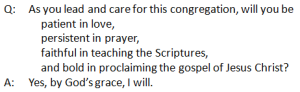
Let’s call this my pastoral New Year’s goal, then. Here’s what I’m aiming for as a pastor for 2017: to be patient in love, persistent in prayer, faithful in teaching the Scriptures, and bold in proclaiming the gospel of Jesus Christ.

commitmentIf that sounds like liturgy, that’s because it is. This was the commitment I made before our congregation when I was installed as pastor. Really, then, my 2017 pastoral New Year’s goal is simply re-committing myself to this calling.

I’ve often been distracted from this. To be fair to myself, though, it’s awfully easy to get distracted from this.

Many pastors feel like they have “a hundred bosses,” or whatever the size of their congregation is, because every person in the church has a different, particular understanding of what it means to be a “pastor,” who a pastor is supposed to be and what they are supposed to do. Some want a congregational visitor, others a community activist, some a spiritual guru, others a private therapist, some a thoughtful theologian, others an extroverted evangelist—and that’s only a small sample of the options. Just imagine the multiple personalities required to do all this, let alone the superhuman skills and physics-bending time and energy.

Into this vortex of competing expectations and impossible demands I hear Jesus’ simple call to me as pastor, a call nicely summarized by that installation liturgy: be patient in love, persistent in prayer, faithful in teaching the Scriptures, and bold in proclaiming the gospel of Jesus Christ.

Be patient in love. This is not so much a specific task to do as it is a general orientation for everything I do. And this is as difficult for me as it is for anyone else—contrary to another common expectation, pastors are not inherently “more spiritual” than others. Yet it is an orientation all Christians are called to nurture in Christ by his Spirit. In whatever tasks I do, in whatever roles I take on, in 2017 I want to strive to be patient with others as I seek to love them in the way of Jesus. (Lord, have mercy!)

Be persistent in prayer. Here my pastoral calling starts to become more specific, and in this I have much room for improvement. This is not incidental to my ministry, but central: to persevere in prayer for those among us and around us, to be deliberate in making and taking time to speak the names and stories, joys and sorrows of our congregation and community before God. May this year be a year of rekindled prayer in my life, in every area of my life.

Be faithful in teaching the Scriptures. You’d think this would already be well in place. After all, this is an area of expertise and experience for me, and teaching the Bible is one of the most fulfilling things I’ve ever done. I have a Ph.D. in biblical studies, for goodness’ sake! But for various reasons this has been pushed to the margins in my ministry. No more: in the coming year I am determined to re-claim this calling, to find and create opportunities to teach the Scriptures in all their difficult challenge and inspired insight.

Tissot - Jesus TeachingBe bold in proclaiming the gospel of Jesus Christ. This is something I have been doing—every sermon I preach is a proclamation of the gospel—but I am resolved (yes, on this I’m “resolved”) to do this even more. Our world—and each one of us—desperately needs to hear God’s good news again and again and again. But beware: this is not the gospel many of us grew up with. It’s the gospel of God’s kingdom come on earth, justice and peace and flourishing life for all, brought about through the crucified and resurrected Jesus. It promises true life, abundant life, but it demands our very lives: walking in the cross-shaped footsteps of the resurrected Jesus. In 2017 I intend to preach this gospel of peace at every opportunity.

Of course, this doesn’t mean that these are the only things I’ll be doing as pastor this year. There are all kinds of specific tasks, necessary or urgent or both, that are part of a lead pastor’s role in this day and age. But these are the things I’ll be focusing my time and energy on, for these are the things to which I have been called.

So watch out, world! Look out, Morden Mennonite Church! Pastor Michael is on the loose! Let 2017 be the year in which I take a leap of faith closer to the goal for which I was commissioned: being patient in love, persistent in prayer, faithful in teaching the Scriptures, and bold in proclaiming the gospel of Jesus Christ!

By God’s grace, may it be so.

Cross-posted from http://www.mordenmennonitechurch.wordpress.com. © Michael W. Pahl.

Our Thoughts and Words Matter

us2016Nobody said U.S. politics were dull.

Like most of the world, I watched the recent U.S. presidential race alternating between fascination, amusement, and horror. Sometimes all three at the same time.

It’s the kind of election that will be analyzed from every angle for years to come. I’ve been sorting through my own thinking on “what this all means,” and one of the things that I keep coming back to is this: our thoughts and words matter.

Even more pointedly: As Christians, called to love both neighbour and enemy, it’s not enough that we act in loving ways. We must also think and speak in loving ways.

I’ve often reflected that, if I were set upon by bandits and left for dead by the side of the road, there’s no one I’d rather have find my nearly lifeless body than an Evangelical Christian. Say what you will about Evangelicals, but pretty much every red-blooded Evangelical I know of would stop and help someone in such desperate need, even at great cost to themselves. Evangelicals make great Good Samaritans.

However, I have heard some of those same people speak demeaning, even downright cruel words about others. I have seen some of those good Evangelical Christians manipulate and deceive and aggressively coerce in order to achieve what they believe to be good ends. I have witnessed their haughty looks, their patronizing gazes, their holier-than-thou disdain, their puffed-up egos run amok.

I have been on the receiving end of this. I know whereof I speak.

I know also that this is not merely an “Evangelical Christian” problem. It is a profoundly human problem.

I’ve heard politically correct liberals speak horrendously about conservatives behind closed doors. I’ve seen poverty-advocating progressives walk right by a homeless beggar on the street with not even a flicker of emotion.

The disjunction between outward action and underlying attitude can be found among all of us in one way or another. I’ve seen this problem all too often in myself, across the whole spectrum of ways. We’ve all got a problem, and it’s a deep-seated, far-reaching human problem: a “sin” problem, to use the Christian lingo.

But what has struck me most profoundly over the past few months of observing U.S. politics is this particular disjunction: we don’t seem to get that our outward actions are rooted in our underlying attitudes and fueled by our shared speech.

We men might never walk up to a woman we don’t know and “grab her by the p*ssy”—but we tell blonde jokes behind closed doors, or we mansplain in our work meetings, or we smirk the words “PMS” to our buddy with a roll of the eyes.

We white people might never lay a finger on a non-white person—but we chuckle at the “drunk Indian” or “lazy Mexican” comment, or we  brush off the brouhaha over “Redskins” for a team name, or we think to ourselves that African Americans or Indigenous people just need to “get over it already.”

We straight folks might never assault the LGBTQ folks among us—but we perpetuate lies about some universal “gay lifestyle,” or we speak about bisexuality as if it’s a fake illness, or we’re not really sure we can trust the lesbian math teacher with our children all day.

We Christians might never bomb the nearest Mosque—but we assume the hijab-wearing woman is living in suppressed silence, or we choose the seat at the airport furthest from the Arabic-speaking men, or we forward the latest “Muslims are Taking Over Canada!!!” email to our family.

I’m not talking about those random thoughts that pop into our head from time to time. I’m talking about those attitudes that we allow to settle into our brains and dwell in our souls. We harbor these fearful, demeaning attitudes toward others, we speak fearful, demeaning words about others, and then we are all shocked when people actually act out of fear in cruelty and violence toward others.

But these things are connected. Our thoughts, our words, our actions—they are all of a piece.

Maybe we’re right about ourselves, that we would never physically harm others. But when we nurture harmful attitudes about others in our hearts and minds, when we encourage hurtful speech about others even in private, these thoughts and words will inevitably bear fruit in action—either ours or someone else’s.

This is what’s behind some of Jesus’ most difficult teachings. “Adultery” is not just about sexual intercourse, Jesus declares, and “murder” is not just about the act of killing someone: these outward acts are rooted in our thoughts and anticipated in our words (Matt 5:21-30). In other words, Jesus asserts, “Evil things come from within, from the human heart,” and this is what truly defiles us before God and others (Mark 7:20-23).

To borrow another favourite metaphor of Jesus—and some direct teaching from the Apostle Paul—“we reap what we sow” (Gal 6:7-8). Our thoughts are like seeds that root themselves deep in the soil of our hearts, and they will shoot up in the words that we speak and bear fruit in the actions of our lives.

If we think otherwise, we are deceiving ourselves. We are mocking God; but God will not be mocked.

When we nurture harmful thoughts, even in the deep places of our heart, or speak harmful words, even behind closed doors, we sow seeds of harm that will bear the fruit of harm. This is true for us as individuals, as families and churches, and as a society.

But if we can instead develop settled attitudes toward others that are based on truth and love, and speak words that build up and don’t tear down, then we can sow seeds that will bear the fruit of goodness and truth and beauty in our lives and in the world.

Let’s stop pretending that our inner thoughts and private words don’t matter. They do.

For the love of God—with all our heart, soul, mind, and strength, and our neighbour as ourselves—let’s dig deep within ourselves and scrape out our stony hearts in repentance. After all, God has promised a heart of flesh ready and waiting for us, beating with the love of Christ.

© Michael W. Pahl

Being a Discerning Christian in the Information Age (Or, What to Do When You’re Forwarded That Email)

We all get those emails, forwarded to us by a concerned friend or family member. Or we see the posts as we scroll through our Facebook feed. Or we hear the reports in the coffee shop, passed along in solemn tones. Something alarming has happened in the world, or is about to happen, or is being planned even as we speak.

You know the ones I mean. I’m talking about those emails or posts or reports that claim that we’re about to be overrun by violent Muslim extremists masquerading as refugees, or that Donald Trump is following Hitler’s playbook, or that there’s some gay agenda to take over our schools, or that climate change is a hoax, or that we’re all going to die in fifty years because of climate change, or whatever.

Usually, when I see these kinds of posts or get forwarded these kinds of emails, I sigh out loud and then hit the delete button or keep on scrolling. Maybe you’re the same way.

But sometimes the email or post requires a response, or maybe it’s something we feel we should be aware of if only to know what people are talking about when they mention it. Or, maybe something about it even grabs our attention and we think, “What if it’s true?”

What do we do then?

In our era of instantly, constantly available “news,” how do we sift through the chaff and find the truth? How should we even think or feel about the relentless storm of bad news, conspiracy theories, and conflicting claims that swirls around us in this age of dis/mis/information?

When sigh-and-delete is not an option, there are three things I try to do. Maybe you will find these things helpful, too.

First, I remind myself that we are called to be people of faith, not fear. These kinds of reports are always driven by fear: at bottom they exhibit a profound lack of trust in God.

As Christians we are called to trust that God is indeed sovereign through all things, that God’s kingdom is indeed growing throughout the world, that Christ is building his church and not even the gates of death can prevail against it, and that God has raised Jesus from the dead, conquering death itself.

These reports are driven by fear, not motivated by faith. The fear may be understandable, it might seem natural, but it runs counter to the fundamental stance of a follower of Jesus: a stance of faith in God.

Second, I remind myself that we are called to be people of love, not enmity. We are commanded by Jesus to love our neighbours—anyone we encounter who is in need—but also to love our enemies—anyone who opposes us, even violently.

The fear that I’ve just mentioned often leads to a kind of “defensive antagonism”—we get our hackles up (it’s the “fight” in the “fight or flight” response built into our most primitive intuition). That defensive antagonism can sometimes leap immediately to the extreme of physical violence, but more often it takes the form of hostile attitudes that settle in our hearts, which then build toward offensive words and aggressive (or passive-aggressive) actions.

This is essentially the nature of prejudice or bigotry: fear, when fueled by ignorance and left unchecked by genuine faith and love, leads to hostile attitudes that separate “us” from “them,” and ultimately to more direct actions of injustice and oppression.

But we are called to empathy and compassion, not prejudice and bigotry. We are called to love, not enmity.

And this leads to the third thing I do: I remind myself to gain knowledge about a situation and to learn more about the “other.” It’s important that we do our best to discern the truth about our world and one another, in order to love each other better. Knowledge dispels ignorance, which is crucial for dismantling bigotry and oppression.

otero-chart

Handy chart of news sources by Vanessa Otero.

For myself, I avoid the so-called “news” sources on either the extreme right or extreme left. Instead I try to get my news from major news outlets—whether leaning left or right—that follow basic codes of journalistic integrity. When I come across a specific item, I first look to its source to see if it fits the bill.

I might also do some quick fact-checking on sites like Snopes.com or TruthorFiction.com (for popular stories), FactCheck.org or PolitiFact.com (for American politics), or Wikipedia (for general info). If more in-depth research is needed I’ll follow the links at those sites, or, even better, I’ll search more academic or technical sources of information such as research pages at university websites, scholarly research portals, various UN sites, or others. I’ll check multiple sites if needed to avoid getting only one angle on things.

Yes, this all takes time, and it doesn’t always yield clear and simple results. Discerning truth is like that. And sometimes we just have to say, “I’m not sure what’s going on, but I still choose to live in faith and love.”

It has never been easy to be a discerning follower of Jesus in the world, being, as Jesus put it, “wise as serpents yet innocent as doves.” In some ways it’s even harder now, with millions of terabytes of information at our fingertips, both true and false, used both for good and for ill.

May God give us wisdom as we seek to discern the truth in our complex world, and may God give us faith and love—and hope!—in a world that at times seems determined to rob us of these gifts.

Cross-posted from www.mordenmennonitechurch.wordpress.com. © Michael W. Pahl

Trust in God, Love One Another

One of my parishioners in a former church used to say that preachers really only have two or maybe three different sermons. “Every sermon they preach—doesn’t matter the text or the title—is really just a variation of one of those two or three sermons,” he’d say.

I’m not quite that cynical about the average pastor’s ability to navigate through a wide terrain of topics and Biblical texts. But I do think my friend was on to something. In fact, as I’ve been reflecting back on three years of preaching here at Morden Mennonite, I think pretty much all of my sermons—along with my pastoral counsel—can be boiled down to one of these two basic exhortations:

Trust in God.

Love one another.

Exploring the mystery of the divine? Trust in God.

Dealing with the latest hot issue? Love one another.

Facing a financial crunch? Trust in God.

Wondering how to strengthen your marriage? Love one another.

Grieving the loss of a loved one? Trust in God.

Got a difficult situation with a co-worker? Love one another.

Needing to make a major decision? Trust in God.

Your son has just come out as gay? Love one another.

The Return of the Prodigal SonOf course, by themselves these refrains—“Trust in God” and “Love one another”—can sound trite. They can be trite: overly simplistic, pat answers, bumper sticker slogans empty of any real meaning or usefulness. Life is complicated, and these statements need to be nuanced and explained, their significance teased out in practical ways.

And in my preaching and teaching and pastoral guidance I certainly say a whole lot more than just “Trust in God” and “Love one another.” I attempt to set biblical texts within their ancient context, and then try to let them speak to us in our current context. I invite us to enter into the theological and moral imagination of Jesus and his first followers. I talk about what this “faith” and “love” looked like when Jesus did them, and what they might look like for us today, in our particular circumstances.

And yet, distilled to their most concentrated form, my sermons and conversations always seem to be some version of these two simple appeals:

Trust in God.

Love one another.

I’ve been reflecting again on the Gospel of John lately. It’s curious how I keep coming back to that Gospel, or maybe more that John’s Gospel keeps coming back to me. I gravitate toward the Synoptic Gospels—Matthew, Mark, and Luke—and the letters that bear Paul’s name. And yet every time I attempt to articulate the core message of these other writings, or the heart of my Christian faith, I seem to end up using John’s language to do so. So it is once again.

Because in the living waters of John’s Gospel two verbs keep rising to the surface, over and over again: “believe” and “love.”

The first one, “believe,” is pisteuō in Greek. This word is not as narrow as the English word “believe.” We tend to use “believe” as “I believe x to be true,” where x is some statement or claim. Or we simply say “Just believe!” or (same thing) “Believe in yourself!”—be authentic to who you are, trust your instincts, your own inner resources. In John’s Gospel, though, as throughout the New Testament, “believe” is more the idea of “I trust in, I rely upon, I am committed to God/Jesus.” It’s a personal thing, an interpersonal thing, our dependence upon and fidelity to the God embodied in Jesus of Nazareth.

The Good SamaritanThe second verb, “love,” is John’s comprehensive ethic: it’s every good thing that anyone does for anyone else. God loves Jesus. God loves the world. Jesus loves his disciples. Jesus’ disciples love Jesus, and love God, and love each other. This love is not about natural attraction or permissive tolerance, but rather selfless giving: a Father giving his beloved Son for the world, a Son giving his life for his disciples, his disciples giving themselves for one another and the world.

Trust in God.

Love one another.

Simple, isn’t it? Maybe. But it’s certainly not easy. In fact, these are the most difficult things we can do.

Trust in God—even when the whole world seems paralyzed by fear of the unknown other, the unknown future.

Love one another—even when the whole world seems caught up in a self-righteous cycle of harm and offense, hostility and retaliation.

Trust in God—right at that moment when your resources are low and your worry is high and you can’t see a way out of this mess.

Love one another—yes, even that person, the most unlovable, annoying, strange, disturbing, [insert negative adjective here] person you know.

Trust in God—cry out to God with your anger, your fear, your unbearable sadness, your overwhelming loneliness, and then look for God’s presence right where you least expect it, right where you most need it.

Love one another—hold that hand in awkward silence, listen to that wounded heart, speak up for that voiceless person, give that fifty bucks, change that flat tire, celebrate that achievement, learn about that culture, learn that child’s name.

Trust in God—pray and worship, weep and lament, sing and rejoice, question and complain, contemplate and meditate, explore with raw wonder the transcendent mystery and immanent presence that is God.

Love one another—be kind, be generous, show compassion, show respect, speak truth, seek justice, be patient, be gentle, be humble, be delighted, be encouraging, forgive, forgive, and forgive again.

Simple, but not easy.

Hard, but necessary.

The essence of Christianity, the essence of human life—and, apparently, the only two sermons I ever preach. No coincidence there—they’re also the two things I most need to be reminded of myself.

Trust in God.

Love one another.

———————————————

Images: Rembrandt van Rijn, The Return of the Prodigal Son; Ferdinand Hodler, The Good Samaritan

© Michael W. Pahl

Love will win. Love must win, or we all lose.

I was getting ready for a busy Sunday at church when I saw something on my news feed about a “shooting in Orlando.” I thought little more than “Here we go again” as I put the finishing touches on my sermon. A sermon on the Greatest Commandment, as it happens, the command to love.

At church someone mentioned it to me, saying it looked like the worst mass shooting in American history. I raised my eyebrows at this with a “Really?” and knew I’d have to check it out once the church day was done.

APTOPIX Nightclub Shooting FloridaBy the time I heard the full story it was already late afternoon. My mind was filled with Sunday school wrap-up, church picnic and races, church people’s stories and faces—and my sermon from the morning, that sermon on the Greatest Commandment, the command to love.

It’s a strange feeling, that grief you feel for someone you never knew. Especially when it’s multiplied 50 times, then multiplied again for their parents, sisters, brothers, and friends, then multiplied yet again for the injured, the traumatized, and all their kith and kin.

I was numbed into silence, this strange grief an ever-present aura even as we went about a normal Sunday evening as a family. Talking, teasing, laughing. Eating, cleaning up, singing. Playing games, watching hockey, praying. That’s what we did. And always in the back of my mind—all those families, what were they doing?

Mourning. Weeping. Consoling each other. Seeking answers. Demanding an end to all this death.

No doubt some were ashamed. Ashamed of their child, where they were found. No doubt some of these felt a pang of guilt at their flush of shame, maybe even greater guilt at the way they had treated their child, the things they had said, or left unsaid.

I can’t think of any recent tragedy this close to home visited by so many of the scourges currently plaguing humanity. Homophobia. Religious extremism. Gun violence.

When will we repent of our stark greed, our desire for power over others, our willful ignorance and fear of the other, our propensity toward violence in word and deed? We who have power and privilege—especially middle-aged, white, straight males like myself—when will we be willing to set aside our own desires and needs, to give up our own rights and privileges, to ensure a better future for all of us together?

In other words, when will we be willing to follow Jesus?

I grieve that strange grief for those I do not know, those who have died, those who have been injured, all their families and friends. But I grieve another grief as well, a grief for those touched more indirectly—yet just as truly—by this tragedy.

I grieve for LGBTQ+ persons, who have already borne the brunt of so much misunderstanding, rejection, and violence, even in places that should be safe spaces, like homes and churches. O God, may you keep them safe in the aftermath of this horrific act of hate.

Among the American Muslims to denounce the terror attack at a gay night club in Orlando was Muhammad Musri, the imam of the Islamic Society of Central Florida.I grieve for Muslims, the vast majority of whom simply want to live in peace and safety with their families and friends, able to practise their religion and work an honest living and watch their children and grandchildren grow up. O God, may you keep them safe from backlash to this horrific act of hate.

And I grieve for all humanity, sometimes even despairing for the human race, until I am reminded of God’s relentless love, and the moral universe’s long-bending arc toward justice, and the many times in human history when heaven has broken through the hell of earth, resurrection bursting out from death. O God, may your kingdom come, your will be done, your kingdom without borders, your will for justice and peace, on earth as it is in heaven.

Love will win. Love must win, or we all lose.

One of the scribes came near and heard them disputing with one another, and seeing that he answered them well, he asked him, “Which commandment is the first of all?”

Jesus answered, “The first is, ‘Hear, O Israel: the Lord our God, the Lord is one; you shall love the Lord your God with all your heart, and with all your soul, and with all your mind, and with all your strength.’ The second is this, ‘You shall love your neighbor as yourself.’ There is no other commandment greater than these.”

Then the scribe said to him, “You are right, Teacher; you have truly said that ‘he is one, and besides him there is no other’; and ‘to love him with all the heart, and with all the understanding, and with all the strength,’ and ‘to love one’s neighbor as oneself’—this is much more important than all whole burnt offerings and sacrifices.”

When Jesus saw that he answered wisely, he said to him, “You are not far from the kingdom of God.” (Mark 12:28-34)

© Michael W. Pahl

The Parable of the Good Muslim

The Parable of the Good Samaritan.

Everyone knows the story. Or, at least, they know what a “good Samaritan” is. It’s someone who does a good deed, someone who helps a person in need.

Sure, but it’s more than that. The story is actually more jarring than that. Or, at least, it should be.

Jesus tells the story to describe what “neighbour-love” looks like, what it actually means to “love your neighbour as yourself.” This “neighbour-love,” Jesus says, is vitally connected to “God-love,” what it means to “love God with all your heart, soul, strength, and mind.” The Greatest Commandment—the One Thing God asks of us, the One Thing that encompasses all things God requires—is to love God and love others.

So what does this “neighbour-love” look like? It looks like a Samaritan showing compassion and extending care to a Jew in desperate need.

Simple, right? Just your everyday good deed, a random act of kindness, the kind of thing any decent person would do. Right?

Not quite. Read it again. And then again. And again—this time with feeling. (And maybe a little context.)

First note: As any first-year seminarian can tell you, the Samaritans and Jews in Jesus’ day didn’t really get along. Okay, that’s understatement. There’s one story of some Samaritans throwing human bones into the Jewish temple in Jerusalem, defiling it. But then again, a century before that the Jews completely destroyed the Samaritan temple on Mount Gerizim. You know, “eye for an eye” and all that. So a Samaritan and a Jew? We’re talking “despised other” here, like when Donald Trump talks about “Mexicans” or “Muslims.”

Note #2: The Samaritan shows compassion and extends care without reservation: no questions asked, no conditions to be met, no fine print to qualify the offer. He’s not concerned about his own safety and security. He’s not concerned about who’s going to pay him back. He’s not all, “Well, maybe if I help this Jew he’ll convert to my religion and come worship at my temple.” (Seriously, think about that a moment.)

A third note: The people who you’d think would most likely help the victim are exactly those who refuse to do so. A priest, a Levite. A Christian, a Canadian, a pastor. Nope. Instead, it’s the least likely person (from the Jewish perspective) who is the hero of the story, the “despised other” themselves.

There’s much more to the story than meets the eye. There’s much more to the story than even these three notes. But these three things have struck me recently as I’ve read and re-read the Parable of the Good Samaritan.

Did I say “Good Samaritan”? I meant “Good Muslim.”

Now there’s an idea. Let’s try that out and see how it feels—and if this makes you uneasy, if it makes you all up-in-arms and red-in-the-face and furious with me, then maybe you’re starting to hear the story correctly.

Wanting to make himself look good, the expert in ethics asked Jesus, “And who is my neighbour?”

Jesus replied, “A man was going down from Morden to Winkler by a back road, and fell into the hands of robbers, who stripped him, beat him, and went away, leaving him half dead in the ditch.

“Now by chance a well-respected pastor was going down that road; and when he saw him, he passed by on the other side. So likewise a devout Christian, when he came to the place and saw him, passed by on the other side.

“But a Muslim immigrant while traveling came near him; and when he saw him, he was moved with pity. He went to him and bandaged his wounds, having treated them with antiseptic. Then he put him in his own car, brought him to the hospital, and sat with him through the night. The next day he wrote a cheque worth two days’ wages and gave it to the nurse on duty, and said, ‘This is for any extra expenses he has; when I come back, I will repay you whatever more is needed.’

“Which of these three, do you think, was a neighbour to the man who fell into the hands of the robbers?”

The ethical expert said, “The one who showed him mercy.”

Jesus said to him, “Go and do likewise.”

Cross-posted from http://www.mordenmennonitechurch.wordpress.com. © Michael W. Pahl