Adult Bible Study Online Supplements

I’ve not been blogging much here lately, but I have been writing short weekly pieces for MennoMedia’s online supplements to their adult Bible study curriculum. That began the first week of December and will go through February 2018.

UPDATE: These are now posted on my website. Links are updated to reflect this.

Jesus and Hell

I preach the good news of Jesus, including Jesus’ way of radical, nonviolent love. As one might expect, I get some pushback on this. “What about sin?” I hear frequently. “What about God’s judgment?” “What about God’s wrath?”

“What about hell?”

Yes, what about hell? After all, Jesus mentions hell more than anyone else in the New Testament. There’s this handy bit of practical advice, for example: “If your hand causes you to stumble, cut it off; it is better for you to enter life maimed than to have two hands and to go to hell, to the unquenchable fire.” Or this lovely bit of encouragement: “You snakes, you brood of vipers! How can you escape being sentenced to hell?”

I’ll admit that my first thought when I hear these kinds of questions is that if anyone thinks my idea of love doesn’t include ideas of sin and its consequences, they aren’t listening. More on point, though, is this: if we want to understand Jesus on hell, we need to read these Gospel teachings carefully, in context, across the Testaments.

Most of the time in the Gospels, the “hell” Jesus mentions is “Gehenna.” The other times when Jesus refers to a hellish judgment, ideas of “Gehenna” are probably still in the background.

“Gehenna” is a reference to a very particular place—and it’s not some location under the earth run by the devil and staffed by his demons. “Ge-henna” refers to the “valley of Hinnom,” a small valley running along the south and west of the Old City of Jerusalem.

Gehenna today

I’ve been there—there’s nothing hellish about it at all. Nor was there in Jesus’ day.

Sometimes you’ll hear that in Jesus’ day there was a perpetually burning garbage dump in the Hinnom valley. But that’s not the case. This idea seems to have originated from a Rabbi centuries after Jesus. In Jesus’ day there was nothing hellish about Gehenna at all.

What was hellish about the valley of Hinnom was its history. There are several Old Testament passages that describe the hellish history of Gehenna. They’re all similar, but to get a taste of hell let’s focus in on one of these—Jeremiah 7, starting with 7:31:

And they [the people of Judah] go on building the high place of Topheth, which is in the valley of the son of Hinnom, to burn their sons and their daughters in the fire—which I [Yahweh, the Lord] did not command, nor did it come into my mind.

Here we learn three key points about Gehenna, the valley of Hinnom.

1) The fires of Gehenna were made by humans, not by God.

In fact, 2) God abhorred the fires of Gehenna.

And why did God so despise the fires of Gehenna? Because 3) they were the epitome of senseless human violence, particularly violence against the most vulnerable.

But there’s more to the story of Jeremiah 7. The people of Judah are appealing to their own special status before God, hoping this will save them from foreign invasion. “The temple of Yahweh is here!” they cry—as if that will help them. “Look,” they say, “we offer all the proper sacrifices!”—as if that will make a difference.

But any special status they think they have is an illusion, all their acts of righteousness are irrelevant, because they are “oppressing the alien, the orphan, and the widow, and shedding innocent blood.” They are committing grave injustices against the most vulnerable among them—of which burning their sons and daughters in the fires of Gehenna was the most horrific.

All this explains why the tables turn at the end of the chapter:

Therefore, the days are surely coming, says the Lord, when it will no more be called Topheth, or the valley of the son of Hinnom, but the valley of Slaughter: for they will bury in Topheth until there is no more room. The corpses of this people will be food for the birds of the air, and for the animals of the earth; and no one will frighten them away. And I will bring to an end the sound of mirth and gladness, the voice of the bride and bridegroom in the cities of Judah and in the streets of Jerusalem; for the land shall become a waste.

Gehenna back in Moloch’s day

It’s a soul-shuddering reference to Jerusalem’s impending doom, the city’s destruction at the hands of the ruthless Babylonian armies. The people’s religiously righteous acts and supposed special status aren’t going to save them.

And all their injustice, all their oppression, all their senseless violence against the most vulnerable? It’s going to rebound against them in equally horrific fashion, until the valley of Hinnom becomes an enduring symbol of God’s judgment on the self-righteous strong who oppress the marginalized weak.

To our three points about Gehenna’s fires above we can now add three more:

4) Gehenna symbolizes God’s judgment, but this divine judgment is not an “angry God directly inflicting violence upon sinners for eternity” judgment.

It’s a 5) “reap what you sow” judgment—if we sow violence, injustice, and oppression, we will reap that violence, injustice, and oppression upon ourselves, in very human, very natural, ways, within human history and not beyond it.

It’s a 6) judgment specifically upon the powerful, those with social or economic or political or religious clout, for the ways in which they oppress and commit violence against the weak, those on the bottom rungs of our social and economic and political and religious hierarchies.

With this background on Gehenna in mind, we can now fully appreciate Jesus’ words on hell in the Gospels.

Jesus isn’t talking about a “literal hell” where unrepentant unbelievers go after they die to be tortured in God’s inferno for all eternity.

He’s talking about the violent consequences of our own violent actions, right here in our lived lives, right here in human history.

He’s talking about such consequences especially for those who use their power to oppress the weak, who live in wealth in indifference to the poor, who have the means to care for the sick and clothe the naked and feed the hungry but refuse to do so, who rest secure in their status and privilege while committing grave injustices against the vulnerable and the marginalized.

And he’s talking in particular to the uber-religious, the people who think they’re on God’s side because they believe the right things or do the right rituals—but they burden others with moral demands while doing nothing to help them, they focus on minor moral issues while neglecting the weightier matters of justice and mercy and allegiance to God above all other powers that be.

These are sobering words, serious warnings, for every age and certainly our own. But all this is right in line with the good news of Jesus and Jesus’ way of love.

After all, there’s nothing more loving, nothing more like Jesus, than standing in solidarity with the powerless, the stepped-upon, the pushed-to-the-side, and standing up to the oppressive powers that be—whatever the cost to ourselves.

And it is this hell of our own harmful actions and their destructive consequences—our sin and all its death—that Jesus has come to save us from. Jesus calls us to leave behind our damaging, violent ways and follow him in his path of compassionate, inclusive, forgiving, self-giving love. If we don’t do this the result will only be death for ourselves, for others, for the world. But if we do this we will find life, full and flourishing life for all.

This is love. This is Jesus. This is good news indeed.


For more on this, see my “Let’s Talk About Hell.”

© Michael W. Pahl

You Know, “Love One Another” Really Is Enough

The 4th-century theologian Jerome tells a story about the Apostle John. John was old and frail, unable to walk, so his disciples would carry him into the gathering of believers on the Lord’s Day. Every week these were his words to the congregation: “Little children, love one another.”

This went on week after week, until at last, more than a little weary of these repeated words, his disciples asked him, “Master, why do you always say this?”

“Because,” John replied, “it is the Lord’s command, and if this only is done, it is enough.”

We have no way of verifying Jerome’s story, but it certainly sounds like John—that is, the author of the Gospel and Epistles of John. Those writings are filled with exhortations to love.

I can sympathize with John in this story. I, too, feel the pressure of this regular question: “Michael, why do you always talk about ‘love’?” Sometimes this is simple curiosity, but often the criticism is plain: this teaching, that we are to “love one another,” is somehow seen as insufficient.

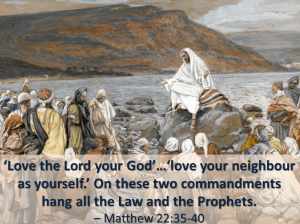
That’s odd, quite frankly. After all, Jesus was emphatic about what the greatest commandments of God were: love God and love others, and you can’t have one without the other. In fact, Jesus says, this love of God/others sums up everything else God commands. All Scripture hangs like a seamless coat on this single hook: love God by loving others.

And Jesus’ first followers were equally clear on this. Loving others is the benchmark of genuine faith, they said—if you don’t love others you’re not a true disciple of Jesusyou don’t even truly know God. You want to fulfill God’s Law? Love others, they said, simple as that. The only thing that matters, in fact, is a faith that works itself out in love. Love is the virtue that binds together all other virtues. It is the most excellent way to live. It’s the one thing that remains always and forever.

According to both Jesus and the Apostles, love is it.

So it’s more than a little odd when Christians, whether back in John’s day or our own, get impatient with those of us who emphasize love above all else.

But why do some Christians react this way? Why is a simple insistence on loving others so wearisome, even so aggravating, to some?

Some insist that “love one another” is too wishy-washy. It’s too soft on sin, not strong enough on holiness. What about God’s judgment of sin seen throughout the Bible, after all, even in Jesus’ own teaching?

Others say that “love one another” is too simplistic, too impractical. The world is far too complicated for mere love, especially once we get beyond one-on-one relationships. What place does “love one another” have in the worlds of bottom-line business or high-stakes politics, or in sovereign countries defending their national interests?

These sound like the criticisms Jesus received, come to think of it. “Soft on sin, weak on holiness,” some of the most religious folks muttered around Jesus. “He sets aside God’s commands!” others among them frowned. “Love our enemies? That will only get us crucified by them!” all the “Make Israel Great Again” zealots exclaimed.

Yes, indeed.

I think much of the problem is that we don’t really know the love that Jesus taught, the love that Jesus lived. And if we know this love, we don’t really trust in this love, not really. This can be true of both “sides,” it seems to me, both those who think love alone is the stairway to a heaven of harmonious society, and those who think “love alone” is the highway to a hell of moral relativism.

Many imagine this love to be mere tolerance. They imagine “love one another” to mean “live and let live,” a sort of “Whatever floats your boat, as long as you let me float mine.”

Others imagine this love to be a kind of affection, good feelings toward others. “Love one another,” then, means “Get rid of all that negativity—good vibes for everyone!”

Still others imagine this love to be basic decency. “Be nice to each other, use your manners, be polite”—this is what “Love one another” means.

Now there’s nothing wrong with tolerance, or affection, or basic decency. In fact, these are a bare minimum for being human together, I would think. They’re bottom-line attitudes and behaviours for a functioning human society.

But these, in themselves, are not the love that Jesus taught, the love he lived. Jesus’ love transcends mere feelings of affection, and it’s exponentially harder than simple kindness or even basic tolerance. People don’t get crucified for being nice.

So what is this love that Jesus says is the be-all and end-all of human living? Thankfully we’ve got a lot to go on in the Gospels, both from Jesus’ teaching and from the way he lived.

Love starts with a stance of openness toward another person. It’s like a father scanning the horizon for a long-lost son. It’s like a holy man embracing a lowly child. It’s like a busy healer stopping in a crowd to find the ill woman who touched him.

Love is freely given, expecting nothing in return. It’s like patiently healing crowds of the world’s poorest, no cost to user. It’s like forgiving the sins of society’s worst offenders, no blood sacrifice required.

Love is given whether we feel the recipient deserves it or notneighbours, strangers, sinners, even enemies. It’s like someone welcoming the least among us: clothing the naked, visiting the prisoners, feeding the hungry, caring for the sick. It’s like a despised enemy-of-us compassionately tending the wounds of one-of-us.

Love is giving one’s very self for the other, even when it hurts the giver. It’s like someone standing up to injustice on behalf of the over-burdened, shifting the target to their own back. It’s like a king giving himself to be crucified by an oppressive power in order to save his people from annihilation.

The goal of this love is mutual flourishing: giver and receiver, all people, experiencing abundant life together. It’s like a final banquet where the lost and found, the last and first, the least and greatest, all feast together with food enough for all who want to be there.

This is the love Jesus taught. This is the love Jesus lived, all the way to the cross. This is love: freely giving ourselves for others so that they might experience flourishing life together with us, even if we feel they don’t deserve it, even when it hurts us to do so.

Make no mistake: there’s nothing wishy-washy about this love. It’s damned hard (sorry, but it is). Seriously, think about the people you know. Think about the people you fear. Think about the people you despise. Think about the people you condemn. Then imagine loving them like that.

This love is in no way soft on sin—but it can turn our “sin lists” upside down. Yes, Jesus speaks God’s judgment on human sin. But it is the most religious who earn Jesus’ harshest criticism, especially religious people with power, because they wield their religion like a club instead of spreading it like a salve. Injustice of all kinds gets roundly condemned by Jesus, including injustice masquerading as justice. Jesus stands alongside the most vulnerable in society: the poor, children, foreigners in an ethnocentric world, women in a patriarchal world. Those who abuse their religion, or abuse their power, or otherwise cause harm to the vulnerable—these are the ones who get threatened by Jesus with divine judgment.

In a world of Jesus-love, then, sin and evil still exist—if anything they are even sharper, more pungent. In a world of Jesus-love, sin and evil are things to be actively, albeit non-violently, resisted, even if this demands your very life. In a world of Jesus-love, your own personal sins are for you to repent of, others’ personal sins are for you to forgive, and the world’s public sins are for you to resist.

This love is, in fact, what holiness is really all about. Jesus overturns common conceptions of “clean” and “unclean,” “pure” and “impure,” “holy” and “profane.” Compassion trumps purity, every time. Heal on a holy day? Touch an unclean leper? Share a meal with impure sinners? In all these ways and more, Jesus agrees with the more liberal of his fellow Jews—liberal with love, that is. Mercy is the new holiness.

And this love is the most practical, the most necessary thing in the world.Eye for an eye” is still the norm in our world, whether in our private vendettas, our societal notions of justice, or our national defense strategies. In fact, “eye for an eye” might actually be better than what we often see, which is more about “pre-emptive strikes” and “total war”—both as nations and as individuals (think about that a moment). How long until the whole world is blind?

I’m reminded here of a quote by G. K. Chesterton: “The Christian ideal has not been tried and found wanting. It has been found difficult; and left untried.” That’s how I hear criticisms that love is simplistic or impractical. We prefer our sanctified greed and justified violence to the narrow path of loving in the way of Jesus. How long until we’re really willing to trust in Jesus alone for our salvation?

I’m with the Apostle John in this: “love one another” really is enough. Who’s with me?

© Michael W. Pahl

Michael Pahl’s Handy-Dandy Handbook of Christian Words and Phrases

Have you ever had two people understand something you’ve said in two very different ways? It happens to all of us sometime. I’ve had it happen to me when I preach, more than once. This happens even when I use common Christian words or phrases derived from the Bible—maybe especially when I do so. It can be a little disconcerting, to say the least.

Part of this is just me needing to look for ways to communicate more clearly. Part of it, however, is our natural tendency to hear what we expect to hear. When we’re in a church and someone speaks about “faith” or “heaven,” for example, or they say “Jesus saves us from our sins,” we are inclined to hear those things in a particular “churchy” or “Christianese” kind of way.

But many of these words or phrases don’t mean for me what they often mean in popular Christianity. The reason? I don’t think the popular understandings actually reflect the biblical ideas behind these words or phrases, at least not completely.

Well, if you’re ever in doubt about what I might mean when I talk about “salvation,” or when I say, “Jesus is Lord,” I’ve created this nifty little guide: Michael Pahl’s Handy-Dandy Handbook of Christian Words and Phrases. Who knows? Maybe I’ll start handing this out before I preach every Sunday.

God. God is depicted in a myriad of different ways in Scripture. These are all metaphors: God is in some sense comparable to a “Father,” for instance, or a “Mother,” or a “Lord,” or a “Rock,” just to name a few. Even “God” is a metaphor: God is analogous to the “gods” of other nations and religions, comparable to what we typically think of when we think of a “deity.” Some biblical descriptions, however, take a different tack: God is YHWH, “I Am Who I Am,” for instance, or God is “the one in whom we live and move and have our being,” or “God is love.” When I speak of “God,” I’m thinking more along those lines: God is “the ground and source of all being, personhood, and love.” I don’t imagine that God is merely “a being,” a distinct being within the universe, like us only bigger and stronger and immortal and invisible.

heaven. The Bible doesn’t speak of “heaven” as “our eternal home.” The New Testament understanding of life after death is simply being “with the Lord” or “with Christ.” In the end this includes living in transformed bodies in a renewed earthly creation (“resurrection” to a “new heavens and new earth”). In the Bible “heaven” means either 1) “the skies,” 2) “God’s dwelling,” or 3) a roundabout way of saying “God” (e.g. “kingdom of heaven” = “kingdom of God”). I don’t use the word “heaven” very often myself because of how it is misunderstood, but when I do it’s along the lines of 2) above: “the ‘place’ where God is most ‘fully present.’” Usually I use the word to speak of the biblical hope of “heaven” come down to earth, God’s presence being fully realized among us within a renewed creation.

sin. We tend to think of “sin” as “personal moral failure”: we’ve crossed a boundary established by God, and these boundaries are mostly related to our private lives or individual relationships. This way of thinking about sin isn’t wrong, it’s just incomplete, and if this is the only way we think about sin then it can be unhelpful and unhealthy. I think a better (and more holistically biblical) way of thinking about sin is as “all the ways we harm others, ourselves, and the natural world through our settled thoughts, our words, our actions, and our inaction.” This “harm” can be thought of as “preventing or hindering flourishing life.” With regard to people this can most practically be understood as keeping them from having their most basic needs met: needs for clean air and water, nutritious food, basic health, security and freedom, meaningful relationships, love and respect. This sin is more than just “personal moral failure,” then—it also includes collective sins such as systemic injustice, as well as actions that harm the natural world.

salvation. In Scripture the language of “salvation” is most often about “rescue” or “deliverance” from some real-life peril, but it also can include ideas of “healing” and “restoration,” whether physically or relationally, individually or collectively. Then there’s all the related biblical words like “redemption,” “reconciliation,” and so on, which are really variations on the “restoration” idea. When I speak of “salvation” or being “saved” or God as “Saviour,” I mean something along the lines of “God delivering us from all the ways we harm others, ourselves, and the natural world, and bringing about a full and flourishing life for all creation.” I don’t mean “God rescuing us from future eternal torture so that we can live a disembodied existence somewhere else forever with God.”

kingdom of God. In much popular thinking the “kingdom of God” or “kingdom of heaven” is equivalent to “heaven,” which is thought of as “our eternal home” (see “heaven” above). But for early Jews, including Jesus and the authors of the New Testament, “kingdom of God” was a way of referring to “God ruling over God’s people and all the peoples of the earth.” When I use the phrase “kingdom of God,” I’m trying to capture Jesus’ particular understanding of this earthly rule of God, something along the lines of “God’s vision of a world of justice, peace, and flourishing life, which becomes a reality when people live according to God’s way of love.”

Jesus Christ. “Christ” is not Jesus’ second name; “Christ” is a title. And it’s not a title of divinity; it’s a human title. “Christ,” or “Messiah,” was most commonly a way of referring to the human kings in the line of ancient Israel’s King David. Eventually it came to refer to the ultimate Messiah, “the king from David’s dynasty who brings about God’s kingdom on earth.” The phrase “Jesus Christ,” then is a mini-creed: “Jesus is the one who makes real God’s vision of justice, peace, and life on earth.”

Son of God. This phrase has a dual meaning in the New Testament. Some writings, Mark’s Gospel, for example, use “Son of God” in one of its Old Testament senses, as a way of referring to the kings in the line of David. In this sense the phrase is equivalent to “Christ” or “Messiah,” and has no overtones of divinity. Other writings, most notably John’s Gospel, use “Son of God” with a clear implication of divinity. I believe both to be true of Jesus, and how I use this phrase tends to depend on which New Testament books I’m talking about: Jesus is “the one who makes real God’s vision of justice, peace, and life on earth,” and Jesus is “the one who uniquely embodies God, showing us most clearly and completely who God is and how God works in the world.”

Jesus is Lord. This doesn’t mean “Jesus controls everything that happens.” Nor does it merely mean “Jesus is the boss of me.” “Lord” in the ancient world had connotations of “master,” yes, but it was also a common way of speaking of human rulers—kings, emperors, and the like. With none of these was the idea that they controlled a person’s life circumstances; it was that they commanded their obedience or allegiance. To say that “Jesus is Lord,” then, means that “Jesus is greater than all human rulers and any powers-that-be in this world, and so he holds our ultimate allegiance in all things.”

gospel. The New Testament word “gospel” means “good news.” The “gospel” is not merely that “God sent Jesus to die for our sins so that we can be forgiven and go to heaven when we die.” It’s the “good news that God has acted in Jesus—through his life, teachings, death, and resurrection—to make right everything that has gone wrong in the world.” In other words, it’s a way of summing up pretty much everything I’ve described above.

faith. We tend to think of “faith” either as “believing certain things to be true,” or “trusting in someone to do something.” The New Testament language of “faith” includes those ideas, but also others: “faith” (pistis) can mean everything from “belief” to “trust” to “faithfulness” to “fidelity” to “allegiance.” When I use the word “faith” I can mean any or all of those, following the New Testament usage. All of those are the response God desires from us: “believing what God says to be true, trusting in God through all things, being faithful to God and following God’s way of love.”

love. Some people hear “love” and think “affection,” a surge of warmth and fondness toward others. Others hear “love” and think “tolerance,” acknowledging and accepting others and their actions with a kind of benign smilingness. Some, perhaps conditioned by Christianity, hear “love” and think “self-sacrifice.” Others, of course, hear “love” and think “romance” or even “sex”: physical, emotional, even erotic intimacy. None of these are bad, but on their own they are incomplete. In the New Testament, love is consistently portrayed as loving the way Jesus loved. It is more along the lines, then, of “freely giving ourselves for others so that they might experience flourishing life together with us, even if we feel they don’t deserve it, even when it hurts us to do so.” This love, I’m convinced, is at the heart of who God is, what Jesus taught and lived out unto death, and how God’s “salvation,” the “kingdom of God,” comes about.

How do you understand these words? What often-misunderstood “Christian words” would you add?

© Michael W. Pahl

Atonement and God’s Wrath

Note: This post has been edited since its original version.

———————–

Diego Velázquez, Cristo crucificado

I’ve been thinking a lot about Jesus’ death lately. There are many reasons for this, not least of which is the journey we’ve just been on through Lent, following Jesus to the cross.

As I’ve thought about Jesus’ death, both recently and over the years, I keep coming back to the “gospel tradition” the Apostle Paul received from others before him and passed on to others after him, a tradition that was probably formulated within two or three years of Jesus’ death:

that Christ died for our sins in accordance with the Scriptures,
that he was buried,
that he was raised on the third day in accordance with the Scriptures,
and that he appeared to Cephas and the twelve. (1 Cor 15:3-5)

This tradition shows that very early on Jesus’ death was being interpreted as “for our sins.” But what exactly does this mean?

I’d guess that when most people hear that phrase, “Jesus died for our sins,” they immediately plug in a whole cluster of ideas: we sin by disobeying God’s moral law; God’s holiness therefore bars us from being in God’s presence and God’s justice demands a penalty be paid, the penalty of death; God is justly angry with us. To say, then, that “Jesus died for our sins” means that “Jesus died in our place, paying the penalty for our sins demanded by God’s justice, and thus turned away God’s righteous wrath, bringing us divine forgiveness and allowing us to be in God’s holy presence.” This idea is called “penal substitutionary atonement.”

However, the phrase, “Jesus died for our sins,” doesn’t necessarily mean all those things. For it to mean all those things requires many assumptions to be true about who God is, how God operates, what sin is, what forgiveness involves, how justice works, and so on. These assumptions are never actually stated in any one passage in Scripture, but must be inferred from various passages and then all brought together before being read into this phrase.

In fact, I’d suggest that the phrase from this early tradition, “Christ died for our sins,” simply means that “Christ died with respect to our sins”—Jesus’ death concerns our sins, even “deals with” our sins, somehow, in some way. Exactly how this works, however, is not spelled out in this phrase.

The New Testament uses many different metaphors to try to explain how this works, what it means to say that Jesus’ death “deals with” our sins. Images of animal sacrifice, scapegoating, redemption from slavery, covenant ratification, military victory, martyrdom, friendship, gift-giving and more are used by the New Testament authors to interpret Jesus’ death “for our sins.” None of these ideas, however, imply “penal substitution”—not even the animal sacrifice images, as Andrew Remington Rillera has amply demonstrated.

Is there a better way of making sense of the confession that “Jesus died for our sins”? How do I think about this?

Elsewhere I’ve done some reflection on what some of this kaleidoscope of meaning is related to Jesus’ death. Here I’d like to sketch out a few thoughts that specifically relate to some of the ideas found in the popular notion of “penal substitutionary atonement,” especially the appeasement of God’s wrath against our sin.

One of the common themes of many human religions through history is the idea that our circumstances are a reflection of divine favour or disfavour. If things are going well, our god is happy with us. If things are not going well, our god is not happy with us. In extreme circumstances—facing a severe drought, experiencing a horrible plague, being conquered in war, suffering exile or enslavement—our god is very angry with us for some terrible wrong that we have done.

What’s needed is “atonement.”* Usually this is some sort of sacrificial act, in many ancient religions even the violent, bloody death of some living thing. This blood sacrifice appeases our god’s wrath against us for the great wrong we have committed and returns us to our god’s favour. (Exactly how or why this works is rarely or variously explained. Does it satisfy some “life-for-life” sense of justice? Does it expend the god’s anger? Does it cover or remove the transgression that has been ritually transferred to the victim? Is there something special about “blood”? Does the god simply like the smell?)

This perspective was shared by at least some of the ancient Israelites, and it’s found in their Scriptures (the Christian Old Testament). When terrible things threatened individuals or God’s people as a whole, it was understood to be because God’s wrath had come upon them for their sin. What was needed to atone for their sin and turn aside God’s wrath was a violent, bloody death, a sacrifice of something or someone else, offered out of devotion to God.

The story of Phinehas son of Eleazar gives the most vivid example of this. The story is told in Numbers 25.

In the story a plague has come upon the people of Israel during their wilderness wanderings. This is viewed as God’s wrath against Israel because of their sin—Israelite men have been cozying up to Moabite women, one thing has led to another, and they have ended up bowing down to their gods. A terrible thing has happened, which means God must be very angry because of a great wrong that has been committed. And so God calls on the Israelites to kill those men who have married Moabite women, in order to “turn away” his “wrath,” his “fierce anger.”

But before this can happen, Phinehas hears of an Israelite man who has taken a Midianite wife, he tracks them down to their family tent, he impales them with a spear—and the plague stops. Phinehas is hailed by God as a hero, with these words:

Phinehas son of Eleazar, son of Aaron the priest, has turned back my wrath from the Israelites by manifesting such zeal among them on my behalf that in my jealousy I did not consume the Israelites. Therefore say, ‘I hereby grant him my covenant of peace. It shall be for him and for his descendants after him a covenant of perpetual priesthood, because he was zealous for his God, and made atonement for the Israelites. (Num 25:11-13)

All this sounds like a few elements of “penal substitutionary atonement”: our sin puts us under God’s wrath, and what’s needed is a violent, bloody death offered in devotion to God in order to turn away God’s righteous anger, to make “atonement.” This same language, the same basic ideas, are found in at least one other biblical story.

But there are some problems with this whole way of thinking, problems which the Old Testament itself acknowledges. Not all bad circumstances are because God is angry with us because of our sin, just as not all good circumstances are because God is pleased with us. A blood sacrifice doesn’t actually change the heart, our inner disposition that prompts our outward actions. Even more, a blood sacrifice doesn’t actually change the world; it doesn’t bring true justice within society, or a real and lasting peace, or a full and flourishing life.

There is a prophetic critique throughout the Old Testament which highlights these problems. Here are a few samples; note that these are not critiques of the sacrificial system itself, but an acknowledgment of the limitations of that sacrificial system:

Sacrifice and offering you [God] do not desire,
but you have given me an open ear.
Burnt offering and sin offering
you have not required. (Psalm 40:6)

For I [God] desire steadfast love and not sacrifice,
the knowledge of God rather than burnt offerings. (Hosea 6:6)

“With what shall I come before the Lord [God],
and bow myself before God on high?
Shall I come before him with burnt offerings,
with calves a year old?
Will the Lord be pleased with thousands of rams,
with ten thousands of rivers of oil?
Shall I give my firstborn for my transgression,
the fruit of my body for the sin of my soul?”
He has told you, O mortal, what is good;
and what does the Lord require of you
but to do justice, and to love mercy,
and to walk humbly with your God? (Micah 6:6-8)

When we turn to Jesus in the Gospels, now, we see a few interesting things.

First, Jesus agrees with this prophetic critique. He severs the necessary link between sin and circumstances: while it is true that we generally reap what we sow, with harmful actions leading to harmful consequences, it is not true that all our experiences of harm are the direct result of our sin. Jesus also affirms that outward cleansing rituals don’t change the heart, and he even re-configures “holiness” in terms of acts of mercy and justice. Jesus also quotes some of those Old Testament texts that deny blood sacrifice as a means of full and final atonement for sins: what’s most important, Jesus says, is devoted love of God and self-giving love of neighbour; in other words, “to do justice, and to love mercy, and to walk humbly with your God.”

Second, Jesus forgives sins apart from blood sacrificeThis is startling to the religious leaders in power primarily because, as they say, “only God can forgive sins.” However, Jesus’ action—like John’s “baptism of repentance for forgiveness of sins” before him—could also have raised concerns because there is no reference to Temple sacrifices. This was a live issue in Jesus’ day—the Essenes, for example, seem to have denied the efficacy of the Temple sacrifices and did not look to them for atonement. After another generation, with the destruction of the Temple and the inability to offer blood sacrifices, Judaism as a whole re-imagined atonement in the terms of the prophetic critique of their Scriptures: repentant prayer, bearing fruit in acts of justice and mercy, atones for sin.

Jesus’ forgiveness of sins anticipates this later Jewish development—and stands in line with that prophetic critique noted above through the Jewish Scriptures. Jesus’ forgiveness shows that God does not need blood sacrifice in order to forgive sins. Instead, what Jesus calls for, and thus what God requires, is “repentance”—an inner change of disposition involving a recognition of one’s sin and a commitment to live differently—and “faith”—a devoted trust or allegiance to God expressed in following the way of God in self-giving love.

This leads to the third thing that distinguishes Jesus’ approach to sin, atonement, and especially “sacrifice”: Jesus does not sacrifice something or someone else for his own good; rather, he gives himself for the good of others, even his enemies. Phinehas, a model of that ancient religious view on these things, you’ll recall, atoned for the sin of Israel by committing violence against another, spilling the blood of another, sacrificing another for the good of many. Jesus, by contrast, atones for or “deals with” sin by bearing the violence of others in himself without retaliation, allowing his own blood to be spilled with forgiveness on his lips, giving up his own life for the good of all.

In all this, in Jesus’ life and teachings culminating in his death, Jesus shows us a better way, God’s true way for atoning for sin: through nonviolent, self-giving love for others, even for one’s enemies. This alone is what will bring about true justice within society, a real and lasting peace, a full and flourishing life for all.

Jesus’ death, then, is really a kind of “anti-sacrifice”—in the full, dual meaning of the Greek prefix “anti.”

Jesus’ death is “anti-sacrifice” in that it is “against sacrifice”: it underscores the reality, found already in the Old Testament, that blood sacrifice is not needed for God to forgive, nor does it bring about either the personal change of heart or the wider justice, peace, and life that we need.

And Jesus’ death is “anti-sacrifice” in that it is “instead of sacrifice”: instead of the violent, bloody death of something or someone other than ourselves in order to bring justice and peace and life, what’s needed is the nonviolent giving of ourselves for the good of others, the good of all, including friends, neighbours, and even enemies.

In other words, Jesus’ self-sacrificial death brings an end to blood sacrifice of any kind—animal sacrifice, capital punishment, war death, and more—once and for all.

As I said earlier, there’s much more that can be said about the meaning of Jesus’ death than this. For example, Jesus’ death is a subversion of the evil powers of this age, the unjust powers-that-be in the world that oppress and enslave. Jesus’ death is also a revelation of who God is and the way God works in the world, showing God’s true power and wisdom, showing God’s love. For some thoughts on these things, you can check out my post on “The Foolishness of the Cross.”

———————–

*Andrew Remington Rillera adroitly argues that “atonement” in the Hebrew Scriptures dealt with religious purification. While generally true, this argument doesn’t as easily explain the language of atonement in Numbers 25, for example (I note that Remington Rillera doesn’t address this story in his book). I see my thoughts here not as negating Remington Rillera’s argument, but as supplementing it.


© Michael W. Pahl

Some Observations on Doing Bad Things

homerOkay, forget the theological jargon. Here are a few observations about doing bad things that most people should be able to agree with:

1) Everyone makes mistakes throughout their life. Some seem more prone to this than others. Some of these mistakes are harmless, others cause relatively mild harm.

2) Everyone does something bad at some point in their life—something truly harmful, whether intentionally or otherwise. Most people do several of these bad things in their lifetime. Some seem to do them frequently.

3) Some people—thankfully very few—do something really bad at some point in their life. One might even call this “evil”—we’re talking intentionally malicious with great damage done.

These three observations are true whether you’re talking about Christians or Muslims or Jews or Hindus or Buddhists or atheists or any other religion or non-religion. They are true whether you’re talking about North Americans or South Americans or Africans or Asians or Europeans or any other region. They are true whether you’re talking about refugees or immigrants or settlers or indigenous people or citizens or any other land-status. They are true whether you’re talking about people of European or African or Asian descent or any other ethnic category. They are true whether you’re talking about men or women, gay or straight, or any other orientation or gender. They are true whether you’re talking about rich or poor or middle-class or any economic status.

These things are true of humans—all humans, everywhere.

This might seem so obvious as to be trivial. But if these things are true, then they have some significant implications.

Yes, some refugees will do bad things. At some point a refugee will even do a truly evil thing. But so do native-born citizens—probably at a higher rate, actually, since these aren’t “vetted” at all.

Yes, some Muslims will do bad things, even a very few will do thoroughly evil things. But so will Christians, and atheists, and even peace-loving Buddhists. We Christians, in fact, have our own set of favourite bad things—self-righteousness being arguably top of the list.

Yes, some African Americans or Indigenous Canadians will do bad things. Sometimes one will even do an evil thing. But so do white Americans and Canadians—in fact, white folks commit certain crimes at far higher rates.

Yes, some gay people will do bad things, even occasionally a truly evil thing. But so do straight men and women—men in particular, as most violent crimes are committed by men, by far.

Yes, some poor people will do bad things. Every once in a while one will even do an evil thing. But so do the rich and the middle-class—and they have the resources to hide it or to evade the punishment.

Most importantly, if we all make mistakes, if we all sometimes do bad things, even occasionally evil things—if this is a human problem, not a problem confined to any particular religion, ethnicity, culture, gender, or class—then we should be able to look deep into the disorder of our own hearts, and find empathy and compassion and forgiveness and a desire for the other’s wholeness and wellbeing, regardless of what they have done. We should also be able to come together as human beings and find better ways to nurture the good among us while reducing the bad.

Are we up for the challenge? Each of us? All of us together?

(By the way, Christians, this is Sin and Salvation 101. We should be leading the way in empathy and compassion and forgiveness and seeking the wellbeing of others and nurturing the good among us. Faith, hope, and love, you know?)

The Straight Lifestyle

“This is one of the things that bothers me most about straight people: the heterosexual lifestyle. They live a life of unrepentant debauchery: casual sex, multiple partners, widespread adultery, easy divorce.”

“It’s all about sex for them: they always dress so provocatively, and their talk is filled with cheap sexual innuendo—‘locker room talk.’”

“For the straight community, sex is just a marketing ploy and people are nothing more than sexual objects.”

“They get fuelled up on pornography, then they harass and abuse and rape at will. Rape culture is straight culture.”

Imagine someone saying these things about heterosexual people. If you are straight, as I am, how would you respond? How would you feel?

My first thought would be: “But wait, I’m as straight as they come, and I don’t do those things. That’s not my ‘straight culture.’ That’s not my ‘heterosexual lifestyle.’”

That’s true—and that’s exactly how gay people feel when they hear straight folks talk about the “gay lifestyle.” Gay Christians even more so, since all the gay Christians I know desire just as much as straight Christians to live out a biblically-grounded, Jesus-centred morality. LGBTQ+ sisters and brothers among us reject sexual promiscuity, infidelity, exploitation, degradation, and abuse just as much as straight Christians do.

adichie-storyThere is no one-size-fits-all “gay lifestyle,” just as there is no monolithic “straight lifestyle.” This is “the danger of a single story,” as Chimamanda Ngozi Adichie describes in a must-see TED Talk. When complex human beings and human situations are boiled down to one simplistic narrative, when “all Muslims” or “all natives” or “all gays” are painted with the same brush, we strip away their humanity and embolden our bigotry against them.

My brothers and sisters, this is not the way of Jesus.

My second thought, however, after some hard, honest reflection on this description of the “straight lifestyle,” would be: “But there is some truth to this.”

Rape culture is a reality in many settings—and it’s largely perpetuated by straight white males.

“Sex as marketing ploy” and “people as sex objects”? Heterosexuals perfected that.

And there’s no need to say much about adultery and divorce: that’s been the playground of straight men and women as long as there’s been marriage.

Of course this goes both ways. There’s no doubt that there are LGBTQ+ folks who are sexually promiscuous, who commit adultery, who exploit and abuse others sexually.

But that’s the thing: sexual promiscuity, infidelity, exploitation, degradation, and abuse—these are not homosexual problems, nor are they heterosexual problems, they are human problems.

Please, for the love of God and neighbour, let’s drop the “gay lifestyle” tag. It’s unfair and untrue—or at least as unfair and untrue as a “straight lifestyle” label would be.

And then, also for the love of God and neighbour, let’s focus on addressing the sexual sins that are truly destructive in our lives, our relationships, and our world.

Our Thoughts and Words Matter

us2016Nobody said U.S. politics were dull.

Like most of the world, I watched the recent U.S. presidential race alternating between fascination, amusement, and horror. Sometimes all three at the same time.

It’s the kind of election that will be analyzed from every angle for years to come. I’ve been sorting through my own thinking on “what this all means,” and one of the things that I keep coming back to is this: our thoughts and words matter.

Even more pointedly: As Christians, called to love both neighbour and enemy, it’s not enough that we act in loving ways. We must also think and speak in loving ways.

I’ve often reflected that, if I were set upon by bandits and left for dead by the side of the road, there’s no one I’d rather have find my nearly lifeless body than an Evangelical Christian. Say what you will about Evangelicals, but pretty much every red-blooded Evangelical I know of would stop and help someone in such desperate need, even at great cost to themselves. Evangelicals make great Good Samaritans.

However, I have heard some of those same people speak demeaning, even downright cruel words about others. I have seen some of those good Evangelical Christians manipulate and deceive and aggressively coerce in order to achieve what they believe to be good ends. I have witnessed their haughty looks, their patronizing gazes, their holier-than-thou disdain, their puffed-up egos run amok.

I have been on the receiving end of this. I know whereof I speak.

I know also that this is not merely an “Evangelical Christian” problem. It is a profoundly human problem.

I’ve heard politically correct liberals speak horrendously about conservatives behind closed doors. I’ve seen poverty-advocating progressives walk right by a homeless beggar on the street with not even a flicker of emotion.

The disjunction between outward action and underlying attitude can be found among all of us in one way or another. I’ve seen this problem all too often in myself, across the whole spectrum of ways. We’ve all got a problem, and it’s a deep-seated, far-reaching human problem: a “sin” problem, to use the Christian lingo.

But what has struck me most profoundly over the past few months of observing U.S. politics is this particular disjunction: we don’t seem to get that our outward actions are rooted in our underlying attitudes and fueled by our shared speech.

We men might never walk up to a woman we don’t know and “grab her by the p*ssy”—but we tell blonde jokes behind closed doors, or we mansplain in our work meetings, or we smirk the words “PMS” to our buddy with a roll of the eyes.

We white people might never lay a finger on a non-white person—but we chuckle at the “drunk Indian” or “lazy Mexican” comment, or we  brush off the brouhaha over “Redskins” for a team name, or we think to ourselves that African Americans or Indigenous people just need to “get over it already.”

We straight folks might never assault the LGBTQ folks among us—but we perpetuate lies about some universal “gay lifestyle,” or we speak about bisexuality as if it’s a fake illness, or we’re not really sure we can trust the lesbian math teacher with our children all day.

We Christians might never bomb the nearest Mosque—but we assume the hijab-wearing woman is living in suppressed silence, or we choose the seat at the airport furthest from the Arabic-speaking men, or we forward the latest “Muslims are Taking Over Canada!!!” email to our family.

I’m not talking about those random thoughts that pop into our head from time to time. I’m talking about those attitudes that we allow to settle into our brains and dwell in our souls. We harbor these fearful, demeaning attitudes toward others, we speak fearful, demeaning words about others, and then we are all shocked when people actually act out of fear in cruelty and violence toward others.

But these things are connected. Our thoughts, our words, our actions—they are all of a piece.

Maybe we’re right about ourselves, that we would never physically harm others. But when we nurture harmful attitudes about others in our hearts and minds, when we encourage hurtful speech about others even in private, these thoughts and words will inevitably bear fruit in action—either ours or someone else’s.

This is what’s behind some of Jesus’ most difficult teachings. “Adultery” is not just about sexual intercourse, Jesus declares, and “murder” is not just about the act of killing someone: these outward acts are rooted in our thoughts and anticipated in our words (Matt 5:21-30). In other words, Jesus asserts, “Evil things come from within, from the human heart,” and this is what truly defiles us before God and others (Mark 7:20-23).

To borrow another favourite metaphor of Jesus—and some direct teaching from the Apostle Paul—“we reap what we sow” (Gal 6:7-8). Our thoughts are like seeds that root themselves deep in the soil of our hearts, and they will shoot up in the words that we speak and bear fruit in the actions of our lives.

If we think otherwise, we are deceiving ourselves. We are mocking God; but God will not be mocked.

When we nurture harmful thoughts, even in the deep places of our heart, or speak harmful words, even behind closed doors, we sow seeds of harm that will bear the fruit of harm. This is true for us as individuals, as families and churches, and as a society.

But if we can instead develop settled attitudes toward others that are based on truth and love, and speak words that build up and don’t tear down, then we can sow seeds that will bear the fruit of goodness and truth and beauty in our lives and in the world.

Let’s stop pretending that our inner thoughts and private words don’t matter. They do.

For the love of God—with all our heart, soul, mind, and strength, and our neighbour as ourselves—let’s dig deep within ourselves and scrape out our stony hearts in repentance. After all, God has promised a heart of flesh ready and waiting for us, beating with the love of Christ.

© Michael W. Pahl

The Horrors of the Apocalypse

Revelation 6, the Four Horsemen of the Apocalypse: domination, war, economic injustice, and death.

Revelation 8-9, the Seven Trumpets and Three Woes: volcanoes, earthquakes, plagues of insects and disease, and war, always more war.

Revelation 12-13, the Dragon and his Two Beasts: persecution, suffering, martyrdom for those who follow Jesus.

Revelation 15-16, the Seven Bowls of Wrath: the earth, the rivers, the seas, the skies, all touched with degradation and devastation, and death, always more death.

Awful, terrible, horrific things. Things almost too monstrous to mention.

War. Poverty. Drought. Famine. Disease. Climate catastrophes. Natural disasters. Religious persecution. Overwhelming death.

It’s only in the White West where we have had the luxury of being able to imagine these horrors as something still future, some future seven-year tribulation. But tell that to the 40 million who died in ancient China’s Three Kingdoms War, or the tens of millions—half Europe’s population—who succumbed to the Black Death in the Middle Ages, or the millions of indigenous persons swept under the first waves of conquering Europeans, or the millions who perished in the Bengal Famine of 1770, or the tens of thousands of Christians killed for their faith each year around the world.

There is no need to imagine all this as some future tribulation. This has been the human experience throughout our history. It was, it is, and it is to come.

This can be hard to accept on its own, but there’s something else that makes all this even more difficult to accept for us as Christians: Revelation, and indeed several passages in the Bible, describe many of these horrific realities as divine judgment.

But does God, in righteous wrath against sin, actually employ violence and destruction and death to exact judgment, to bring about justice? If so, how do we reconcile that with Jesus’ call to nonviolence, to love our enemies, to forgive seventy times seven times? And if not, how do we make sense of this kind of language in Revelation, or even elsewhere in the Bible?

There are several things in Revelation that suggest that all this is more complex than it first seems, and that notions of God seeking “retributive justice” or using “redemptive violence” are missing the point of Revelation’s language of divine judgment.

Yes, God judges human sin—but not by zapping us with lightning bolts of violence, not by doling out destruction with one hand and death with the other.

Lion-Lamb 2Let’s start with the first major vision of Revelation, Revelation 4-5. This vision sets the stage for everything else that follows in Revelation. It sets the tone for how we should imagine Jesus and God. And there God reigns through Jesus, and Jesus is the Lion of Judah—Israel’s Messiah—who reigns as the Lamb who has been slain.

Jesus does not reign as a tyrant, as a bully, as a cruel and violent despot. Jesus reigns as the one who is willing to die rather than kill, who rejects violence and coercion as the path to justice and peace.

This should sit like a burr in our brain, making us uncomfortable with connecting all these horrific things on earth with God’s reign from heaven.

Then look ahead to one of the last major visions of Revelation, the judgment scene in Revelation 20. There we have another clue that things are not as they seem. There, at the end of God’s judgment of all things, we are told that “Death and Hades” are themselves condemned and eradicated. To put this into Paul’s words in 1 Corinthians 15, “The last enemy to be destroyed is death.”

God does not deal in death; God is out to destroy it.

In short, both the first major vision of Revelation and one of the last visions highlight one crucial fact: violence and injustice and suffering and death are not the way of God, but they are the very enemies of God which God is seeking to eliminate.

So how do we make sense of all the visions in between that seem to say the opposite?

Think of those Four Horsemen of Revelation 6: domination, war, economic injustice, and death. Although these are portrayed as coming at the call of heaven, they are thoroughly human evils, originating in our own human greed and cruelty and reflecting a pattern seen throughout human history.

The same assessment could be made of all the expressions of “God’s wrath” in Revelation. Not just the killing and wars, but even the famines and diseases and degradations of the earth, the sea, and the skies—these are caused by human action, human harm, human sin. These are not “God directly inflicting punishment,” but rather “God giving people up to the consequences of their sinful actions.”

This is exactly how Paul describes “God’s wrath” in Romans 1. Paul says that “the wrath of God is revealed from heaven against all ungodliness and wickedness.” And how is that “wrath of God” revealed? Paul goes on: by God “giving us over” to our sins, to experience the full impact of our own destructive attitudes and actions.

No wonder Revelation repeatedly calls on humans to repent.

Then take a look at the two beasts of Revelation 13. Revelation scholars agree that these beasts do not represent specific human leaders (e.g. Nicolae Carpathia) but rather the Roman empire and its imperial cult. These beasts, in other words, are human structures and systems of power gone wrong.

Our human structures for organizing society—our political structures, our economic systems, our religious structures—these can become inhuman, corrupt and cruel, perpetuating injustice and bringing more death than life. At that point, these “powers that be” become “evil powers.” They become beasts.

These beasts, then, and the diabolical ethos that animates them, are not God’s creation. God does not make them. They are not God’s instruments. God does not use them. They are God’s enemies. In fact, we discover by the end of Revelation that the devil and his beasts, all these evil “powers that be,” face the same fate as “Death and Hades”: they are condemned and eradicated.

Evil is not God’s instrument; it is God’s enemy.

God does not deal in death and destruction. God does not stand behind oppressive governments and unjust economic systems. All these things—all the horrors depicted in Revelation, all the horrors experienced in human history—all these things are the very things God condemns, the very things Jesus came to deliver us from.

This way of understanding Revelation is both comforting and disturbing.

It is comforting to know that God does not use violence and destruction and death at all, even to bring about good. As John 10 says, it is the thief who seeks to steal and kill and destroy, not Jesus—Jesus brings life. If there is anything that brings hurt or harm, damage or devastation or death, that thing is decidedly not-God.

SeraphAnd this means there is more than meets the eye in Revelation. All those depictions of God’s judgment being a sort of violent vengeance, a kind of retribution, cannot mean what we think they mean at first glance. God is out to eliminate human sin, evil powers, even death itself—but not human persons. As Ephesians 6 puts it, “our battle is not against flesh and blood, but against the rulers, against the authorities, against the cosmic powers of this present darkness.”

Yet in another way, all this is very disturbing. For it means that we are our own worst enemy. Our selfishness, our self-indulgence, our unbridled aggression, our prejudice, our capacity for cruelty, our political oppression, our corporate greed—this is what lies behind so much of the violence and death our world experiences, the degradation and devastation even of the earth itself.

This is the judgment of God. This is God’s assessment of the human predicament.

Hear, then, what the Spirit is saying to us. Hear the call of God for us to repent, to “come out of Babylon and not take part in her sins,” to resist the lure of our world’s “powers that be” gone wrong, to say a firm “No!” to the corruption and injustice and oppression of human structures of power gone bad. Hear the call of Jesus the Lamb to follow him in his cross-shaped footsteps, his footsteps of selfless self-giving for the good of the other, for the good of all, even in the face of death.

In this is the salvation of God. This is the path to the kingdom of God, God’s reign of justice and peace and flourishing life.


Here’s the next post in this series on Revelation: “The (S)Word-Wielder”

The first image is a painting by Viktor Vasnetsov. All other images are from a mandala of Revelation 4-5 created by Margie Hildebrand.

© Michael W. Pahl

You Are Forgiven

This post in an adapted excerpt from my sermon in the series “Four Things,” preached at Morden Mennonite on January 17, 2016. See others in the series: “Loved,” “Needed,” “Not Alone.” Here is the audio of the full sermon:

Here’s a word we know all too well: guilt.

You know the feeling. You’ve done something, said something, something wrong, something that crossed the line. And you know it.

You might not be ready to admit it right after it happens. In the heat of the moment we are often too caught up, too riled up, to see the wrong we have just done. But later, after we’ve gone through all the self-justification, all the self-talk of “they deserved it” or “what else was I supposed to do?”—after we’ve spent our allotment of pride, we admit it to ourselves: we were wrong.

Then there’s guilt’s close cousin: shame.

You know that feeling too. You’ve done something, said something, something socially wrong—and so you pay the social consequences. You’re embarrassed, maybe even humiliated. You lower your eyes and turn away. Maybe you slink off into a corner, trying to avoid the looks of all those people. You’ve lost face, and you can’t show your face.

Guilt and shame. They are normal human experiences, normal human emotions, that we all experience at one time or another. They can even serve a good purpose: they help to shape our morality, our ethics, so that we become better people, treating each other in better ways.

But what if your life is defined by guilt and shame? What if you live in a world constructed out of rules and penalties? What if you spend a good bit of your time and energy trying to avoid being guilty and evade being ashamed?

What if your past is spotted with unresolved guilt and unmended shame? Or—heaven forbid—what if your experience is one moment of guilt after another, one shameful encounter after another, overfilled with false guilt and undeserved shame?

If any of this describes where you are at, then this is what you need to hear: you are forgiven.

You are forgiven. God stands ready to forgive you, always, at any time. And that forgiveness can be the doorway to forgiveness and restoration with others. You are forgiven.

“Whoa, wait a minute! Doesn’t forgiveness need confession and repentance? How can you simply say, ‘You are forgiven’?”

Good question. And to answer it, let’s listen carefully to what the Apostle Paul says in 2 Corinthians:

The love of Christ urges us on, because we are convinced that one has died for all; therefore all have died… God reconciled us to himself through Christ, and has given us the ministry of reconciliation; that is, in Christ God was reconciling the world to himself, not counting their trespasses against them, and entrusting the message of reconciliation to us.

Did you catch that? God has taken the initiative, God has taken the risky step of love, to reconcile the entire world to himself, and Jesus has died to seal that reconciliation. And so God no longer counts our trespasses against us. In love there is no record of wrongs.

It’s a bit mind-boggling, to be honest. But here’s how I understand this: in Christ God has done everything needed for our forgiveness. And so God stands ready to forgive us, arms open, hands empty, eyes scanning the horizon like a father waiting for a prodigal child. God stands ready to forgive us, always, at any time.

It is true that to receive that forgiveness we need to admit that we need it. But this is not some kind of hyper-spiritual Christianese God-talk. It’s just the reality of the way forgiveness works, with anybody: if we don’t think we’ve done anything wrong, we won’t think we need to be forgiven.

So if you’ve never done anything wrong in your life, if you’ve never felt guilty or been ashamed for something you’ve said or done, then this post isn’t for you. The healthy don’t need a doctor, only the sick.

But the reality is that we’ve all said or done things to hurt other people, we’ve all harmed others in our lives, intentionally or not. We all know what it’s like to feel guilt. We all know that feeling of shame.

And so when we are at that place where we feel that guilt or shame, whether real or imagined, that’s exactly the place where God stands ready to forgive us, always, at any time.

Rembrandt ProdigalIt’s the reason Jesus could simply say to the paralytic, right out of the blue: “Take heart, son; your sins are forgiven.” The religious leaders of his day didn’t like it, Jesus forgiving sins just like that: no sinners’ prayer, no sacrifice of blood. Jesus saw his heart, and forgave him his sins.

It’s the beautiful, transcendent truth of 1 John’s first chapter: “If we confess our sins, he who is faithful and just will forgive us our sins and cleanse us from all unrighteousness.” If we know in our hearts before God that we have done harm to others, the faithful God forgives us.

If you need forgiveness, you are forgiven. It’s as simple as that.

If you are awash with guilt, stuck in the mud and mire of guilt, and you know it: you are forgiven.

If you wrestle with feelings of shame for who you are, what you’ve said, what you have done: you are forgiven.

When you say those hurtful words, when you do that harmful deed, when you don’t say or do that good thing you should have, and you know it: you are forgiven.

You are forgiven.

God stands ready to forgive you, always, at any time. And that forgiveness can be the doorway to forgiveness and restoration with others.

You are forgiven.

Cross-posted from http://www.mordenmennonitechurch.wordpress.com. © Michael W. Pahl.