What is “Pacifism”?

Pacifism is on the way out in some circles, even as it’s trending in others.

I’m certainly not the first or the only one to have noticed this. Many churches and individuals with historic or traditional ties to pacifism are shrugging off that label, while many others are trying pacifism on for size, and liking the fit very much.

A large part of what’s going on in all this is that “pacifism” means different things to different people.

For some it is associated almost entirely with “conscientious objection,” refusing to participate in military service or specifically combat roles. For many it is understood to be all about “nonresistance,” passively accepting harm done to you even if unjustly deserved. Most of the people that I’ve talked to who have rejected pacifism have understood it in one of these ways.

However, those who are newly embracing pacifism—the “new pacifists,” one might say—see these understandings of “pacifism” as far too narrow, and perhaps even missing the point. In fact, because of those common understandings of the term—along with connotations of “cowardice” and the like—many neo-Anabaptists and other “new pacifists” prefer not to use the word “pacifism” at all.

I’m one of those “new pacifists” or neo-Anabaptists. Sure, I grew up going to an evangelical Anabaptist church, but my thinking there was shaped more toward evangelicalism than Anabaptism. It was not until much later, when I began studying and teaching the New Testament in an academic context, that I found myself articulating an Anabaptist theology—including pacifism.

So what do I mean when I talk about “pacifism”? If it’s more than “conscientious objection,” if it’s not about “nonresistance,” if it’s got nothing to do with “cowardice,” what is it?

Here’s my attempt to encapsulate “pacifism” in a nutshell—more technically, this is a “theistic pacifism,” even a “Christian pacifism” shaped very much by my understanding of Jesus and the Christian gospel:

God’s goal for all things is a comprehensive peace: humans living in harmony with God, one another, and the rest of creation, together experiencing the flourishing life of God. God uses peaceful means to achieve that goal, and calls us to do the same: resisting evil nonviolently, including the sin within us, the sins against us, and the systemic or structural sin among us as human societies; seeking reconciliation with others across all divisions and despite all harms; and building relationships and social structures and systems that promote harmony and well-being and flourishing life for all people and all creation.

Cross-posted from http://www.mordenmennonitechurch.wordpress.com. © Michael W. Pahl

The Horrors of the Apocalypse

Revelation 6, the Four Horsemen of the Apocalypse: domination, war, economic injustice, and death.

Revelation 8-9, the Seven Trumpets and Three Woes: volcanoes, earthquakes, plagues of insects and disease, and war, always more war.

Revelation 12-13, the Dragon and his Two Beasts: persecution, suffering, martyrdom for those who follow Jesus.

Revelation 15-16, the Seven Bowls of Wrath: the earth, the rivers, the seas, the skies, all touched with degradation and devastation, and death, always more death.

Awful, terrible, horrific things. Things almost too monstrous to mention.

War. Poverty. Drought. Famine. Disease. Climate catastrophes. Natural disasters. Religious persecution. Overwhelming death.

It’s only in the White West where we have had the luxury of being able to imagine these horrors as something still future, some future seven-year tribulation. But tell that to the 40 million who died in ancient China’s Three Kingdoms War, or the tens of millions—half Europe’s population—who succumbed to the Black Death in the Middle Ages, or the millions of indigenous persons swept under the first waves of conquering Europeans, or the millions who perished in the Bengal Famine of 1770, or the tens of thousands of Christians killed for their faith each year around the world.

There is no need to imagine all this as some future tribulation. This has been the human experience throughout our history. It was, it is, and it is to come.

This can be hard to accept on its own, but there’s something else that makes all this even more difficult to accept for us as Christians: Revelation, and indeed several passages in the Bible, describe many of these horrific realities as divine judgment.

But does God, in righteous wrath against sin, actually employ violence and destruction and death to exact judgment, to bring about justice? If so, how do we reconcile that with Jesus’ call to nonviolence, to love our enemies, to forgive seventy times seven times? And if not, how do we make sense of this kind of language in Revelation, or even elsewhere in the Bible?

There are several things in Revelation that suggest that all this is more complex than it first seems, and that notions of God seeking “retributive justice” or using “redemptive violence” are missing the point of Revelation’s language of divine judgment.

Yes, God judges human sin—but not by zapping us with lightning bolts of violence, not by doling out destruction with one hand and death with the other.

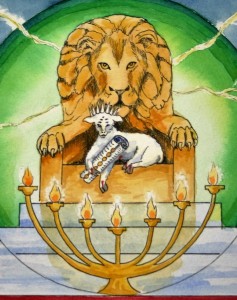
Lion-Lamb 2Let’s start with the first major vision of Revelation, Revelation 4-5. This vision sets the stage for everything else that follows in Revelation. It sets the tone for how we should imagine Jesus and God. And there God reigns through Jesus, and Jesus is the Lion of Judah—Israel’s Messiah—who reigns as the Lamb who has been slain.

Jesus does not reign as a tyrant, as a bully, as a cruel and violent despot. Jesus reigns as the one who is willing to die rather than kill, who rejects violence and coercion as the path to justice and peace.

This should sit like a burr in our brain, making us uncomfortable with connecting all these horrific things on earth with God’s reign from heaven.

Then look ahead to one of the last major visions of Revelation, the judgment scene in Revelation 20. There we have another clue that things are not as they seem. There, at the end of God’s judgment of all things, we are told that “Death and Hades” are themselves condemned and eradicated. To put this into Paul’s words in 1 Corinthians 15, “The last enemy to be destroyed is death.”

God does not deal in death; God is out to destroy it.

In short, both the first major vision of Revelation and one of the last visions highlight one crucial fact: violence and injustice and suffering and death are not the way of God, but they are the very enemies of God which God is seeking to eliminate.

So how do we make sense of all the visions in between that seem to say the opposite?

Think of those Four Horsemen of Revelation 6: domination, war, economic injustice, and death. Although these are portrayed as coming at the call of heaven, they are thoroughly human evils, originating in our own human greed and cruelty and reflecting a pattern seen throughout human history.

The same assessment could be made of all the expressions of “God’s wrath” in Revelation. Not just the killing and wars, but even the famines and diseases and degradations of the earth, the sea, and the skies—these are caused by human action, human harm, human sin. These are not “God directly inflicting punishment,” but rather “God giving people up to the consequences of their sinful actions.”

This is exactly how Paul describes “God’s wrath” in Romans 1. Paul says that “the wrath of God is revealed from heaven against all ungodliness and wickedness.” And how is that “wrath of God” revealed? Paul goes on: by God “giving us over” to our sins, to experience the full impact of our own destructive attitudes and actions.

No wonder Revelation repeatedly calls on humans to repent.

Then take a look at the two beasts of Revelation 13. Revelation scholars agree that these beasts do not represent specific human leaders (e.g. Nicolae Carpathia) but rather the Roman empire and its imperial cult. These beasts, in other words, are human structures and systems of power gone wrong.

Our human structures for organizing society—our political structures, our economic systems, our religious structures—these can become inhuman, corrupt and cruel, perpetuating injustice and bringing more death than life. At that point, these “powers that be” become “evil powers.” They become beasts.

These beasts, then, and the diabolical ethos that animates them, are not God’s creation. God does not make them. They are not God’s instruments. God does not use them. They are God’s enemies. In fact, we discover by the end of Revelation that the devil and his beasts, all these evil “powers that be,” face the same fate as “Death and Hades”: they are condemned and eradicated.

Evil is not God’s instrument; it is God’s enemy.

God does not deal in death and destruction. God does not stand behind oppressive governments and unjust economic systems. All these things—all the horrors depicted in Revelation, all the horrors experienced in human history—all these things are the very things God condemns, the very things Jesus came to deliver us from.

This way of understanding Revelation is both comforting and disturbing.

It is comforting to know that God does not use violence and destruction and death at all, even to bring about good. As John 10 says, it is the thief who seeks to steal and kill and destroy, not Jesus—Jesus brings life. If there is anything that brings hurt or harm, damage or devastation or death, that thing is decidedly not-God.

SeraphAnd this means there is more than meets the eye in Revelation. All those depictions of God’s judgment being a sort of violent vengeance, a kind of retribution, cannot mean what we think they mean at first glance. God is out to eliminate human sin, evil powers, even death itself—but not human persons. As Ephesians 6 puts it, “our battle is not against flesh and blood, but against the rulers, against the authorities, against the cosmic powers of this present darkness.”

Yet in another way, all this is very disturbing. For it means that we are our own worst enemy. Our selfishness, our self-indulgence, our unbridled aggression, our prejudice, our capacity for cruelty, our political oppression, our corporate greed—this is what lies behind so much of the violence and death our world experiences, the degradation and devastation even of the earth itself.

This is the judgment of God. This is God’s assessment of the human predicament.

Hear, then, what the Spirit is saying to us. Hear the call of God for us to repent, to “come out of Babylon and not take part in her sins,” to resist the lure of our world’s “powers that be” gone wrong, to say a firm “No!” to the corruption and injustice and oppression of human structures of power gone bad. Hear the call of Jesus the Lamb to follow him in his cross-shaped footsteps, his footsteps of selfless self-giving for the good of the other, for the good of all, even in the face of death.

In this is the salvation of God. This is the path to the kingdom of God, God’s reign of justice and peace and flourishing life.


Here’s the next post in this series on Revelation: “The (S)Word-Wielder”

The first image is a painting by Viktor Vasnetsov. All other images are from a mandala of Revelation 4-5 created by Margie Hildebrand.

© Michael W. Pahl

Why Worship? Why Worship Together?

It’s Sunday morning, and we gather together as Christians to worship God.

The specific experiences are as varied as the number of churches, but most worship services have a few things in common.

We sing together—sometimes off-key, sometimes hymns too slowly, sometimes choruses too repetitively, too repetitively, too repetitively.

We pray together—sometimes faltering, sometimes mumbling, sometimes with too little genuine feeling, sometimes with too much “Lord, we just, Lord, want to just ask, Lord…”

We break bread together—not all of us every Sunday, not always in a ritual, sometimes with too little ritual.

We read Scripture and reflect on it together—sometimes with poor exegesis, sometimes with too little Jesus, sometimes going past noon with dinner waiting in the crockpot.

Why exactly do we do all these things, worshiping in these and other ways Sunday morning after Sunday morning? And is this “worship” really all that important?

Revelation 4-5 speaks directly to these kinds of questions—and gives us some surprising and challenging answers.

Let’s start with the big picture, stating the obvious: Revelation 4-5 is all about worship. (That much at least everyone can agree on.)

But notice where this vision is in the book of Revelation. Revelation 1 is introduction, setting up the rest of the book. Revelation 2-3 are specific letters to the seven specific churches Revelation is written to—in a sense still introduction, setting the stage for the main act. And then we hit Revelation 4-5—the first major vision John sees, determining the course of everything else that follows.

The first major vision at the heart of the book—and it’s all about worship.

This tells us that worshiping God is an essential activity. And not just worshiping God individually—worshiping God collectively, gathering together with others in worship, is essential. It grounds our way of life. It sets the tone for everything else.

But why is this? And how exactly does this work?

Let’s focus in on some of the details of this vision.

At the centre of it all, the object of all this worship, is God, seated on his heavenly throne, ruler over all creation. God, the Indescribable One, only imagined in colours and light.

Elder 2Four “living creatures” are immediately around the throne, one on each side: a lion, an ox, a human being, and a flying eagle. These represent all living things—later they are heard saying “Amen” to the declaration of “every creature in heaven and on earth and under the earth and on the sea, and all that is in them” (that’s pretty comprehensive). All creatures of our God and king, giving honour and praise to God.

Twenty-four “elders” surround them, seated on thrones, dressed in white robes with golden crowns on their head. These represent all God’s people, the twelve tribes of Israel and the twelve apostles of Christ—as we hear later when the twelve tribes and twelve apostles are brought together in the gates and foundations of the New Jerusalem. All God’s people, bowing in reverence to God, singing God’s praises.

All creation, all God’s people, from the beginning of the world until its end, worshiping God.

So here’s one answer to our question of “why worship God”: Our collective worship is a participation in something fundamental to all creation, something that all creation is intrinsically engaged in.

The birds of the air, the flowers of the field—they honour their Creator simply by being what God created them to be, doing what God created them to do. Simply by being as God made them to be, existing as God made them to exist, all living things worship God.

Likewise, humans honour our Creator simply by being the way God made us to be, living the way God made us to live. We glorify God in our humanness, by being fully human. Simply by being as God made us to be, existing as God made us to exist, we worship God.

This ceaseless praise of God is intrinsic to creation; it is the very grain of the universe.

And so we are encouraged to see our worship together as a participation in this eternal, ceaseless worship of God by all creation and all God’s people. We are encouraged to see our worship together as giving voice to this never-ending, underlying rhythm of worship that is happening all around us.

But there’s more.

As we keep moving through this vision in Revelation 4-5, we hear some very specific declarations of praise. As the elders and living creatures give voice to the worship of all creation, their voice says some specific things.

God is holy. God is other. God is unlike any other. God is unique.

God is almighty. God is the source of all true power, power that creates and gives life.

God is eternal. God was. God is. God will be.

God is Creator. All that is, is because God is.

God is Redeemer. All that is good, is good because God loves.

Elder 1Here, then, is a second answer to our question of “why worship God”: Our collective worship is worldview-shaping, crafting the lenses through which we see our world and understand our place in it.

Good worship—worship in both spirit and in truth—is instructive. It teaches us; we learn from it.

Through our worship together we understand God’s role in the world as Creator and Redeemer. All things exist because God is. And although there is hurt and brokenness in our world, and in ourselves, all things can be redeemed because God loves. We learn this in part through our worship together.

Through our worship together we understand the world as God’s beloved creation. God does not hate us. God does not despise the work of his hands. God loves all creation, and imbues it with his grace and glory. We learn this in part through our worship together.

And through our worship together we understand our role as redeemed priest-kings and priestess-queens extending God’s reign throughout the earth. God calls us as God’s people to a particular task, a particular way of being in the world. God calls us to faith, to hope, to love. We learn this in part through our worship together.

Revelation 4-5 gives us a third answer to the question of “why worship God,” and it’s the most surprising one of all: Our collective worship is a profoundly political act; it is a powerful statement about how we should order our lives as human societies.

It’s all too easy for us to pass over the significance of the “throne.” For us, thrones are something from ancient times or fairy tales, or from the Bible. Of course God sits on a throne! God is king, after all!

But when was the last time you saw a king or a queen or an emperor or empress actually sitting on a throne, wielding some real power?

The “throne” doesn’t really mean much to us. But no one in the time of Revelation would miss the significance: the throne was a thoroughly political symbol, even the most potent political symbol one could use. And, in a world filled with absolute claims to absolute power, it was also about as subversive as you could get.

“Worship” is about “ascribing worth”; it is about declaring value. Worship is an expression of devotion and commitment, an expression of allegiance. When we come together and “worship God,” then, we are declaring our allegiance to God above all other claims to power and authority in the world.

But this vision is even more politically subversive than that.

Lion-Lamb 2In Revelation 5 we see a scroll, and we’re told that “no one can open the scroll”—no one in heaven or on earth or even under the earth, no creature, no human being, no human ruler, no angelic being. It’s not clear what the scroll represents—the title deed to the universe, perhaps, or the unfolding of human history. Either way, it’s the kind of thing that any good Roman would expect the emperor to rightfully possess and be able to open at will.

Yet it is the “Lion of the tribe of Judah” who alone can open it—Israel’s Messiah, Israel’s promised king from the tribe of Judah, descendant of king David. This is as any Jew in Revelation’s day would expect—but there’s another twist.

The “lion” is in fact a “lamb,” a “lamb who has been slaughtered.” The Messiah, Israel’s king, has not gained the right to rule by crucifying his enemies, but by being crucified. The true Lord and Ruler of the cosmos has not changed the tides of human history by killing his enemies, but by being willing to die for them.

God reigns not as a tyrant, not as a bully, not through coercion or violence or any other form of raw power. God reigns through the humble, self-giving, suffering servant, who gives himself for the world. God reigns through forgiveness and compassion. God reigns in love.

When we come together and worship God, then, we are saying “no” to any other way of being in the world, any other way of ordering our lives as human societies. We are saying that no human society that will stand the test of time, no civilization that will last, can be built on deceit or corruption or coercion or violence or injustice of any kind.

When we come together and “worship God” we are worshiping the God who exercises power and authority through self-giving love. We are declaring our allegiance to this God above all other claims to power and authority in the world.

So the next Sunday you’re in church and the person next to you is singing that hymn a little off-key, or the organist is dragging a little, or you’re on your twenty-fourth time through the chorus of “Oceans,” or the Scripture reader stumbles over “Melchizedek,” or the preacher is droning on while the roast is drying out, remember this: there’s more going on here than meets the eye.

You are participating in the worship of all creation. You are giving voice to the wordless praise of all living things.

Your mind and heart, your very soul, is being shaped by God. God is training you to see the world differently, preparing you to step out and find your God-ordained role in this world.

You are making a declaration of allegiance. You are standing unequivocally with the God who loves, the God who brings life, the God who gives his life in love.

Come, let us sing to the Lord. Come, let us worship and bow down.

Together.


Here’s the next post in this series on Revelation: “The Horrors of the Apocalypse”

All images are from a mandala of Revelation 4-5 created by Margie Hildebrand.

© Michael W. Pahl

Entering the Apocalypse

What comes to mind when you hear the word “Revelation,” as in the last book in the Bible?

Chances are pretty good you think about “end times prophecy” in some way, Revelation as depicting the end of the world at the end of human history. Probably a “rapture” comes to mind, with all the Christians being snatched up to heaven. There’s likely an “Antichrist” in the mix along with some “tribulation”—you know, with the “mark of the beast” inscribed on people’s foreheads (or micro-chipped under their skin). Almost certainly there’s an all-out “Armageddon” of war and a cataclysmic destruction of the world or “apocalypse” involved.

But these popular ideas about Revelation—and there is no easy way to say this—are simply wrong.

New Testament scholars have pretty much come to consensus on this: while Revelation may well culminate in a vision of a future new creation, the book for the most part is describing realities that were present at the time it was written in the first century Roman Empire. How do they know this?

Lion-Lamb 2First, Revelation is written as a letter: “John to the seven churches that are in Asia: Grace to you and peace…” A man named John wrote this as a letter to seven actual churches, seven ancient churches in Asia Minor or what is now western Turkey (1:4). It is, in other words, much like all the other letters we have in the New Testament—written as a message for specific people at a specific time long past.

And Revelation directly says as much. In describing what John “has seen” in his visions it is portraying both “what is”—realities during the time he was writing at the end of the first century—and “what will happen after this”—in the time that immediately followed (1:19).

Second, Revelation is a kind of ancient literature that historians now know quite a bit about, what is called “apocalyptic literature.” These ancient Jewish writings have similar kinds of images in them: terrifying multi-headed beasts, unusual heavenly creatures, and significant numbers like 3 and 4 and 7 and 12. And all of these are symbolic. This doesn’t mean they are not true—they point to something real, something true, but they do so through symbol and metaphor. All these images and numbers mean something.

And in all these ancient Jewish apocalyptic writings—whether it’s 1 Enoch or 4 Ezra or 2 Baruch or Revelation itself—what these images and numbers point to are realities before or during the time the particular apocalypse was written, with at most a glorious glimpse of an anticipated final future.

So if Revelation is not about some future end-time tribulation and antichrist world leader and total cataclysmic world destruction, what is it all about? What can we expect to find when we read Revelation responsibly? Here are three broad themes that tie in to the original purpose of the book and have profound relevance to us today.

Revelation gives us a critique of power and evil in the world. Structures and systems of power—political, economic, religious, and more—can become inhuman, corrupt and cruel, perpetuating injustice and bringing more death than life. (That’s what the “beasts” are all about.) And we can ourselves participate in these “evil powers” by turning a blind eye to their corruption and injustice in order to maintain our way of life. (That’s what the “mark of the beast” is all about.)

Elder 1Revelation gives us a vision of God’s reign over all things. God reigns as Creator and Sustainer and Redeemer, working out God’s purposes even through all the chaos and conflict on earth. God’s reign of justice and peace through the crucified and risen Jesus is the alternative to the evil powers of our world. (That’s what the “divine throne” and “Lion/Lamb” stuff is all about.)

And so Revelation invites us to worship God, to be devoted to God and God’s ways, and not to swear allegiance to the ways of the world. Revelation calls us to live under the reign of God, seeking justice and mercy even if it means our own suffering, even as we live in a world of human rulers and authorities and powers that often go astray. And Revelation calls us to trust in God, even through our own suffering, even through our own death, that God will bring about true life.

Revelation gives us a unique encounter with Jesus. The word “apocalypse” actually means “revelation,” an “unveiling” of something previously concealed, and this is what the book’s opening statement announces it is: “A revelation of Jesus Christ.” From this opening declaration to the book’s closing benediction, Revelation shows us Jesus—in ways unlike any other portrait of Jesus we find in the New Testament.

We see Jesus as a majestic Lion that rules as a slaughtered Lamb. We see Jesus born as a child-king on earth while all hell breaks loose in the heavens. We see Jesus as a terrifying warrior on his warhorse, wielding a sword which turns out to be a word. We see Jesus as the light of heaven come down to earth, illuminating the nations in a never-ending festival of celebration.

It is Jesus who shows us who God is. It is Jesus who brings about God’s kingdom on earth, who shows us what it means to say “our God reigns.” Jesus, as Revelation states at its beginning and repeats at its end, is “the first and the last.”

The following posts dive into a few key chapters of Revelation, drawing these three threads together: the evil powers of the world, replaced by God’s reign of justice and peace, through Jesus the crucified Lamb and risen Lord.


This series is adapted from a sermon series preached at Morden Mennonite Church in 2016. All images are from a mandala of Revelation 4-5 created by Margie Hildebrand.

© Michael W. Pahl

The Parable of the Good Muslim

The Parable of the Good Samaritan.

Everyone knows the story. Or, at least, they know what a “good Samaritan” is. It’s someone who does a good deed, someone who helps a person in need.

Sure, but it’s more than that. The story is actually more jarring than that. Or, at least, it should be.

Jesus tells the story to describe what “neighbour-love” looks like, what it actually means to “love your neighbour as yourself.” This “neighbour-love,” Jesus says, is vitally connected to “God-love,” what it means to “love God with all your heart, soul, strength, and mind.” The Greatest Commandment—the One Thing God asks of us, the One Thing that encompasses all things God requires—is to love God and love others.

So what does this “neighbour-love” look like? It looks like a Samaritan showing compassion and extending care to a Jew in desperate need.

Simple, right? Just your everyday good deed, a random act of kindness, the kind of thing any decent person would do. Right?

Not quite. Read it again. And then again. And again—this time with feeling. (And maybe a little context.)

First note: As any first-year seminarian can tell you, the Samaritans and Jews in Jesus’ day didn’t really get along. Okay, that’s understatement. There’s one story of some Samaritans throwing human bones into the Jewish temple in Jerusalem, defiling it. But then again, a century before that the Jews completely destroyed the Samaritan temple on Mount Gerizim. You know, “eye for an eye” and all that. So a Samaritan and a Jew? We’re talking “despised other” here, like when Donald Trump talks about “Mexicans” or “Muslims.”

Note #2: The Samaritan shows compassion and extends care without reservation: no questions asked, no conditions to be met, no fine print to qualify the offer. He’s not concerned about his own safety and security. He’s not concerned about who’s going to pay him back. He’s not all, “Well, maybe if I help this Jew he’ll convert to my religion and come worship at my temple.” (Seriously, think about that a moment.)

A third note: The people who you’d think would most likely help the victim are exactly those who refuse to do so. A priest, a Levite. A Christian, a Canadian, a pastor. Nope. Instead, it’s the least likely person (from the Jewish perspective) who is the hero of the story, the “despised other” themselves.

There’s much more to the story than meets the eye. There’s much more to the story than even these three notes. But these three things have struck me recently as I’ve read and re-read the Parable of the Good Samaritan.

Did I say “Good Samaritan”? I meant “Good Muslim.”

Now there’s an idea. Let’s try that out and see how it feels—and if this makes you uneasy, if it makes you all up-in-arms and red-in-the-face and furious with me, then maybe you’re starting to hear the story correctly.

Wanting to make himself look good, the expert in ethics asked Jesus, “And who is my neighbour?”

Jesus replied, “A man was going down from Morden to Winkler by a back road, and fell into the hands of robbers, who stripped him, beat him, and went away, leaving him half dead in the ditch.

“Now by chance a well-respected pastor was going down that road; and when he saw him, he passed by on the other side. So likewise a devout Christian, when he came to the place and saw him, passed by on the other side.

“But a Muslim immigrant while traveling came near him; and when he saw him, he was moved with pity. He went to him and bandaged his wounds, having treated them with antiseptic. Then he put him in his own car, brought him to the hospital, and sat with him through the night. The next day he wrote a cheque worth two days’ wages and gave it to the nurse on duty, and said, ‘This is for any extra expenses he has; when I come back, I will repay you whatever more is needed.’

“Which of these three, do you think, was a neighbour to the man who fell into the hands of the robbers?”

The ethical expert said, “The one who showed him mercy.”

Jesus said to him, “Go and do likewise.”

Cross-posted from http://www.mordenmennonitechurch.wordpress.com. © Michael W. Pahl

Seeing God Face to Face

Seeking God’s Face

“Come,” my heart says, “seek his face!”
Your face, O Lord, do I seek.

There are many ways to think about Christian spirituality, but these words from Psalm 27 do a pretty good job of summing it all up. You could say that the spiritual life is all about “seeking God’s face.”

Different words are used by different people, of course. Pursuing God, desiring God, knowing God, experiencing God, loving God. Being filled with the Spirit, walking in the Spirit. Being at one with our Creator, touching the transcendent, sensing the divine.

Different words are used by different people, both Christians and others. But they all reflect the same longing: there is a spiritual dimension to being human.

There is something within us that craves something beyond us.

“Come,” my heart says, “seek his face!”
Your face, O Lord, do I seek.

This longing to experience God, to “seek God’s face,” comes through in different ways throughout the biblical stories.

In Genesis 3 God walks with Adam and Eve in the garden in the cool of the day—until that fateful day when sin enters the story, and they hide from the Lord God. They are ashamed because of their selfish, prideful actions, and they no longer want to see God’s face.

In Exodus 33 Moses asks to see Yahweh’s divine glory. God allows Moses to see a measure of his glory, but God says to him, “you cannot see my face; for no one shall see me and live.” Even that measure of divine glory, that glimpse of Yahweh’s back, is enough to make Moses glow with the radiance of his experience of God.

In Isaiah 6 Isaiah sees a vision in the temple: the Lord God, sitting on a throne, high and lofty, surrounded by heavenly beings. Really, though, Isaiah can only see God’s feet: God’s face is too high, too holy, too transcendent, too far beyond for anyone to see.

Each of these Old Testament stories, and many others besides, point to this “something within us that craves something beyond us,” this human longing to know God, to touch the transcendent, to sense the divine. Yet the people in each of these stories never quite get there. They get a taste of God, a fleeting glimpse, or they hide from God or put God behind all kinds of protective barriers.

And so that longing of Psalm 27 continues:

“Come,” my heart says, “seek his face!”
Your face, O Lord, do I seek.

Seeing God’s Face

There is a profound shift that happens in the New Testament with all this: yes, there is still something within us that craves something beyond us—but that something beyond us has now come among us.

We no longer need to search desperately for the face of God—because God has already shown his face, and it’s the face of Jesus.

This is what’s behind John’s words in John 1: “The Word became flesh and lived among us, and we have seen his glory…full of grace and truth… No one has ever seen God. It is God the only Son, who is close to the Father’s heart, who has made him known.” God has shown her face, and it’s the face of Jesus.

This is what’s behind Paul’s words in Colossians 1 and 2: Christ “is the image of the invisible God”; “in him the whole fullness of deity dwells bodily.” God has shown his face, and it’s the face of Jesus.

This is what’s behind the anonymous author of Hebrews words in Hebrews 1: “In these last days God has spoken to us by a Son… He is the reflection of God’s glory and the exact imprint of God’s very being.” God has shown her face, and it’s the face of Jesus.

James Tissot (French, 1836−1902). Jesus Goes Up Alone onto a Mountain to Pray (detail), 1886−94. Opaque watercolor over graphite on gray wove paper, 1138 x 61⁄4 in. (28.9 × 15.9 cm). Brooklyn Museum, Purchased by public subscription, 00.159.137From Matthew to Revelation, the New Testament writings are united in the conviction that the man Jesus of Nazareth shows us the God of Israel. The man Jesus, who lived a certain way and taught certain things, who healed the sick and forgave sinners and cast out evil powers, who suffered and died and was raised to life again—this man Jesus shows us who God is.

God has shown God’s face, and it’s the face of Jesus. So to “seek God’s face” we need to seek the face of Jesus.

How do we do this? How can we, two thousand years after Jesus walked this earth, see Jesus, and so see the face of God?

As the Bible itself acknowledges, we can no longer see Jesus in the flesh (John 20:29; 1 Peter 1:8). But we can still see the imprint of Jesus, we can still discern the Spirit of Jesus. How do we do this?

Well, we can read the Bible’s stories of Jesus, the Gospels. Read Matthew, or Mark, or Luke, or John. And as you read, ask yourself some questions.

What does this tell me about Jesus? What does this tell me about Jesus’ character, his desires, his motivation, his way of thinking, his way of life?

And so, then, what does this tell me about God, who God is, how God relates to us? The character of Jesus is the character of God. The desires of Jesus are God’s desires. The things that motivate Jesus to speak or act, those are the things that motivate God. How does Jesus think? That’s a window into how God thinks. How does Jesus live his life? That’s a parallel to how God acts in the world.

And then, what does this tell me about who I am, who I can become? No, we are not God, we cannot be God. But we are all created in God’s image, we can reflect God in all these ways.

So the character of Jesus shows us the character we should seek to develop ourselves. The desires of Jesus show us what we should desire. The things that motivate Jesus to speak or act, those are the things that should motivate us. How does Jesus think? That’s a pattern for how we should think. How does Jesus live his life? That’s a model for how we should seek to live our lives in our world today.

So we can see the face of God in Jesus by reading the Bible’s stories of Jesus. But we can also read Jesus’ Bible, our Old Testament. Read Genesis, or Deuteronomy, or the Psalms, or Isaiah, or Daniel, or Amos. Read any Old Testament book—but read it in the light of Jesus.

So ask yourself: How does this particular passage parallel Jesus’ character, his desires, his motivation, his way of thinking, his way of life? How do I see the God revealed in Jesus, here in this Old Testament book?

Then re-read the Bible’s stories of Jesus. Go back and do it all again.

We can read the letters and other writings of Jesus’ first followers, our New Testament. Read Acts, or Romans, or 1 Corinthians, or Ephesians, or Philippians, or Hebrews, or James, or 1 John, or Revelation.

And ask yourself: How does this particular passage describe Jesus? How does this New Testament book take the character and attitudes and life and death and resurrection of Jesus, and apply it to the specific situation of these early Christians and their world?

Then re-read the Bible’s stories of Jesus. Go back and do it all again.

We can think about Jesus, ponder his way of life, mull over his teachings, contemplate his sufferings, revel in his resurrection. We can gather together with other Christians and consider Jesus together, honour Jesus together, cry out to Jesus together, bow down to Jesus together.

Then re-read the Bible’s stories of Jesus.

We can talk about Jesus. Read well-researched books about Jesus. Watch time-tested films about Jesus. Study classic paintings of Jesus. We can see how other people have envisioned the man from Galilee.

Then re-read the Bible’s stories of Jesus.
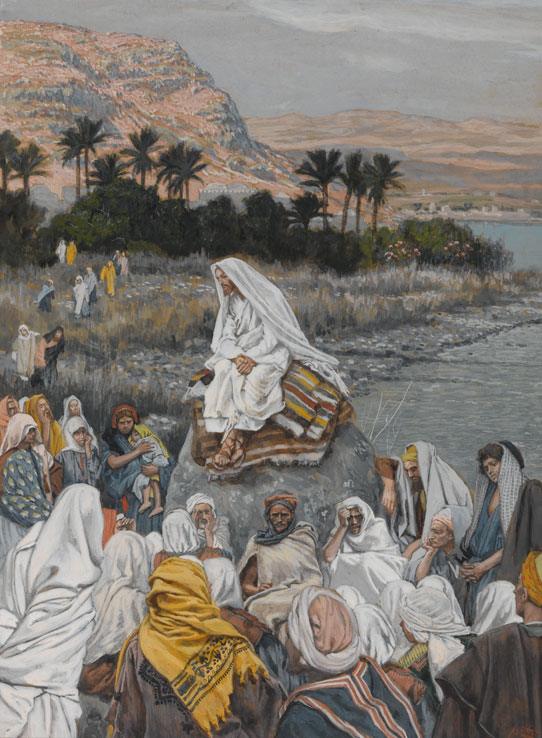
James Tissot (French, 1836–1902). Jesus Sits by the Seashore and Preaches, 1886–96. Opaque watercolor over graphite on gray wove paper, 103⁄16 x 79⁄16 in. (25.9 × 19.2 cm). Brooklyn Museum, Purchased by public subscription, 00.159.109We can look for Jesus in other people. The poor, the stranger, the suffering. The merciful, the gentle, the steadfast, the kind. We can look for Jesus in ourselves. In our own hardships and sorrows, in our own moments of joy and delight, in our own sometimes-surprising feelings of empathy and compassion and forgiveness.

Then re-read the Bible’s stories of Jesus.

You get the picture.

We can see the imprint of Jesus, the Spirit of Jesus, in lots of different places, and so see God’s face. But we see Jesus most clearly, most completely, in the stories and teachings of Scripture. Indeed, this is what the Bible is for.

The Bible is not an encyclopedia of all truth—though it speaks the truth we most need to hear. It is not a comprehensive moral handbook—though it gives us guidance on how to live.

No, the Bible is first and foremost a witness to Jesus. We read the Bible to see Jesus.

And then, as we learn about Jesus from the Bible, we can learn to see Jesus in other places. And when we see Jesus, we see who God is, and we see who we can become as those created in God’s image.

Seeing God Face to Face

Let me leave you with two Bible verses to ponder.

2 Corinthians 3:18 says that as we “see the glory of the Lord as though reflected in a mirror, we are being transformed into the same image from one degree of glory to another.” Paul is talking about looking to Jesus, seeing God’s glory in Jesus, and being transformed in the process, being re-made in the image of God in Jesus. That’s just what I’ve been talking about: seeing Jesus, and so seeing God, and so seeing who we can become as those created in God’s image.

But you’ll notice the little phrase, “as though reflected in a mirror.” It’s an acknowledgment that we don’t see Jesus face to face. Even in looking to Scripture to see Jesus, even in carefully discerning the imprint of Jesus, the Spirit of Jesus, diligently seeking Jesus’ face in all the ways I’ve talked about, it is still only like seeing a reflection of Jesus in a mirror.

1 Corinthians 13:12 picks up on that same idea, but gives us some powerful encouragement: “For now we see in a mirror, dimly, but then we will see face to face. Now I know only in part; then I will know fully, even as I have been fully known.

“Come,” my heart says, “seek his face!”
Your face, O Lord, do I seek.

There is something within us that craves something beyond us—and that something beyond us has now come among us in Jesus.

God has shown his face, and it’s the face of Jesus.

For now, we see Jesus’ face by looking for his imprint in the Scriptures, by looking for his Spirit in his followers and in the world. But one day—one day!—we will see Jesus face to face.

And then our craving for something beyond us—the transcendent, the divine, the presence of God—will be fulfilled. Then our quest to seek God’s face will finally be at an end—an end which will be just the beginning of a new and even better story “which goes on forever: in which every chapter is better than the one before” (C. S. Lewis, The Last Battle).

This is adapted from my sermon at Morden Mennonite Church on February 21, 2016. Artwork is by James Tissot; click on pictures for more details. Cross-posted from http://www.mordenmennonitechurch.wordpress.com. © Michael W. Pahl

“Confess and believe, and you will be saved!”

If you confess with your lips that Jesus is Lord and believe in your heart that God raised him from the dead, you will be saved. For one believes with the heart and so is justified, and one confesses with the mouth and so is saved. (Romans 10:9-10)

This is one of those classic evangelistic texts, the kind that get painted on signs and propped up on billboards, like John 3:16. It’s a gospel text, a mission text, a conversion text: it gets right down to the core of what we should believe, and it promises salvation for those who do.

Here’s how I used to understand these verses. I used to think they are telling us what we need to do to be saved from God’s eternal punishment for our sin. We need to confess with our mouth and believe with our whole heart: we need to confess our own personal sin and confess Jesus as our own personal Saviour, and we need to believe in our hearts that Jesus died on the cross for our sins.

The problem is, that’s not what these verses actually say.

Check it out again: “if you confess that Jesus is Lord and believe that God raised him from the dead, you will be saved.”

No mention of sin.

No mention of Jesus as personal Saviour.

No mention of the cross at all, let alone of Jesus dying on the cross for our sins.

Paul does talk elsewhere about some of these things. Sin and the cross are even pretty important to Paul. But why doesn’t Paul specifically mention them here, in this “classic evangelistic text”? How exactly can this particular “confession” and “belief” bring about “salvation”?

“You will be saved…”

Well, to make sense of this the first thing we have to get right is what Paul means by “salvation.” And to get that right, we need to go back to Paul’s Scriptures, our Old Testament. And a good place to start there is with the biblical writings Paul most quotes here in Romans 10: Deuteronomy and Isaiah.

Take Deuteronomy 30. Moses is speaking to the ancient Israelites before they enter into the Promised Land. Through Moses God promises to bring the Israelites blessings and life if they keep the commandments of the covenant. But God also warns them of curses and death if they disobey—in particular, being conquered by foreign armies and being sent into exile among the nations.

And then Moses makes this prediction: Israel will in fact fail to keep the covenant (which they did), they will be exiled (which they were), but if they return to the Lord they will be “saved”—they will be rescued from their exile and restored to their land to thrive once again.

This, then, is “salvation” according to Deuteronomy. Salvation is about God delivering God’s people from the powers of the world that have oppressed them, restoring them after they have experienced the consequences of their collective sin, bringing them back to where they can again experience life and liberty.

van Gogh - BibleThen take Isaiah 52. Isaiah speaks of God’s “messenger” who announces God’s “salvation”: “How beautiful are the feet of those who announce peace, who bring good news, who announce salvation, who say to Zion, ‘Your God reigns!’”

This, like Moses’ promise of God’s future salvation, is a message of salvation to the exiled people of Israel a few hundred years before Christ, scattered as slaves and refugees throughout the world. And the message of salvation is this: God is returning to his throne to reign over all, and God’s reign will bring peace and justice once again for God’s people.

Now back to Romans 10. This is what Paul is talking about when he talks about “salvation”: he’s referring to Israel’s promised salvation, drawing on these and other Old Testament passages.

But Paul says something new, something completely unexpected. He says this promised salvation is not just for Israel, but it’s also for the nations, for the Gentiles—for everyone. As he puts it: “For there is no distinction between Jew and Greek; the same Lord is Lord of all and is generous to all who call on him. For, ‘Everyone who calls on the name of the Lord shall be saved.’”

This, then, is the salvation that Paul promises to those who confess and believe: God’s reign of justice and peace has arrived through Jesus, bringing deliverance from oppressive powers and restoration to flourishing life.

“…if you confess and believe.”

But what does it mean then to “confess that Jesus is Lord”? What does it mean to “believe that God raised him from the dead”? And how does this confession and belief bring about that salvation? To get at these questions we need to put ourselves in the sandals of those first Christians in Rome.

For us, it seems pretty simple to say, “Jesus is Lord.” But for those first Christians in Rome, confessing that “Jesus is Lord” was not mere words.

No, in Paul’s day, to confess that “Jesus is Lord” was a bold declaration of allegiance.

As Paul points out in 1 Corinthians 8, there were many “lords” and “gods” in the ancient world, many “powers that be” that called for allegiance. And at the very top of the heap, king of the castle, was the Roman Emperor, Caesar. For good Romans—and anyone who cared about their lives—this was one of the most self-evident truths around: Caesar is Lord, master over any and all other powers that be. For them, this was the most fundamental confession: “Caesar is Lord.”

So to confess that “Jesus is Lord” was potentially a dangerous act, a revolutionary act, a radical commitment. It wasn’t something that slipped easily off the lips. This explains why Paul can say in 1 Corinthians 12, “No one can say ‘Jesus is Lord’ except by the Holy Spirit”—you would need the Spirit’s boldness to confess such a thing!

Jesus is Lord.

He is Lord over any and all other lords and gods, any other powers that be in the world: whether Caesar or the President or Prime Minister Trudeau, whether nation states or church structures or social norms, whether Supreme Courts or vigilante militias, whether ISIS or the UN, whether constitutions or confessions of faith, whether the boss at work or the bully in the playground.

Any power at work in the world you can think of, Jesus is Lord over it.

Jesus is Lord over all—and so Jesus commands our ultimate allegiance.

But Jesus is not like any other powers that be, whether back then or today. And that’s where the next part comes in: “believe in your heart that God raised him from the dead.”

Our Lord that we confess, the One to whom we hold fast with total allegiance, is a man who was executed by the powers that be, but was vindicated by God by raising him from the dead.

Love DisciplesThat’s the point of the resurrection. The powers of this world have assessed Jesus and vilified him; but God has assessed Jesus and vindicated him. The resurrection is God’s loud shout of “Amen!” to everything about Jesus: his teachings, his way of life, his self-giving suffering, his selfless death.
So we confess that “Jesus is Lord,” Jesus is Master over all, including us. But we follow a Lord who gave himself for us. We obey a Master who taught us to love one another, and who showed us what that love looks like. And we follow this Lord and Master because he is the one whom God has given his “Yes” to, he is the one whom God has stamped with his full approval, confirming that Jesus’ way is the only way to true blessing and real life.

It’s easy to say the words, “Jesus is Lord.” But it’s hard to truly “confess that Jesus is Lord,” that the way of Jesus is the only way to true life, and so we need to commit ourselves fully to Jesus’ way of self-giving love.

But that’s what it means to “confess that Jesus is Lord.”

It’s easy to agree with the words, “God raised Jesus from the dead.” But it’s hard to truly “believe that God raised Jesus from the dead,” that God has given his resounding “Yes!” to a man who spent his time with misfits and sinners, to a man who embraced the sick and the poor and the outcasts and the enemy others, to a man who would rather die than kill, to a man who willingly gave up his life for others—even if it meant being pronounced a blasphemer and condemned as a criminal and executed by the state.

But that’s what it means to “believe that God raised Jesus from the dead.”

And this, Paul insists, is the only way to true salvation. This is the only way for all of us together to experience true justice and peace, to experience the flourishing life God desires for all humanity: following our resurrected Lord in his cross-shaped footsteps.

© Michael W. Pahl

You Are Not Alone

This post in an adapted excerpt from my sermon in the series “Four Things,” preached at Morden Mennonite on January 31, 2016. See others in the series: “Loved,” “Forgiven,” “Needed.” Here is the audio of the full sermon:

It’s one of the most basic needs we have: the need for human connection. It’s one of the most common fears we have: the fear of being alone. They’re two sides of the same coin: fear on the one side, desire on the other.

As soon as our eyes begin to focus as babies, we are looking for faces: eyes and noses and smiles. And, as babies, we need that human touch: loving, gentle, firm, safe.

At the other end of our lives, not much has changed. We still look for kind faces with warm smiles. We still crave that loving human touch. Right to the end.

This desire to be connected to others, and its flip side, the fear of being alone, drives us far more than we realize. All social groupings are at bottom fueled by that need for contact with other persons. We form friendship bonds, and partnership bonds, and permanent pair bonds, because we have a deep need to connect with others, and a deep fear of being isolated from others.

Put another way, there’s a reason why solitary confinement is one of the most horrific punishments that can be inflicted on people. Even the most introverted among us craves social interaction with other persons. The difference among us is only a matter of degree.

We long for meaningful connection; we fear being alone.

There’s an interesting feature of the creation stories in the book of Genesis that many people have noticed.

When you read through the first story in Genesis 1, you hear this repeated refrain: “And God saw that it was good.” God separates the land and the waters, and it is good. The earth brings forth vegetation, and it is good. God separates the light from the darkness, and it is good. God creates every living creature, and it is good.

Seven times in Genesis 1, the Creator God shapes something, forms something, makes something, fills something—and then declares it to be “good.”

But then comes Genesis 2, the second creation story. And smack in the middle of it, you read this: “Then the Lord God said, ‘It is not good.’”

Keep in mind, this is before sin has even entered the picture. This is when everything is supposed to be untainted and unspoiled and perfect in its goodness. And in the middle of this very good creation is something that is “not good.”

Here’s the whole statement: “The Lord God said, ‘It is not good that the Human should be alone.’”

The very first thing in the Bible noted as “not good,” even in the pristine paradise of Eden, is human isolation, a lack of meaningful connection with others—being all alone in a big wide world.

We long for meaningful connection; we fear being alone. This parallel desire and fear is not only built into our DNA; it’s built into our most primal stories, our first Scriptures.

And to each of us, God speaks these words of good news: “You are not alone.”

You are not alone. Others are with you: companions on the journey of life, partners in the purpose of life. And God is with you: even if all others fail, God will never leave you or forsake you. You are not alone.

Right from the very beginning of the human story, then, the Bible highlights our need for connection with others, that it is “not good” for us to be alone. But as interesting as that is, what’s even more interesting is what God does about it.

We typically think of the story this way: God says, “It’s not good for the Man to be alone,” and then we jump immediately to the end of the story, where there is a Man and a Woman who come together to be “one flesh” in marriage.

But that’s not actually the way the story is told. The Hebrew word for “Man” here is adam, which can mean “man” or “male human.” But it can also mean “human” or “human being” generally, and in the context it’s clear that’s what it means here.

Because right after God says, “It’s not good for the adam to be alone,” God doesn’t immediately make a womanGod makes the animals. You see, the distinction is not between the Man and the Woman, but between the Human and the Animals.

All the Animals are paraded before the Human, and none of them is the “suitable companion” that God says the Human needs. And so God makes another Human, “bone of bone and flesh of flesh”—exactly the same, a fully human counterpart—to be the first Human’s “suitable companion.”

In other words, the problem is not that a man needs a wife, or that a woman needs a husband. The problem is that a human needs another human—we need meaningful human connection, human companionship. And God has provided for that need by creating other humans, other people around us, to give us the connection and companionship that we require. Marriage, then, is one specific and important way in which this basic need for human relationship is fulfilled—but it is not the only way.

I know, that way of reading the story goes against the grain of our received interpretations of Genesis 2. But it’s really the best way to understand the story. After all, if that need for companionship is only satisfied through marriage, then there have been a lot of single people through history who have not fulfilled God’s purpose for relationships—including Jesus.

So here’s the important takeaway from all this: We are not all mandated to get married, but we are all created for human companionship—and God provides us with human companions on the journey of life, human partners in the purpose of life.

You are not alone. Others are with you: companions on the journey of life, partners in the purpose of life. You are not alone.

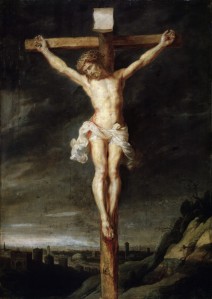
Rubens - Jesus on CrossBut there’s more. God is with you: even if all others fail, God will never leave you or forsake you.

This can be hard for us to believe, to really believe. We can at times feel abandoned by God—usually when we also feel abandoned by others. We can, in other words, feel like Jesus on the cross, crying out in our hearts, “My God, my God, why have you forsaken me?”

Yet, as Jesus himself would have known, God never really abandons us, God is always with us. Even that Psalm that Jesus quotes—his words on the cross are the opening words of Psalm 22—that Psalm goes on to say, “God did not hide his face from me, but heard when I cried to him” (22:24).

So even in our loneliest moments, those times when we feel most isolated from others, most disconnected, even completely abandoned—God is with us.

If you feel like this—lonely, isolated, disconnected, abandoned—listen to these words from Scripture; let them wash over you:

From Isaiah 43:5: [God says,] “You are precious in my sight, and honored, and I love you…Do not fear, for I am with you.”

From Hebrews 13:5: God has said, “I will never leave you or forsake you.”

You are precious in God’s sight, and honoured, and God loves you. Do not be anxious or afraid, for God is with you. Indeed, God will never leave you or forsake you.

You are not alone. Others are with you: companions on the journey of life, partners in the purpose of life. And God is with you: even if all others fail, God will never leave you or forsake you. You are not alone.

Cross-posted from http://www.mordenmennonitechurch.wordpress.com. © Michael W. Pahl.

You Are Needed

This post in an adapted excerpt from my sermon in the series “Four Things,” preached at Morden Mennonite on January 24, 2016. See others in the series: “Loved,” “Forgiven,” “Not Alone.” Here is the audio of the full sermon:

Astronomers tell us that the stars we see at night are only the tiniest fraction of all the stars out there. Someone with the best eyesight on the clearest night with no moon will see around 4,000 stars—but there are billions upon billions of stars in the universe. In fact, some of those “stars” up there are not even stars at all, but whole galaxies: billions more stars, so far away that even through a telescope they look like a single, tiny point of light.

It can be awe-inspiring, but it can also make us feel pretty small, pretty insignificant. That’s the feeling behind these familiar words from Psalm 8:

When I consider your heavens,
the work of your fingers,
the moon and the stars,
which you have set in place,
what is humankind that you are mindful of them,
human beings that you care for them?

God our Creator, your creation is so vast, you must be even more vast! Why should we think that you care about us, mere ashes and dust? Why should we think there is any meaning to this life, any purpose for our existence?

Have you ever felt this way? Small, insignificant, hardly worth anyone’s attention, let alone God’s?

Maybe you are on the cusp of adulthood, making the transition to full independence. You are at a crossroads, wondering what you should do with your life. The world can seem so big, and you so small, and the answers you received in your childhood are starting to seem pretty simplistic.

Or maybe you are closer to the end of your life than the beginning. You think of all the things you used to do, that you can’t do any more. You used to be so useful, but now maybe you feel useless, unnecessary.

Or maybe you are somewhere in between, but faced with illness or death, a job loss, a relationship rupture, a big move. You feel de-stabilized, like the ground is shifting beneath your feet.

It’s at times like these that we tend to ask the “purpose” questions of life: “Why am I here?” “What is the meaning of life?” “What is my purpose?”

If any of this is how you feel, God has some good news for you: “You are needed.”

You are needed. God has created you for a purpose, a purpose that is tied into God’s larger purposes for the world. And that purpose doesn’t change, regardless of your past or your present or whatever stage of life you’re at. That purpose doesn’t change, regardless of who you are or aren’t, or what you know or don’t know, or what you can or cannot do. You are needed.

Listen again to the way Psalm 8 continues:

You have made them [human beings] a little lower than the angels
and crowned them with glory and honor.
You made them rulers over the works of your hands;
you put everything under their feet.

Think of this: you are a ruler over the works of God’s hands! This is how God looks at you. God sees everything about you: strengths and weaknesses, temperament and emotions, inner thoughts and outward actions, past and present. But through all this—both the good and the bad—God sees you as a queen or a king, charged with ruling in God’s earthly creation.

Okay, that might sound strange! Maybe some of you have read C. S. Lewis’s stories of Narnia, and you think of the “sons of Adam and daughters of Eve” being “kings and queens in Narnia.” It sounds like fantasy, not reality.

But C. S. Lewis had it exactly right. You see, Psalm 8 is simply reflecting Genesis 1 and the profound truth there that human beings are created “in the image of God.” This is what that means: we are each of us, all of us, you and me and every person, created by God to be God’s representatives on earth, extending God’s kingdom throughout the whole earth, sharing God’s love and God’s light and God’s life with the world.

You are needed. You are needed by God to extend God’s kingdom of love and light and life throughout the world, wherever you are, just the way you are. You are needed.

Maybe this seems easier for some than for others. Some of us have money or education, strength or skill—obvious resources that can be used to fulfill this God-given purpose.

But whether we have these resources or not, we all have something we bring to this life—time, energy, encouraging words, compassionate deeds, a listening ear, our simple presence—things that can be used to further God’s life-giving, kingdom purposes for the world.

Maybe when we think about God’s kingdom we think about big things: justice in our society, peace in the wider world. That’s true: God’s kingdom is about those things.

But those things don’t happen instantly, all fully-grown. Remember, Jesus said that God’s kingdom starts small, like a mustard seed. It started small, with Jesus, a crucified peasant in the backwater of a long-gone empire. And it continues to start small, tiny pulses of love and light and life that magnify into waves of justice and peace.

Each moment we choose to share love instead of being indifferent to the needs of others, God’s kingdom is bursting forth. Each moment we choose to shine a light instead of complaining about the darkness, God’s reign is being revealed. Each moment we choose to sustain and enhance life instead of simply giving up and giving in to death and destruction, God’s rule is being extended.

You are needed. God has created you for a purpose, a purpose that is tied into God’s larger purposes for the world. And that purpose doesn’t change, regardless of who you are or aren’t, or what you know or don’t know, or what you can or cannot do. You are needed by God to share God’s kingdom of love and light and life throughout the world, wherever you are, just the way you are. You are needed.

Cross-posted from http://www.mordenmennonitechurch.wordpress.com. © Michael W. Pahl.

MLK and “The Things that Make for Peace”

On December 20, 2015, I preached a sermon at Morden Mennonite Church on “The Things that Make for Peace.” I’ve excerpted some of that sermon already in a previous post, but in honour of Martin Luther King, Jr. Day in the U.S. I’m posting another excerpt, my conclusion to that sermon.

Many of you will know that a month ago I went to a theological conference down in Atlanta. While I was there I went to Ebenezer Baptist Church, the church Martin Luther King grew up in, the church he served as pastor for part of his career.

MLK Light LoveAs I’ve been reflecting on these “things that make for peace” this week, I’ve been reminded of Martin Luther King and his struggle for racial justice in the U.S. during the 1950s and 60s. King developed several principles of nonviolent resistance—principles of peacemaking, in other words—that sound a whole lot like what I’ve just described from Luke’s Gospel. This is no coincidence, as King based these principles in large part on the life and teachings of Jesus.

First, Martin Luther King emphasized that peacemaking is not passive, and it’s not for cowards. To use King’s words, peacemaking “is not passive nonresistance to evil, it is active nonviolent resistance to evil.” This takes tremendous moral courage, because it means standing against evil on one side while facing ridicule on the other. This takes tremendous inner strength, because it means resisting violence and injustice without resorting to violence or injustice oneself.

Another of King’s principles of peacemaking: in his words, it is “directed against forces of evil rather than against persons who happen to be doing the evil.” The goal is to defeat injustice, not unjust persons. The goal is to defeat fear and ignorance and hatred, not fearful or ignorant or hateful persons. The goal is to bring peace, what King called the “beloved community.”

Here’s the next of MLK’s principles: we must be willing to accept suffering without retaliation. How can we do this? King says “the answer is found in the realization that unearned suffering is redemptive.” The goal is to reduce or even eliminate unearned suffering for everyone; but sometimes, this requires that some people—or even just one person—needs to suffer unjustly before the eyes of the world in order to bring about that redemptive transformation.

Underlying these principles of peacemaking are two further principles, spiritual principles. In King’s words, this brand of nonviolent peacemaking “avoids not only external physical violence but also internal violence of spirit.” There’s an important correlation between inner peace and outward peace: peace among us requires peace within us.

We need to know forgiveness ourselves in order to forgive others. We need to have empathy awoken within ourselves if we want to have compassion for others. We need to rid our hearts of hatred if we want to see the world rid of violence. We need peace in our own souls if we hope to have lasting peace in society.

And underlying all this is one final principle: the principle of faith. This peacemaking, King says, is “based on the conviction that the universe is on the side of justice.” In our active struggle for peace, a struggle that may require our own suffering, we must believe that “there is a creative force in this universe that works to bring the disconnected aspects of reality into a harmonious whole.”

You see, Martin Luther King realized something that many of us miss: God has already revealed his peace in Jesus. God has shown us “the things that make for peace.” God has laid out for all to see God’s “way of peace,” peace within us, peace among us.

The question is, will we walk in it? Will we “recognize the things that make for peace”? Will we follow Jesus in “the way of peace”? Or does Jesus weep over us as he wept over Jerusalem?

May God give us eyes to see the path of peace laid out for us in Jesus. And may God give us the faith, the hope, the love—the moral courage and selfless compassion—to trust in God’s way of peace and walk in Jesus’ way of love.

Cross-posted from http://www.mordenmennonitechurch.wordpress.com. © Michael W. Pahl